Tips From A Century Ago: Write Clearly and Don’t Plagiarize

Planning on starting an email newsletter? Here are some tips on how—from 100 years ago.

That’s when the House Organ Association held a convention in 1918. It was co-sponsored by the Direct Mail Advertising Association, now known as the Data & Marketing Association.

Old-timers remember house organs–they were the magazines companies published to keep their customers informed. They served the same purpose as email newsletters. Here are some lessons from that October 1918 event, held in the closing weeks of World War I:

Don’t lift content from other publications. The prevailing attitude in 1918 was: “Why waste time rewriting or pay for stuff when there was plenty of it going the rounds for the mere trouble of taking it?”

Don’t steal artwork, another widespread practice. “It doesn’t make a tinker’s darn difference how much gray matter, sweat, time, ink, experience, execution and money was involved if a certain design or illustrated ‘looks good’ or is “just the thing” to illustrate some new fangled clock whose alarm tickles your toes—Use It! Trace it or photography it direct—but use it!” the speaker said.

Make sure that articles are relevant and engaging—they weren’t in most house organs. “Most are over-weighted with ponderous lectures by men who know their own departments, but unfortunately do not know how to WRITE,” a speaker complained.

The conference was organized into tracks like House Organs for Salesmen, House Organs for Dealers, and House Organs for Customers. The most crowded session was the one titled, “Why House Organs are essential in War time.” (It was because editors “have steadily made use of articles designed to aid in the organization of the country for war”).

Wisdom from the ancients.


The Face Of Ho Chi Minh: A Time Magazine Direct Mail Piece

By Ray Schultz

Marketing guru Ron Jacobs has observed that “Consumers don’t have the patience anymore to read an eight-page direct mail letter.” True, and they probably don’t even have what it takes to read a four-page one.

But they must have had it in 1966, because that’s when Time magazine sent the following four-pager.

Like the classic Time letters from the 1940s and ‘50s, this one is a historical artifact. It introduces Ho Chi Minh, the leader of North Vietnam, to the American people. Then it goes on to quote Marshall McLuhan, mention both LBJ and Jimmy Hoffa in passing, and explain—in some detail—the benefits of Time.

The envelope features a line drawing of a pair of sandals, with this copy: “The wearer of these sandals said: “Americans don’t like long, inconclusive wars. This is going to be a long, inconclusive war.”

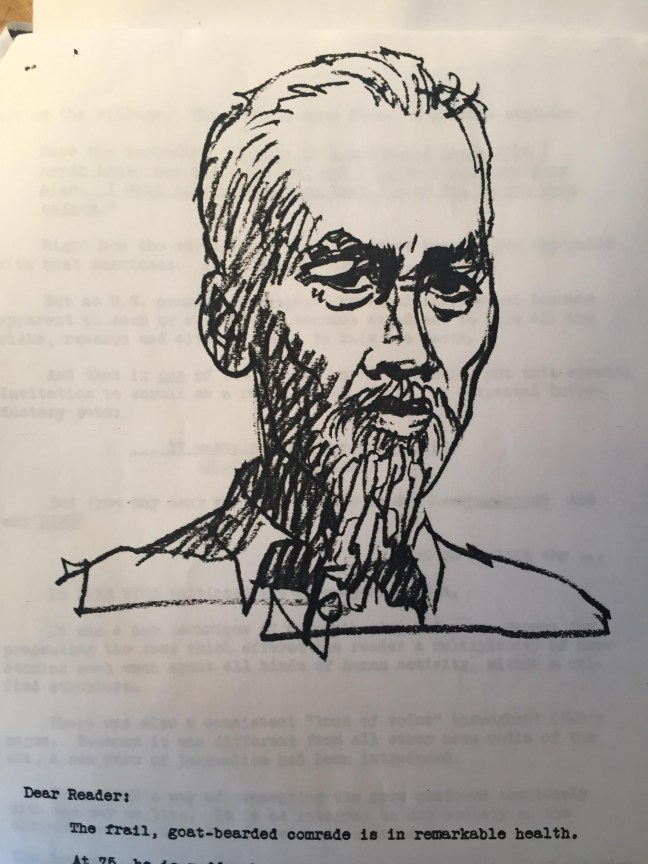
Inside, at the top of the letter, is a compelling image of Ho Chi Minh. Unfortunately, I have only a black-and-white Xerox copy, and did not write down the color of these illustrations. I suspect it was red.

Having found this letter in the Time Inc. archive, I am sad to report that it was one of the last of its type. That very year, Time started sending charmless, computer-generated sweepstakes letters, although Bill Jayme’s long Cool Friday letter was mailed into the 1970s.

There were no handwritten notes attached to this one, so I don’t know who wrote it, or how it pulled. And I wonder how many people, even those who snapped up the offer, made it all the way through. But here it is: One of the last great long letters written by Time’s direct mail masters. Enjoy.

Dear Reader: 

The frail, goat-bearded comrade is in remarkable health.

At 76 he is ruddy-cheeked and cheerful. He dresses in –cream-colored, mandarin-style uniforms and “Ho Chi Minh scandals” carved from automobile tires. His tastes are exquisite. He smokes American cigarettes and dines on a rare delicacy called “swallow’s nest” – a marriage of sea algae and swallow’s saliva. 

In 1962 Ho Chi Minh said: “We held off the French for eight years. We can hold off the Americans for at least that long. American’s don’t like long, inconclusive wars. This is going to be a long, inconclusive war.”

Drenched by a monsoon rain, a leathery U.S. Marine sergeant and his platoon wait in the swampy dark outside a wretched hamlet where V.C. are reported hiding. Finally a wan moon reappears. Its dim light glints on weapons carried by four fleeing figures heading out of the village. The marines open fire. A grenade explodes.  

Says the sergeant: “I hate this goddamned place like I never hated any place before, but I’ll tell you something else: I want to win here more than I ever did in two wars before.”

Right now the war in Viet Nam is neither popular nor unpopular with most Americans. It is simply confusing.

But as U.S. commitment deepens, personal involvement becomes apparent to each of us. And it becomes expedient to know all the risks, reasons and alternatives. To know the facts.

And that is one of the reasons why I am sending you this special invitation to enroll as a regular TIME reader, at a special introductory rate:

. . . 17 weeks of TIME for only $1.87. (Just 11 cents an issue.)

But (you may ask) why do I want to read a newsmagazine? And why TIME?

Let me explain why…

In 1923 TIME initiated the newsmagazine idea.

It was a new technique of newsgathering and a new format for presenting the news which offered the reader a multiplicity of news stories each week about all kinds of human activity, within a unified structure.

There was also a consistent “tone of voice” throughout TIME’s pages. Because it was different from all other news media of the era, a new form of journalism had been introduced.

Today TIME’s way of presenting the news conforms completely with the way we live. It is as integral to our society as the electric and electronic wonders that surround us.

The newsmagazine form offers an integrated mosaic picture of our time…

Says Professor Marshall McLuhan, Canada’s social catalyst: “The newsmagazine form is pre-eminently mosaic in form presenting a corporate image of society in action…The reader of the newsmagazine becomes much involved in the making of meanings for this corporate image…”

After assembling what McLuhan calls “the crucial commodity of information” through many channels and from many sources, TIME prints only the most significant of that week’s news, news of greatest human interest. From all directions, covering all facets.

It is then up to the reader to assemble this mosaic of the news and discover for himself what it means…and by doing so becoming involved in his world in a way never before possible.

The reader begins to know who he is, what he is doing, and what it means to be a member of this particular society at this particular moment in history.  

Thus the newsmagazine is recognized as a modern, efficient and essential tool of communication.

But how does this happen? How does the reader receive sufficient information each week to formulate his own meanings?

If you know TIME (and most people do) you know that it covers the news each week completely in23 separate sections. Among them: The Nation, The World, People, Education, Law, Religion, Medicine, Art, Modern Living, Music, Sport, Science, Show Business, Theater, U.S. Business, World Business Cinema, Books.

Each section of Time is also composed as a mosaic…

Take “Medicine” for example. In six consecutive issues TIME published the important news about infectious diseases, orthopedics, metabolic disorders , cardiology, physiology, parasitic diseases, gynecology, cancer, neurology, doctors, diagnosis, bacteriology, gastro-enterology.  

In a single issues under “U.S. Business” there were stories on the economy, profits, auto, advertising, government, mining, banking. The following issue carried news of housing, publishing, publishing, communications, corporations, steel, money, retailing, oil, industry. And the next: shipping, airlines, finance, Wall Street, aviation, insurance, taxes.

One week recently under the heading “The Nation” TIME reported on President Johnson’s Hawaii Conference; the $3.39 billion foreign aid package; Senator Dirksen’s filibuster; Jimmy Hoffa; a wicked snowstorm; California’s Governor Pat Brown; Wyoming’s Governor Clifford Hansen; Mississippi’s Governor Paul Johnson; the Hudson River Valley; and the new head of all military construction in Viet Nam: Brig. Gen. Carroll Dunn.

TIME connects you with the world through a fascinating, complex, modern grapevine of information…

TIME’s staff of editors, writers, researchers and technicians scans the world to amass each week’s fund of new information. They read and translate millions of words, examine thousands of pictures, sift ideas, opinions, quotations, figures, reports….trimming, fitting, checking and transfixing it all into just about 125 columns of news and news-pictures each week. (TIME is a magazine for busy people.)

Each week too, there is an important Cover Story, a TIME Essay (on some subject as controversial as the Divorce Laws, or the Homosexual in America), and a color portfolio. With listings of what’s best in theater, movies, records, books, television.

Only an organization of TIME’s stature, structure and dimension could expend this amount of energy and effort.

But what is just as important: Time is a lot of fun to read … it often reads like fiction, humor or biography…

You can follow the exciting thriller 9reported from TIME’s Paris Bureau): “L’Affaire Ben Barka”, a sensational spy-murder-police scandal that has rocked France as the Dreyfus case did a the turn of the century.

You can play TIME’s new game of “barrendipity” (in contrast to “serendipity”, or the art of finding somewhere where you least expect to find it). Barrendipity is the art of not finding something where you might expect to find it: Danish pastry in Denmark, frankfurters in Frankfurt, English muffins in England, or baked Alaska in Alaska.

You can gain intimate knowledge of a great artist. From TIME’s Cover Story on pianist Arthur Rubenstein, who says:

“I’m passionately involved in life; I love its change, its color its movement. To be alive, to be able to speak, to see, to walk, to have houses, music, paintings – it’s all a miracle. I have adopted the technique of living life from miracle to miracle. Music is not a hobby, not even a passion with me. Music is me.”

With this weekly fund of news, insight, sidelight and background . . . you sense the unpredictable variety of life itself.

Writes Professor Marshall McLuhan: “By using our wits, we can translate the outer world into the fabric of our being.”

TIME helps you “translate.”

There is no set rule about how to read TIME. Some begin at the beginning. Others start from the back. What interests each man and woman is incalculable. So TIME tries to provide as much of interest and value to as many interested people as possible.

As the artists of 6th century Ravenna arranged mosaic tesserae according to size, contour and direction to create monumental designs, so TIME presents the design of our times.

Why not partake of this experience?

Our invitation is enclosed. It enrolls you at once as a TIME reader and brings TIME to your home or office regularly – for 17 weeks at only $1.87 (just 11 cents an issue).

Just put the card in the mail to me today – it’s already postage-paid.

And thank you.

Cordially,

Putney Westerfield

Circulation Director
Tears For The Tar Baby

By Ray Schultz

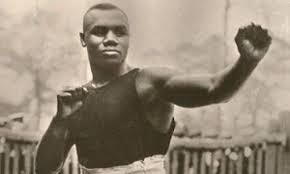
Jack Johnson, newly pardoned by President Trump, had one of the hardest heads ever pounded on by the leather boxing glove. Stylish, arrogant, successful and persecuted, he was, like Muhammad Ali in the 1960s, revered by many for his attitude and skills. But if Johnson was typical of black aspiration in the ring, he was never typical of actual black gain. He was healthy and still trading on his name when killed in an auto crash in 1948, unlike Sam Langford, who died blind, broke and forgotten, except by true aficionados.

Johnson may have been run out of the country and jailed by the white establishment, but he never sank to the misery experienced by his black contemporaries who fought each other for peanuts and were denied the chance to challenge for the world title.

This may be a good time to reflect on the history of black fighters in the heavyweight class.

The first men ever to fight for sport and profit in America were black freemen—Tom Molineaux and Bill Richmond, “The Black Terror.” They practiced their brutal art in the early years of the 19th century, and were close friends, according to the historians. Molineaux became the first American ever to fight for a championship—the heavyweight title—when he met Jim Cribb in London in 1810 and lost by a very tight margin—so close, in fact, that a rematch was held a year later at Thistoleton Gap in the County of Rutland, and Londoner Pierce Egan, inspired by what he had seen, started the first publication ever devoted exclusively to boxing, Boxiana.

Boxing was illegal in those days, and matches were conducted on the sly, at hidden rendezvous, much the same as cock-fighting today. In his book, “The Sweet Science,” A.J. Liebling describes a picture of the second Molineaux-Cribb bout that had appeared in Boxiana. The scene was typical of boxing matches up into the twentieth century.

“In the foreground of the picture there is a whore sitting on her gentleman’s shoulders the better to see the fight, while a pickpocket lifts the gentleman’s reader (watch). Cribb has just hit Molineaux the floorer and Molineaux is falling, as he has continued to do for a hundred and forty-five years since.”

But Liebling adds that “the detail I recall first when I think of the picture is the face of Bill Richmond, also an American Negro, as he sees his man go. He is following Molineaux down with his eyes, bending as the challenger falls, and his face is desolate.”

Egan paid heed to Molineaux by writing: “The hardiest frame could not resist the blows of the Champion; and it is astonishing the Moor stood them for so long.”

It is equally astonishing that boxing stood its illegality for so long—right up to the time of Jack Johnson. If it was difficult for a white man to get along in the sport, it was ten times as difficult for a black man. Talented black fighters could only hope to scrape out living in the ring—nothing more.

John L. Sullivan barred black opponents while champion, saying, “I will never fight a black man.” Sullivan’s leading contender was just such a black man, Peter Jackson, who was finally held to a draw in 61 rounds by Gentleman Jim Corbett after several years of futile waiting. Guess who got the title shot? After losing to Corbett himself for the title, Sullivan is said to have remarked, “Thank God I lost to an American.”

Black fighters of the lower weight classes were never quite that unfortunate, although they came close. The most untalented heavyweight king is always a shade above the middle and welterweight champions in charisma and respect—the title is like a lightning rod. Thus, several lighter black men—Joe Gans, George Dixon, Joe Walcott, Tiger Flowers, Battling Siki—were able to become champion of their divisions during times when a black heavyweight king was unthinkable to the white American public.

Conditions were at their worst, if anything, during Johnson’s unlikely reign. The leading black contenders—Sam McVey, Joe Janette and Sam Langford—were forced to fight each other sometimes as many as 20 or 25 times in every tank town along the pike. The white contenders avoided them if they could, and even Johnson, as champ, refused to fight them. He did face a black contender—Jim Johnson—during his exile in Europe: they fought to a draw in Paris. But the bout lost money. It was the first time two black men every met in a heavyweight title fight, and the last for many a long day.

Sam Langford, the Boston Tar Baby, was typical of the time. He was a slippery boxer with a good punch, and murderous infighting skills. Born in Nova Scotia in 1880, he began boxing in 1902 as a featherweight. Growing up the weight scale, he fought almost every leading boxer of his time: Joe Gans, Joe Walcott, Jack Blackburn (who later trained Joe Louis), Stanley Ketchel, defeating many of them. He beat most of the white hopes of the time: Jim Barry, Jim Flynn, Tony Ross and Sandy Ferguson, and lost a close fight to Johnson who refused to meet him again for the title or otherwise.

As a result, Langford with his deadly skills was forced to go on tour of the sticks, fighting his fellow blacks. He fought Joe Jeanette 14 times, McVey 14 times, and Harry Wills 23 times. He took many a beating, and dished many out. Towards the end of his career he went blind from cataracts, and managed to stay alive in the ring by holding on to his opponents and punching in their direction in the clinch. He retired in 1924, with a record of 151 pro fights, 39 decision wins, 99 knockouts and only 19 decision losses and 4 knockout losses, the remainder being draws and no-decisions. When elected to the Boxing Hall of Fame in 1955, he was living in cellar in Boston. They took up a benefit for him, but he died a year later.

Langford, like Johnson, was hated and feared by a generation of whites. After he fought Gunboat Smith in Boston , the Boston Globe cartoonist wrote some very racist captions for drawings of the fight: “The Tar Baby’s grin, which rapidly vanished,” for flashing white teeth, and “The smoke at times made if difficult to see the Tar Baby,” for a picture of dense smoke and the vague shadow of a human form.

Johnson, of course, didn’t fare any better in the press. One cartoon of the era showed a group of white hopes running away from a black man (looking very much like Johnson) with a spear, vowing never to fight “that coke,” or “that smoke.”

Even Damon Runyon was guilty of racism when commenting on Johnson’s loss to Jess Willard in Havana in 1915, Had Johnson cut a deal with U.S. authorities to throw the fight and be readmitted to the States after his fled to Europe to avoid being jailed on a Mann Act conviction? Runyon wrote that “the case was in the hands of the feds who were not making deals with the likes of Johnson.”

Jack Dempsey, in his autobiography, admitted that he was frightened of Sam Langford and refused to fight him on the way up. Dempsey, however, is better known for his failure to meet another African-American fighter, Harry Wills, who was a leading contender during Dempsey’s championship reign. Wills was entitled to the shot, and at one point had even signed a contract with Dempsey for the bout. Somewhere along the line, Dempsey’s people pulled out, and in Dempsey’s own words, Harry Wills died without ever knowing how he would do in a title fight.

It is unclear today who deserves blame, but Dempsey’s promoter Tex Rickard could share some of it. Rickard had promoted the Jack Johnson-Jim Jeffries match in Nevada in 1910, when Jeffries was brought out of retirement to re-establish the “fistic supremacy of the white race,” and was beaten to a pulp. The match caused repercussions that were still felt up to and after Dempsey’s time. It wasn’t until 1937 that another black fighter received a shot at the heavy title, and only after he had carefully instructed about how behave. He was Joe Louis.

Black heavyweight kings have been predominant since then. But they owe a debt to the McVeys and Langfords, and others who went down unsung.

Your GDPR Security Blanket

By Ray Schultz

Last December, I was at a holiday party thrown by a software developer, and was just about to sample some rigatoni when I felt a great weight on my left shoulder: Yale Moss, six feet, 195 pounds, stuffed into one of those tiny Tom Brown suits, was leaning on me.

It wasn’t a pleasant surprise. The last time we talked, Yale threatened to punch me out for failing to get his father Mo Moss into the DMA Hall of Fame. Now he was pretending to be friendly. “We’re having a Webinar tomorrow for my new business. I’d like you to be on it.”

“That’s short notice,” I said.

“Not in the age of real-time response,” he replied.

Trying to change the subject, I asked, “How’s your dad?”

“I’m no longer his son,” Yale said. “I refuse to be associated with that slimebucket.”

Huh? Now I had no interest in getting involved in any business of Yale’s, especially at the Moss family’s usual pay rate, which is no pay, nor in their internal disputes. But Yale insisted on hyping his new scam, Your GDPR Security Blanket, and he ordered, “Hear me out!”

I protested, mildly, that there are many fine products that help firms deal with GDPR.

“Not like this.” He was right about that.

To hear Yale tell it, all you have to do to comply with GDPR is merge your email list with his and Mo’s Proclivities database of alcoholics, opioid abusers and other such miscreants.

That sounded like a non-starter to me–nobody in their right mind would turn a list over to Yale, given the Moss family’s history of stealing lists.

And what would happen if Yale’s algorithms failed and you ended up in trouble anyway? Yale said he would deploy his crack legal team. After probing, though, I learned that this consisted of Erwin Forrest, a collection hack who is unable to function outside of Part B of the New York Civil Court, and is known for shouting at reporters, opposing counsel and even clients.

I tried to demur, but Yale was insistent, and since he was twisting my arm and getting close to breaking my elbow, I agreed to participate.

The next day, I showed up at the Data Shack headquarters, in a desk-share place in Williamsburg. There was Erwin, looking reduced, and Yale, dressed in a knit cap, sweatshirt and pajama pants.

We had the usual hot chocolate laced with hot shots of caffeine, and jelly donuts, this being Free Jelly Donut Day in this joint. High on sugar and caffeine, we went into the Media Room, a small airless chamber with thick glass windows. There was no rehearsal. Yale got on Skype, there was a beep, and we got started.

My role, I learned, was to give the technical instructions for listeners, as they used to do in 2002. This took 10 minutes. Then Erwin started reading from legal documents in his gravelly voice, getting flustered at times by footnotes. It turned out he was reading an out-of-date paper on landlord-tenant law, so he tore through his papers until he found something on GDPR. Then he really got lost.

For his part, Yale gave his pitch, and as always, there was something menacing in his tone. “You’ve got three months,” he said. “Don’t be stupid.” By the end, the only person left was a British lawyer who commented, “You people don’t know what you’re talking about.”

Erwin and I shared a green cab back to Manhattan. “Erwin,” I asked, “do you really expect to get paid for all this?”

“I’m a collection lawyer,” he growled. ”I know how to get paid.”

That was the last I heard of it for a month. Then Yale called me to say, “-You won’t believe this–we’re being sued by the FTC,” as if I cared.  It turned out that the Data Shack had been hacked in 2016, and that data on persons on the Proclivities list was exposed, and Yale forgot to report it. “Hell, I’ve got a business to run,” he said. Yale insisted that I  attend the first hearing in the Brooklyn Federal Court.

Who was there but Mo himself, up from Tampa, with an expensive lawyer who specializes in this area. “I have to defend my own flesh and blood,” Mo said. Of course, he had little choice, since his name was also on the incorporation papers. Yale looked sullen.

I never gave Mo too much credit for smarts. But the two of us had coffee at  Starbucks afterwards, and he revealed the cause of his falling out with his son—namely that he, Mo, had refused to back Your GDPR Security Blanket.

Note: All resemblance to persons living or dead is strictly coincidental, etc. 

What Do You Call A Norwegian?

By Ray Schultz

President Trump’s alleged comment that we need more Norwegian immigrants in this country (as opposed to people from Africa and Haiti) has caused some wags to wonder: Are there any racial epithets for Norwegians?

Of course there are.  The late Chicago columnist Mike Royko wrote a column in the 1970s laying out at least a couple of ethnic slurs for individuals of Norwegian descent.

Like many Royko columns, this one is presented as a barroom conversation. While beering themselves up, a small circle of white guys debate what Norwegians should be called.

The sole Norwegian present says there are no epithets for them because Norwegians are all nice. But his friends respond with names that they seem to invent on the spot.

The consensus is that there are two names for Norwegians: Noogins and herring benders.

Like many ethnic insults, these may sound funny unless you’re part of the group being assailed. If Norwegians ever attained critical mass in the U.S., they would have to deal with that and more.

Welcome to America.

Rokyo also reported that Lithuanians are called Loogins, proving that there’s an ugly name for everyone.

We never heard that one in New York. It must be a Chicago thing.

DEAR FRIEND: The Rascals, Rogues and Roues Who Made American Junk Mail, Chapter 13: The Confederate Croupiers

By Ray Schultz

Born in 1837, the grandson of a Baptist minister, John Wanamaker was so good a student that one of his teachers said, “It is no use to send John to me any more; I have taught him all I know.” By rights, Wanamker should have gone into the family brick-building business, but he was diagnosed as a possible consumptive, and spent months in a Minnesota rest home. Filled with the “serious thoughts of one likely to die,” he left the family faith to join the Presbyterian church, then, that matter resolved and his health restored, turned to his livelihood.

In April 1861, as the city and country were buzzing about the Confederate attack on Fort Summer, Wanamaker, age 22, opened a ready-to-wear clothing store with his brother-in-law Nathan Brown: the Oak Hall Clothing Bazaar. Each man invested $2,000.

Soon, they were sending “four-page papers containing a good deal of miscellaneous and original reading matter, sandwiched between bright, readable advertising paragraphs, for instance, ‘A sad sign—to sign your name to a note; better buy your clothes at Oak Hall and pay cash,’” one historian wrote.

In 1969, the partners tried a larger store. And in 1877, after buying a parcel of land for $500,000, Wanamaker opened one of the country’s first department stores. It was heralded in a double-column advertisement in all the Philadelphia papers: “The Inauguration of the Dry Goods Business at the Grand Depot will take place Monday, March 12, from nine to six o’clock.”

Wanamaker hired a writer named J.E. Powers to write “daily store talk in bright, catchy sentences.” And he spent $300,000 a year on this advertising in a time when, as one historian noted, it was “not considered polite to advertise.” He also sent a 148-page mail order catalog containing “a list of the goods in every department in the store.”

The lifelong Sunday school teacher was a benign employer: Every staff member received two weeks vacation with full salary every summer–unusual for that time. And the company library was free for female workers.

Wanamaker was also active in politics. In 1888, he raised more than $200,000 for the Republican presidential candidate Benjamin Harrison, asking fellow businessmen, “What would you pay to be insured for a better year?” Later, he boasted, “We raised the money so quickly that the Democrats never knew anything about it.” That fall, Harrison unseated the sitting President Grover Cleveland, and Wanamker received the prize so often tendered to contributors and political hacks: The Postmaster Generalship.

As promised, Wanamaker approached this job as a businessman. “Gentleman, you want to run your post office as if there were another fellow across the street competing with you, and you were trying to get all of the business.” he said. But then he did something that was decidedly unbusinesslike—he tried to dump his largest customer: The Louisiana Library.

*****

Louisiana had been occupied since 1867 by federal troops, and run, one outraged Southern editor charged, “by corrupt Republicans, ignorant Negroes cooperating with a gang of white adventurers, strangers to our interests and our sentiments,” reflecting the racism rampant in the former Confederacy. Among the newcomers was a 31 year-old Baltimorean named Charles T. Howard.

Some people said Howard inflated his Confederate war record, but it didn’t matter, for in 1868 he had something in short supply in Louisiana: capital provided by the New York gambler John Morris, and he liberally dispensed it to the Republicans in the legislature. His hosts rewarded him with a 25-year charter to operate a lottery, and made it a crime for anyone else to start one. And the company was exempted from all taxes except for a $40,000-a-year contribution to the state educational fund.

At first, the Louisiana Lottery sold chances mostly through policy shops in the state: the daily drawings were “the special curse of the colored population,” one observer alleged. But this was a limited market. In 1873, in perhaps his wisest move,  Howard appointed Dr. Maxmilian A. Dauphin as president.

Dauphin was born in 1837 in Alsace Lorraine, and emigrated to the United States at age 16 with a brother. But the siblings separated soon after arriving, and Maxmilian ended up friendless in New Orleans. He attached himself to Dr. Sam Choppin, “then the center of one of the most brilliant social, professional and politicial coteries.” and under his sponsorship became a physician. Then he went into business.

Dauphin knew that the lottery would never realize its full potential until it dominated the Yankee market, which it did, within a few years. Next to New Orleans, Washington was the most lucrative city. The Lottery offered tickets at cigar stores, hotels, saloons and barber shops, and through bootblacks and newsboys in the streets. And, of course, it peddled them by mail, so many that Bin “D,” in the Washington post office was assigned to Dauphin, and clerks worked into the night, using “express wagons and furniture cars to haul the outgoing mail,” one account reported.

It was similar in New York and Chicago, where lottery agents mailed tens of thousands of packages a month, containing letters, certificates, logos, entry forms and tickets, and promises of “grand” and “extragavant” prizes.” One package sent in New York in 1880 said: .“No seed, no harvest.” Altogether, the Lottery’s mailings pulled in $30,000 a day, or almost $11 million a year. And they constituted 45 percent of the entire business of the New Orleans post office.

The Lottery could usually buy off anyone in its way, but it made a mistake when it offered payments of $25,000 a year to Anthony Comstock, made out to him personally. The vice crusader yelled, ““As long as I live and have my reason and health, your company shall never have another office open in New York.” No matter: business went on.

The drawings were held in an ancient hall in New Orleans, with an alligator paddling around in a pool outside. And they were under the “personal supervision” of two venerated Confederate generals: Jubal T. Early, who had torched Montgomery Blair’s house in Maryland during the war, and G.T. Beauregard, both dressed in Confederate gray and crowned with white hair.

General Beauregard “was of large stature, but the progress of years weighed heavily upon him, and his shoulders were bent so as to throw his florid face, with its full white hirsute covering, forward towards the floor. Gray-blue eyes, fierce and penetrating, gleamed beneath bushy, overhanging brows. A suit of Confederate gray clothing, well cut and near, covered the aged man.”

Then there was Jubal, “clad in black, and a handsome face crowned by now-white closely cropped hair was poised proudly sabove an elegant, dignified form,” aided by two small boys wearing knickers.

The generals were each paid tens of thousands of dollars a year to stand on stage once a month and “preside.” The drawings featured blindfolded boys from a local orphan asylum, and were conducted before men who were “redolent of rum and tobacco and poor bathing facilities, and had no taste or money for clean raiment,” according to one eyewitness account. “With the utmost solemnity, Croupier Early proceeded to blindfold the boy beside him,” wrote another witness. “Located near the brazen drum, Croupier Beauregard, with corresponding gravity, tied a white handkerchief over the eyes of his juvenile assistant.”

The drawing began. Jubal drew the white paper from the encircling black rubber tube. In measured tones he read the number, 48,146.” The voice of General Beauregard was likewise measured and somewhat harder in is timbre when he called the figures on the white slip of paper which he drew from the little black tube: ‘200’ he said.” What it meant was the holder of ticket 48,146 had won $200.”

Several larger prizes were drawn, including jackpots of $100,000 and $300,000, but no winner came up to claim them, causing groans in the gallery. With good reason: One third of the tickets in the drum were unsold, still owned by the Lottery, which meant that the bettors were playing against the house. And the house did well. Government lotteries in Europe distributed up to 85% of their ticket money in prizes; the Louisiana Lottery kept more than half.

In 1890, Congress passed yet another law making it a crime to use the mails to conduct a Lottery. Unlike previous bills, this one made it a crime even to patronize a lottery by mail. Harrison signed it, and Wanamaker vowed to enforce it.

Dauphin decided to bypass the mails, employing private express deliverers and in this way removing he criminal taint for customers. His ads advised players to “remit currency by express at our expense. Give full addresa and make signature plain.” But the pressure and his rich New Orleans diet must have gotten to him, for in December Dauphin died at age 53 after a brief illness. Charles Howard was dead, too, having been thrown from a horse.

Paul Conrad, former chief clerk of the Lottery and part owner of an ice company, took over. As Pattee and Nathan Read had done, he opened a Lottery office in Canada, then had circulars sent over the border to advertise the fact that “recent changes in the United States Postal regulations have rendered it preferable to more closely consult the interest of our Canadian patrons by establishing a branch office in Canada.”

At this point, the Supreme Court of Louisiana was deciding whether to renew the Lottery charter or put it on a ballot referendum. The court, heavily subsidized by the Lottery, ruled to renew, and Conrad quickly got out a mailing hailing the victory. And he rubbed it in Wanamaker’s face: The pamphlet contained return express envelopes addressed to the New Orleans National Bank, again bypassing the Post Office. Worse, it was designed to look like a newspaper, and was mailed at the second class rates for pubishers.

That tore it for Wanamaker. Employing the full machinery of law enforcement, postal authorities made 153 arrests. But they rarely netted anything more than a $500 fine. Still, the bad publicity had its effect: The flow of incoming envelopes slowed down to a trickle.

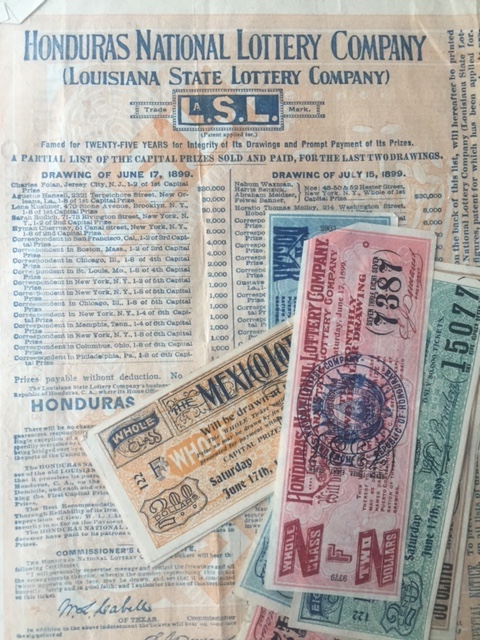
Conrad had one more trick. He relocated the Lottery to Honduras, and started sending pink circulars under the name the Honduras National Lottery Company by express mail, bypassing the post office. “We use the express companies in answering correspondents and sending lists of Prizes to the U.S.A.,” they said. “Reply by Express only.”

But it didn’t work. In 1892, the U.S. Supreme Court upheld the anti-lottery laws and Conrad announced that he would close shop. Wanamaker claimed victory. Morality and sound business practices had prevailed over the rebels. In 1895, green goods were also wiped out in the courts.

Too bad not all of Wanamaker’s schemes ended in victory. He was ridiculed for his most brilliant idea: Free rural delivery. One Republican editor wondered whether Wanamaker also wanted to “have the Government present every farmer with a free telephone and a free telegraph instrument.” Free rural delivery wasn’t enacted until after Wanamaker left office.

The robber baron Jay Gould himself denounced as socialistic Wanamekr’s plan to nationalize the telephone and telegraph systems and run them through the post office. Then it was over: Harrison lost to Grover Cleveland in the 1892 election, making Cleveland the only President to serve two non-consecutive terms. Wanamaker returned to his business, and lived until 1922, despite his youthful fears of consumption.

Chapter 14: The Road To Wellville

Ivanka Live

By Ray Schultz

Ah, memories. Did you know that Ivanka Trump, the daughter of our next President, once spoke at a direct marketing event?

It happened on June 16, 2009 at DM Days in New York. And I covered it. Not that it was a big story—I can’t remember where, or even if, it was published. But it might be of some slight historical interest. So here’s my report, with not a word changed, not even the archaic term “DMer.”

Lessons From Ivanka Trump

With all respect, why do beleaguered DMers need lessons in living from 27 year-old Ivanka Trump?

It’s not that we disagree with any of the tips she offered this morning on how to succeed. But she’s Donald Trump’s daughter. What can she possibly know about adversity?

Granted, she’s been around enough self-made people to know what it takes (not that her dad qualifies). And she argued that it’s not easy being a Trump. “Much is given, much is expected,” she said.

She did make one pertinent observation about the downturn: “The last 18 months are the best education I’ve had to date, better than Wharton and operating in the hottest real estate marketing anyone’s seen.”

We’re still not sure why her real estate job in the Trump empire qualifies her as a speaker at DM Days. But here are some of her prescriptions:

  1. Make sure you love what you’re doing. 
  2. Be resilient. Ivanka has seen many successful people become despondent during the downturn, “unable to get out of their own way.
  3. Don’t be afraid to make cold calls.

We’d suggest that she collect these nostrums into a book. But she probably already has.


Scoundrels, Demagogues and Boobs

By Ray Schultz

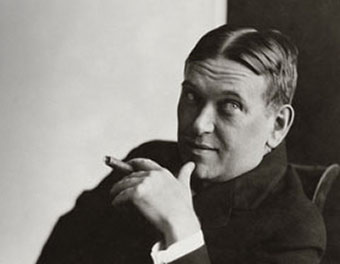
You want politically incorrect? Try H.L. Mencken. I turned to the Sage of Baltimore to get perspective on the election, and he made me laugh, as always. So there is reason to live. Granted, things have changed in this country since his time, but it all sounds strangely familiar. What were Mencken’s politics? He hated everyone. Here was the man who called the New Deal “a milch cow with 125 million teats.” Yet the proud libertarian also despised fundamentalist Christians. If your group or state is skewered here, I can only repeat what a Republican told a Liberal the other day: “Toughen up.”

Nothing could have been further from the intent of Washington, Hamilton and even Jefferson than that the official doctrines of the nation in the year 1922, should be identical with the nonsense heard in the Chautauqua, from the evangelical pulpit, and on the stump. But Jackson and his merry men broke through the barbed wires thus so carefully strung, and ever since 1825 vox poluli has been the true voice of the nation. Today there is no longer any question of statesmanship, in any real sense, in our politics. The only way to success in American public life lies in flattering and kowtowing to the mob. A candidate for office, even the highest, must either adopt its current manias en bloc, or convince it hypocritically that he has done so, while cherishing reservations in petto. The result is that only two sorts of men stand any chance whatever of getting into actual control of affairs—first, glorified mob-men who genuinely believe what the mob believes, and secondly, shrewd fellows who are willing to make any sacrifice of conviction and self-respect in order to hold their jobs. One finds perfect examples of the first class in Jackson and (William Jennings) Bryan. One finds hundreds of specimens of the second among the politicians who got themselves so affectingly converted to Prohibition, and who voted and blubbered for it with flasks in their pockets.” (On Being An American, 1922)

***

On the steppes, Methodism has got itself all the estate and dignity of a state religion; it becomes a criminal offense to teach any doctrine in contempt of it. No civilized man, to be sure, is yet actually in jail for the crime; civilized men simply keep out of such bleak parking spaces for human Fords, as they keep out of Congress and Franz Josef Land. But the long arm of the Wesleyan revelation now begins to stretch forth toward Nineveh. The mountebank, Bryan, after years of preying upon the rustics on the promise that he would show them how to loot the cities, now reverses his collar and proposes to lead them in a jehad against what remains of American intelligence, already beleaguered in a few walled towns.

Not much gift for Vision is needed to imagine the main outlines of the ensuing Kultur. The city man, as now, will bear nine-tenths of the tax burden; the rural total immersionist will make all the laws. With Genesis firmly lodged in the Testament of the Fathers he will be ten times as potent as he is now and a hundred times as assiduous. No constitutional impediment will remain to cripple his moral fancy. The Wesleyan code of Kansas and Mississippi, Vermont and Minnesota will be forced upon all of us by the full military and naval might of the United States. Civilization will gradually become felonious everywhere in the Republic, as it already is in Arkansas. (The Husbandman, 1931)

***

Virginians, even the worst of them, show the effects of a great tradition. They hold themselves above other Southerners, and with sound pretension. If one turns to such a commonwealth as Georgia, the picture becomes far darker. There the liberated lower orders of whites have borrowed the worst commercial bounderism of the Yankee and superimposed it upon a culture that, at bottom, is but little removed from savagery. Georgia is at once the home of the cotton-mill sweater, of the Methodist parson turned Savonarola and of the lynching bee. A self-respecting European, going there to live, would not only find intellectual stimulation utterly lacking, he would actually feel a certain insecurity, as if the scene were the Balkans or the China Coast. (The Sahara of the Bozart, 1917).

***

At each election we vote in a new set of politicians, insanely assuming that they are better than the set turned out. And at each election we are, as they say in the Motherland, done in.

Of late the fraud has become so gross that the plain people begin to show a great restlessness under it. Like animals in a cage, they trot from one corner to another, endlessly seeking a way out. If the Democrats win one year, it is a pretty sure sign that they will lose the next year. State after state becomes doubtful, pivotal, skittish, even the solid South begins to break. (The Politician, 1924)

***

(The average American’s) docility and pusillanimity may be overestimated, and sometimes I think that they are overestimated by his present masters. They assume that there is absolutely no limit to his capacity for being put on and knocked about—that he will submit to any invasion of his freedom and dignity, however outrageous, so long as it is depicted in melodious terms. He permitted the late war to be “sold” to him by the methods of the grind-shop auctioneer. He submitted to conscription without any of the resistance shown by his brother democrats of Canada and Australia. He got no further than academic protests against the brutal usage he had to face in the army. He came home and found Prohibition foisted on him, and contented himself with a few feeble objurgations. He is a pliant slave of capitalism, and ever ready to help put down fellow-slaves who venture to revolt. But this very weakness, this very credulity and poverty of spirit, on some easily conceivable tomorrow, may convert him into a rebel of a peculiarly insane kind, and so beset the Republic from within with difficulties quite as formidable as those which threaten to afflict it from without.

What Mr. James N. Wood calls the corsair of democracy–that is, the professional mob-master, the merchant of delusions, the pumper-up of popular fears and rages–is still content to work for capitalism, and capitalism knows how to reward him to his taste. He is the eloquent statesman, the patriotic editor, the fount of inspiration, the prancing milch-cow of optimism. He becomes public leader, Governor, Senator, President. He is Billy Sunday, Cyrus K. Curtis, Dr. Frank Crane, Charles H. Hughes, Taft, Wilson, Cal Coolidge, General Wood, Harding. His, perhaps, is the best of trades under democracy–but it has its temptations! Let us try to picture a master corsair, thoroughly adept at pulling the mob nose, who suddenly bethought himself of that Pepin the Short who found himself mayor of the palace and made himself King of the Franks. There were lightnings along that horizon in the days of Roosevelt; there were thunder growls when Bryan emerged from the Nebraska steppes. One some great day of fate, as yet unrevealed by the gods, such a professor of the central democratic science may throw off his employers and set up a business for himself. When that day comes there will be plenty of excuse for black type on the front pages of the newspapers. (On Being an American, 1922).

***

Most of the rewards of the Presidency, in these days, have come to be very trashy. The President continues, of course, to be an eminent man, but only in the sense that Jack Dempsey, Lindbergh, Babe Ruth and Henry Ford have been eminent men.

The honors that are heaped upon a President are seldom of a kind to impress and content a civilized man. People send him turkeys, opossums, pieces of wood from the Constitution, goldfish, carved peach kernels, models of the state capitols of Wyoming and Arkansas, and pressed flowers from the Holy Land. Once a year some hunter in Montana or Idaho sends him 20 pounds of bear-steak, usually collect. It arrives in a high state, and has to be fed to the White House dog. (The Imperial Purple, 1931)

Trump’s Brand of Content

By Ray Schultz

Content is king, and Donald Trump is the king of content. So said The New York Times in an article two weeks ago.

“Mr. Trump is not running a campaign in the modern sense…Rather, he oversees a prolific content production studio that has accomplished what every major media conglomerate is trying to pull off with mixed success,” Jim Rutenberg wrote in the Times.

That was, of course, before the Orlando massacre, and Trump’s emotional meltdown, in which he seemed to blame Barack Obama for the attack. But it still stands.

Trump isn’t big on position papers. Instead, he gives us is stream-of-consciousness spewing–every bleat and gurgle that come out of his mouth. Who cares if they add up to incandescent BS?

Well, there must be a buck in it. Two Rubio retainers, Alex Conant and Will Holley, have opened an agency devoted to Trumpspeak: Firehouse Strategies, Rutenberg reports. Blowing hot air will soon be a mainstream marketing tactic.

But Trump isn’t the first “hypnotic, post-literacy” verbal artist. There was one before him.

Adolf Hitler.

Mind you, I’m not comparing Trump, a common bigot, to Hitler, whose crimes were the most monstrous in human history. What we’re talking about here is communications.

“Together with his actual ability to manipulate an audience, Hitler also showed an intuitive sense which amounted to genius that the spoken word was going to be of core significance than the written word in the coming years, “wrote in A.N. Wilson in “Hitler,” a sincere but slight bio of the monster.

Just as Trump eschews paper documents, so did Hitler.

“From the beginnings of Communism in the early nineteenth century to its crisis or unraveling in the 1970s, Communism remained, among other things, a doctrine whose texts, like the Koran or the Talmud, could be endlessly re-perused by the Doctors of the Church, and interpreted in a literary way,” writes Wilson, who coined the “post literacy” phrase. “They belonged to the vanishing world of the text; Hitler belonged to the oral future, the future which contained Walt Disney, television and cinema.”

According to Wilson, Hitler said that “the greatest revolutions in this world have never been directed by a pen! [The irony appears heavier in German, because the word for pen is feather.] No, the only thing the pen has been able to do is provide theoretical foundations. But the power which has always set rolling the greatest religious and political avalanches in history from time immemorial has been the magic power (die Zauberkraft] of the spoken word.'”

Wilson continues: “Zauberkraft. From the beginning he saw himself as a magician. In fact, his sense of the power of the spoken word, the word blared through a loud-hailer, the word broadcast on radio and in film, was very far form being some ancient truth which had rolled down the ages from time immemorial.”

And Hitler didn’t have to know much to do it.

“He made clever use of his reading, but that reading was extremely limited,” Wilson wrote. “Indeed, it was the very fact of his limitations which gave him such strength. He had few abilities and it was these which carried him along.”

Sounds familiar doesn’t it?


DEAR FRIEND: The Rascals, Rogues and Roues Who Made American Junk Mail, Chapter 8: The Pride Of Park Row

By Ray Schultz

J. M. Pattee left Omaha for good—some say he was run out—in the summer of 1873. The Nebraska legislature had outlawed lotteries, effective Sept. 1, so he regrouped in New York, where he owned a brownstone near Central Park.

Not a man of idle nature, as one reporter put it, he ran a few scams in the city, then made his way to  Laramie and ingratiated himself with the right people. The Wyoming legislature passed a bill granting him a ten-year lottery license that could never be altered, and Pattee acted on it before the governor could sign it (which he never did).

It didn’t matter. The so-called Wyoming Lottery would operate entirely by mail. And Pattee could get away with it,for lawmakers had failed to keep lotteries like his out of the postal system.

Congress had tried in 1865 with a law defining “nonmailable matter”—everything from explosives to lottery materials. But it failed to specify letters or circulars, and what it meant the courts could never figure out.

Realizing their error, the lawmakers attempted  to clarify things in 1868 by prohibiting the mailing of “any letters or circulars concerning lotteries, so-called gift concerts, or other similar enterprises.” But this bill, too, was flawed in that it failed to set penalties for disobeying it.

In 1872, trying one more time, they forbade the mailing of “any letters or circulars concerning illegal lotteries, so-called gift concerts, or other similar enterprises, offering prizes, or concerning schemes devised and intended to deceive and defraud the public for the purpose of obtaining money under false pretenses.”

The blunder this time was that they had added the word “illegal.” How could a lottery chartered by a state or an institution be considered illegal?

Pattee knew that they would get it right sooner or later, and he knew he had to move beyond lotteries. He had doubtless heard of E.C. Allen, of Augusta, Maine, who in 1869 started Peoples’ Literary Companion, a paper filled with stories, homilies, recipes, songs and advertisements.

Other publishers followed Allen’s lead. A fellow Augustan named P.O. Vickery started Fireside Visitor, and W.W. Gannett followed with Comfort. Mailed to farmers whether they wanted them or not, these mail order papers were “the great business of the city, completely overshadowing everything else,” wrote Frank A. Munsey.

Pattee could do the arithmetic as well as anyone. He created The Times Illustrated, a promotional vehicle for the Wyoming Lottery. The cost was defrayed, in part, by paid advertisements for Red Cloud’s Great Indian Blood Purifier and other patent medicines.

He followed it with The Laramie News, in which he described Laramie and the local mining deposits: “There are within a hundred miles of Laramie City a hundred miles in length of gulches which will pay an average of five dollars per day in gold, for every day’s labor, and they can be worked with very little outlay of capital.”

Thus he sharpened his pen for a new venture—and just in time. On July 12, 1876, Congress enacted a new bill, dropping the term “illegal” when describing lotteries. Now it was unlawful to send any sort of lottery letter.

This bill turned out to be as hollow as the previous ones, but that wasn’t clear at first. Pattee cancelled his next lottery mailing, saying “times have been hard,” and accelerated a plan he apparently already had: He prepared a letter for fools who had won his previous lotteries and were now on his sucker’s list.

“On account of the new Postal law and the penalty for sending letters concerning lotteries through the mails, I have been obliged to make some other arrangement to pay off the small prizes of $1 and 50 cents as it would cost the party receiving them more than the amount to pay the express charges,” Pattee wrote under his own name.

Instead, he awarded shares in “one of the most extensive gold mines on this continent.” Additional shares could be had for $2 apiece.

“It is the richest gold mining country in the world,” Pattee wrote. “For miles away up in the heights of those tremendous elevations in the Big Horn Mountains glisten rich veins of gold quartz that run in golden ribbons at close intervals across their breasts. Some specimens of gold quartz have been found which assayed $47,000 to the ton—a mountain of gold ore.”

Pattee’s own employees turned against him. They sent a mailing to his “winner’s” list, offering for one dollar “a most complete exposure of this ‘arch swindler’s’ manner of defrauding the public during the past years.” They added that he planned to “foist upon those who have won good prizes in his last drawings, amongst whom we see your name, certain stock certificates…instead of the money they have RIGHTFULLY WON.”

The master returned to New York, where there was less danger of getting shot. He now worked only through designated criminals who would take the fall if there was trouble. One was N. Sherman Read, a tiny man known to friends as Nate. Pattee was married to Read’s sister Eunice, and they had often summered at Read’s resorts in New Jersey.  In 1876, now working for his brother-in-law, Read opened a lottery office on Nassau St. near Park Row.

Flanked on one side by City Hall, Park Row was home to newspapers and advertising agencies–and dozens of lottery shops. “Entering the office of any one of these so-called firms, the inquirer finds himself surrounded on all sides by a ground-glass partition,” a reporter wrote. And each one had a “hard-featured man peering through a wire netting under the sign ‘Cashier.’”

These offices also sent quantities of junk mail. The city’s best printers and engravers were two blocks south on Maiden Lane, and the largest post office in the country, a five-story granite block known as the Whale, stood on the triangular lot bordered by Park Row and Broadway.

Pattee made full use of these facilities, not only for his lotteries but for schemes like the Bullion Gold Mining Co. and Carburrus Gold Mining Company.

He also got to know his fellow mail fraud artists. Ellis and William Elias were driven out of Cincinnati for swindling, then made a fortune in New York running “dollar stores”—stores in which the shopper never knew what he was buying. They enjoyed a “very unenviable reputation,” the New York Times wrote.

The brothers operated a mail room in which men and girls sat at two rows of tables shaped in the letter “L,” addressing envelopes. Also to be found there was H.P. Jones, a former post office employee who was “discharged from P.O. for NY for embezzlement or helping himself to other peoples’ money.” A handwritten note signed by him was sent to 140,000 people in the fall of 1878:

“Dear Sir:

“A cousin of mine bearing the same name as yours, after the war was over, left his Regiment and I have not heard from him since. Now I do not know whether you are the same person or not but you can tell as soon as you see my signature to this letter.”

The note continued that a contest was about to be held, and that if the recipient agreed it would be rigged in his favor. Why this largesse? “I am sure that if a large prize was drawn by you and shown around that thousands of tickets could be sold in your County.”

A series of followup letters persuaded the sucker to pay $8 apiece for lottery tickets—a seemingly paltry sum by today’s standards—but the letters cost only a penny apiece to mail, and not much more to print. The Eliases had discovered the immutable law of junk mail—that a profit could be made even after expenses and the pilfering of cash-filled envelopes by postal workers.

Anyway, it was not their only business. They also ran several “stores,” including a jewelry store on Broadway and 21st St. (above which was their mail room). Their flagship was the Centre, a large outlet at 22nd St. and Broadway, in which they displayed gold and silver jewelry in cases. It operated on the same marketing principles as the junk mail business.

The Eliases promised in circulars that they could deliver “the most valuable articles to the purchaser at the same price as those of less cost,” but what they really offered was a lottery. The customers bought tickets in sealed envelopes from a cashier, who sat hidden in a teller’s cage. Most opened the envelopes to find that they had won cheap merchandise.

Operating on the border of legality, the pair had to pay occasional modest fines. But they “reaped a rich harvest from their numerous enterprises,” the New York Times reported. Ellis Elias alone had $300,000 in assets, including a country estate and $3,000 worth of trotting horses.

“A man who came in contact with the senior member of the Elias firm used to tell of seeing him exhibit a roll containing sixty one thousand dollar bills, one day, and when putting it back in his pocket heard him remark, pleasantly, that that was some that came in after he had got done expecting to make any money,” wrote George Rowell, whose ad agency was located at 41 Park Row.

Pattee could admire these accomplishments. And though they were competitors, he started working with Eliases on a matter that would benefit them both: The trading of names and addresses.

There was at this time no mailing list business per se. Some frauds wrote to small-town postmasters offering a dollar for the names of “all men (no women) as herein provided, who are permanent residents and who receive mail at your office.” Others asked customers for the names of their friends. “Any person, who will send us the Address of ten persons of their acquaintance, we will send free post-paid, a beautiful Chromo for their trouble, and Wholesale Price-list of Jewelry,” the City Novelty Co. promised in 1873.

Still another way was to copy names out of a city directory. But this was too much work for the average fraud—an easier method was to sell or rent names from each other. Pattee had 300,000, and he turned an unknown number of them over to the Eliases for a consideration.

This bartering of names quickly grew into a business. L’Orient Chemical Company of Bristol, Rhode Island, offered its letters to all comers in 1875.

By this time, using his list, Pattee had broadened his product offering. First, he went into stock brokerage with a Louisiana criminal named J.F. Barrett, using Andrew Simpson, his Maiden Lane printing foreman, as a front man. They mailed a newspaper called The New York Stock Exchange.

Next was an outfit called Heath & Co., The office was located a few doors away from a legitimate brokerage—Wm. Heath & Co. Victims received stock certificates and regular reports on how their investments were soaring, but requests to redeem the stock were never answered.

Then Pattee unveiled his masterpiece—the Silver Mountain Mining Co. For this, he hired a former postal agent named William R. McCall, who had also worked for the Eliases.

“Persons who invest a few dollars to develop the Mine may realize a fortune,” said the prospectus, which featured a map marked in several places by the word “ore.”

What they got, though, were regular reports and requests for more money to keep the mine running. Said one: “The Indians made their appearance last week, but have all but disappeared.”

It was the summer of Custer’s last stand and the lead-up to Hayes-Tilden presidential contest. The Brooklyn Bridge was being built—the noise could be heard on Park Row. And Pattee, like many other businessmen, coped with problems beyond his control. The Pennsylvania and New York Central Railroads stopped hauling mail cars because the post office had reduced their compensation by 10%. Then there was a nationwide rail strike. Meanwhile, he feuded with the Eliases. None of it stopped him from reaching the “zenith of his prosperity.”

But he was being watched.

Chapter 9: The Vice Crusader