Sam Exits The Stage

By Ray Schultz

There were rumors months ago that Sam Shepard was ill. I suspected it was liver trouble caused by his reputed alcohol consumption. But it wasn’t: He died of Lou Gehrig’s disease, a malady caused by genetics. It was nothing he did to himself.

And I was saddened in several ways—for one, over the suffering he must have endured with that illness. As a Shepard character says of a deceased singer, “He was going out, and he knew it.” Then there was the loss of this figure who was on the cultural stage for over 50 years, whose work I and many other people enjoyed. Finally, it reminded me of the passing of time.

The first Sam Shepard play I saw was Forensic and the Navigators, at Theater Genesis, upstairs from Saint Mark’s Church on the Bowery. It was a snowy Saturday night in January 1968. The playwright Lanford Wilson showed up wearing jeans and sneakers.

The play started in darkness, with the cast singing a spiritual: “We’re gonna be born again, oh Lord.” Soon the two guys in the cast were being instructed on the proper way to prepare Rice Krispies—you could hear the cereal snapping, crackling and popping. Shepard’s future wife Olan Jones gave a lively performance. It ended with exterminators arriving. The small room filled up with steam and colored lights flashing through it. .

I have no idea whether Shepard ever took LSD, but this play was trippy. And it was funny—all that talk about the myth of the west obscured just how funny he was. In this way, Forensic and the Navigators was in line with the other one-acters he seemed to jot off, like Chicago and Icarus’ Mother. 

You have to remember the time. The Fillmore East was a block or two down 2nd Ave., and the East Village Other had its office there. You could get the best Danishes in the city in Ratner’s, the old dairy restaurant.

Shepard was a figure in the neighborhood. You’d see him at the luncheonette on 10th, buying a container of tea to take a rehearsal. And he was at the acid-drenched party at St. Mark’s church on New Year’s Eve 1969, dressed in full hippie regalia.

The first Western-themed play that I recall was The Unseen Hand, which was presented on a double bill with Forensic and the Navigators downtown in the spring of 1970. It was a futuristic play in which some cowboys are projected into a bleak Mars-like landscape. A character plaintively asks, “There’s no more trains?”

It was a fine companion piece to Forensic and the Navigators. But the new Western direction wasn’t clear at the time. What was obvious was that Shepard wanted to be more than a playwright: There he was in the lobby, playing drums with the Holy Modal Rounders.

I didn’t get it: would Pinter or Beckett do this? But I later realized that Shepard had a rock ‘n roll sensibility (not a trait I admired in a playwright). It came out in The Melodrama Play (a bad play), The Tooth of Crime (a great play) and Cowboy Mouth, the piece he wrote and performed in with Patti Smith.

And it emerged when he accompanied Bob Dylan on a tour. I wondered why a talent like Shepard had to cozy up to a rock star. But his onscreen presence in the resulting documentary led to his getting a role in Terrence Malick’s Days of Heaven, in which he was a quiet, haunting figure. And he was off on his movie career.

In between, Shepard wrote some of his best plays, like Buried Child and True West, for San Francisco’s Magic Theater. I can quote lines from memory (forgive me if I get them wrong). In Buried Child, a character says, “I was thrown out of Arizona. I don’t want to be thrown out of Illinois.”

In True West, in which two adult brothers battle it out, exchange roles and are pulled apart by their mother as they grapple on the floor, one rejects a dinner plate showing the capital of Montana. In effect, he says, “I don’t want to see Montana when I’m eating. When I’m eating, I’m here.”

We saw the original production of that classic, starring John Malkovich and Gary Sinese.

Shepard had a certain integrity as a writer. But at some point, I feared that he had lost his sense of humor. He made a film with Wim Wenders called Paris, Texas, a slow-moving work that was symbolized for me by the guitar going, “boiiiinnng!”

Later, Shepard and Wenders made a movie called Don’t Come Knocking, in which he played a Western movie star who escapes the set. It was savaged by the critics, but I kind of liked it. His mother, portrayed by Eva Marie Saint, keeps a scrapbook of his DWI arrests. It had some of that old anarchic spirit.

Contrary to reports that Shepard hated New York, he was often in the city. Andrea and I would go to a Moroccan place called Orlin on St. Mark’s Place at midnight to write headlines and eat pasta with potatoes and pesto.

Shepard would sometimes be there, eating by himself, reading a book. Maybe he’d have a drink with his meal Nobody treated him like a celebrity. He looked like a man who could survive and enjoy life on his own. Maybe that’s the Western spirit they’re always talking about.

DEAR FRIEND: The Rascals, Rogues and Roues Who Made American Junk Mail, Chapter 13: The Confederate Croupiers

By Ray Schultz

Born in 1837, the grandson of a Baptist minister, John Wanamaker was so good a student that one of his teachers said, “It is no use to send John to me any more; I have taught him all I know.” By rights, Wanamker should have gone into the family brick-building business, but he was diagnosed as a possible consumptive, and spent months in a Minnesota rest home. Filled with the “serious thoughts of one likely to die,” he left the family faith to join the Presbyterian church, then, that matter resolved and his health restored, turned to his livelihood.

In April 1861, as the city and country were buzzing about the Confederate attack on Fort Summer, Wanamaker, age 22, opened a ready-to-wear clothing store with his brother-in-law Nathan Brown: the Oak Hall Clothing Bazaar. Each man invested $2,000.

Soon, they were sending “four-page papers containing a good deal of miscellaneous and original reading matter, sandwiched between bright, readable advertising paragraphs, for instance, ‘A sad sign—to sign your name to a note; better buy your clothes at Oak Hall and pay cash,’” one historian wrote.

In 1969, the partners tried a larger store. And in 1877, after buying a parcel of land for $500,000, Wanamaker opened one of the country’s first department stores. It was heralded in a double-column advertisement in all the Philadelphia papers: “The Inauguration of the Dry Goods Business at the Grand Depot will take place Monday, March 12, from nine to six o’clock.”

Wanamaker hired a writer named J.E. Powers to write “daily store talk in bright, catchy sentences.” And he spent $300,000 a year on this advertising in a time when, as one historian noted, it was “not considered polite to advertise.” He also sent a 148-page mail order catalog containing “a list of the goods in every department in the store.”

The lifelong Sunday school teacher was a benign employer: Every staff member received two weeks vacation with full salary every summer–unusual for that time. And the company library was free for female workers.

Wanamaker was also active in politics. In 1888, he raised more than $200,000 for the Republican presidential candidate Benjamin Harrison, asking fellow businessmen, “What would you pay to be insured for a better year?” Later, he boasted, “We raised the money so quickly that the Democrats never knew anything about it.” That fall, Harrison unseated the sitting President Grover Cleveland, and Wanamker received the prize so often tendered to contributors and political hacks: The Postmaster Generalship.

As promised, Wanamaker approached this job as a businessman. “Gentleman, you want to run your post office as if there were another fellow across the street competing with you, and you were trying to get all of the business.” he said. But then he did something that was decidedly unbusinesslike—he tried to dump his largest customer: The Louisiana Library.

*****

Louisiana had been occupied since 1867 by federal troops, and run, one outraged Southern editor charged, “by corrupt Republicans, ignorant Negroes cooperating with a gang of white adventurers, strangers to our interests and our sentiments,” reflecting the racism rampant in the former Confederacy. Among the newcomers was a 31 year-old Baltimorean named Charles T. Howard.

Some people said Howard inflated his Confederate war record, but it didn’t matter, for in 1868 he had something in short supply in Louisiana: capital provided by the New York gambler John Morris, and he liberally dispensed it to the Republicans in the legislature. His hosts rewarded him with a 25-year charter to operate a lottery, and made it a crime for anyone else to start one. And the company was exempted from all taxes except for a $40,000-a-year contribution to the state educational fund.

At first, the Louisiana Lottery sold chances mostly through policy shops in the state: the daily drawings were “the special curse of the colored population,” one observer alleged. But this was a limited market. In 1873, in perhaps his wisest move,  Howard appointed Dr. Maxmilian A. Dauphin as president.

Dauphin was born in 1837 in Alsace Lorraine, and emigrated to the United States at age 16 with a brother. But the siblings separated soon after arriving, and Maxmilian ended up friendless in New Orleans. He attached himself to Dr. Sam Choppin, “then the center of one of the most brilliant social, professional and politicial coteries.” and under his sponsorship became a physician. Then he went into business.

Dauphin knew that the lottery would never realize its full potential until it dominated the Yankee market, which it did, within a few years. Next to New Orleans, Washington was the most lucrative city. The Lottery offered tickets at cigar stores, hotels, saloons and barber shops, and through bootblacks and newsboys in the streets. And, of course, it peddled them by mail, so many that Bin “D,” in the Washington post office was assigned to Dauphin, and clerks worked into the night, using “express wagons and furniture cars to haul the outgoing mail,” one account reported.

It was similar in New York and Chicago, where lottery agents mailed tens of thousands of packages a month, containing letters, certificates, logos, entry forms and tickets, and promises of “grand” and “extragavant” prizes.” One package sent in New York in 1880 said: .“No seed, no harvest.” Altogether, the Lottery’s mailings pulled in $30,000 a day, or almost $11 million a year. And they constituted 45 percent of the entire business of the New Orleans post office.

The Lottery could usually buy off anyone in its way, but it made a mistake when it offered payments of $25,000 a year to Anthony Comstock, made out to him personally. The vice crusader yelled, ““As long as I live and have my reason and health, your company shall never have another office open in New York.” No matter: business went on.

The drawings were held in an ancient hall in New Orleans, with an alligator paddling around in a pool outside. And they were under the “personal supervision” of two venerated Confederate generals: Jubal T. Early, who had torched Montgomery Blair’s house in Maryland during the war, and G.T. Beauregard, both dressed in Confederate gray and crowned with white hair.

General Beauregard “was of large stature, but the progress of years weighed heavily upon him, and his shoulders were bent so as to throw his florid face, with its full white hirsute covering, forward towards the floor. Gray-blue eyes, fierce and penetrating, gleamed beneath bushy, overhanging brows. A suit of Confederate gray clothing, well cut and near, covered the aged man.”

Then there was Jubal, “clad in black, and a handsome face crowned by now-white closely cropped hair was poised proudly sabove an elegant, dignified form,” aided by two small boys wearing knickers.

The generals were each paid tens of thousands of dollars a year to stand on stage once a month and “preside.” The drawings featured blindfolded boys from a local orphan asylum, and were conducted before men who were “redolent of rum and tobacco and poor bathing facilities, and had no taste or money for clean raiment,” according to one eyewitness account. “With the utmost solemnity, Croupier Early proceeded to blindfold the boy beside him,” wrote another witness. “Located near the brazen drum, Croupier Beauregard, with corresponding gravity, tied a white handkerchief over the eyes of his juvenile assistant.”

The drawing began. Jubal drew the white paper from the encircling black rubber tube. In measured tones he read the number, 48,146.” The voice of General Beauregard was likewise measured and somewhat harder in is timbre when he called the figures on the white slip of paper which he drew from the little black tube: ‘200’ he said.” What it meant was the holder of ticket 48,146 had won $200.”

Several larger prizes were drawn, including jackpots of $100,000 and $300,000, but no winner came up to claim them, causing groans in the gallery. With good reason: One third of the tickets in the drum were unsold, still owned by the Lottery, which meant that the bettors were playing against the house. And the house did well. Government lotteries in Europe distributed up to 85% of their ticket money in prizes; the Louisiana Lottery kept more than half.

In 1890, Congress passed yet another law making it a crime to use the mails to conduct a Lottery. Unlike previous bills, this one made it a crime even to patronize a lottery by mail. Harrison signed it, and Wanamaker vowed to enforce it.

Dauphin decided to bypass the mails, employing private express deliverers and in this way removing he criminal taint for customers. His ads advised players to “remit currency by express at our expense. Give full addresa and make signature plain.” But the pressure and his rich New Orleans diet must have gotten to him, for in December Dauphin died at age 53 after a brief illness. Charles Howard was dead, too, having been thrown from a horse.

Paul Conrad, former chief clerk of the Lottery and part owner of an ice company, took over. As Pattee and Nathan Read had done, he opened a Lottery office in Canada, then had circulars sent over the border to advertise the fact that “recent changes in the United States Postal regulations have rendered it preferable to more closely consult the interest of our Canadian patrons by establishing a branch office in Canada.”

At this point, the Supreme Court of Louisiana was deciding whether to renew the Lottery charter or put it on a ballot referendum. The court, heavily subsidized by the Lottery, ruled to renew, and Conrad quickly got out a mailing hailing the victory. And he rubbed it in Wanamaker’s face: The pamphlet contained return express envelopes addressed to the New Orleans National Bank, again bypassing the Post Office. Worse, it was designed to look like a newspaper, and was mailed at the second class rates for pubishers.

That tore it for Wanamaker. Employing the full machinery of law enforcement, postal authorities made 153 arrests. But they rarely netted anything more than a $500 fine. Still, the bad publicity had its effect: The flow of incoming envelopes slowed down to a trickle.

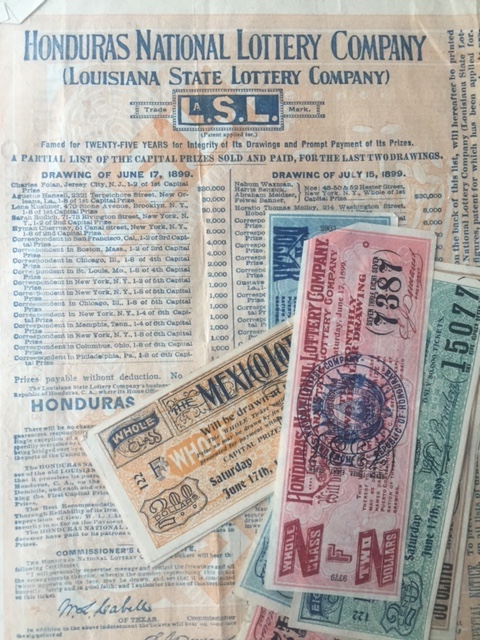
Conrad had one more trick. He relocated the Lottery to Honduras, and started sending pink circulars under the name the Honduras National Lottery Company by express mail, bypassing the post office. “We use the express companies in answering correspondents and sending lists of Prizes to the U.S.A.,” they said. “Reply by Express only.”

But it didn’t work. In 1892, the U.S. Supreme Court upheld the anti-lottery laws and Conrad announced that he would close shop. Wanamaker claimed victory. Morality and sound business practices had prevailed over the rebels. In 1895, green goods were also wiped out in the courts.

Too bad not all of Wanamaker’s schemes ended in victory. He was ridiculed for his most brilliant idea: Free rural delivery. One Republican editor wondered whether Wanamaker also wanted to “have the Government present every farmer with a free telephone and a free telegraph instrument.” Free rural delivery wasn’t enacted until after Wanamaker left office.

The robber baron Jay Gould himself denounced as socialistic Wanamekr’s plan to nationalize the telephone and telegraph systems and run them through the post office. Then it was over: Harrison lost to Grover Cleveland in the 1892 election, making Cleveland the only President to serve two non-consecutive terms. Wanamaker returned to his business, and lived until 1922, despite his youthful fears of consumption.

Chapter 14: The Road To Wellville

DEAR FRIEND: The Rascals, Rogues and Roues Who Made American Junk Mail, Chapter 26: Black Mail

By Ray Schultz

To the untutored, 1940 probably seemed like just another year ending in a zero. The movies Gone with the Wind and The Wizard of Oz were playing around the country. On the radio, one heard Frank Sinatra singing with the Tommy Dorsey band. But some people were not consoled by such entertainment: The Germans were overrunning Europe, the Jews were in peril.

In March 1939, a charitable group called the Committee of Mercy, had sent a direct mail letter to people of good will:

Dear Friend:

The situation of the intellectual Jews who are still living in Germany in a state of misery, humiliation and ill-treatment attains a degree of horror which cannot easily be described in words. They endure it with great courage. They say:

“We do not mind so much for ourselves. We have made the sacrifice of our lives and of our welfare. We let them take our properties, our wealth, our factories, etc……We do not ask any help for ourselves, but for pity’s sake save our children.”

It was an eloquent plea, but the letter went on to offer anti-Semitic readers a way out: WILL YOU HELP? it asked. Or if you do not care to assist the Jews, will you aid the tubercular, and pre-tubercular children in France?

It’s not known how many recipients took either option. Either way, the letter reminded them, without explicitly saying it, that there could be another war.

Soon there was. And Time magazine hammered it home, both on its pages and in its direct mail pieces. This is America’s year, it said in a letter dated Jan. 2, 1940 and signed by Time’s circulation manager Perry Prentice. It continued:

All over Europe the lights are going out. All over Europe the nights are dark with fear.

But here in America the nights are bright with the lights of a thousand factories as America starts back to work after the long depression — bright with the lights of a thousand laboratories whose discoveries may change the course of history and all the ways of our living — bright with the lights of forty-million homes, where Americans are newly confident that they can find and conquer new frontiers in the American way.

 Yes–this is America’s year — so this is the year you need TIME most.”

The letter went on to offer a subscription.

That was soon followed by:

Time has been banned in Germany! 

Banned in Russia! Banned in Italy! Banned in Japan!

But here in America, where men are still free to think and learn the truth — thousands upon thousands of new families are turning to TIME each week to help them make the confusing news and war and peace make sense.

In February, at the height of the Phony War, Time sent a a direct mail piece, saying:

This is the dullest war in history…

FOR PEOPLE WHO DON’T KNOW WHAT IT’S ALL ABOUT!

But it’s a tremendously exciting, moving, portentious war for those who know and understand what is really going on…

 …tremendously exciting for the readers of TIME.

Two months later, with Hitler now on the march, recipients read this stark reminder:

When kingdoms vanish in the night…

  – and nations wake to find the enemy within their gates..

Millions of people snap up each extra as it comes off the press and scan each headline in fear and horror – as puzzled children turn to parents for reassurance and explanation.

The real war had started. And in June, Time reported this

The Nazi Blitzkrieg has swept like a flame —

–over Norway, Denmark, Holland, Belgium, Luxembourg, Northern France.

 In eight short weeks kingdoms and governments have fallen, peoples have been subjugated, the balance of power of the whole world has changed.

 It cannot go on much longer, many experts say — the next hundred days should tell the story.

In September, Time continued on its roll.

Dear American

Ours is the tragic previlege–

     The tragic previlege of living and taking part in the greatest worldwide military crisis since Napoleon, the greatest American election crisis since Lincoln, the greatest economic crisis since Adam Smith.

     And in times like these, when the news is so confusing and so dramatic and so immediately important — no American need be reminded that keeping thoughtfully well-informed is a personal duty.              

Meanwhile, there was a struggle between isolationists like Charles A. Lindbergh, whose comments were tinged with anti-Semitism, and those who felt the U.S. had to help defeat Hitler. Among the latter was Henry Hoke, the 46 year-old Baltimore native and Wharton graduate who had befriended Louis Victor Eytinge. Hoke was ever on the alert for frauds who abused the medium, and he felt he had uncovered just such a group.

The Nazis.

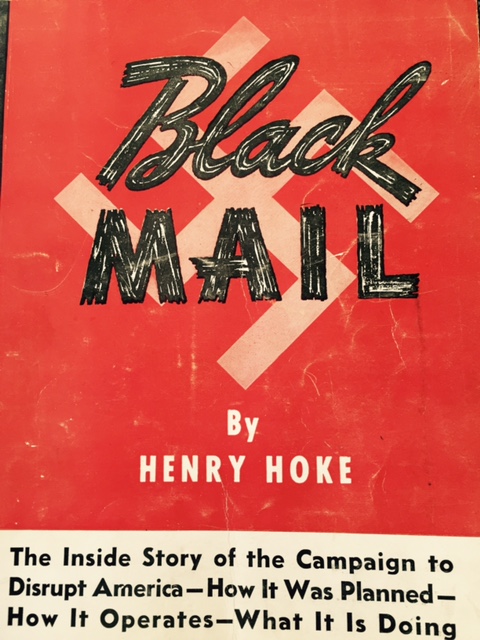
The Germans were using the U.S. mails to spread propaganda, and Hoke, whose son Pete had received pro-German circulars at Wharton, took it on himself to expose them. As he wrote later, in a book titled Black Mail, “the German government, through mail issued by specified agencies to selected lists, was attempting to divide the country so that the United States would be helplessly unprepared for future military attack.”

For instance, “the German Library of Information guided by Matthias F. Schmitz (assisted by George Sylvester Viereck), issued about 90,000 copies of a semi-weekly, well printed and written Facts in Review to ministers, school teachers, editors of college papers, legislators, publishers,” Hoke wrote in May 1940 in his magazine. “Purpose: to sell the National Socialist ideology and to prevent preparedness against attack.”

Then he added that “the German Railroads Information Office, guided by Ernest Schmitz, issued about 40,000 weekly mimeographed bulletins to hotel mangers, travel agencies, stock brokers, bankers and ‘small business men,’” to “convince Americans that the Nazi system of doing business was best.”

Hoke wasn’t done: “The American Fellowship Forum, guided by Friedrich E. Auhagen, assisted by George Sylvester Viereck, Lawrence Dennis, and others, issued pamphlets or bulletins to a ‘cultural class,’—educators, civic leaders, authors and a selected list of persons who might be sold the idea that the German mind was filled with nothing but the milk of human kindness for all humanity.”

It took courage to write that, even for an American tucked safely at home in Garden City, Long Island. E. Schmitz, from the German Railroads Information Office, wrote to demand that Hoke retract these “slanders,” and assured him that if he did, “a waiver will be given, releasing you and your publication from further claim.” Hoke noted that the letter “had been sent to my home…not to my office.”

Hoke published his exchange with Schmitz in a special mailing—“I refuse to be intimidated by you or by any German controlled organization. I refuse to have my family intimidated,” he wrote. And he got more outspoken as he realized the scope of the German operation.

“For the first time, it was possible to show how the Nazis had built a large mailing list (estimated at 250,000) of German Americans with relatives in Germany…how Japanese boats brought hulls full of printed material from Hamburg, Munich, Berlin…how these pieces were delivered under International Postal Union Treaties free of charge by the United States. (Under International Postal Treat, the country of origin retains the postage collected,” he wrote in Black Mail. “The country of delivery delivers free. A wash-out transaction to avoid bookkeeping).”

But the Germans were only part of it. Hoke found that Sen. Burton K. Wheeler, the Montana Democrat who had broken with Roosevelt over his court-packing plan, was sending out isolationist mail under his free Congressional frank. Analyzing the addressing on the envelopes, Hoke traced the pieces to a German group: the Steuben Society, Also sending seemingly pro-Hitler mail, for free, was Rep. Hamilton Fish (R-NY), who in 1938 had met with German Foreign Minister Joachim von Ribbentrop in Europe, and reportedly said that Germany’s demands in Poland were “just,” according to Hoke.

Hoke deplored the anti-Semitism shown by many isolationists. “On April 25, 1941, in Omaha, Nebraska, Charles B Hudson, violently anti-Semitic publisher, admitted to reporters that he had distributed isolationist speeches under the Congress free mailing franks of Senators Worth Clark of Idaho, Bennett Champ Clark of Missouri and Burton K. Wheeler of Montana, and Representatives Oliver of Maine and Bolton of Ohio,” he reported.

Hoke wrote to Wheeler: “Unaddressed franked mail under your signature and under that of former Representative Jacob Thorkelson of Montana, has been distributed by your violent adherent Donald Shea at his anti-Semitic meetings and by Nazi-loving, Jew-baiting Joe McWilliams at Christian Front meetings. Recipients were instructed to address the franked envelopes and dump them into the nearest postal box, without payment of postage.”

Of course, isolationists had a right to circulate their views, although not under franked mail, Hoke argued. Wheeler fought back. “I am not seriously concerned about Mr. Hoke’s misrepresentations,” he wrote in a letter. “In the first place, Mr. Hoke is interested in direct mail advertising, as he himself says, and is opposed to the use of the franking privilege on general principles.”

Wheeler then claimed that “Mr. Hoke makes no reference to the fact that those in Government who apparently favor our intervention in foreign war sent out under various Congressional franks some 2,00,000 pieces of mail all over the United States, much of it distributed by the pro-interventionist committees and organizations.”

Wheeler also falsely wrote that Hoke was employed by the Anti-Defamation League of the B’nai Brith, as if that discredited him. Meanwhile, Hoke reported that the supposedly good name of the Order of the Purple Heart was being used as a cover in the scheme.

Events moved quickly. FDR was elected to an unprecedented third term in November 1940. On June 2, 1941, Hoke wrote, “a friend beside a news ticker called me on the ‘phone to beat the headlines…’Henry, you ought to be glad to know,’ he said, ‘the President of the United States has just issued an executive order closing the German Railroads…the German Library of Information…and the German Consulates.’”

Hoke was pleased, although this crusade had practically wrecked his business. But he kept after the Nazi sympathizers, using the techniques of his trade to undo them. For example, friends wrote flattering letters to the appeasers, using dummy names, and soon received isolationist letters addressed to those names, fueling his investigative reporting. And more was to follow.

“We learned from a girl who worked in a locked and guarded room on the top floor of the Ford Building at N. 1710 Broadway in New York City that Ford Motor Car Company employees were compiling a master list of appeasers, anti-Semites, pro-Nazis and Fascists from fan mail addressed to Colonel Charles A. Lindbergh, to former Senator Rush Holt and to Representative Hamilton Fish,” Hoke wrote.

He added that “the lists, when compiled, were delivered to Bessie Feagin, circulation manager of Scribner’s Commentator. That explained how some of the dummy names used in writing to radio orators eventually got on the list of the American First Committee and Scribner’s Commentator. But why the Ford organization? But why…a lot of things?”

Feagin was eventually hauled before a grand jury, as were many others, including Hamilton Fish. “No one knows what Hamilton Fish told the Grand Jury on December 5, 1941,” Hoke said. “Someone was pulling every possible string to have the case buried.”

Two days passed. Then: “Sunday afternoon, December 7, 1941, just as our little family sat down to dinner…the flash we feared came over the radio…Pearl Harbor!”

Time wasted no time in getting letters out:

Dear American:

And now the news is happening to us!

Its unpredictable turns and changes are altering the whole course of your life — the job you work at, the town you live in, the clothes you wear and the food you eat.

The news is happening to you in the Pacific — and sudden developments in Malaya and the China Sea, at Singapore and off San Francisco, in Tokyo and Manila and the Dutch East Indies can change your life more than you can possibly change it yourself.

The news is happening to you across the Atlantic — where Russia bleeds Germany white, where American tanks fight the Axis in Libya, where Britain waits tense for an attempted invasion – and your life and my life, the safety of our families and the future of our children all wait on tomorrow’s news.

The news is happening to you at home — where new laws and new regulations pour out of Washington – where entire industries are changing over to war production, where uniforms fill the streets and the whole nation moves with a new unity and determination.

Yes, the news is the biggest things in our lives today – stirring and vital and very near us all. And it is very confusing.

And that is why this is the year you need TIME most.

Despite this development, and the collapse of the America First organization, the flow of isolationist mail continued, some letters containing vicious attacks on “the Jews.” George Sylvester Vierick was indicted by the Federal Grand Jury for failure to give a true statement of his activities in registering as a german agent, and held on $15,000 bail. (Nazi agent).

Hoke recorded the scene:

“11:30 P.M. Judge Lawes appears and the courtroom is filled with an air of dignity…and tension. The jury walks in a semi-circle at the side of the bench. Viereck stands before the jury and glares. The clerk reads each count and the foreman answers—‘Guilty’…six times. Vierecks lawyer asks that the jury be polled. Viereck glares at each juror as the question is put six times, an the answer six times is ‘Guilty.’ Seventy-to times Viereck hears his ‘fellow citizens’ say the word ‘Guilty.’ The big marshal standing behind George Sylvester Viereck takes out his handcuffs and the Nazi agent goes out through the back door. Court adjourned.”

It was the last blast for Viereck—and also for junk mail. As they had in World War names disappeared from iists—these men were unreachable. Not that it mattered– there were paper shortages that prevented mail pieces from being printed. And there was nobody to send them, for copywriters and list brokers were now in uniform. Except for the mail sent by charitable fundraisers, like the people who served coffee and donuts to servicemen, the business was on hold.

Chapter 27: The Veteran’s List


How Does A Gentleman Know a Cad?

By Ray Schultz

Ernest Hemingway committed suicide in 1961, and many people believed he had lost it as a writer by that time. First, there had been his 1950 novel, Across the River and Into the Trees. It was savaged by critics as self-parody; only Tennessee Williams thought it was among his poetic best.

Hemingway recovered in 1952 with The Old Man and the Sea, a short novel published to universal acclaim; it won him a Pulitzer and helped him snare the Nobel Prize for Literature. I especially love the scenes in which the boy brings food and coffee to the old man. But a certain revisionism soon crept in. Some critics deplored what they saw as the heavy handed symbolism of the old man carrying the mast of his boat, like Christ carrying his cross. I never bought that academic line. But it was the last book published in Hemingway’s lifetime, and readers wondered what he had been doing.

What he had been doing was working. In 1964, three years after his death, his widow Mary published A Moveable Feast, his memoir about his youthful days in Paris. I first read it at age 19, while working in a Navy photo lab. Here’s how it opens:

Then there was the bad weather. It would come in one day when the fall was over. We would have to shut the windows in the night against the rain and the cold wind would strip the leaves from the trees in the Place Contrescarpe. The leaves lay sodden in the rain and the wind drove the rain against the big green autobus at the terminal and the Café des Amateurs was crowded and the windows misted over from the heat and the smoke inside.

Imagine opening a book with the word “then,” a word Jonathan Franzen says a writer should never use. But who needs Franzen’s advice? A Moveable Feast contained some of the best prose Hemingway ever wrote, on a level with that of his short stories. I read on, enjoying paragraphs like this one, in which he enters a cafe:

It was a pleasant café, warm and clean and friendly, and I hung up my old waterproof on the coat rack to dry and put my worn and weathered felt hat on the tack above the bench and ordered a café au lait. The waiter brought it, and I took out a notebook from the pocket of the coat and a pencil and started to write. I was writing about up in Michigan and since it was a wild, cold, blowing day it was that sort of day in the story. I had already seen the end of fall come through boyhood, youth and young manhood, and in one place you could write about it better than in another. That was called transplanting yourself, I thought, and it could be as necessary with people as with other sorts of growing things. But in the story the boys were drinking and this made me thirsty and I ordered a rum St. James. This tasted wonderful on the cold day and I kept on writing, feeling very well and feeling the good Martinique rum warm me all through my body and my spirit.

Thirty or 40 years before the movie, that section transported me to the fantasy world depicted in Woody Allen’s Midnight in Paris. Obviously, it did the same for Allen and millions of other people.

Then there was this little scene about hunger, which Hemingway believed heightened his perception of the Cezanne paintings in the Louvre. Hemingway had just visited Shakespeare’s bookstore, where he all but admitted he was broke, and was handed a letter from a German publisher, containing 600 francs, a nice piece of change in those days.

Hemingway is angry at himself: You God-damn complainer. You dirty phone saint and martyr, I said to myself. You quit journalism of your own accord.

But now he has money. So, he writes, Hunger is healthy and the pictures do look better when you are hungry. Eating is wonderful too and do you know where you are going to eat right now?

 Lipp’s is where you are going to eat and drink too.

 It was a quick walk to Lipp’s and every place I passed that my stomach noticed as quickly as my eyes or my nose made the walk an added pleasure. There were few people in the brassiere and when I sat down on a bench against the wall with the mirror in back and a table in front and the waiter asked if I wanted beer I asked for a distingue, the big glass mug that held a liter, and for potato salad.

 The beer was very cold and wonderful to drink. The pommes a’ I’huile were firm and marinated and the olive oil delicious. I ground black pepper over the potatoes and moistened the bread in the olive oil. After the first heavy draft of beer I drank and ate very slowly. When the pommes a I’huile were gone I ordered another serving and a cervelas. This was a sausage like a heavy, wide frankfurter split in two and covered with a special mustard sauce.

I share these quotes merely to give you a sample of Hemingway’s writing—I offer no critical commentary. But admit it: Wouldn’t you want to be there?

But let’s get down to cases. This book also has its detractors. Gore Vidal, a writer I admire very much, hated “the spontaneity of his cruelty. The way he treated Fitzgerald, described in A Moveable Feast. The way he condescended to Ford Maddox Ford, one of the best novelists in our language.”

Vidal was right about the cruelty, and he would have known–look at some of the portraits in his own memoir Palimpsest . But those chapters were so funny. And both Ford and Fitzgerald  were fair game- they were world-renowned authors. Consider this exchange between Hemingway and Ford Maddox Ford as they drink at an outdoor table. Ford had just “cut” a man he identified as the writer Belloc. “Did you see me cut him?” he asks in a boastful way. Young Hemingway challenges him about it.

“A gentleman,” Ford explained, “will always cut a cad.”

 I took a quick drink of brandy.

 “Would he cut a bounder?” I asked.

 “It would be impossible for a gentleman to know a bounder.”

 “Then you can only cut someone you have known on terms of equality?” I pursued.

“Naturally.”

“How would you ever meet a cad?”

 “You might not know it, or the fellow could have become a cad.”

 “What is a cad?” I asked. “Isn’t he someone that one has to thrash within an inch of his life?”

 “Not necessarily,” Ford said.

 “Is Ezra (Pound) a gentleman?”

 “Or course not,” Ford said. “He’s an American”

Oh, how delicious.

And Fitzgerald? I revere him as an author, but the man had his tics, and Hemingway captured them. Take this scene, in which the two are traveling in Fitzgerald’s car, which has no roof, from Lyon to Paris, and are drenched in the rain, drinking wine all the way. Fitzgerald is convinced he has caught a fatal congestion, and they check into a hotel, and are dressed in their pajamas in the room while their clothes are being dried. Hemingway is reading a crime serial in a French newspaper.

On this evening in the hotel I was delighted that he was being so calm. I had mixed the lemonade and whisky and given it to him with two aspirins and he had swallowed the aspirins without protest and with admirable calm and was sipping his drink. His eyes were open now and were looking far away. I was reading the crime in the inside of the paper and was quite happy, too happy it seemed.

 “You’re a cold one, aren’t you?” Scott asked and looking a him I saw that I had been wrong in my prescription, if not in my diagnosis and that the whisky was working against us.

 “How do you mean, Scott?”

 “You can sit there and read that dirty French rag of a paper and it doesn’t mean a thing to you that I am dying.”

 “Do you want me to call a doctor?”

 “No. I don’t want a dirty French provincial doctor.”

“What do you want?”

 “I want my temperature taken. Then I want my clothes dried and for us to get on an express train for Paris and to go to the American hospital at Neuilly.”

That doesn’t happen. Fitzgerald who had just published The Great Gatsby, is finally persuaded by Hemingway that he is well (“I’ve always had remarkable recuperative powers”), and they get dressed and go down for dinner, where Scott passes out.

I’m sorry, but I still laugh when I read it.

By today’s standards, one may quibble with the portrait of Gertrude Stein: Hemingway wrote that he broke with her after walking in on an intimate scene between Stein and her partner. It’s a distasteful, stereotypical anecdote, if you will, but I believe there had to be more to it. There was growing professional tension between Stein and Hemingway. And Stein had plenty of nasty things to say about Hemingway, both his writing and masculinity, long before he wrote that account.

Hemingway also ridiculed an apparently gay writer who sat down with him, uninvited, while he was writing in a café. Well, nobody said Hemingway was a saint. Later, if you believe Kenneth Tynan, Hemingway had a friendly encounter with Tennessee Williams at a bar in Key West; they exchanged the names of doctors.

But back to A Moveable Feast. How did the physically declining writer achieve that level of prose? Biographers report that in 1956, when stopping at the Ritz Hotel in Paris, Hemingway was told that a trunk had been found that he’d stored there in 1927. To his delight, it contained his notebooks from that time.

Did Hemingway merely rearrange anecdotes written 30 years earlier that he discovered in the notebooks? Or did he truly write A Moveable Feast? in the 1950s based on information in the notebooks? That’s not clear, but I hope it’s the latter. Either way, he was preparing the book for publication, as he was The Dangerous Summer, on a bullfighting rivalry. Sitting there unpublished, not quite ready in his view, were three full-length books: Islands in the Stream, The Garden of Eden, and True At First Light (later repackaged as Under Kilimanjaro).

What had he been doing, indeed.

So yes, I’m a Hemingway fan. Do I also worship the macho man who reveled in what H.L. Mencken called “the armed pursuit of the lower fauna?” No, I compartmentalize that, just as I plan to compartmentalize the news, just out, that Hemingway signed on as a Soviet spy in the 1940s, although he never gave them anything. One must forgive him. just as one forgives John Dos Passos and James Gould Cozzens for being conservatives—it’s the work that’s important. Even Picasso was a Communist for a time. But who thinks about that when viewing his paintings?

Forget all the Life magazine hoopla. To see what kind of man Hemingway was, one must turn to Nelson Algren. In 1955, five years after he won the first National Book Award for his novel, The Man With The Golden Arm, Algren was in crisis. He was losing his beach house in Gary, Indiana, his passport had been seized because of his support for the Rosenbergs, his brief marriage (his second to the same woman) had ended, he regularly lost money gambling and his confidence as a writer had been shaken. Passing through Miami, he took a steamer to Havana; you didn’t need a passport to go to Cuba then. He called the Hemingways, and Mary Hemingway invited him out to their farm, Finca Vigia. Hemingway had been an early booster of Algren’s work, but they had never met. So Algren visited Hemingway, who was bed-ridden from injuries sustained in his 1953 plane crashes in Africa. To Algren, Hemingway looked more intellectual than he’d imagined. Algren, who had seen Disney’s The African Lion in Miami, insisted on showing the great hunter how big cats stalked prey. They talked about boxing, and Hemingway invited Algren for Christmas dinner the next day. Algren’s biographer, Bettina Drew, notes that Christmas at the Hemingways’ was just where he belonged…knowing he was accepted and respected for his writing, for what he was. The party was significant for Nelson because of the emotional affinity, far deeper than words, stirred by Hemingway.

Algren spent time alone with Hemingway prior to the dinner. Then, he reported, “Hemingway got out of bed painfully. He was fully dressed. There were guests waiting.” Algren recorded this scene in a remarkable 1965 book, titled Notes From A Sea diary: Hemingway All the Way, in which he wrote about his time as a passenger on a tramp steamer in the Pacific, in the form of a diary, and combined that with reflections on Hemingway and a counter attack against Hemingway’s critics. Here’s what he had to say about Hemingway and his guests:

He sat among them gravely serious. He carried an air of tranquility. He didn’t throw a punch at anybody. He didn’t stagger. He didn’t brag. He listened, perceived, and he liked having company. What he brought to a table of many guests was the feeling that everyone understood one another. I remember hearing Spanish spoken, and French, and of understanding not a word of what was said: and of knowing, when I spoke English, that some of the guests didn’t understand me. But because of Hemingway’s presence everything seemed understood.

His beautiful and moving writing aside, that’s how I think of Ernest Hemingway.

The Fuehrer’s Database

By Ray Schultz

Twitter received kudos this month when it said it would not assist in the creation of a Muslim registry. Of the nine companies queried, it was the only one to give a definite “no.”

Good for Twitter. But it made me wonder: Did a country ever use information technology to identify people by religion?

Sure it did. The Nazis utilized a metal punch-card sorting system to find Jews and send them to their deaths, Edwin Black writes in his 2001 book, IBM and the Holocaust.

In essence, the equipment leased to the Nazis by IBM’s German subsidiary, Deutsche Hollerith Maschinen Gesellschaft (or Dehomag), was a state-of-the-art mailing list system for that time.

With Dehomag’s help, the Nazis conducted a census, asking pointed questions about religion and ancestry, Black alleges.

“What emerged,” Black continues, “was a profession-by-profession, city-by-city, and indeed a block-by-clock revelation of the Jewish presence.” Moreover, by cross-sorting the columns, the Nazis could “identify who among the Jews would be its first targets for confiscation, arrest, imprisonment, and ultimately expulsion.”

Another effort occurred a few years later when Germany was about to launch the war; they even went through old church records to find Jews whose families had converted to Christianity generations before.

Later, the punch-cards were used to code the demises of the victims, and record which ones had received “special handling” (usually, extermination in a gas chamber), Black claims.

“All Auschwitz name information, including workers still alive, deaths, and transferees, was continuously punched into the camp’s Hollerith system,” Black charges. “Tabulated totals were wired each day to the SS Economics Administration and other offices in Berlin to process cards and lists for each inmate transferred.”

It’s not clear how much guilt is shared by IBM/Demohag. But one thing is certain: Technology can result in monstrous ends, especially when misused by states in partnership with the private sector.

Ivanka Live

By Ray Schultz

Ah, memories. Did you know that Ivanka Trump, the daughter of our next President, once spoke at a direct marketing event?

It happened on June 16, 2009 at DM Days in New York. And I covered it. Not that it was a big story—I can’t remember where, or even if, it was published. But it might be of some slight historical interest. So here’s my report, with not a word changed, not even the archaic term “DMer.”

Lessons From Ivanka Trump

With all respect, why do beleaguered DMers need lessons in living from 27 year-old Ivanka Trump?

It’s not that we disagree with any of the tips she offered this morning on how to succeed. But she’s Donald Trump’s daughter. What can she possibly know about adversity?

Granted, she’s been around enough self-made people to know what it takes (not that her dad qualifies). And she argued that it’s not easy being a Trump. “Much is given, much is expected,” she said.

She did make one pertinent observation about the downturn: “The last 18 months are the best education I’ve had to date, better than Wharton and operating in the hottest real estate marketing anyone’s seen.”

We’re still not sure why her real estate job in the Trump empire qualifies her as a speaker at DM Days. But here are some of her prescriptions:

  1. Make sure you love what you’re doing. 
  2. Be resilient. Ivanka has seen many successful people become despondent during the downturn, “unable to get out of their own way.
  3. Don’t be afraid to make cold calls.

We’d suggest that she collect these nostrums into a book. But she probably already has.


The Right Stuff: Remembering Tom Foster

By Ray Schultz

When asked how he was doing on March 19, 1996, Tom Foster answered, “Well, I’m still here.”

The comment had double meaning. Foster & Gallagher, his $350 million catalog company, was indeed alive at a time when Spencer Gifts and other mail order houses started in the years after World War II had long since gone out of business.

On the personal side, the remark was typical of his sense of humor, for Foster was nearing the end of a battle with cancer. When he died that July, at age 66, the world lost one of the last of the mail order legends—the self-made people who started small and built themselves up through grit, street-smarts and not a little luck.

Foster grew up in Peoria, IL, where his grandfather had owned a drugstore dating back to 1900. Expected to help out, he often went along on buying trips to the Merchandise Mart in Chicago, gaining “a slight understanding of the Chicago wholesale marketplace.”

That understanding was to serve him well after he was kicked out of the University of Arizona for failure to attend class. (He later received his bachelor’s and master’s degrees from Bradley University in Peoria.) Determined to prove himself and make it up to his family, he started a small mail order business in 1949 at age 20.

Why mail order? Foster had seen an article in Collier’s magazine on mail order start-ups like Green Gables Gifts, the brainchild of returning World War II vet Alex Green. “I’ll never forget it—there was a picture of a U.S. postal bag dumping mail out on a table,” Foster said.

Another source of inspiration was the mail order ad section in the back of Esquire (which Foster regularly bought so he could look at the Vargas girls). “They’d advertise things I had seen in the wholesale market in Chicago,” he said.

So Foster started not with a catalog, but with a tiny ad in Esquire in September 1949. The product: A four-inch, “bronze-looking” golf bag made in Providence, the center of manufacture for cheap jewelry and metal castings. “When you pressed on the putter, the top flipped back, and it was a cigarette lighter.” It sold, and that fall Foster earned $2,000 in profits on $12,000 in sales.

That was just the beginning. Soon, he was offering a variety of gifts and tcotchkes in various national magazines, all chosen in the belief that “you better get a goddamned product people will want to buy that you can make a buck on or you won’t stay in business.”

Despite his lack of formal training in mail order, Foster had an instinctive feel for what to do. He put his mailing list on the market in 1951, using Ed Proctor of Guild Co., though he never came to depend on the revenue.

He also took measures to protect and develop the business. In 1951, realizing that he would probably be drafted for the military, he formed a partnership with Helen Gallagher, a former department store buyer who owned a gift shop in Peoria. Gallagher and her husband Frank, both in their mid-40s at the time, ran the business while Foster did a two-year hitch in the Air Force.

The great years began upon his return in 1954. The first success was Naughty Angels, a set of ceramic cherubs in see-no-evil, hear-no-evil poses. Foster found the product, made in Japan, Helen named it, and within 18 months, they sold 250,000 sets at $1.50 apiece.

They did $1 million in sales for the first time that year. They also mailed their first catalog—“four-color on one side of the press, black-and-white and maybe two-color on the other side.” The economics were right. “When I started, the postage rate was $10 per thousand,” Foster explained. “The next year, it went up to $15. We always thought of a catalog as costing a nickel, including the paper, ink, postage and the list.”

A year later, they made the first of several acquisitions—the now-bankrupt Green Gable Gifts, which had been featured in Colliers.

There followed several very successful years, and in 1965 they sold to Stanley Home Products. Gallagher retired, but Foster repurchased the business and in 1972 made his most important acquisition—bulb cataloger Breck’s.

This marked the start of a strategic shift. Though Foster & Gallagher was doing $80 million a year in gift sales by 1980, Foster repositioned it and eventually bought at least 10 horticultural catalogs, including spring Hill Nurseries, Stark Bros. and Michigan bulb, often getting “the real estate that went with it so that we grew the product.”

Why change? Foster saw earlier than most gift catalogers that prices and lead times were being jacked up for foreign merchandise, and that the business was becoming untenable. He also turned Foster & Gallagher into an employee-owned company.

When we talked that March, Foster was full of recollections of the business and the people in it, including Lillian Vernon, one of the few people still in business (“A good friend, and without peer) and Ed Proctor (Talk about green eyeshades and arm garters– there were old wooden filing cases and bare light bulbs hanging from the ceiling”).

Then there were the competitors who didn’t make it—“people who used up their inheritance on their kitchen table and then it was over with.”

Had Foster made any mistakes?

“Life is filled with mistakes,” he said. “but we live on the law of averages. You can live on 49%.”

Scoundrels, Demagogues and Boobs

By Ray Schultz

You want politically incorrect? Try H.L. Mencken. I turned to the Sage of Baltimore to get perspective on the election, and he made me laugh, as always. So there is reason to live. Granted, things have changed in this country since his time, but it all sounds strangely familiar. What were Mencken’s politics? He hated everyone. Here was the man who called the New Deal “a milch cow with 125 million teats.” Yet the proud libertarian also despised fundamentalist Christians. If your group or state is skewered here, I can only repeat what a Republican told a Liberal the other day: “Toughen up.”

Nothing could have been further from the intent of Washington, Hamilton and even Jefferson than that the official doctrines of the nation in the year 1922, should be identical with the nonsense heard in the Chautauqua, from the evangelical pulpit, and on the stump. But Jackson and his merry men broke through the barbed wires thus so carefully strung, and ever since 1825 vox poluli has been the true voice of the nation. Today there is no longer any question of statesmanship, in any real sense, in our politics. The only way to success in American public life lies in flattering and kowtowing to the mob. A candidate for office, even the highest, must either adopt its current manias en bloc, or convince it hypocritically that he has done so, while cherishing reservations in petto. The result is that only two sorts of men stand any chance whatever of getting into actual control of affairs—first, glorified mob-men who genuinely believe what the mob believes, and secondly, shrewd fellows who are willing to make any sacrifice of conviction and self-respect in order to hold their jobs. One finds perfect examples of the first class in Jackson and (William Jennings) Bryan. One finds hundreds of specimens of the second among the politicians who got themselves so affectingly converted to Prohibition, and who voted and blubbered for it with flasks in their pockets.” (On Being An American, 1922)

***

On the steppes, Methodism has got itself all the estate and dignity of a state religion; it becomes a criminal offense to teach any doctrine in contempt of it. No civilized man, to be sure, is yet actually in jail for the crime; civilized men simply keep out of such bleak parking spaces for human Fords, as they keep out of Congress and Franz Josef Land. But the long arm of the Wesleyan revelation now begins to stretch forth toward Nineveh. The mountebank, Bryan, after years of preying upon the rustics on the promise that he would show them how to loot the cities, now reverses his collar and proposes to lead them in a jehad against what remains of American intelligence, already beleaguered in a few walled towns.

Not much gift for Vision is needed to imagine the main outlines of the ensuing Kultur. The city man, as now, will bear nine-tenths of the tax burden; the rural total immersionist will make all the laws. With Genesis firmly lodged in the Testament of the Fathers he will be ten times as potent as he is now and a hundred times as assiduous. No constitutional impediment will remain to cripple his moral fancy. The Wesleyan code of Kansas and Mississippi, Vermont and Minnesota will be forced upon all of us by the full military and naval might of the United States. Civilization will gradually become felonious everywhere in the Republic, as it already is in Arkansas. (The Husbandman, 1931)

***

Virginians, even the worst of them, show the effects of a great tradition. They hold themselves above other Southerners, and with sound pretension. If one turns to such a commonwealth as Georgia, the picture becomes far darker. There the liberated lower orders of whites have borrowed the worst commercial bounderism of the Yankee and superimposed it upon a culture that, at bottom, is but little removed from savagery. Georgia is at once the home of the cotton-mill sweater, of the Methodist parson turned Savonarola and of the lynching bee. A self-respecting European, going there to live, would not only find intellectual stimulation utterly lacking, he would actually feel a certain insecurity, as if the scene were the Balkans or the China Coast. (The Sahara of the Bozart, 1917).

***

At each election we vote in a new set of politicians, insanely assuming that they are better than the set turned out. And at each election we are, as they say in the Motherland, done in.

Of late the fraud has become so gross that the plain people begin to show a great restlessness under it. Like animals in a cage, they trot from one corner to another, endlessly seeking a way out. If the Democrats win one year, it is a pretty sure sign that they will lose the next year. State after state becomes doubtful, pivotal, skittish, even the solid South begins to break. (The Politician, 1924)

***

(The average American’s) docility and pusillanimity may be overestimated, and sometimes I think that they are overestimated by his present masters. They assume that there is absolutely no limit to his capacity for being put on and knocked about—that he will submit to any invasion of his freedom and dignity, however outrageous, so long as it is depicted in melodious terms. He permitted the late war to be “sold” to him by the methods of the grind-shop auctioneer. He submitted to conscription without any of the resistance shown by his brother democrats of Canada and Australia. He got no further than academic protests against the brutal usage he had to face in the army. He came home and found Prohibition foisted on him, and contented himself with a few feeble objurgations. He is a pliant slave of capitalism, and ever ready to help put down fellow-slaves who venture to revolt. But this very weakness, this very credulity and poverty of spirit, on some easily conceivable tomorrow, may convert him into a rebel of a peculiarly insane kind, and so beset the Republic from within with difficulties quite as formidable as those which threaten to afflict it from without.

What Mr. James N. Wood calls the corsair of democracy–that is, the professional mob-master, the merchant of delusions, the pumper-up of popular fears and rages–is still content to work for capitalism, and capitalism knows how to reward him to his taste. He is the eloquent statesman, the patriotic editor, the fount of inspiration, the prancing milch-cow of optimism. He becomes public leader, Governor, Senator, President. He is Billy Sunday, Cyrus K. Curtis, Dr. Frank Crane, Charles H. Hughes, Taft, Wilson, Cal Coolidge, General Wood, Harding. His, perhaps, is the best of trades under democracy–but it has its temptations! Let us try to picture a master corsair, thoroughly adept at pulling the mob nose, who suddenly bethought himself of that Pepin the Short who found himself mayor of the palace and made himself King of the Franks. There were lightnings along that horizon in the days of Roosevelt; there were thunder growls when Bryan emerged from the Nebraska steppes. One some great day of fate, as yet unrevealed by the gods, such a professor of the central democratic science may throw off his employers and set up a business for himself. When that day comes there will be plenty of excuse for black type on the front pages of the newspapers. (On Being an American, 1922).

***

Most of the rewards of the Presidency, in these days, have come to be very trashy. The President continues, of course, to be an eminent man, but only in the sense that Jack Dempsey, Lindbergh, Babe Ruth and Henry Ford have been eminent men.

The honors that are heaped upon a President are seldom of a kind to impress and content a civilized man. People send him turkeys, opossums, pieces of wood from the Constitution, goldfish, carved peach kernels, models of the state capitols of Wyoming and Arkansas, and pressed flowers from the Holy Land. Once a year some hunter in Montana or Idaho sends him 20 pounds of bear-steak, usually collect. It arrives in a high state, and has to be fed to the White House dog. (The Imperial Purple, 1931)

Riding the Rails

By Ray Schultz

Spare me your three-word tweets: I yearn for the day when publishers sent four-page direct mail letters. They were worth reading whether you responded or not.

Take this stirring note written by the copywriter Frank Johnson. It’s for a book on railroads offered by American Heritage magazine.

The letter is dated Dec. 30, 1974, but readers probably didn’t get it until the calendar year 1975. If I’m reading it correctly, in fact, the book wasn’t available until that summer.

Hmnn, I wonder if the volume was even written when the letter went out: The single-spaced missive almost serves as an outline or proposal. Did American Heritage plan to go forward only when it had sufficient orders? (Hardly an uncommon practice in those days).

It’s hard to know now. In Frank Johnson’s files, the piece is identified only as RR letter – final, 11/13. And there’s no information on response. But one thing’s for sure: This letter is a richly enjoyable piece of Americana. And it could only have been written by someone who grew up in Ohio, listening to those railroad whistles. Here’s Frank Johnson at his absolute best.

 December 30, 1974

If you’re old enough and lucky enough, you can remember lying in bed as a child and hearing, far off, the whistle of a steam locomotive as it pounded through the night. The wail was hoarse, mournful, inimitable. And once upon a time it was a siren song for any youngster.

You could imagine the engineer, red bandana around his neck, eyes riveted on the gleaming rails ahead, wind-blown and ruddy in the glow from the open fire door. You envied – oh, how you envied – the impossibly glamorous travelers in the spruce train behind, eating five-course feasts in the spotless dining car, ice tinkling in their wine buckets. Or snug in their berths behind swaying green curtains in the long Pullmans, each car lettered with its name. “Someday,” you told yourself, “”Someday ….” It was magic.

Someday, lackaday. Such high-style overland travel is almost gone, as someone has said, with the wind. But as all of us who remember can tell all of us who were a bit too young, railroads were once magic carpets for Americans. The miraculous iron horse changed our modes of life more radically than any mechanical device before or since, from steel plows to airplanes.

Railroads are obviously an important part of the American experience That’s one reason why our editors are now at work on a first-rate, expertly written and illustrated history of the subject.

But I’m inviting you to look at the completed book for ore reasons than its “importance.” As you already now a proper history of railroads is bound to include invention, skullduggery, wild economics, outrageous politics, dashing adventures, and a motley cast of characters. A great history of American railroads, I think you’ll agree, should also include a touch of the magic you – or your parents, and theirs – once felt.

And that touch will be evident in our forthcoming AMERICAN HERITAGE HISTORY OF RAILROADS IN AMERICA. Here I’d like to tell you about the book, make some heady claims, and offer to prove them by sending you a copy late this summer, on approval, and at a good bargain.

To get the magic as well as the facts of that important, colorful story into one illustrated book calls for someone who has an intimate knowledge of America’s history, and more than a bit of railroading experience. Ideally, this historian should also have ready access to the archives of railroad pictures and art; and the ability to write with precision, economy, and wit.

Not by happenstance, our author with all those qualifications built in is Oliver Jensen. For two decades he has been the editor of the world’s biggest and best-known history magazine, American Heritage. All his life he has been railroad buff. And he founded and is chairman of the Valley Railroad of Essex, Connecticut. It features antique steam engines and restored wooden coaches.

He starts with the achievement of the wonderful 19th-century “locomotive engine”: For the first time, you could move across the land without using leg power of some sort! That thought simply hadn’t occurred to right-thinking people since the world began. Even the idea of an “engine” was new in 1830, when The Best Friend of Charleston, the first practical U.S-built locomotive, began to haul goods and people. (So new that six months later, The Best Friend’s unsuspecting fireman, annoyed by the hissing safety valve, sat on it to gain a few quiet moments … his and the boiler’s last.)

But wonder turned to love, and to avarice, in short order “Railroad fever” brought a mania for wildcat railroad enterprises … and a push of rails to the new western states. “West” in the 1830’s an ‘40’s meant Ohio Indiana, Illinois. And access to their rich lands quickly emptied New England’s hardscrabble farms of ambitious young men, and built the first railroad city: Chicago.

Early on, you’ll come across familiar names in new roles. For example, that foxy young railroad lawyer, Abraham Lincoln of the Illinois Central; U.S. Secretary of War Jefferson Davis, espousing the virtues of a southern route for the projected transcontinental railroad; Peter Cooper, racing a horse with his Tom Thumb engine; John Quincy Adams, escaping injury in the firs train wreck; and Andrew Carnegie as a young train dispatcher.

A B.&O. train was stopped by John Brown’s men during the bloody raid at Harpers Ferry. Once released, the conductor wired the first news of Brown’s threatened rail blockade – and U.S. Marines were rushed to the rescue, by train. From the Civil War on, railroads were to be part and parcel of all military strategies.

But not even war could stop the drive west. Lincoln signed the Pacific Railroad Act on July 1, 1862, chartering two companies to complete the first Atlantic-to-Pacific rail link. “The Great Highway of Nations between OCCIDENT and ORIENT,” as the ads had it, was completed just seven years later. What rousing stories there are to tell about railroading in the 1860’s: The stolen “General” and the great locomotive chase, Promontory Point and the golden spike, the real emergency that tested the first air brake ….

RAILROADS IN AMERICA will put you on scene at these historic occasions, with fine reproductions of wartime Brady and Gardner photos; with paintings and sketches made by artists who followed the Irish and Chinese track layers into the Rockies; with a moving picture essay of Lincoln’s funeral train; with enticing posters (“83 hours, coast to coast!”), and photos of spidery trestles and tangled wrecks.

The whole saga of our railroads is one of the most picturesque – and best-pictured – in America’s history. So the 300-and-more carefully chosen illustrations in the book are remarkably evocative windows to the past.

You’ll see how the notorious railroad robber barons o the late 19th century were often viciously lampooned by press cartoonists. And you can understand why they were so cordially hated: Among other tyrannies, U.S .cavalrymen were used to break a strike that had been called because the Pullman Company cut its workers’ wages, but not the rents fro the Pullman-owned tenements. There were reasons aplenty by the turn of the century for America’s biggest business to become our most stringently regulated one as well.

But of course railroads were also an economic force that simply coined capital, built cities, populated our plains, made a national market, and cud take you anywhere in the U.S.A. – Key West, Death Valley, Pike’s Peak – in posh style. So by and large, although there was plenty to complain about, there was more to love America’s passion for railroads continued well into the 1930’s.

A chapter looks at the great “name” trains, such as The 20thCentury Limited, The Overland Limited, The Santa Fe Chief – and the music and literature and art they inspired. Another shows you the workmen: the lordly engineer; the fireman, with his giraffe-necked oil can; the busy conductor, turnip watch in hand; the lantern-swinging brakemen; the sledge-hammering trackmen, called gandy dancers ….

Then a couple of spectacular chapters lead you through the crowded bell-echoing palaces we once had for depots, up the long red carpets, and aboard sinfully luxurious cars – with pump organs to sing around, plush an inlaid-rosewood décor barbers, shoe shines, and blue stories in the men’s lounges, already blue with the smoke of fine havanas. And the dining cars, the menus, the service! Wait till you see these pictures.

An 1870’s guidebook advised the rail traveler to “sit and read, play games, and indulge in social conversation and glee.” And so we did. But the “glee,” and the boarding stocks, and the dragon-like locomotives that grew from big to huge to gargantuan – such excitements, obscured some problems. By World War I, seven major “combinations” controlled the country’s key rail systems. Like their steam engines, they were massive, impressive, and doomed.

World War II gave the monsters a brief, busy respite from the attacks of the subsidized competition and the dry rot of rigid managements and archaic laws and too-soft featherbeds for labor. Then came the years of “last trips” and abandonments, of rust and recrimination and nostalgia. The pictures here are exceptional.

And the last chapter, if not a “happy” ending, is a most hopeful one for all of us who wish this once-lovely way to go would get going again. What’s the most fuel-efficient, prettiest device for moving tons of goods and crowds of people across the U.S.A.?

Listen for that whistle. It’s beginning to sound again.

Meanwhile, I can promise you a wonderful trip through history with THE AMERICAN HERITAGE HISTORY OF RAILROADS IN AMERICA. To see an early copy of the $27.50-retail book, with an option on the lowest price we can offer, $19.95, return the enclosed form promptly. There’s also a most elegant, and slipcased, de luxe edition. See the form.

Of course we’ll guarantee the special price, regardless of inflation; and the book is fully returnable if it doesn’t whistle your tune.* But I’m sure it will. And thank you!

Sincerely,

Paul Gottlieb

President

*Speaking of steam whistles and tunes. SONGS AND SOUNDS OF THE GREAT DAYS OF STEAM is both title and description of a rousing stereo record we’ll have available for buyers of the book. The enclosed folder describes it.


Calling Western Union

By Ray Schultz

Direct mailers have often tried and failed to find alternative delivery systems. But they were offered one in the early 20th century by a trusted brand name.

“The Western Union Telegraph Company has a complete messenger service for delivering telegrams,” manager J.A. Rudd told Printers’ Ink magazine in an interview published on Sept. 30, 1903.

That said, Rudd announced that this service had been expanded to include advertising matter. It would cover “more than 30,000 cities, towns and villages in every part of the United States.”

As Rudd explained, two developments drove this move. First, the company realized that its messengers had too much time on their hands.

“They came to the offices at eight in the morning, uniformed and ready for work, but the rush did not begin until eleven o’clock, and at three it was over,” Rudd said. “This left five or six hours of time during which they were unoccupied.”

Second was the fact that the Post Office had excluded some publications from second-class privileges.

“The express companies could not handle mail matter, and many publishers were at a loss for methods of distributing their periodicals,” Rudd explained.

So Western Union stepped into the breach, delivering samples, advertising literature, catalogs and “any other matter that we could profitably handle,” Rudd said. “Our service is not based on weight, like that of the Post Office, but on individual deliveries, and we are able to distribute small packages at rates far below those of the express companies.”

Case in point: “A publication weighing one pound, which is the minimum weight of most monthly magazines and trade journals,” Rudd said. “The government carries such a publication for one cent at second-class rates, or eight cents third-class. We deliver it for one cent, and get a signed receipt in each case. The latter is turned into the publisher.”

Rudd continued that, “for a publication weighing five pounds we charge four cents, saving a penny on second-class rates, and thirty-five cents on third-class, under which catalogues are mailed.”

And samples? One patent medicine seller “had a remedy which he was sending by mail, selling it at twenty-five cents,” Rudd said. “Postage came to twelve cents, eating up his profit. Consignments of this remedy were shipped to our distributing centres, and when the manufacturer received an order a bottle was delivered and twenty-five cents collected form the addressee. This service cost five cents, including return of money and receipt.”

Thanks to clients like this one, there was so much work that “we are now putting on boys who work wholly at delivering,” Rudd added.

Western Union even offered mailing lists. “We have made no attempt to furnish addresses to our customers, but our books contain thousands of cable addresses, and we also have lists of wholesale and retail houses throughout the country,” Rudd stated. “These lists, under certain conditions, are accessible to responsible customers.”

It’s not clear how long this service lasted. But there was one false note in Rudd’s presentation.

“There are thousands of people right here in New York who have never received a telegram, and delivery by telegraph messenger is an event,” Rudd said.

That’s a little dubious. As I recall, a telegram was a frightening thing for an average person to get—it usually meant a death in the family.