DEAR FRIEND: The Rascals, Rogues and Roues Who Made American Junk Mail, Chapter 10: Green Goods

By Ray Schultz

In 1875, in a article titled, “Fancy Advertising,” the New York Times reported a man whose letter and Post Office boxes were “daily ‘made the recipients’… of a lot of envelopes, which he is put to the trouble of opening, and which he finds contain only advertisements of articles that he does not want to buy, or of companies or professional persons that he does not wish to employ.”

Some of these doubtless came from the City Novelty Co. of Philadelphia, established in 1860. At the height of the Depression in 1873, it mailed a brochure in a hand-written envelope. “The Crisis that has so suddenly burst upon the Country and so rapidly extended to every branch of Business, has particularly affected manufacturers of Jewlery, and we find ourselves carrying a very etxensive stock of FINE GOODS for LADIES’ AND GENTLEMEN’S WEAR, And have determined to dispose of our Stock on the following plan, which is PERFECTLY LEGITIMATE, AND NOT A LOTTERY.”

And the plan? “We do not sell any tickets to tell you what article you can have for a dollar, but we sell you a box of very extra quality of Writing Pens, twenty-four in a box, for twenty-five cents, and warrant them to give entire satisfaction; will not corrode—and are adapted to any hand that can hold a pen. In this box we put a sealed envelope, that has in it a slip of paper with some one of the above articles named on it, which you can have if you desire it, by paying one dollar.

“We also sell the Ladies’ Casket for fifty cents, which contains the following articles, (whih are worth separately at retail $1.15) viz: four papers (100) of Cole’s Celebrated Duplex Silver Spring Steel Needles, Nos. 5 to 10, (Sharps); one Patent Button-Hole Cutter, twelve Yosemite Pens, one Silver Plated Pen Holder. The Casket opens like a book, with gold edges and clasp. In this Casket you will find two envelopes, each contaning a slip of paper, naming some article in this list which you can have, if you desire it, upon paying one dollar.”

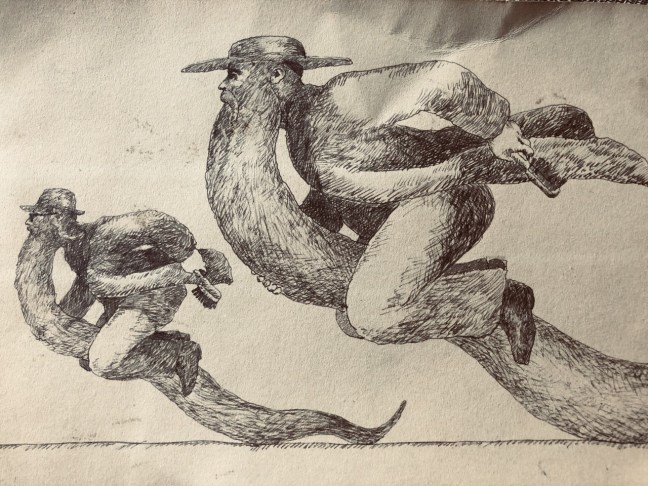
Anthony Comstock had overlooked the City Novelty Company, but there were bigger bigger frauds being perpetrated. One was the so-called Green Goods scam. Having divined that most people were as dishonest as they were, rogues like Ed Parmalee and Tony Martin prospered by sending letters like this one:

“Dear Sir: — If you have no conscientious scruples regarding how men get money, I write to say that I am in a position to supply you with an ‘article’ that — for commercial purposes — is as good as gold.”

If the reader was too dense to grasp what he was being offered, the attached clipping, looking like it came right out of a New York newspaper, would set him straight:

“A COUNTERFEITER GOES FREE”

“The country flooded with $2,000,000,000 of counterfeit money in the past year, and pronounced by Government experts to be as good as the genuine greenback.”

Yes, counterfeit money. Most people got little mail of any kind, let alone letters from a stranger inviting them to commit a crime, but the note stated a truth obvious to many in that age of robber barons: “People are growing rich around you every day (no one knows why), why not you?

Another wrote, “My Dear Sir: I am desirous of obtaining a good shrewd agent in your locality to handle my ‘goods.’ If you have been unsuccessful in your business, I can supply you with goods with which you can pay off all your debts and start free and clear again. You can purchase mortgages, etc.”

Of course, most green-goods operators apologized for the intrusion. One said, “This communication may be somewhat startling or probably unwelcome. If so, I trust you will be good enough to destroy the same as no harm or insult is intended.”

The actual sale took place in two stages. If he responded, the would-be millionaire would be sent a free sample — usually a genuine $1 bill. After examining and spending it, he would send a sum of money for 10 times that amount in counterfeit notes (there was a sliding scale through which the customer received a better percentage the more he paid). On the happy day that his order arrived C.O.D., he would open the box to find not the greenbacks he had ordered, but sawdust or green paper.

Few victims griped because they feared “the odium that is attached to their being willing to be a party to purchasing and putting into circulation counterfeit money,” according to the Pinkerton Detective Agency. And they needn’t have expected any sympathy from Comstock. “Any person who sends money for counterfeit money should lose every cent of it,” he wrote.

Some green-goods artists ran industrial-strength enterprises (one group had free run of Jersey City city hall). Others operated out of saloons on Hudson Street in New York City, many of which had private mail boxes. They would come in for a beer and the mail, and quietly slip out if they saw anyone asking questions.

As for printing, some lottery men used processes that allowed them to mimic handwriting or typewriting. In 1883, a tip led Comstock to the back room of Eugene Marvin’s print shop on Eighth Ave., where he found two big cylinder presses, cutting and numbering machines, 875,000 green-goods circulars and phony Western Union telegraph blanks.

In 1890, Congress passed a law making it illegal not only to offer green goods by mail, but also to order them. (Ditto for “green articles,” “green coin,” “United States goods” and “green cigars”.) So the perpetrators returned to the practice they’d followed earlier: Conducting the swindle in person.

Invited to New York or to a smaller town (after the initial direct mail letter, all communications would be by telegraph), the mark would be plied with food and liquor by his hosts, and the party would retire to a hotel room to finalize the deal. Then one of two things would happen. In the first, men posing as police would barge in and threaten to arrest everyone for counterfeiting; the only way out would be for the one man with actual legal tender in his pocket to bribe the officers. In the second, the swindlers would switch a suitcase filled with cash for one containing sawdust. As one writer put it, the victim would find himself alone in the room, his money gone, the idea slowly dawning on him of just what a fool he had been.

Occasionally, this would backfire. Tony Martin, known as the Prince of Green-Goods Men, was shot to death by an outraged rube from whom he had euchred $650. Comstock attended the funeral, hoping to catch Martin’s Comstock. Failing that, he used the occasion to denounce the dead man to a reporter. “The woman he lived with was another man’s wife,” he said. “And he was a confirmed opium fiend.”
Chapter 11: The Crooked Road To The End

DEAR FRIEND: The Rascals, Rogues and Roues Who Made American Junk Mail, Chapter 6: The Postmaster

By Ray Schultz

The U.S. Post Office was then headquartered in a two-story building near the War Department in Washington. Opened during the Franklin Pierce administration, the structure was finished with white marble from Maryland and New York, none of which stopped the roof from leaking. Into this setting in 1861 came Montgomery Blair.

Abraham Lincoln had become President in March of that year. In May, partly to pay off a political debt, he appointed Blair, a border-state moderate whose family had a house across the street from the White House and another in Maryland, as postmaster general.

A former U.S. attorney who represented the fugitive slave Dred Scott, Blair was reviled by radical Republicans for his moderation on the slavery issue. To add to his woes, his house in Maryland was burned down by the Confederates led by General Jubal A.Early.. But Lincoln wrote of his service as postmaster that “I remember no single complaint against with you in connection therewith.”

Blair’s first problem was getting the mail to its destination. The dying words of a wounded Pony Express rider—“Get out of the way—of the—United—States—mail,” in no way implied certainty of delivery. In many areas, service was only nominally better that it was in Franklin’s time, when the main conveyance was the horse. Some rural towns got no mail at all during high water.

Things were worse out west. Jefferson Davis, the secretary of War for Franklin Pierce, had tested camels in the Southwest, but they proved unsuitable, being used to the soft desert sand of the Middle East, not the hard-scrabble ground in the West. All this bred a certain cynicism: Mark Twain expected the stage driver taking him to Utah to “unload the most of our mail matter somewhere on the Plains and leave it to the Indians or whosoever wanted it.”

In 1862, largely thanks to Blair, the post office started operating mail cars on the growing national railroad system. Crews of men, “eyeshaded gnomes in shirt sleeves,” stood on their feet overnight, sorting mail by destination and dropping it into pouches.

One year later, mailmen started delivering to the door in the 49 largest cities. “Little can I tell how my life has been interwoven with those to whom I have carried mail,” said Morris Church, of Worchester, Mass. when he retired decades later. “Their joys and sorrows have taken a deep hold upon my life.”

And in November 1864, the post office started selling money orders so that families could send money to soldiers at the front without fear of theft. (Registered letters had been around since 1855, but the New York Times had argued that the system facilitated “fraud on the part of Post office officials, by pointing out the letters which contain money.”)

Finally, postage was now affordable. Advance payment had been mandatory since 1855, but Congress now sweetened it by lowering the rates and dividing mail into three classes: First class (regular letter mail); second class (periodicals); and third class (circulars).

The lottery men noted all this. And by the time Blair, who had offered to resign when it suited the President, was told by Lincoln, “The time has come,” they were taking full advantage of it.

Chapter 7: Ode To A Crook

DEAR FRIEND: The Rascals, Rogues and Roues Who Made American Junk Mail, Chapter 5: Show The Money

By Ray Schultz

William France was a “common drunk” who rigged a lottery so that he won the grand prize himself. When he used the name of a competitor, Murray, Eddy & Co., on some of his envelopes, that firm complained that it was “being daily robbed by a man who, at the same time, swindles the public and makes the Post Office Department the innocent accomplice of his guilt.”

Murray, Eddy & Co. wasn’t any better. Its main offering, the Kentucky Lottery, had been chartered in 1838 to improve the water supply in Frankfurt, Kentucky—a project long since completed.

France and others like him invented devices that would later become standard in the trade. In 1861, Schoofield & Co., of Baltimore, sent a mailing for the Delaware State Lotteries. It went in a small brown envelope with Schoolfield’s name and post office box stamped on it—one of the first return envelopes. The note that went with it implied that a prize was a sure thing.

“Dear Sir: From what we can learn of Public Sentiment we are satisfied that there exists a strong feeling against Lotteries in Your State – and desiring to remove all such prejudices by selling a good Prize to some influential person in your locality who will give it publicity, – we take the liberty to enclose you a Scheme of the Consolidated Lottery of Delaware Drawing April 24th – Class 68.”

Another agent said that he was “anxious to sell you a prize and create an excitement in your neighborhood.” That evolved into this: “We are confident that if a good Prize was sold by us to some person in your neighborhood who would show the money and give it publicity that it would greatly extend our business and add to our reputation as Prize sellers. For this purpose, we have thought proper to tender you the Prize upon condition that you will use your influence among your acquaintances in our favor.”

Not all these letters explicitly stated that the person would win. But they inferred it, and by 1865 the mails were flooded with letters offering prizes to people who would show the money.

Chapter 6: The Postmaster

DEAR FRIEND: The Rascals, Rogues and Roues Who Made American Junk Mail, Chapter 4: Gospel Mail

By Ray Schultz

One morning in 1855 or thereabouts, in a church in upstate New York, a minister of the Gospel opened his mail and, according to Postal Inspector J. Holbrook, found the following letter:

“Brother P —

“I heard you once, while passing through your place — a sermon that has many times recurred to my memory, though its calm piety and deep perception of human nature may be weekly occurrences to your congregation.

“I have several times thought it would be well for our church to call on you for a trial here. Our house is wealthy, and ‘up town,’ though that is no matter.”

The writer mentioned that he had seen “a notice of you in the new publication of travels through the states; in which I see the writer has heard you, and was so impressed that he gives a strong description of your and your style…” And there’s the rub: The minister could have a copy of the book for $1.50. Pastors who fell for it soon learned, according Inspector Holbrook,  that “the dollar and a half went to the ‘bourne from which no traveler returns.’”

One minister wasn’t fooled, and his answer showed a clear understanding of the direct mail art, such as it was at that time. He wrote: “I am in receipt of a communication from you, of whose flattering contents I have reason to believe that I am not the only recipient; as I am not ignorant of the fact that the art of lithography can be employed to multiply confidential letters to any extent.

“If, as you state, you have at any time heard a discourse from my lips, I regret that the principles which it has inculcated have produced so little impression upon your actions, especially as it has ‘many times recurred to your memory.’

(Perhaps the minister also noticed that the word “brother” was lithographed, and that a blank space was included for his own name).

“If you ever happen to pass through this place again, and to be detained over the Sabbath, your name, mentioned to the sexton, or indeed, to any member of my congregation, will secure you as good a seat as the house will furnish: And if you will inform me of your intended presence, beforehand, I will endeavor to suit my discourse to your wants, if not to your wishes.

“‘Not what we wish, but what we want Do thou, O Lord, in mercy grant.’

“If, however, circumstances like some that I can foresee, if you continue in your present course, should prevent a visit to our place, I hope you will manage to be satisfied with the ministrations oef the chaplain at Sing Sing, who, I understand, is an excellent, talented man.”

That was once instance where the intended victim avoided harm. But it was a rarity.

Chapter 5: Show The Money

The Last Rebbes: Life Among The Hasidic Jews Part VIII

By Ray Schultz

I wasn’t the only one suffering from a spiritual overdose. Levi was a 26 year-old ex-Hasid, a very thin young man with long hair, a friend of David’s. His father was a Lubavitcher Hasid who came to the U.S. in 1946 after spending most of World War II in China. Levi received the standard Yeshiva education, and was considered a brilliant student, a credit to his father who taught at the same school. By his teenage years, though, he began to have doubts. For one thing, he could see the bad effects the Hasidic life had on his family. His father struggled to support multiple children on a yeshiva salary of roughly $80 a week: he was sometimes ill-tempered. And Levi gradually had a loss of faith that was aggravated by the fact that “I wasn’t allowed to read certain books and check out certain ideas.”

Meanwhile, he deplored the bullying that went on at the yeshiva, some of it practiced, he claimed, by the principal Samuel Shrage. I let him know that I had very friendly relations with Shrage, but he was adamant in his dislike of him, claiming that he beat people for minor infractions.

Even without that, Levi was bored by the constant, trancelike study of the Talmud. “You’d spend six hours on one paragraph,” he said. “I still get into those trances. There’s the commentaries, and the commentaries on the commentaries, and the contradictions between those commentaries. I think you have to lay something very heavy on a kid to get them to want to dwell on that stuff—something along the lines of a lobotomy.”

His faith slipped further, and audiences with the Rebbe failed to bring him back. “They always have one saint after another to send you to, until they finally touch a raw nerve, then they work on that until you break—they’re experts at it. But the Rebbe didn’t seem to spot where I was at that point. He was laying a lot of things on me that he should have been able to know I wouldn’t take seriously. It was very disappointing.”

In what way?

“Very unconversational, very pedantic, shallow, actually. He’s very impressive in the way he looks and the way he moves, but not in the things he says. And he didn’t seem to spot where I was at the point. You know, he was laying a lot of things on me that he should have been able to know that I wasn’t gonna take seriously, so it was a disappointment. I didn’t feel he had a personal interest. His hegemony was really threatened because I think he really sensed I was considering actually breaking away, and he was acting very stern and all that because I feel he was being threatened politically.”

Levi went to Yeshiva University, a compromise with his family, then to Columbia, which had not yet erupted in protest. “I wore the yarmulke at Columbia at first, because my father said he was gonna make periodical checks on me to make sure I still wear a yarmulke. But then I called his bluff and realized he wouldn’t dare do a thing like that.”

Then Levi started taking drugs, and school authorities saw him as “self-destructive.” He suffered two confinements in a mental hospital. The second time, he was drugged with heavy doses of Thorazine. Fearful that they would keep him for a long term, he asked his father for help, and his father went to the Rebbe. “A guy came up from Lubavitch,” he said. “He was a friend of mine I went to school with, and I cried my head off to him. He put tefillin on me. I never dreamed I would put tefillin on again. Finally, the Legal Aid got me out. My father thinks it was the Rebbe’s blessing that got me out, but I know better. Still, it’s the only time in my life I think he really came through. That’s why I remain in touch with him, because he could have said to himself, ‘I’ll let this kid go through the whole thing and he’ll come running back to Lubavitch,’ but he didn’t, he stuck up for me, and I admire him for it.”

Now Levi was living a life similar to that of David, and to me seemed even more vulnerable. He belonged to a mall mental patients’ liberation group. “The hospital is the most important thing that’s ever happened to me, and I learned a lot about so-called systems,” he said. “Like I put together and could sort of see that the outside culture, the American culture, had just as many rules and regulations and kind of taboos that Hasidic culture had, and I just wasn’t living up to them somehow. So they had to cure me from that, and I think it was a disciplinary move.”

Now, as we sat in the West End, Levi discussed his feelings about Hasidism:

RS: What’s the difference between Orthodox Judaism and Lubavitch?

Levi: There’s a real difference. You see, orthodoxy is a way of life but it’s not a real community. It has rituals and prescriptions, like you have to do this, and you have to do that, and you do this when you’re supposed to do that. But it doesn’t have that cohesive force which keeps people trapped the way Lubavitch does. Lubatich is is a commuinty, a totality, it’s got it’s center., it’s got the Rebbe, who’s really the focal point of everything.

RS: Do you admire the Rebbe?

Levi: That’s like the rough question. Just like every other movement has something to go on, otherwise it couldn’t eist, so they have their talent, he’s an extremely talented guy, an exceptional con artist, a beautiful man, he probably has a lot of psychi cpowers and stuff like that, but I think he’s an evil person because he’s, like, ontorlling people’s lives like that. It’d be oice to try to sort it out, you know, if I didn’t have any real biases against it I could dig through it all and see what in it was really good. The way I see it now, baseically it was an oppressive system, so like, he’s the leader of it, he’s gto be condemned for that. He’s an eceptionally talented guy, what’ he’s doing, but it’s very easy to see through him, just like you see through a leader of any sort.

RS: What will happen when the Rebbe dies?

Levi: I don’t know what’s going to happen when he goes. There’s gonna be a lot of sectarian fights within it, and it may just dissipate. There are probably people who could possibly take over who have reached positions of power, but no-one has the kind of charisma that he’s got. And it it really revolves to quite an etent around him. And when he passes on, it’s gonna be really rtough on a lot of people, who won’t know where to go.

RS: Do you still see yourself primarily as a Jew? 

Levi: Probably more universal because I wasn’t really brought up as a Jew, I was brought up as a Hasid. We didn’t have a real Jewish consciousness. We didn’t even study Jewish history–very little, in fact. I know more about the Talmud than the actual hisory of my people. Very znti-Zionistic, so that didn’t even exsit. I had a Hasidic consciousness, or a religious consciousness,, so I don’t really see myself as a Jew. That’s where I’m very different from David. One of the first things he’ll note or try to find out about a person—usually, he can spot it without inquiring—is whether the person is Jewish or not. I can’t tell, and I really don’t care.”

RS: Do you believe in God?

Levi: I don’t think it’s a religious question, I think it’s a political question. It’s sort of like asking, ‘Do you think that all these things that are great are one, or are all these things part of one onsciousness?’ That’s either political or semantical—I don’t think it’s the religious question. It’s always a mistke that people first try to find out, ‘Who’s the boss hesre?’ That’s not the point, the point is to find out what’s inside yourself, what’s around you, how to look at life and really experience the likeness of it rather than know who’s boss in this world. I think that whole conept of God has evolved for political reasons. Like kings or leaders of the tribe or something wanted to have an analogy or a model –so –kings always aligned htemselves with God, they always said they were the son of God.

RS: So you don’t believe the Torah was divinely inspired? 

Levi: Well, something can be divinely inspired even if there’s no God. There’s the great spirit or something. I don’t believe in the Torah at all, in fact, I believe it’s one of the most uninspired things I’ve ever run across.

RS: Did you find contradictions in the way the Hasidim relate to sex?

Levi: No, there’s no contraction in the way they realate to it, they have it all worked out. In fact, there’s more contradictions on the outside. In the first world, there are no contradictions at all. It’s mainly a lot of repression, sublimation, it’s all explaied do you and you know exactly why you’re doing it, and when to do it, it’s all defined. I think it’s lousy, but it’s not full of contradictions, and it’s not as painful.

RS: How do people fare when they’ve left Hasidic life? 

Levi: I find with ex-Hasidic Jews, with the eception of me and David, I guess, is that they walk into the success story mentality very quickly because that’s what they feel they’ve been depirved of. So they get into this conception of making it, and I think David’s going to fall into that pretty soon. I don’t think he has the facilities or educational background for it, but he’s gonna get into that soon.

RS: David says he may actually go back to Lubavitch.

Levi: I think he may actually go back. I would never try to stop hi because he’s in a lot of pain now. 

RS: And you?

Levi: The only thing I ever did I my life that I’m proud of was to break away from Lubavitch because it took a lot of courage. But I’d never recommend it to anyone else because I couldn’t tell them where to go.


The Last Rebbes: Life Among The Hasidic Jews, Part III

By Ray Schultz

There wasn’t much doubt who was going to succeed the alter Rebbe. Joseph Schneerson had left no son, so the mantle would—most likely—fall to his son-in-law. But the elders wondered if he was up to it, and whether he even wanted it.

Menachim Mendel Schneerson had studied engineering at the Sorbonne., and had worked on atomic submarines. He was a Torah scholar and had served the Rebbe; his wife, the Rebbe’s daughter, was his third cousin. But he was only in his late 40s. There were elder Hasids who were privy to the late Rebbe’s council. These men knew Schneerson as “Mendelah, Mendalah,” Shrage said. “As a kid, he used to hang around, you know, ‘Mendelah.’ All of sudden, it took a lot of soul-searching for them to accept this new leadership. It’s not just ‘the Queen is dead long live the Queen’—it’s a spiritual transference. Some were crying, saying, ‘God, give me the strength, I must accept my Rebbe.’’

Shrage was one of the very young admirers who followed Schneerson wherever he went. “We stuck with him, calling him Rebbe, annoying him that way.” Still, Schneerson resisted.

“The first year after a person dies is the year of year of sadness and contemplation,” Shrage explained. “And the old-timers began to see him in a different light altogether, all of a sudden they would begin to see this man. During the first year, he would pray and lead the congregation, and he couldn’t complete his prayer, he’d just break down in deep sobbing, in deep tears, like when he was repeating the 18 benedictions, the most important part of the morning prayer, and there would be silence in the synagogue.”

Schneerson also refused to sit in the previous Rebbe’s chair. “He’d sit next to it,” Shrage said. “And to this day, when they bless the new moon, he gets up early in the morning and is driven to the cemetery, old Montefiore, and spends a whole day at his grandfather’s grave. When you ask him for a blessing, he says, in Hebrew, “I will remember it at the grave site.”

Yehuda Krinsky was another Young Turk. “My years go back to three or four years before he became Rebbe,” Krinsky said. “I used to observe him very closely, I used to scrutinize everything he used to do publicly, that was visible. I think that the students at that time used to look at him a little differently. First of all, he was the previous Rebbe’s son-in-law. He was obviously a little bit different. At the same time, it was clear that the man was a sheer genius in everything he discussed, especially the Torah. He was totally immersed in Torah and Yiddishkeit. There were things he used to do that we tried to scrutinize—why did he do it this way? Or that way? He didn’t conduct himself differently than anybody else, he used to daven in the shul like anybody else, and went about his business like everybody else, but yet there was something noticeable to those who knew who he was a little different. The Talmud tells us that one leader is not taken away until there is a leader than can take his place. And obviously, though he was sort of clandestine, and very secretive in many things—not obviously secretive, but for a person who tailed him, you could see there was a lot more to the person than was visible to the naked eye. A gentile professor in psychiatry said that the Rebbe was the first man besides Freud and Einstein to give him new insights into his profession.

*****

The Crown Heights Dairy was a glatt kosher luncheonette located just south of Eastern Parkway on Kingston St. It specialized in Eastern European Jewish fare like kasha varnishkas. Coffee was served in a glass, and as in Russia, some people sweetened it with a cube of sugar they held in their front teeth. The Lubavitch public relations machine had kicked in, and it was there I met Rabbi Leibel Groner, a direct descendent of the founder of Lubavitch, Schneur Zalman, but he didn’t tell me much about that, nor about the mystical aspects of Chabad, which I wanted to delve into. “Hasidim falls into two general categories,” Groner explained. “The Lubavitcher and all the others. The others stress the emotional aspect—the joy. Lubavitchers stress the intellectual part of it.” He then gave me a progress report. “On the Rebbe’s 70th birthday, we asked for 71 new institutions,” Groner said. “We gave him 143. For his 71st birthday, he has asked for 72. We plan to give him 145.”

My own entry into the mysteries of Hasidic prayer began–rather quickly–with an afternoon service attended by the Rebbe. It took place not in the grand synagogue, but in a small room filled with wooden tables. A couple of men were already davening. I was escorted in by Rabbi Menachim Blau, and we got ourselves a perch at a table in the center. Other men came in, and a group of boys from Israel. The prayer books were on this table, and men were gabbing at them. There were a couple of jars, one with look on, for money for poor, and an empty bench and chair in left-hand corner near the left-hand door. Everyone stood facing the front of room at no particular angle. Suddenly there was a hush of expectation, and the Rebbe came in. I couldn’t keep my eyes off him. He had a deep-set face, a white beard and a quiet, almost somber look. As always, he was dressed in knee-length black coat. He stood holding a prayer book.

A man in the right front started the prayers, and the others answered in cadence. The Rebbe mostly stared at the book. One Israeli boy wearing colorful clothes let out with burst of incredible burst of prayer, the Rebbe looked up at him. I faked my way through it as best I could. Then it was over. The Rebbe turned and left, and the men followed him out, clamoring amongst themselves.

I pondered this event for days—just what was this man’s power that if he told an adherent to go to a town in Iowa where there were few Jews, he would go? How did he hold together an extended group, hundreds of thousands of people around the world, keeping close tabs on everyone, it was said? “In Yiddish, there’s an expression—he doesn’t sleep himself, and he doesn’t let the other fellow sleep,” Krinksy explained.

Krinsky let it be known, though, that there would be no interview with the Rebbe. What would I ask him, anyway? I was in over my head.

Meanwhile, at Shrage’s urging, I attended a rally for the mayoral candidate Abraham Beame at the Satmar Hasidic summer camp upstate. At first, the Hasidim were wary of Beame—it was almost as if they feared the exposure a Jewish mayor would bring—but they had warmed up to him. Shrage said, “We know that nobody is going to say to Rockefeller, that Protestant bastard! Whoever will call John Lindsay an Episcopalian bastard? Beame is not Beame the bastard, but Beame the Jew bastard.”

After the event, Shrage kindly offered me a ride back to the city. I spent the early evening with Shrage and his wife Rose at their getaway, the Pioneer Hotel near Liberty, and we had dinner in the dining room. It being Tisha B’Av, a Rabbi read from Torah and said the Kaddish prior to dinner. The meal started with shot glass of cherry wine, and it was followed by cake, coffee and soda.

Rose remained at the hotel, and Shrage and I took off for the city. The conversation got personal during the two-hour ride. He told me that he welcomed Friday night, the start of the Sabbath. “I really need that to recharge my batteries,” he said. “I forget about all this—I don’t answer telephones. It sustains me.”

He admitted, though, that “I have doubt that I could go back to the yeshiva after being in world. I introduced Beame because I wanted him to see who could deliver these votes.” Shrage dreamed of running for mayor himself and dedicating a statute in front of City Hall to the millions who died in the Holocaust.

In contrast, my conversation was stilted—I recited literature to show I had a retentive mind. Finally, we arrived in New York, he asked me my Jewish name so Rose could sew it on a yarmulke. If I had one, I didn’t know it. But a few days later, I got a yarmulke in the mail, with the name “Raymond” sewn on it, and a cordial note from Shrage saying that he and Rose hoped I would often have occasion to wear it.

The Last Rebbes: Life Among The Hasidic Jews, Part II

By Ray Schultz

Samuel Shrage’s father belonged to a Polish Hasidic group called the Beltz, (after the town memorizlied in the Yiddish song, Beltz, Mayn Shtetele Beltz). But he had a dark vision in the mid-1930s. “They saw the impending Holocaust,” Shrage said. It was hard to get a visa to the U.S., but Brazil was looking for immigrants, so the Shrage family went there without knowing a word of Portugese.

They arrived in Brazil on Carnival Day, and saw thousands of people of jumping and screaming on the street. Shrage’s mother was frightened and wanted to get back on the boat. But they settled in Belo Horizonte (“beautiful horizon”) wih 30 to 40 other Jewish families.

“My father’s a very devout orthodox Jew—a saintly man,” Shrage said. “He reads and studies all day, and never eats meat in Brazil because he doesn’t trust the quality of the kashrut. My father fasts because the great Kabala students of years ago believed in fasting twice a week, on Monday and Thursday. He’s up all Thursday night praying.”

Yes, a saintly man, but a poor one who made a meagre living selling lottery tickets. His son was more ambitious in the worldly sense. One day, the mayor of Belo Horizonte, Juscelino Kubitschek, came to the school and heard Shrage, the valdictorian, gave a speech.

“You know, Samuel, one day you’re going to be in government the way you talk,” Kubitschek said.

“And you’re going to be a great man,” Shrage blurted out.

“Kubitschek became president of Brazil—he built Brasilia as a monument to himself,” Shrage laughed. “I’m still waiting to become a great man in government.”

But he soon became a militant Jew. One night, young Shrage heard voices in the living room at 2 a.m., and came out and saw his father and some men holding shovels and picks. His father invited him along—to rob a grave.

A local Hasid had married a Christian woman, and while he never converted, his children were being raised in the Catholic faith. The man repented of these deviations on his death bed. He told the senior Shrage, who had often invited him to Passover Seders, “You have to do one thing for me. I lived as a goy, but I want to be buried as a Jew.” But his wife had him buried in a Catholic cemetery.

The men in the living room were about to reverse that decision.

“He didn’t like to do it—it was dangerous,” Shrage said. “If you’re caught, in Brazil, you can go to jail for the rest of your life for messing with the Catholic church. But my father felt it was a good education for me in the meaning of being a Jew—and in the middle of the night we went to the cemetery, dug that man out and buried him that same night in a Jewish cemetery.”

Despite that episode, Shrage was becoming assimilated: He sang on radio, and enjoyed his secular studies in the public schools. “One day my father found out that my Catholic teacher was getting married and I was going to sing the Ave Maria in the church,” he said. “That did it for him.”

One day, a Lubavitcher emmissary showed up and Shrage’s father said, “Please take me son with you. There’s no future for him here. I’m afraid of intermarriage, I’m afraid of assimilation. He already hangs around all these places. He knows too much.’”

The Rabbi asked the youth, ‘Why don’t you come to learn in New York at the Yeshiva?” “I didn’t buy that, but when he told me that America meant the Empire State Building, Hollywood, and all that, I figured why not, it’s a trip,” Shrage said. “So I came to the U.S. in 1949. I left a little boy of 13, the week after my bar mitzvah.”

* * *

Shrage didn’t see Hollywood, or even New York. “My last contact with the outside world was on the S.S. Brazil,” Shrage said. “Swinging parties and the whole thing that goes on. And here I come to the port of New York, Rabbi Weinberger is waiting for me, and another rabbi, and they drive me down to Bedford-Stuyvesant, to this dismal-looking place, and they take me downstairs to the kitchen for lunch. And an old man puts two pieces of whole white fish on my plate, and I almost died because I always saw the old men in shul eating white fish and I figured, ‘This is it, I’m in for it, that’s gonna be my life.’ And I cried for three weeks. I couldn’t take it.”

The worst part was the yeshiva schedule. Up at 6:45 a.m., prayers from 7:15 to 9 a.m., breakfast until 9:30, then rigorous Talmud classes until 1. There was a 45-minute lunch, followed by more Talmud. From 3:30 to 7, they studied secular high school subjects, then had supper. A half hour later, the boys turned to Hasidus, and at 9 began their “home” study. At 10:30, they were called to evening prayers. Finally, at 11, they were allowed to go to bed.

The only time Shrage ever left the building was on Shabbos. “The Yeshiva was poor and they couldn’t afford to feed us, so generous people would invite us to their homes,” he said. “We would sleep there Friday night, and have our meals, and come back Saturday night.”

There were no movies or television. The New York Times was allowed because of secular high school requirements that the students know current events. But the very devout wouldn’t even read that out of fear that it would dilute their principles.

Four weeks after he arrived, Shrage was brought before the old Rebbe. “Somebody says it’s good for you to come and see him. It was possible to get to him because he was very ill—they schlepped me upstairs, they pushed me and they shoved me, suddenly I’m faced with this grand room at 770, that looked like the chambers of King Arthur of the Roundtable. There sat a man in a wheel chair, motionless, kindly blue eyes, very ill, yet red-faced, white beard, and he was wearing that fur hat, and he was looking straight ahead, never winking his eyes. It was an amazing thing, and it shocked me to see that. I was planning how to run away, stow away or something, and go home. Then I stood facing that man and chills came down my spine. I never saw anything like that in my life.

“Somebody put a slug of vodka in my hand and said, ‘Say l’Chaim!’ So I gave a shout, ‘l’Chaim!.’ The rabbi looked at me and his face was almost motionless because he was paralyzed, and he smiled at me, and if I were a painter, 23 or 24 years later, I would still be able to paint that scene vividly. That changed my mind about running away.”

It was just in time. Shrage was finishing prayers in Brownsville one cold Saturday in January, the 10th day of Shevat, when a man entered the shul and said, “The Rebbe passed away.” “I was stunned,” Shrage recalled. “My God, it was only a few weeks since I had seen him—it meant so much to me. I began to run back through, to Brownsville and Crown Heights, and I saw Eastern Parkway crowded with black hats, people with their kaftans, word had spread, nobody could call, by word of mouth. People were coming from all over. I came to 770 about 2 or 3 in the afternoon, and the old men were crying, and there was such deep sadness, there was a pall on Eastern Parkway, and by then there were thousands of people—nobody could get through.”

In came Rabbi Wiler, to whom the untrained Shrage had given haircuts, caryying two shopping bags filled with bottles of vodka. “He asked, ‘Where is everybody?’” Shrage remembered. “We said, ‘Didn’t you hear? The Rebbe passed away.’ He said, ‘What Rebbe? We said ‘Our Rebbe.’ He dropped the bags and broke the bottles, and started screaming, screaming, out in the streets of Bedford-Stuyvesant, He saw the significance of this as being the end of the world.”

That night, Shrage, that “little schnook from Brazil,” found himself viewing the body of the deceased Rebbe. It was laying on the ground, covered with white linen, surrounded by men saying the psalms of David.

The body had to be cleansed before burial. And this fell upon one of Shrage’s teachers: one Rabbi Dov. “He was a kind man, a pious man. But had to perform this, so he took a gallon of vodka, and drank it all because he didn’t want to have his senses while he did that,” Shrage said.

The next day was the burial at Montefiore Cemetery. The Squarer Rebbe was there, and he fainted. “There were thousands of people on Eastern Parkway—people had come in on charter flights from Montreal, the provinces and even Europe. The police were on horses to hold the crowd back, everybody wanted to touch the casket.”

The Last Rebbes: Life Among The Hasidic Jews, Part I

By Ray Schultz

One spring Saturday in 1973, an African-American doctor was trying help a patient in Crown Heights, Brooklyn, but the access road where he was parked was blocked by Hasidic Jews observing the Sabbath. There was a scuffle, the police arrived, and Hasidim poured out of their synagogue. The cops arrested several, then entered the renowned Lubavitch headquarters at 770 Eastern Parkway like Cossacks raiding a village, and committed the offense of making their prisoners ride in vans on Shabbos.

What a story: Orthodox Jews being clubbed by cops on horseback–in modern-day New York. How could this be? As a writer who specialized in urban strife, I thought this was perfect, and it would be so easy to get: All I had to do was talk to Samuel Shrage, who in 1964 had founded a Hasidic street patrol called the Macabees, said to be nice Jewish boys with walkie-talkies who tried to defend the elderly from muggers. Shrage now worked in city government as director of the Neighborhood Action Program, under Mayor John Lindsay. I called, and was given an appointment.

A few days later, I entered a spare but high-ceilinged government office on Chambers St. and met a large dark-haired man dressed in a crisp modern suit and head-covering, and wearing the obligatory fringes and beard.. He greeted me cordially, using my full first name instead of the single syllable I used in my byline, then started talking and didn’t stop for two hours.

First , he described the episode. “They walked into 770, the Temple of the world, with guns drawn on the Sabbath. Can you imagine what would happen if they came into St. Patrick’s Cathedral? With their guns drawn? Can you imagine when a cop walks into a Black Muslim temple? It’s a big issue.”

Were the cops anti-Semitic? “Cops are big in our community,” Shrage answered. “They represent order. That Saturday, a lot of it wasn’t racist at all, just too many cops for too small an issue, and too many who didn’t understand the Hasidim don’t ride in cars on Shabbos. The Hasidim will gather if one their people are in trouble. They’re not going to assault anyone, they’re just going to be there.. Too many cops from different precincts were not as familiar with the cultural thing of the Hasidim. They saw a mob coming, and said, ‘Let’s take our sticks and break the mob apart.’ The cop who works there knows the Hasidim are always in mobs. We’re mobs.”

Shrage was used to this kind of controversy. He had been criticized for starting the Macabees, even within his own synagogue. “’What are you doing?’ they said. ‘The goyim are gonna say this, the goyim are going to say that.’ There was so much concern about the goyim. Well, I like to get along with the goyim, I like the goyim. I’m part of this society, I’m an American. But damnit, I can’t go around doing things to please other people when I’m being stepped on.”

Shrage went into politics, campaigning for Lindsay and eventually was named director of the New York City Youth Board, the first Hasidic Jew ever to achieve such a post. “After the Macabee experience, I said, ‘If we can’t fight in the streets, let’s fight in City Hall. And I also believe that we broke ground then politically. Up until then, if you take a look at the Hasidim, they were the lovely little remnants of yesteryear walking the street. If they ever wanted to see somebody in government, like a district leader, they had to hire a lawyer to be a spokesman for them. And the lawyer will say to them, ‘Chaim Yankel, you stand in the corner, there, I’ll do the talking for you,’ and there stood the Hasid smiling, looking good. I’ve seen that, and it killed me.’”

And now?

“There were those here who said look closely at this because you’ll never see it again,” he went on. “The acculturation processes of America are going to make real American Jews out of these people, meaning that their beards and their earlocks and their black kaftans will go. They said, ‘That’s a dead generation.’ The fascinating thing is right here in America the movement has not only increased in quantity, it has increased in quality,” Shrage said.

I wanted to know more, especially about the latter point, so Shrage gave me some phone numbers, and I found myself at 770 Eastern Parkway a few days later, meeting with Rabbi Yehuda Krinsky, a kindly but slightly pained-looking man, who served as personal secretary to the Lubavacher Rebbe, in charge of public relations, among other things. He had attended the Boston Latin School, and had a partially non-Lubavitch background. Krinsky asked if I had any religious affiliation. I answered that I had none—I considered myself an existentialist, neither Christian nor Jew. I think he sensed some softness both in that and in my plan. He advised me that. I could write about the neighborhood conflicts, and the Lubavitchers would offer what little comment they could. Or I could write about the Hasidim in general, and they would help. Maybe it was his paternal manner, but I chose the latter.

Meanwhile, I studied up on the Hasidim in my imperfect way. Hasidism was founded by Israel Bal Shem Tov (circa 1700-1760), a Jewish peasant and mystic who taught his followers, mostly illiterate Jews who could barely live off the Polish mud, that book learning was not as important as fervor in dealing with the Almighty. His ideas were opposed by Jewish scholars like the Vilna Goan. But they were accepted by the suffering masses. Within 30 years of the Bal Shem Tov’s demise, half the Jews in Eastern Europe were Hasidim (pious ones), and every town had its tzaddik or Rebbe, a Hasidic master whose word was taken as law by his followers.

Some were in Poland, some in Hungary, still others in Russia. And while their beliefs and observances were the same, each group developed its own character. “There was practically no contact at all,” one rabbi told me. “Once in years would different Hasidim ever meet—at a wedding, perhaps.”

Schneur Zalman founded what is now known as Lubavitch (or Chabbad) in the Russian city of Ladi. It was both mystical and intellectual, a “profound system,” one man called it, based largely on Hasidus and Kabala.

But it was a hard life in the Pale of Settlement, the area to which Jews were restricted in Russia: They could expect a pogrom by Cossacks at any time. And things worsened, if anything, when the Bolshevik experiment started in in 1917. Joseph Isaac Schneerson, the Lubavitcher Rebbe, was sentenced to death by the Soviets in 1927 for spreading Judaism, I was told. Jews in the United States appealed to Herbert Hoover to get him freed, and through some diplomatic maneuver, it was done in 1929. But it was only a temporary relief.

In 1939, the Nazis invaded Poland. Like Hoover, Roosevelt intervened on behalf of Schneerson. “Two men from Goering came and asked the Rebbe for a list of people he wanted to take with him out of Poland. He picked 10 or 11 people, and they crossed the Lithuanian border in December 1939 after promising never to return.”

The Rebbe arrived in the United States on May 25, 1940, determined to reach out to Jewish youth. In Europe, The Nazis commenced the Holocaust. “The Hasids were particularly massacred in Europe, because they were so visibly Jewish,” Shrage said. “In fact, if you take a look at Nazi propaganda materials, they taught their children in Goebbels and those books it would always be a man with a beard with the earlocks.”

Rebbes like Schnerson “demanded very much from themselves, and they demanded very much of those people who were close to them, who adhered to whatever they said,” Yehuda Krinsky said. “It was true in Russia. It wasn’t only the Rebbe who was involved, but hundreds of Hasidim who used to go around literally with a sword at their throats, building mikvas in basements and establishing chedorim. Getting matzohs to the Jews for Pesach, all this went under the threat of the death penalty. Many were killed, or sent to Siberia and never heard from again.”

Their ranks decimated, the Hasidic survivors tried to regroup after the war. Many went to Palestine, and large groups ended up Brooklyn. Some gravitated to the Lubavitcher Rebbe in Brownsville and Crown Heights, some to the Satmar Rebbe in Williamsburg, still others to the Bobover Rebbe in Borough Park. They hadn’t all been followers of these Rebbes, but their own tzaddiks had perished in many cases. I wondered if a few chose their new Rebbes based on where they could find an apartment.

The Last Rebbes: Life Among The Hasidic Jews–Introduction

By Ray Schultz

For a thin man, I have a strange tendency to associate key events with food. For instance, I can never think of one of the strangest days I’ve ever spent—at a Hasidic summer camp in the Catskills—without recalling the feast bestowed on us by our hosts.

I had arrived at Camp Rov Tov D’ Satmar that morning. The occasion was a political rally, but I really was there to learn about the Hasidim, so I was early and had no sooner gotten out of the cab from the town when I was surrounded by teenage boys who looked like they had come from an 18th century village in Eastern Europe. Dressed in long black coats and wide hats, some had beards and all had side curls; not one had a sun-tan.

They were gentle and gracious. They asked me who I was. I stated several times that I was a reporter, and they repeated it to each other in Yiddish. One, a 19-year old named David, offered to act as host, and he invited me to walk around with him. So I did, followed by the entire group of boys, and saw a series of low-rise, run-down buildings, some serving as barracks, others as synagogues, and an empty swimming pool with moss growing in the cracks in the cement. One young man was sitting on the ground painting a pair of signs, saying: “Welcome, Abe Beame,” for the mayoral candidate who was visiting that day.

Then the conversation started. At least two boys asked me if I had seen “The Ten Commandments,” the Cecil B. DeMille epic that had been around for about 20 years. Of course, I had seen it. They had heard of it, though they were denied access to television and movies.

Another boy asked me about “My Name Is Michael,” a pop tune that was out then, and seemed to call for a better world. I wasn’t very aware of it.

Finally, one boy asked, “Do you know how we feel about Zionism” That I knew. I had been warned: the Satmar Hasidim were against the secular nation of Israel, believing that a Jewish state should not exist until the Messiah arrives. There were rumors that they had defaced the Israeli embassy to the UN.

Pro-Israel in the conventional way, I couldn’t understand this. I asked them if they would fight if threatened. One kid vehemently said, “Of course we would fight if we are threatened with death!” Then I asked: Didn’t the Holocaust prove that the Jews needed a state? I don’t know why I thought they needed to be educated on this subject. David answered for everyone.

“We have no grandparents!” he said.

Most of the boys left to go to a Talmud class. David remained, and we were joined by an adult, one Rabbi Stein, who invited us into the administration building for a spread of soda, cake and matzos, my first experience in Satmar hospitality.

Now I was no religious scholar, nor a believer in much of anything. But I soon grasped that the whole Satmar set-up rested on the shoulders of one man: the Rebbe, Yoel Teitelbaum, who was now 90 and ailing. They went to the Rebbe, who had rebuilt the community in the U.S. after Work War II and the Holocaust, for everything–for legal advice, for his blessing on marriages, for textual interpretation.

We sat there and snacked. I learned that David lived with his parents and three brothers in a three-room flat that cost $120 a month. His father had a blue-collar job, but David planned go into clerical work. Young men were usually given a year after school when they could continue to live at home while learning a trade. Then, at 20 or 21, they got married with the help of a paid matchmaker, after a long courtship in which the two parties rarely if ever saw each other.

Suddenly there was tumult outside: Abe Beame had arrived, along with the rest of the press pack. David and I went out. The 5-foot tall mayoral candidate spoke briefly and was mobbed when he finished. The boys practically carried him into one of the barracks. I never saw him smile once.

Following this tour, everyone started crowding into cars to move on to the Satmar girl’s camp down the road; David pushed me into one. On the way, we passed a man identified as Israel Zupnik, a middle-aged Hasid who also seemed to be trying to hitch a ride. Mr. Zupnik made a fortune selling Nutola vegetable oil to the U.S. Army in World War II, and he and his wife Thelma were major benefactors to Satmar, I was told; Mrs. Zupnik ran the girl’s camp.

We arrived at Camp Emunah, and I saw the future wives of the boys I had met lined up next the entrance road. They were conservatively dressed, wearing dresses and long socks. One girl presented Beame with a torch, but smeared red paint on his shirt. Again, he didn’t smile. Beame toured the girls’ rooms, with their homemade quilts and curtains.

There was another speech or two. Then we all went into a building, and were served cakes stuffed with almonds and apples, bottles of soda, then plates of blintzes made by Mrs. Zupnik herself, the best I’ve ever eaten anywhere, accompanied by coffee and homemade coffee ice cream.

This partly erased my view of the Hasidim as dour people who did little but gnash their teeth: But it was a short-lived occasion. We were in the middle of Tisha B’av, which commemorates the destruction of the Temple by the Romans in 66 AD and includes a day of fasting. I realized that for these boys—and adults—this event was only a momentary break in the serious daily routine of Talmud, Torah and prayer.

I Was a Bitcoin Billionaire

By Ray Schultz

Late one Thursday night when I was about to nod out, the phone rang and a blaring voice said, “Scoop! How are ya?” It was my old nemesis Mo Moss.

“Why, Mo, how nice to hear from you,” I said, lying through my teeth.

“You’ve got to come down for a visit,” he said, knowing full well that I would never be caught in Tampa, alive or dead.

“Hey, listen to this,” he said. “I taught my Alexa to talk dirty.” He put his phone next to the device, and the robotic female voice came out with a stream of profanity that would have shamed Winston Churchill’s parrot.

“Mo, What can I do for you tonight?’ I asked.

“I need you to talk to Yale. He’s having a rough time.”

“What am I, his uncle?” I asked, reluctant to get involved with Mo’s son Yale in good times, let alone bad.

“That’s some attitude after all I’ve done for you,” Mo said.

I tried to recall anything Mo had done for me, but rather than argue about it, I finally agreed to talk to Yale.

I had barely gotten a few hours sleep when the phone rang again. It was Yale.

“Meet me at 9,” he commanded, then gave me an address in the West 40s.

The address turned out to be a Starbucks. There was Yale, unshaven and dressed in none-too-clean sweat clothes.

Yale demanded coffee, so I bought tall coffees for the two of us, and a chocolate chip cookie that we shared, for $4.98.

“What’s the problem, Yale? Your dad says you’re having trouble.”

“Not really,” he said. “I have a proposition for you.”

Now I realized I was being set up by father and son. What was the scam this time?

It was an enterprise called CharityBits. People could donate bitcoin to charities in small amounts while investing in bitcoin in larger amounts. When the payoff came, a certain tiny percentage also went to the charities. Yale was the front man for some unnamed blockchain genius in Silicon Valley.

“Where do I come in?” I asked, hearing the clank of prison doors.

“You put in $500 now, and you’ll be a millionaire by the end of this year and a billionaire by the end of the next.”

“I’m not carrying that much cash right now.”

“Go a bank machine. And I need you to write ad copy.”

“Ad copy?”

“Yeah, real storytelling. Tell them how people got rich overnight with bitcoin and also helped the poor. Make it up.”

He handed me a list of deserving institutions, including the community college in Connecticut where Mo, mostly as a tax dodge, had endowed the Hy Moss Chair of Marketing in honor of his crooked late father. Yale had spent a troubled semester there before dropping out.

“Yale, I’m not sure I’m up to this.”

He punched me in the arm—hard. “I don’t want to hear that,” he said. Then he added, “You’ll be the front man.”

I should have resisted, but instead I went home and wrote some copy. It wasn’t hard. I could well imagine  being a billionaire. With every big lottery jackpot, I went through detailed exercises of deciding where to live, what to buy and how much to give each friend and relative, although I never was gullible enough to actually buy a ticket.

What I was dumb enough to do was to pull the $500 together the next day and give it to Yale. He demanded lunch, so we went into a Shake Shack, where I bought two burgers and fries for $18.85. Now I was an investor.

A couple of weeks passed. Yale called me and said that my $500 had turned into $17,600. “Can I cash out now?” I asked.

“How could you even think of it?” he said. “That money is feeding retired professors.”

A week later, I had over $100,000 on account, and a week after that $1,200,000. Yale, of course, had $15,000,000. Then, thanks to infusions from the West Coast, we were both up in the ten figures. Yale rented a whole floor at WeWork, I bought an airplane, and we celebrated over porterhouse steaks in Wolfgang’s. One of the Winkelvoss twins stopped by to say hello (Yale didn’t introduce me). I paid with my new black card —the bill was $1,532.

Then the bottom fell out. Our paper holdings vanished within 45 minutes one Monday, and a criminal probe was started—not a dime had gone to any charities, and investors were bilked. The whole record was right there in blockchain.

Yale was evicted from WeWork, and the two of us were cuffed and marched into court, facing 20 years apiece. Mo’s high-priced lawyer came up from Miami to represent Yale, bur I had to make do with Erwin Forrest, a gravel-voiced landlord-tenant hack and fixer who had done collection work for Mo.

Yale’s lawyer got into an immediate confrontation with the judge, who said, “Will you shut up? When the State of New York needs your advice on criminal law, we’ll ask for it.” Declaring that Yale was a flight risk, he ordered that he be held in Riker’s Island for Thanksgiving weekend in lieu of $500,000 bond. Yale was sobbing, and I was whimpering. I was about to get on my knees and admit to the judge that I had let down my family and my God, then offer to cooperate against Yale.

Instead, Erwin went over to a clerk sitting in the well, who seemed to know him, pointed to me and said something. The clerk got up and gave the judge something to sign. Erwin then came back and told me all charges were dismissed. I had to surrender two front-row seats I had for Hamilton.

Erwin handed me a bill for $300, his usual fee for eviction cases—and he wouldn’t accept bitcoin.

I watched as Yale was led away in chains. Mo flew in that night, put his house up as security and got his son freed. He wasn’t happy–he used the same expressions as his potty-mouthed Alexa. The next day, with Erwin’s help, Yale turned state’s evidence against the genius in California, and was released for time served.

Although we were both financially ruined for life, Yale and I celebrated our freedom with Mo and Erwin over Cantonese food in a place in Chinatown, two blocks from the courthouse. It cost $46 for all of us. I paid in cash.