The Right Stuff: Remembering Tom Foster

By Ray Schultz

When asked how he was doing on March 19, 1996, Tom Foster answered, “Well, I’m still here.”

The comment had double meaning. Foster & Gallagher, his $350 million catalog company, was indeed alive at a time when Spencer Gifts and other mail order houses started in the years after World War II had long since gone out of business.

On the personal side, the remark was typical of his sense of humor, for Foster was nearing the end of a battle with cancer. When he died that July, at age 66, the world lost one of the last of the mail order legends—the self-made people who started small and built themselves up through grit, street-smarts and not a little luck.

Foster grew up in Peoria, IL, where his grandfather had owned a drugstore dating back to 1900. Expected to help out, he often went along on buying trips to the Merchandise Mart in Chicago, gaining “a slight understanding of the Chicago wholesale marketplace.”

That understanding was to serve him well after he was kicked out of the University of Arizona for failure to attend class. (He later received his bachelor’s and master’s degrees from Bradley University in Peoria.) Determined to prove himself and make it up to his family, he started a small mail order business in 1949 at age 20.

Why mail order? Foster had seen an article in Collier’s magazine on mail order start-ups like Green Gables Gifts, the brainchild of returning World War II vet Alex Green. “I’ll never forget it—there was a picture of a U.S. postal bag dumping mail out on a table,” Foster said.

Another source of inspiration was the mail order ad section in the back of Esquire (which Foster regularly bought so he could look at the Vargas girls). “They’d advertise things I had seen in the wholesale market in Chicago,” he said.

So Foster started not with a catalog, but with a tiny ad in Esquire in September 1949. The product: A four-inch, “bronze-looking” golf bag made in Providence, the center of manufacture for cheap jewelry and metal castings. “When you pressed on the putter, the top flipped back, and it was a cigarette lighter.” It sold, and that fall Foster earned $2,000 in profits on $12,000 in sales.

That was just the beginning. Soon, he was offering a variety of gifts and tcotchkes in various national magazines, all chosen in the belief that “you better get a goddamned product people will want to buy that you can make a buck on or you won’t stay in business.”

Despite his lack of formal training in mail order, Foster had an instinctive feel for what to do. He put his mailing list on the market in 1951, using Ed Proctor of Guild Co., though he never came to depend on the revenue.

He also took measures to protect and develop the business. In 1951, realizing that he would probably be drafted for the military, he formed a partnership with Helen Gallagher, a former department store buyer who owned a gift shop in Peoria. Gallagher and her husband Frank, both in their mid-40s at the time, ran the business while Foster did a two-year hitch in the Air Force.

The great years began upon his return in 1954. The first success was Naughty Angels, a set of ceramic cherubs in see-no-evil, hear-no-evil poses. Foster found the product, made in Japan, Helen named it, and within 18 months, they sold 250,000 sets at $1.50 apiece.

They did $1 million in sales for the first time that year. They also mailed their first catalog—“four-color on one side of the press, black-and-white and maybe two-color on the other side.” The economics were right. “When I started, the postage rate was $10 per thousand,” Foster explained. “The next year, it went up to $15. We always thought of a catalog as costing a nickel, including the paper, ink, postage and the list.”

A year later, they made the first of several acquisitions—the now-bankrupt Green Gable Gifts, which had been featured in Colliers.

There followed several very successful years, and in 1965 they sold to Stanley Home Products. Gallagher retired, but Foster repurchased the business and in 1972 made his most important acquisition—bulb cataloger Breck’s.

This marked the start of a strategic shift. Though Foster & Gallagher was doing $80 million a year in gift sales by 1980, Foster repositioned it and eventually bought at least 10 horticultural catalogs, including spring Hill Nurseries, Stark Bros. and Michigan bulb, often getting “the real estate that went with it so that we grew the product.”

Why change? Foster saw earlier than most gift catalogers that prices and lead times were being jacked up for foreign merchandise, and that the business was becoming untenable. He also turned Foster & Gallagher into an employee-owned company.

When we talked that March, Foster was full of recollections of the business and the people in it, including Lillian Vernon, one of the few people still in business (“A good friend, and without peer) and Ed Proctor (Talk about green eyeshades and arm garters– there were old wooden filing cases and bare light bulbs hanging from the ceiling”).

Then there were the competitors who didn’t make it—“people who used up their inheritance on their kitchen table and then it was over with.”

Had Foster made any mistakes?

“Life is filled with mistakes,” he said. “but we live on the law of averages. You can live on 49%.”

Scoundrels, Demagogues and Boobs

By Ray Schultz

You want politically incorrect? Try H.L. Mencken. I turned to the Sage of Baltimore to get perspective on the election, and he made me laugh, as always. So there is reason to live. Granted, things have changed in this country since his time, but it all sounds strangely familiar. What were Mencken’s politics? He hated everyone. Here was the man who called the New Deal “a milch cow with 125 million teats.” Yet the proud libertarian also despised fundamentalist Christians. If your group or state is skewered here, I can only repeat what a Republican told a Liberal the other day: “Toughen up.”

Nothing could have been further from the intent of Washington, Hamilton and even Jefferson than that the official doctrines of the nation in the year 1922, should be identical with the nonsense heard in the Chautauqua, from the evangelical pulpit, and on the stump. But Jackson and his merry men broke through the barbed wires thus so carefully strung, and ever since 1825 vox poluli has been the true voice of the nation. Today there is no longer any question of statesmanship, in any real sense, in our politics. The only way to success in American public life lies in flattering and kowtowing to the mob. A candidate for office, even the highest, must either adopt its current manias en bloc, or convince it hypocritically that he has done so, while cherishing reservations in petto. The result is that only two sorts of men stand any chance whatever of getting into actual control of affairs—first, glorified mob-men who genuinely believe what the mob believes, and secondly, shrewd fellows who are willing to make any sacrifice of conviction and self-respect in order to hold their jobs. One finds perfect examples of the first class in Jackson and (William Jennings) Bryan. One finds hundreds of specimens of the second among the politicians who got themselves so affectingly converted to Prohibition, and who voted and blubbered for it with flasks in their pockets.” (On Being An American, 1922)

***

On the steppes, Methodism has got itself all the estate and dignity of a state religion; it becomes a criminal offense to teach any doctrine in contempt of it. No civilized man, to be sure, is yet actually in jail for the crime; civilized men simply keep out of such bleak parking spaces for human Fords, as they keep out of Congress and Franz Josef Land. But the long arm of the Wesleyan revelation now begins to stretch forth toward Nineveh. The mountebank, Bryan, after years of preying upon the rustics on the promise that he would show them how to loot the cities, now reverses his collar and proposes to lead them in a jehad against what remains of American intelligence, already beleaguered in a few walled towns.

Not much gift for Vision is needed to imagine the main outlines of the ensuing Kultur. The city man, as now, will bear nine-tenths of the tax burden; the rural total immersionist will make all the laws. With Genesis firmly lodged in the Testament of the Fathers he will be ten times as potent as he is now and a hundred times as assiduous. No constitutional impediment will remain to cripple his moral fancy. The Wesleyan code of Kansas and Mississippi, Vermont and Minnesota will be forced upon all of us by the full military and naval might of the United States. Civilization will gradually become felonious everywhere in the Republic, as it already is in Arkansas. (The Husbandman, 1931)

***

Virginians, even the worst of them, show the effects of a great tradition. They hold themselves above other Southerners, and with sound pretension. If one turns to such a commonwealth as Georgia, the picture becomes far darker. There the liberated lower orders of whites have borrowed the worst commercial bounderism of the Yankee and superimposed it upon a culture that, at bottom, is but little removed from savagery. Georgia is at once the home of the cotton-mill sweater, of the Methodist parson turned Savonarola and of the lynching bee. A self-respecting European, going there to live, would not only find intellectual stimulation utterly lacking, he would actually feel a certain insecurity, as if the scene were the Balkans or the China Coast. (The Sahara of the Bozart, 1917).

***

At each election we vote in a new set of politicians, insanely assuming that they are better than the set turned out. And at each election we are, as they say in the Motherland, done in.

Of late the fraud has become so gross that the plain people begin to show a great restlessness under it. Like animals in a cage, they trot from one corner to another, endlessly seeking a way out. If the Democrats win one year, it is a pretty sure sign that they will lose the next year. State after state becomes doubtful, pivotal, skittish, even the solid South begins to break. (The Politician, 1924)

***

(The average American’s) docility and pusillanimity may be overestimated, and sometimes I think that they are overestimated by his present masters. They assume that there is absolutely no limit to his capacity for being put on and knocked about—that he will submit to any invasion of his freedom and dignity, however outrageous, so long as it is depicted in melodious terms. He permitted the late war to be “sold” to him by the methods of the grind-shop auctioneer. He submitted to conscription without any of the resistance shown by his brother democrats of Canada and Australia. He got no further than academic protests against the brutal usage he had to face in the army. He came home and found Prohibition foisted on him, and contented himself with a few feeble objurgations. He is a pliant slave of capitalism, and ever ready to help put down fellow-slaves who venture to revolt. But this very weakness, this very credulity and poverty of spirit, on some easily conceivable tomorrow, may convert him into a rebel of a peculiarly insane kind, and so beset the Republic from within with difficulties quite as formidable as those which threaten to afflict it from without.

What Mr. James N. Wood calls the corsair of democracy–that is, the professional mob-master, the merchant of delusions, the pumper-up of popular fears and rages–is still content to work for capitalism, and capitalism knows how to reward him to his taste. He is the eloquent statesman, the patriotic editor, the fount of inspiration, the prancing milch-cow of optimism. He becomes public leader, Governor, Senator, President. He is Billy Sunday, Cyrus K. Curtis, Dr. Frank Crane, Charles H. Hughes, Taft, Wilson, Cal Coolidge, General Wood, Harding. His, perhaps, is the best of trades under democracy–but it has its temptations! Let us try to picture a master corsair, thoroughly adept at pulling the mob nose, who suddenly bethought himself of that Pepin the Short who found himself mayor of the palace and made himself King of the Franks. There were lightnings along that horizon in the days of Roosevelt; there were thunder growls when Bryan emerged from the Nebraska steppes. One some great day of fate, as yet unrevealed by the gods, such a professor of the central democratic science may throw off his employers and set up a business for himself. When that day comes there will be plenty of excuse for black type on the front pages of the newspapers. (On Being an American, 1922).

***

Most of the rewards of the Presidency, in these days, have come to be very trashy. The President continues, of course, to be an eminent man, but only in the sense that Jack Dempsey, Lindbergh, Babe Ruth and Henry Ford have been eminent men.

The honors that are heaped upon a President are seldom of a kind to impress and content a civilized man. People send him turkeys, opossums, pieces of wood from the Constitution, goldfish, carved peach kernels, models of the state capitols of Wyoming and Arkansas, and pressed flowers from the Holy Land. Once a year some hunter in Montana or Idaho sends him 20 pounds of bear-steak, usually collect. It arrives in a high state, and has to be fed to the White House dog. (The Imperial Purple, 1931)

Riding the Rails

By Ray Schultz

Spare me your three-word tweets: I yearn for the day when publishers sent four-page direct mail letters. They were worth reading whether you responded or not.

Take this stirring note written by the copywriter Frank Johnson. It’s for a book on railroads offered by American Heritage magazine.

The letter is dated Dec. 30, 1974, but readers probably didn’t get it until the calendar year 1975. If I’m reading it correctly, in fact, the book wasn’t available until that summer.

Hmnn, I wonder if the volume was even written when the letter went out: The single-spaced missive almost serves as an outline or proposal. Did American Heritage plan to go forward only when it had sufficient orders? (Hardly an uncommon practice in those days).

It’s hard to know now. In Frank Johnson’s files, the piece is identified only as RR letter – final, 11/13. And there’s no information on response. But one thing’s for sure: This letter is a richly enjoyable piece of Americana. And it could only have been written by someone who grew up in Ohio, listening to those railroad whistles. Here’s Frank Johnson at his absolute best.

 December 30, 1974

If you’re old enough and lucky enough, you can remember lying in bed as a child and hearing, far off, the whistle of a steam locomotive as it pounded through the night. The wail was hoarse, mournful, inimitable. And once upon a time it was a siren song for any youngster.

You could imagine the engineer, red bandana around his neck, eyes riveted on the gleaming rails ahead, wind-blown and ruddy in the glow from the open fire door. You envied – oh, how you envied – the impossibly glamorous travelers in the spruce train behind, eating five-course feasts in the spotless dining car, ice tinkling in their wine buckets. Or snug in their berths behind swaying green curtains in the long Pullmans, each car lettered with its name. “Someday,” you told yourself, “”Someday ….” It was magic.

Someday, lackaday. Such high-style overland travel is almost gone, as someone has said, with the wind. But as all of us who remember can tell all of us who were a bit too young, railroads were once magic carpets for Americans. The miraculous iron horse changed our modes of life more radically than any mechanical device before or since, from steel plows to airplanes.

Railroads are obviously an important part of the American experience That’s one reason why our editors are now at work on a first-rate, expertly written and illustrated history of the subject.

But I’m inviting you to look at the completed book for ore reasons than its “importance.” As you already now a proper history of railroads is bound to include invention, skullduggery, wild economics, outrageous politics, dashing adventures, and a motley cast of characters. A great history of American railroads, I think you’ll agree, should also include a touch of the magic you – or your parents, and theirs – once felt.

And that touch will be evident in our forthcoming AMERICAN HERITAGE HISTORY OF RAILROADS IN AMERICA. Here I’d like to tell you about the book, make some heady claims, and offer to prove them by sending you a copy late this summer, on approval, and at a good bargain.

To get the magic as well as the facts of that important, colorful story into one illustrated book calls for someone who has an intimate knowledge of America’s history, and more than a bit of railroading experience. Ideally, this historian should also have ready access to the archives of railroad pictures and art; and the ability to write with precision, economy, and wit.

Not by happenstance, our author with all those qualifications built in is Oliver Jensen. For two decades he has been the editor of the world’s biggest and best-known history magazine, American Heritage. All his life he has been railroad buff. And he founded and is chairman of the Valley Railroad of Essex, Connecticut. It features antique steam engines and restored wooden coaches.

He starts with the achievement of the wonderful 19th-century “locomotive engine”: For the first time, you could move across the land without using leg power of some sort! That thought simply hadn’t occurred to right-thinking people since the world began. Even the idea of an “engine” was new in 1830, when The Best Friend of Charleston, the first practical U.S-built locomotive, began to haul goods and people. (So new that six months later, The Best Friend’s unsuspecting fireman, annoyed by the hissing safety valve, sat on it to gain a few quiet moments … his and the boiler’s last.)

But wonder turned to love, and to avarice, in short order “Railroad fever” brought a mania for wildcat railroad enterprises … and a push of rails to the new western states. “West” in the 1830’s an ‘40’s meant Ohio Indiana, Illinois. And access to their rich lands quickly emptied New England’s hardscrabble farms of ambitious young men, and built the first railroad city: Chicago.

Early on, you’ll come across familiar names in new roles. For example, that foxy young railroad lawyer, Abraham Lincoln of the Illinois Central; U.S. Secretary of War Jefferson Davis, espousing the virtues of a southern route for the projected transcontinental railroad; Peter Cooper, racing a horse with his Tom Thumb engine; John Quincy Adams, escaping injury in the firs train wreck; and Andrew Carnegie as a young train dispatcher.

A B.&O. train was stopped by John Brown’s men during the bloody raid at Harpers Ferry. Once released, the conductor wired the first news of Brown’s threatened rail blockade – and U.S. Marines were rushed to the rescue, by train. From the Civil War on, railroads were to be part and parcel of all military strategies.

But not even war could stop the drive west. Lincoln signed the Pacific Railroad Act on July 1, 1862, chartering two companies to complete the first Atlantic-to-Pacific rail link. “The Great Highway of Nations between OCCIDENT and ORIENT,” as the ads had it, was completed just seven years later. What rousing stories there are to tell about railroading in the 1860’s: The stolen “General” and the great locomotive chase, Promontory Point and the golden spike, the real emergency that tested the first air brake ….

RAILROADS IN AMERICA will put you on scene at these historic occasions, with fine reproductions of wartime Brady and Gardner photos; with paintings and sketches made by artists who followed the Irish and Chinese track layers into the Rockies; with a moving picture essay of Lincoln’s funeral train; with enticing posters (“83 hours, coast to coast!”), and photos of spidery trestles and tangled wrecks.

The whole saga of our railroads is one of the most picturesque – and best-pictured – in America’s history. So the 300-and-more carefully chosen illustrations in the book are remarkably evocative windows to the past.

You’ll see how the notorious railroad robber barons o the late 19th century were often viciously lampooned by press cartoonists. And you can understand why they were so cordially hated: Among other tyrannies, U.S .cavalrymen were used to break a strike that had been called because the Pullman Company cut its workers’ wages, but not the rents fro the Pullman-owned tenements. There were reasons aplenty by the turn of the century for America’s biggest business to become our most stringently regulated one as well.

But of course railroads were also an economic force that simply coined capital, built cities, populated our plains, made a national market, and cud take you anywhere in the U.S.A. – Key West, Death Valley, Pike’s Peak – in posh style. So by and large, although there was plenty to complain about, there was more to love America’s passion for railroads continued well into the 1930’s.

A chapter looks at the great “name” trains, such as The 20thCentury Limited, The Overland Limited, The Santa Fe Chief – and the music and literature and art they inspired. Another shows you the workmen: the lordly engineer; the fireman, with his giraffe-necked oil can; the busy conductor, turnip watch in hand; the lantern-swinging brakemen; the sledge-hammering trackmen, called gandy dancers ….

Then a couple of spectacular chapters lead you through the crowded bell-echoing palaces we once had for depots, up the long red carpets, and aboard sinfully luxurious cars – with pump organs to sing around, plush an inlaid-rosewood décor barbers, shoe shines, and blue stories in the men’s lounges, already blue with the smoke of fine havanas. And the dining cars, the menus, the service! Wait till you see these pictures.

An 1870’s guidebook advised the rail traveler to “sit and read, play games, and indulge in social conversation and glee.” And so we did. But the “glee,” and the boarding stocks, and the dragon-like locomotives that grew from big to huge to gargantuan – such excitements, obscured some problems. By World War I, seven major “combinations” controlled the country’s key rail systems. Like their steam engines, they were massive, impressive, and doomed.

World War II gave the monsters a brief, busy respite from the attacks of the subsidized competition and the dry rot of rigid managements and archaic laws and too-soft featherbeds for labor. Then came the years of “last trips” and abandonments, of rust and recrimination and nostalgia. The pictures here are exceptional.

And the last chapter, if not a “happy” ending, is a most hopeful one for all of us who wish this once-lovely way to go would get going again. What’s the most fuel-efficient, prettiest device for moving tons of goods and crowds of people across the U.S.A.?

Listen for that whistle. It’s beginning to sound again.

Meanwhile, I can promise you a wonderful trip through history with THE AMERICAN HERITAGE HISTORY OF RAILROADS IN AMERICA. To see an early copy of the $27.50-retail book, with an option on the lowest price we can offer, $19.95, return the enclosed form promptly. There’s also a most elegant, and slipcased, de luxe edition. See the form.

Of course we’ll guarantee the special price, regardless of inflation; and the book is fully returnable if it doesn’t whistle your tune.* But I’m sure it will. And thank you!

Sincerely,

Paul Gottlieb

President

*Speaking of steam whistles and tunes. SONGS AND SOUNDS OF THE GREAT DAYS OF STEAM is both title and description of a rousing stereo record we’ll have available for buyers of the book. The enclosed folder describes it.


Calling Western Union

By Ray Schultz

Direct mailers have often tried and failed to find alternative delivery systems. But they were offered one in the early 20th century by a trusted brand name.

“The Western Union Telegraph Company has a complete messenger service for delivering telegrams,” manager J.A. Rudd told Printers’ Ink magazine in an interview published on Sept. 30, 1903.

That said, Rudd announced that this service had been expanded to include advertising matter. It would cover “more than 30,000 cities, towns and villages in every part of the United States.”

As Rudd explained, two developments drove this move. First, the company realized that its messengers had too much time on their hands.

“They came to the offices at eight in the morning, uniformed and ready for work, but the rush did not begin until eleven o’clock, and at three it was over,” Rudd said. “This left five or six hours of time during which they were unoccupied.”

Second was the fact that the Post Office had excluded some publications from second-class privileges.

“The express companies could not handle mail matter, and many publishers were at a loss for methods of distributing their periodicals,” Rudd explained.

So Western Union stepped into the breach, delivering samples, advertising literature, catalogs and “any other matter that we could profitably handle,” Rudd said. “Our service is not based on weight, like that of the Post Office, but on individual deliveries, and we are able to distribute small packages at rates far below those of the express companies.”

Case in point: “A publication weighing one pound, which is the minimum weight of most monthly magazines and trade journals,” Rudd said. “The government carries such a publication for one cent at second-class rates, or eight cents third-class. We deliver it for one cent, and get a signed receipt in each case. The latter is turned into the publisher.”

Rudd continued that, “for a publication weighing five pounds we charge four cents, saving a penny on second-class rates, and thirty-five cents on third-class, under which catalogues are mailed.”

And samples? One patent medicine seller “had a remedy which he was sending by mail, selling it at twenty-five cents,” Rudd said. “Postage came to twelve cents, eating up his profit. Consignments of this remedy were shipped to our distributing centres, and when the manufacturer received an order a bottle was delivered and twenty-five cents collected form the addressee. This service cost five cents, including return of money and receipt.”

Thanks to clients like this one, there was so much work that “we are now putting on boys who work wholly at delivering,” Rudd added.

Western Union even offered mailing lists. “We have made no attempt to furnish addresses to our customers, but our books contain thousands of cable addresses, and we also have lists of wholesale and retail houses throughout the country,” Rudd stated. “These lists, under certain conditions, are accessible to responsible customers.”

It’s not clear how long this service lasted. But there was one false note in Rudd’s presentation.

“There are thousands of people right here in New York who have never received a telegram, and delivery by telegraph messenger is an event,” Rudd said.

That’s a little dubious. As I recall, a telegram was a frightening thing for an average person to get—it usually meant a death in the family.

Time Was

By Ray Schultz

Time Inc, not even two years old and decades away from algorithms, sent personalized direct mail letters to businessmen in the 1920s. Take this piece identified in the files only as “before 25.” It went to Alexander Jones, of Market Street, Philadelphia. Since Time magazine debuted in 1923, that gives you some idea of the timeframe.

The letterhead says “Time,” and lists the address as East Thirty-ninth Street New York.” Here’s the direct mail letter:

 Dear Mr. Jones:

 Because TIME is particularly a magazine for people how are not “magazine readers”; for people who have little time to take up with new fads; it seemed to the publishers of TIME that the usual methods of subscription solicitation by mail and advertisements would not bring the new-magazine to the attention of those for whom it was primarily intended—the busy man and woman of affairs.

The publishers, therefore, asked a leading citizen and TIME subscriber in several large cities the great favor of suggesting the names of persons in his city to whom he thought the news-magazine would be of interest. Mr. Edward M. Bok in Philadelphia, Mr. William Allen White in Kansas, Mr. Robert Underwood Johnson in New York, Mr. Bernard M. Baruch, Mr. Otto Bannard were kind enough to give us the names of such people in their respective communities. The judgment of these men in this instance has been most effectively upheld.

The specimen issues of TIME sent to the busy persons whom they suggested have resulted in almost 100% enthusiastic subscribers—an unparalleled response. It is with a feeling of confidence that we have sent you the several issues of TIME. Whether or not you are in a position at the moment to enter a subscription we trust that TIME has afforded you as much pleasure in reading as we have had in sending them to you.

The enclosed card bears your name and address and requires only your signature to bring TIME for the next year. If you will return it promptly we shall take care to see that there is o gap in the delivery of your copies. The card is stamped ready for mailing. It will be a great pleasure to consider you as a subscriber.

Cordially yours,

 Briton Hadden

PRESIDENT


Alexander Jones Esq.,

Market Street,

Philadelphia, Pa.


Cleanse Thyself

By Ray Schultz

Suffering from cancer or leukemia? Had a stroke or two? Don’t despair, friend. You can reverse these illnesses with a common syrup: a miracle cure that can also help you rebound from heart attacks, diabetes and everything else right down to post-nasal drip.

So said a classic direct mail piece that promoted a “nine-day inner cleansing and blood wash.” It was sent some years ago by the brilliant copywriter Eugene Schwartz.

How could he get away with this baloney without bringing the Federal Trade Commission down on his head?

It’s simple. Gene never offered the actual products: Rather, he peddled a book that told about them. And under the so-called Mirror Image rule, you can’t get in trouble for selling a book as long as your marketing copy accurately describes what’s in the volume.

Granted, he didn’t mention the book until the second-to-last paragraph in the four-page letter signed by one I.E. Gaumont. And he qualified the offering with this notice on the bottom of the very first page:

“The statements contained in this book express the opinions of the author, who is not a medical doctor.” Who knows if he was forced into including that?

Gene Schwartz has been dead for over 20 years, but there is much to learn from his copywriting approach: it wasn’t wordsmithing, but vision, to steal a phrase from the late Andi Emerson.

Mind you, Gene believed in naturalistic healing, claiming that it helped him recover from his own stroke in 1978. And his “authors” were real people, who believed in the cures they were hyping.

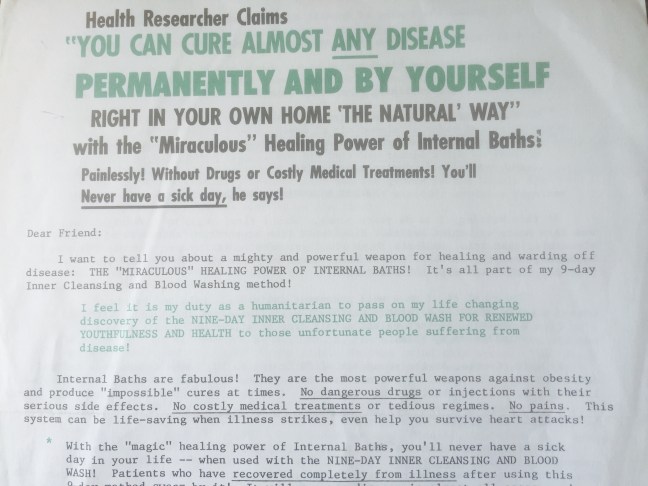
Who was Gene Schwartz? The six-foot-four legend from Montana was known as much for his art collection and service on museum boards as he was for his direct mail copy. (Click here for his bio). But he was one of the greatest copywriters who ever lived. And here he is at his best. (There’s a bad visual of the letter at the bottom).

Health Researcher Claims

“YOU CAN CURE ALMOST ANY DISEASE PERMANENTLY AND BY YOURSELF

RIGHT IN YOUR OWN HOME ‘THE NATURAL WAY’ WAY” with the “Miraculous” healing Power of internal Baths:

Painlessly! Without Drugs or Costly, Medical Treatments! You’ll Never have a sick day, he says!

Dear Friend:

I want to tell you about a mighty and powerful weapon for healing and warding off disease: THE “MIRACULOUS” HEALING POWER OF internal BATHS! It’s all part of my 9-day Inner Cleansing and Blood Washing method!

I feel it is my duty as a humanitarian to pass on my life changing discovery of the NINE-DAY INNER CLEANSING AND BLOOD WASH FOR RENEWED YOUTHFULNESS AND HEALTH TO those unfortunate people suffering from disease!

Internal Baths are fabulous! They are the most powerful weapons against obesity and produce “impossible” cures at times. No dangerous drugs or injections with their serious side effects. No costly medical treatments or tedious regimes No pains. This system can be life-saving when illness strikes, even help you survive heart attacks!

*With the “magic” healing power of Internal Baths, you’ll never have a sick day in your life – when used with the NINE-Day CLEANSING AND Blood WASH! Patients who have recovered completely from illness after using this 9-day method swear by it! It will conquer disease in almost all cases, and free your body of accumulated poisons that make you sick, in only 9 days!

Here’s what happens during the 9 days of cleansing:

*It will rid your body of poisonous wastes (toxins) that have accumulated and formed a lining around your intestinal wall – causing disease

*It will reverse the aging process, and increase your longevity by 20 years!

*It will reduce your weight without dieting or the use of drugs – and keep you slim during your lifetime!

*It is a positive way to avoid ever having a heart attack. It may keep you alive even if you’ve had a heart attack or stroke!

*It will heal arthritis if not in the advanced stages!

*It will lessen the intake of insulin by diabetics!

*It will restore masculine vigor and put energy back in your sex life!

*It will overcome low blood sugar!

*It will aid in normalizing high blood sugar!

*It will overcome post nasal drip!

*It will overcome an urge to urinate too frequently

…and still that’s just the beginning!

SECRET DISCOVERY REVEALED!

At this writing, I am 84 years young. When I first began my investigations, I was in a state of broken health. I suffered from bronchitis, shortness of breath, sinusitis, gastritis, acidosis, high blood pressure, constipation, chronic fatigue, backache, obesity, and hay fever. Then, about 35 years ago I discovered the NINE-DAY CLEANSING AND BLOOD WASH!

Today, at 84, I am a well preserved individual, hale and hearty, mind sharp as a razor and productive. I am erect in stature, with a youthful 34-inch waist, a full crop of silver-white hair an no wrinkles on my face.

My wife, Connie, at the young age of 70 “going on 50,” hasn’t been to a medical doctor in about 20 years. I did not have occasion to see a doctor until I was 65 when I thought it best to start having check-ups. I’ve only had one brief illness in 3 years.

What is the secret!

Inner cleansing! You see, my studies revealed to me that many illnesses seem connected with cell stagnation. If your nose is “stuffed up” or congested, or if you experience congestion in your throat or chest, it indicates that there is an accumulation of stagnant matter within you…sinus trouble, bronchitis, asthma, or colitis, is the result of stagnation. So are arthritis and skin eruptions.

All this can be prevented by giving the body an opportunity to cleanse and purify itself, and then rebuilding the body and its cells with proper nourishment.

FOUR NATURAL BLOOD WASHING FOODS WITH HEALING POWER!

During the 9 “Cleansing Days,” you’ll be eating certain foods I recommend. During this time, you will also begin the action which will effect a good, thorough wash of your bloodstream. You’ll simply begin to sip certain fresh juices.

What are these foods? There are several, but during my years of research. I have singled out FOUR NATURAL BLOOD-WASHING FOODS WITH HEALING POWER that play an important part in healing, curing, and preventing disease.

You may be skeptical, but remember, the NINE-DAY Inner Cleansing and Blood Wash which I take yearly, has warded off common ailments and most pernicious diseases. It has kept me in the best of health throughout the years..and I am 84. If I merely told you the names of these foods you might not be impressed. But wait till you see what doctors, nutritionists, scientists, researchers, an users themselves say!

BLOOD WASHING FOOD #1: NATURE’S CURATIVE WONDER FOOD!

One of these foods, a common syrup, is in my opinion, an Unheralded Cancer Fighter. I believe it will not only close the door on cancer in general, but is especially helpful in cases of leukemia, strokes, ulcers, arthritis, varicose veins, and menopause 

*James P. was in a state of broken health, unable to do even the lightest work. He was suffering from a growth in the bowels, blocked bronchial tubes, constipation, indigestion, pyorrhea, sinus trouble, and weak nerves. In addition, he was losing weight, and his hair and turned white – despite medical treatment. On hearing of a remarkable cure with this syrup, he decided to try it himself. And not only did the growth in his bowels disappear, together with all the other troubles, but his hair actually regained its original color (he was over 60 at the time). 

Others, apparently, have had the same remarkable results, including a man with a fibroid growth of the tongue, and another with cancer of the knee. Reputedly, tumors in various parts of the body have withered away without any other measures than taking this syrup. (No cancer cure is claimed, and reputable medical help is advised, of course, in all cases.)

*A “MIRACLE RECOVERY” FROM TWO STROKES! It is widely thought that when a person has had two strokes the third will be fatal – and yet it need not be so. Mr. K., an elderly man, had had two strokes and was completely paralyzed on one side. He then tried this syrup. The result was that he recovered the use of all his limbs and became completely fit, much to the astonishment of his doctor.

*SPECTACULAR CURES OF ARTHRITIS! Elaine B., 60, had severe arthritis in her knees and hip joints. She was in a great deal of pain and was unable to walk without assistance. Finally, she tried this syrup. One week later, she could swing her legs and flex her knees painlessly! Mr. J., an elderly man, could barely hobble with canes. After using this syrup for four weeks, he threw away his canes!

This common syrup can be obtained at any health food store or supermarket at negligible cost. There is nothing like it for prevention of these diseases I always take my quota of this syrup every day. I strongly recommend that you do the same. It’s a must! Several men who had been denied driver’s licenses because of heart trouble were put on treatment with this syrup. After six weeks they got their licenses. A woman afflicted with recurrent heart attacks took this syrup and the attacks subsided!

BLOOD WASHING FOOD #2: A WONDER BEVERAGE!

It has been said that there are a number of ailments that will automatically disappear after taking this beverage in a certain manner. It is made of the most health-giving fruit that exists.

It has been said that there are a number of ailments that will automatically disappear after taking this beverage in a certain manner. It is made of the most health-giving fruit that exists.

Reduction of weight without dieting will be achieved permanently if this beverage is taken a few times a day. It will burn up the surplus fat. It retards the onset of old age…renders the urine normal thus counteracting a too-frequent urge to urinate)…it promotes digestion because it is very much like a digestive juice! 

Observers have been quite astonished to see how forgetfulness in old people partially or wholly disappears through the practice of taking this beverage. Excessive bleeding can be reduced to a minimum in the case of an operation, and the healing process greatly quickened, if the patient takes this beverage. In cases of frequent nose-bleeding due to some unknown cause, a drink of this beverage with each meal will soon put a stop to the trouble. Sore throats – even of the streptococcus type – can be cured with astonishing rapidity, often in one day, by taking this beverage as a gargle. Tickling coughs and laryngitis will rapidly disappear. It regulates menstruation and is very beneficial to women. Belching can be cured or greatly lessened by taking this beverage.

BLOOD WASHING FOOD #3: A FOOD FOR HEALING!

Here is another syrup that is a most effective remedy for insomnia, emphysema, shortness of breath, sinusitis, asthma, and chronic fatigue. Combined with a certain beverage I tell you about it, it is most beneficial to those suffering from various heart troubles, hay fever, colitis, arthritis, neuritis, and many other common ailments. It is a natural laxative, and one of nature’s most powerful germ killers.

Russian medico-scientists have shown that it will cure a condition as serious as gastric ulcers. One doctor wrote: “In heart weakness I have (this syrup) to have a marked effect in reviving heart action and keeping the patients alive.”

BLOOD WASHING FOOD #4: A 3,000-YEAR-OLD MIRACLE MEDICINE!

This vegetable is the oldest known “home remedy.” It has long been used to rid the body of parasites and in the healing of disease. According to an old news item, “in test tube experiments Virile bacilli that can be killed only after hours of boiling in water die, after one hour of exposure to (this vegetable).”

This vegetable’s almost miraculous antiseptic power is an aid of high blood pressure, asthma, emphysema, colds, gas, gall stones, bronchitis, infections, hardening of the arteries, mucus, elimination, sinus trouble, and many other maladies. It has been widely used in restoring masculine vigor. It clears the blood of excess sugar as effectively as an oral drug. It has remarkable preventive powers and healing powers and offers protection against heart disease.

POWERFUL WEAPONS YOU CAN USE TO OVERCOME MAJOR DISEASES!

The diligent use of these 4 foods, with their extensive curative properties, healing powers, and remarkable preventive powers, will aid tremendously in “healing the body” in my opinion. They are all part of my NINE-DAY INNER CLEANSING AND BLOOD WASH FOR RENEWED YOUTHFULNESS AND HEALTH!

SEND TODAY FOR FREE TRIAL COPY!

Mail the enclosed card for your FREE trial copy. You have 15 days to discover all the incredible health-building secrets that will bring amazing youthfulness to your body: honor the invoice for four easy payments $6.98 pus applicable state tax, postage handling – or return the book and owe nothing.

 Sincerely yours

 I.E. Gaumont

 REWARD BOOKS

Health & Self Improvement

 IMPORTANT NOTICE [appearing at bottom of first page of letter):

The statements contained in this book express the opinions of the author, who is not a medical doctor. These opinions may, in certain cases, be contrary to those of the medial professions, and are based on experiences which may not be representative of results that can be expected for others. The publisher suggests that you do not attempt to make a self-diagnosis based on the symptoms referred to. Many of those symptoms can be caused be more than one condition, and these conditions cannot be self-diagnosed by the lay person. Where cancer may be involved, early diagnosis and treatment may be critical. In all cases, early diagnosis and treatment by a competent medical practitioner is advisable and, in some case, may be essential.schwartz letter
Golden Cities

By Ray Schultz

Geographic segmentation was no big thing fifty years ago. What was new was the ability to tailor the copy to the area. Take this direct mailing done by Time magazine.

The letters contained a sort of glorified Johnson Box at the top, printed in gold, asking questions that concerned the reader’s city. Below that box, they were the same.

Here are two samples. One focuses on Boston, the other on Cleveland. I assume that other cities were also targeted, but I only have these two letters.

To put things in context, these pieces were dated Feb. 17, 1964 ten days after the Beatles arrived in America and eight days before Cassius Clay, soon to be Muhammad Ali, won the heavyweight championship. Lyndon Johnson had been president for three months in the wake of the Kennedy assassination, and later that year would win a full term by beating Barry Goldwater.

The envelopes were postmarked Lincoln, Nebraska and were identified in the Time archive by the cities to which they were going.

Did the computer play a role in this direct mail campaign? Hard to say. Time Inc did conduct personalized computer mailings to doctors that very year, but it was a long time before this became a regular practice.

Let’s start with the Boston version. Is there anyone there who remembers these worries? Old-timers will recall that the MBTA was called the M.T.A. in those days.

Who will be Ted Kennedy’s opponent in the Senate contest? / What is the outlook for Boston’s tax rate? / When will we have an answer to the nagging on-street parking problem—are theft-proof meters the solution? / Why should the M.T.A. be extended to the South Shore? / Where will the Celtics finish the season? / How corrupt is Massachusetts—and can the crime commission do anything to correct it?

 Now here’s the Cleveland variation.

Who will be Ohio’s favorite son at the Democratic National Convention? / What are the prospects for this year’s Cleveland Indians team? / When did the term “diffusion” come up in connection with school integration? / Where is the first apartment building in Erieview to be erected?  / Why are Shaker Heights residents protesting the proposed construction of the Clark Freeway? / How does Senator Stephen Young feel about John Glenn’s 1960 voting record?

What follows is the body of the direct mail letter, which was identical in each case:

February 17, 1964

Dear Reader: 

Questions like these, of largely local interest illustrate something that’s also true of national or international issues. It’s essential to have more than just a few raw facts; it’s important to know the background.

These same questions also help show why, in reporting the news from every field, TIME has always done something more than give a plain recital of the facts. Naturally it starts of with the eyewitness story; but when the event is big news, the eyewitness may be standing too close to get the full significance. TIME stands back, examines the causes, digs out other pertinent facts, relates it to other events. TIME also knows the personalities involved.

As a way of following the news, TIME makes sense – because it makes sense of the news.  

It’s not just the international news that you find all the more understandable. To give a few examples from other fields – if a report on a dramatic discovery takes you beyond the door that’s just been unlocked, you’re beginning to understand the real meaning of the discovery itself. Events in Washington can be better judged if the issues are clearly spelled out. Explore, instead of just recount, new developments in education and you od justice to their fundamental importance.

In TIME’s other news departments also, even in the briefest reports, you find you get more out of the news, because TIME looks at sit with a penetrating, appraising eye.

It’s the reason why many leaders in business and the professions in communities across the country vote TIME their favorite magazine the most important magazine in the U.S. today. TIME reports with the intelligence, accuracy, and consciousness that the leadership community needs and demands.

If, so far, you’ve only read an occasional copy of TIME, we hope you’ll take advantage of an invitation we offer here and now to read TIME regularly at a special introductory rate. Return the card and we’ll send you

20 weeks of TIME For $1.97 (that’s only 10 cents a copy).

No need to sign or check it. Just drop it in the mail – today.

Cordially,

Putney Westerfield

Circulation Director

DEAR FRIEND: The Rascals, Rogues and Roues Who Made American Junk Mail Chapter 3: ‘We Accidentally Met With Your Address…’

By Ray Schultz

History doesn’t tell us much about A. Paisley. All we know is that he lived in Gloucester, Mass., and that a letter was sent to him there in 1837. When Paisley opened the “envelope,” a folded-over sheet sealed by a red-wax wafer, he found a promotion from Sylvester’s Exchange & Commission of New York.

“I beg leave to submit to your attention to the annexed – Our brilliant Schemes to be drawn in the month of March either of which professes attractions far superior to any Scheme yet laid before you,” announced the handwritten note. “Early notice is thus given that my most distant correspondents may not be disappointed.”

Behold an early example of junk mail. Like today’s ad letters, it was full of hype, promising that the advertused lotteries were ““beautiful, grand, splendid and brilliant.” It even had what is now called a privacy policy: “All communications strictly confidential.”

In 1827, Congress passed a law prohibiting local postmasters from working as lottery agents—no longer could they dispense handbills in return for a percentage of the sales. So the lottery barons started mailing directly to the rubes; by 1830, if you believe the later claims, they even had an agency in New York to facilitate this “circular advertising.”

So great was the moral outcry against lotteries that most northern states gave up theirs. But tickets for border and Southern state lotteries were sold in shops and by mail by firms like Wood, Eddy & Co., of Wilmington; Egerton & Bros. of Baltimore; and the combine of Archibald McIntyre and John Barentse Yates, of New York. And these men decided that they had to educate their customers on how to buy by mail. Egerton & Bros. explained that “we invariably answer letters by return mail, enclosing the Tickets in a proper envelope, observing the strictest confidence and after the Drawing is over we send the Official Printed Drawing, duly certified to by the State Officer, and Managers with a written explanation of the result.” Smallwood Co. promised that its tickets would be returned in “strong safety envelopes.”

The average person learned that he had mail when he saw his name in a newspaper listing. Or he found out when he visited the post office, usually part of a dark general store with tools and bacon hanging from the ceiling. Then he had to pay for the letter.

Most mail was dropped into the system without postage; the recipient had to pay, and few did. Why would they? Some unpaid letters were sent as jokes—the victim would pay 25 cents for an envelope full of manure. General Zachary Taylor refused to pay for the letter informing him he had been nominated for the Presidency of the United States. Even the lottery companies wouldn’t pay: “No unpaid letters received in our office,” B.B. Mars & Co. of Baltimore warned customers:

This changed when Congress passed the Postal Reform Act of 1855. Magazines and newspapers excepted, senders now had to pay in advance. And the lottery operators were happy to inform people about it. “From and after 1st April 1855, prepayment, either by stamps, stamped envelope, or in money, is compulsory,” Emory & Co. advised its customers. With this system in place, the lottery promoters papered the country with offers, almost all containing an apology:

“Trusting you will not find us intrusive…”

“We crave your indulgence for intruding on your valuable time…”

“We accidentally met with your address…”

Chapter 4: Gospel Mail

Then As Now

By Ray Schultz

Is there no getting away from advertising? It pops up everywhere online, even in the middle of content, instead of being gated off. And it’s annoying even for someone who works on the fringes of the business

But it’s nothing new. In this brief paragraph, Frank Presbrey describes the ad acene in the 1860s, before the telephone or even electricity. It’s from The History and Development of Advertising, his 1929 classic:

A merchant would hire a man to stand and look fixedly at a placarded announcement; many would stop and read what seemed so interesting to him. At busy street corners boys were distributing handbills, while others went from hosue to house. Every horse car had packages of them tied to the rods in the cars so that passengers could pull them off. Drugstore counters had piles of free almanacs carrying advertisements for patent medicines. (A generation later one patent-medicine house—Ayer—is said to have distributed 25,000,000 almanacs in a year.) Advertising cards were common in the saloons of river steamers and other excursion boats. Novels contained an assortment of advertisements in the back pages—an old practice. Advertising assailed the eye to an extent which then was sensational.


DEAR FRIEND: The Rascals, Rogues and Roues Who Made American Junk Mail, Chapter 11: The Crooked Road to the End

By Ray Schultz

Flush with success, J.M. Pattee decided he needed a vacation, so he took his family to Saratoga Springs, a resort almost 200 miles north of New York City. But it was bad timing: He was going out one morning when he saw Anthony Comstock coming up the steps.

Pattee panicked and ran, not knowing that Comstock was there only to give a speech. But the vice crusader had spotted him. “He is a remarkably nervous man, and seems to be always in fear; having at times a wild, frightened look, as though he expected to be arrested every moment,” Comstock observed.

And Comstock did want to arrest Pattee. He next confronted his prey at the Simpson & Co. Brokerage in New York. A side door opened, and Comstock saw “a little gray-haired old man with gold spectacles on, bob out, and then instantly dodge back into the dark room, and attempt to quietly close the door, as to attract no attention.”

Pattee “reached out his hand to shake hands, and becoming very much excited, repeated over and over again, how glad he was to see me, stuttering out, ‘Well—I—am—devilish—glad to see you.’” In Comstock’s account, Pattee denied that he had any business in the office. “Well, well, I only have an office room here,” he allegedly said. Comstock entered a back room, and saw several employees stuffing envelopes.

Meanwhile, Pattee was indicted in Wyoming for sending false advertisements from the territory for the Seminole Gold and Silver Company. His lawyer, a former U.S. attorney named Col. George Bliss, described his client as a “man of wealth and reputation,” and made the incredible lying claim that Pattee had never been in Wyoming. Pattee escaped extradition.

Frustrated, Comstock staged another raid against Pattee’s brother-in-law Nate Read (“American, Protestant, Married, Swindler”), seizing over a million names and addresses. Bliss got them returned to Pattee, and soon Read was sending letters to that list from Canada.

These pieces described the Royal New Brunswick Popular Monthly Gift Soiree as “the only legal Gift Drawing in the whole Dominion of Canada.” And they claimed that “hundreds of clerks, working-men, merchants and farmers have paid off a mortgage on a house or farm—may have added to his mercantile stock or bank account—may have settled a number of old debts or refurnished his house, making happy and comfortable his family—all through a lucky ticket bought from us,”

This was rubbish, Comstock knew, but he was powerless to stop it. Instead, he took to vilifying Pattee in books like Frauds Exposed. “I have yet to find the first person who ever received one dollar from him in return for money sent,” he wrote.

Pattee, though, was getting tired of the chase. In 1880, beset by legal bills, he sold or lost his house in New York, and started residing in hotels in the east 40’s. Nate Read was arrested in Canada in 1884 and promptly jumped bail to the U.S.

What became of the man who had discovered the most basic law of junk mail, that a person who had fallen for one scheme was ripe for another? Pattee moved to St. Louis, and set up an office on Olive St. But his business was short-lived, for he died in 1888 at age 64 of “softening of the brain.” Thanks to his various scams, though, he left his wife an estate of comfortable proportions.

And Comstock? By the time he died in 1915, he was widely viewed as a crank and an enemy of the First Amendment. “The fight for the young!” Heyward Broun wrote. “The phrase was always on Comstock’s lips…But, with the passing years, may it not have become a formula with which he sustained himself, unconscious that its relation to his work was growing increasingly remote?”

Comstock had changed in one respect. When younger, he had railed against direct mail. Under his leadership, though, the Society for the Prevention of Vice sent it to ask for “sympathy, co-operation, and such financial assistance as you may be disposed to give.”

But some things remained the same. In 1906, 38 years after their first encounter, Comstock again arrested the pornographer Charles Conroy. The ledger tells it all: age 66, Irish Cath., Scheme to defraud by mail. Tombs in default of $2,500 bail.

Chapter 12: Montgomery Ward Raises The Barn