Fantasy Boxing: Ali Vs. Frazier In 1967

By Ray Schultz

More than most sports fans, boxing enthusiasts like to fantasize about hypothetical matchups: Would Dempsey have beaten Louis, would Louis have whipped the Klitchkos, would Duran have gotten to Benny Leonard?

I’m guilty of it, too. But I mostly wonder about two men who actually did fight—Muhammad Ali and Joe Frazier.

What would have happened if they’d fought when Ali was in his prime in 1967?

To consider this, one has to crawl out from under the weight of history.

The first bout between this pair took place in 1971 when Ali was just back form his 3 ½-year exile. He was rusty, and no longer had the legs that had once carried him. Frazier was at his best: He had Ali in serious trouble in the 11th and floored him in the 15th. It was a clear win for the man from Philadelphia.

Three years later, after Frazier had lost to George Foreman, Ali won a close 12-round decision over Joe in a fast-paced bout. He staggered Frazier in the 2nd but had to survive savage left hooks later in the fight.

Still, his legs held out and most pundits agree he had outboxed Frazier. In 1975, when both were shopworn, they fought the Thrilla in Manila, a brutal fight that Ali won by TKO at the end of the 14th round after they had pummeled each other incessantly.

The common wisdom is that Ali’s last fights before his exile were his best—he destroyed Cleveland Williams in three, dominated Ernie Terrell in 15 and kayoed Zora Folley in 7. Angelo Dundee wondered where he could have gone from there.

That’s clear in hindsight. Frazier was rising in the rankings in 1967, having stopped George Chuvalo and Eddie Machen. He was already a threat, although not quite as seasoned as he would later be.

That spring, though, Ali refused induction in the Army, and was convicted of draft evasion, stripped of his title and forbidden to fight.

To envision an earlier Ali-Frazier fight, you have to accept one of several unlikely scenarios. One is that Ali served in the Army. But that would have put him out action, too, for a couple of years, so he might have been just as rusty when he met Frazier.

Or, to create an alternate universe, you could imagine there was no Vietnam war and no racial injustice and that Ali just breezed through his career.

I feel a little guilty even thinking about this—it’s irresponsible, given the state of the world and what happened to both of them. But let’s imagine that they ought early in 1968—in fact, maybe on March 8, the date they fought on in 1971. Would Ali have dominated the fight and knocked Frazier out?

No.

I suspect that Ali would have fought Frazier much the same as he did in 1974, dancing and throwing combinations, only more effectively, jarring his opponent with rights, swelling his face and staying away from him on surer legs.

But Frazier would have applied enormous pressure, driving in with his left hooks. Ali might have won a lopsided decision, but it would not have been easy.

Picture this alternate scenario, though: That Ali, who had been champ for four years and might have been a bit jaded, would have underestimated Joe. Maybe he wouldn’t have gone down from a left hook as he did in 1971, but he could have run out of steam at some point, losing points while clowning around.

It has been said that Ali had mostly faced older fighters. Here was a younger one who could give and take enormous punishment.

The fight would have been a classic, and it doubtless would have led to a rematch and maybe to a three-fight series, the outcomes being much the same as they were years later.

Styles being what they were, Frazier would have given Ali hell at any time. And both men would have emerged damaged.

The Last Rebbes: Life Among The Hasidic Jews–Introduction

By Ray Schultz

For a thin man, I have a strange tendency to associate key events with food. For instance, I can never think of one of the strangest days I’ve ever spent—at a Hasidic summer camp in the Catskills—without recalling the feast bestowed on us by our hosts.

I had arrived at Camp Rov Tov D’ Satmar that morning. The occasion was a political rally, but I really was there to learn about the Hasidim, so I was early and had no sooner gotten out of the cab from the town when I was surrounded by teenage boys who looked like they had come from an 18th century village in Eastern Europe. Dressed in long black coats and wide hats, some had beards and all had side curls; not one had a sun-tan.

They were gentle and gracious. They asked me who I was. I stated several times that I was a reporter, and they repeated it to each other in Yiddish. One, a 19-year old named David, offered to act as host, and he invited me to walk around with him. So I did, followed by the entire group of boys, and saw a series of low-rise, run-down buildings, some serving as barracks, others as synagogues, and an empty swimming pool with moss growing in the cracks in the cement. One young man was sitting on the ground painting a pair of signs, saying: “Welcome, Abe Beame,” for the mayoral candidate who was visiting that day.

Then the conversation started. At least two boys asked me if I had seen “The Ten Commandments,” the Cecil B. DeMille epic that had been around for about 20 years. Of course, I had seen it. They had heard of it, though they were denied access to television and movies.

Another boy asked me about “My Name Is Michael,” a pop tune that was out then, and seemed to call for a better world. I wasn’t very aware of it.

Finally, one boy asked, “Do you know how we feel about Zionism” That I knew. I had been warned: the Satmar Hasidim were against the secular nation of Israel, believing that a Jewish state should not exist until the Messiah arrives. There were rumors that they had defaced the Israeli embassy to the UN.

Pro-Israel in the conventional way, I couldn’t understand this. I asked them if they would fight if threatened. One kid vehemently said, “Of course we would fight if we are threatened with death!” Then I asked: Didn’t the Holocaust prove that the Jews needed a state? I don’t know why I thought they needed to be educated on this subject. David answered for everyone.

“We have no grandparents!” he said.

Most of the boys left to go to a Talmud class. David remained, and we were joined by an adult, one Rabbi Stein, who invited us into the administration building for a spread of soda, cake and matzos, my first experience in Satmar hospitality.

Now I was no religious scholar, nor a believer in much of anything. But I soon grasped that the whole Satmar set-up rested on the shoulders of one man: the Rebbe, Yoel Teitelbaum, who was now 90 and ailing. They went to the Rebbe, who had rebuilt the community in the U.S. after Work War II and the Holocaust, for everything–for legal advice, for his blessing on marriages, for textual interpretation.

We sat there and snacked. I learned that David lived with his parents and three brothers in a three-room flat that cost $120 a month. His father had a blue-collar job, but David planned go into clerical work. Young men were usually given a year after school when they could continue to live at home while learning a trade. Then, at 20 or 21, they got married with the help of a paid matchmaker, after a long courtship in which the two parties rarely if ever saw each other.

Suddenly there was tumult outside: Abe Beame had arrived, along with the rest of the press pack. David and I went out. The 5-foot tall mayoral candidate spoke briefly and was mobbed when he finished. The boys practically carried him into one of the barracks. I never saw him smile once.

Following this tour, everyone started crowding into cars to move on to the Satmar girl’s camp down the road; David pushed me into one. On the way, we passed a man identified as Israel Zupnik, a middle-aged Hasid who also seemed to be trying to hitch a ride. Mr. Zupnik made a fortune selling Nutola vegetable oil to the U.S. Army in World War II, and he and his wife Thelma were major benefactors to Satmar, I was told; Mrs. Zupnik ran the girl’s camp.

We arrived at Camp Emunah, and I saw the future wives of the boys I had met lined up next the entrance road. They were conservatively dressed, wearing dresses and long socks. One girl presented Beame with a torch, but smeared red paint on his shirt. Again, he didn’t smile. Beame toured the girls’ rooms, with their homemade quilts and curtains.

There was another speech or two. Then we all went into a building, and were served cakes stuffed with almonds and apples, bottles of soda, then plates of blintzes made by Mrs. Zupnik herself, the best I’ve ever eaten anywhere, accompanied by coffee and homemade coffee ice cream.

This partly erased my view of the Hasidim as dour people who did little but gnash their teeth: But it was a short-lived occasion. We were in the middle of Tisha B’av, which commemorates the destruction of the Temple by the Romans in 66 AD and includes a day of fasting. I realized that for these boys—and adults—this event was only a momentary break in the serious daily routine of Talmud, Torah and prayer.

Tips From A Century Ago: Write Clearly and Don’t Plagiarize

Planning on starting an email newsletter? Here are some tips on how—from 100 years ago.

That’s when the House Organ Association held a convention in 1918. It was co-sponsored by the Direct Mail Advertising Association, now known as the Data & Marketing Association.

Old-timers remember house organs–they were the magazines companies published to keep their customers informed. They served the same purpose as email newsletters. Here are some lessons from that October 1918 event, held in the closing weeks of World War I:

Don’t lift content from other publications. The prevailing attitude in 1918 was: “Why waste time rewriting or pay for stuff when there was plenty of it going the rounds for the mere trouble of taking it?”

Don’t steal artwork, another widespread practice. “It doesn’t make a tinker’s darn difference how much gray matter, sweat, time, ink, experience, execution and money was involved if a certain design or illustrated ‘looks good’ or is “just the thing” to illustrate some new fangled clock whose alarm tickles your toes—Use It! Trace it or photography it direct—but use it!” the speaker said.

Make sure that articles are relevant and engaging—they weren’t in most house organs. “Most are over-weighted with ponderous lectures by men who know their own departments, but unfortunately do not know how to WRITE,” a speaker complained.

The conference was organized into tracks like House Organs for Salesmen, House Organs for Dealers, and House Organs for Customers. The most crowded session was the one titled, “Why House Organs are essential in War time.” (It was because editors “have steadily made use of articles designed to aid in the organization of the country for war”).

Wisdom from the ancients.


Drinking In The New Neon Wilderness

By Ray Schultz

Poor Nelson Algren. A new bar, the Neon Wilderness, has opened in Chicago’s Wicker Park neighborhood. But it can’t be like the ones Algren hung out in when he lived there, nor can it reflect the ethos behind the name.

 The Neon Wilderness is the title of Algren’s 1947 short story collection. His third book, it mostly focused on the desperate lives of the people who inhabited the area around Milwaukee Ave. and Division.

Among its 24 stories was “The Captain has bad dreams, or who put the sodium amytal in the hill & hill?”, a harrowing yet often funny account of a police lineup. This scene prefigured a similar one in The Man with the Golden Arm, Algren’s 1949 novel, which won the first National Book Award and was the basis of the movie starring Frank Sinatra (that Algren hated).

Algren turned another story in the volume, “The Face on the Barroom Floor,” into the climactic episode of A Walk On the Wild Side, his 1956 novel and the seed of yet another bad movie. And one of the earlier pieces in the collection, “A Bottle Of Milk for Mother,” was the foundation of Never Come Morning, Algren’s 1942 novel that sold over one million copies in paperback.

Perhaps the best story is “Design For Departure,” a novella unto itself, which described how a damaged woman lived in that era before gentrification—“in one of those great city caverns which are halfway between a rooming house and a cheap hotel. Every door has a number; and no one knows anyone else and nobody keeps the hallway clean because nobody rents the hall.

“The beds are rented by week or by night. They are rented along with the air and the hours. There is just so much warmth, just so much air…” (But where would she live now?)

Algren, who died in 1981, never saw much money from any of this, and what little he did see he lost at the track; His world view can perhaps be summed up by this line from Chicago: City On The Make, his 1951 prose poem: “Every day is D-day under the El.”


The Face Of Ho Chi Minh: A Time Magazine Direct Mail Piece

By Ray Schultz

Marketing guru Ron Jacobs has observed that “Consumers don’t have the patience anymore to read an eight-page direct mail letter.” True, and they probably don’t even have what it takes to read a four-page one.

But they must have had it in 1966, because that’s when Time magazine sent the following four-pager.

Like the classic Time letters from the 1940s and ‘50s, this one is a historical artifact. It introduces Ho Chi Minh, the leader of North Vietnam, to the American people. Then it goes on to quote Marshall McLuhan, mention both LBJ and Jimmy Hoffa in passing, and explain—in some detail—the benefits of Time.

The envelope features a line drawing of a pair of sandals, with this copy: “The wearer of these sandals said: “Americans don’t like long, inconclusive wars. This is going to be a long, inconclusive war.”

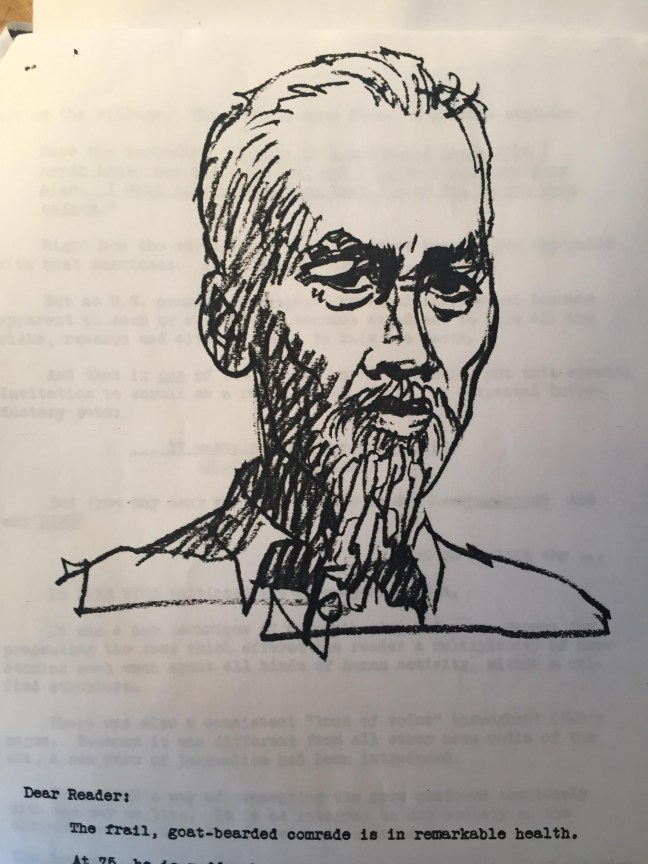
Inside, at the top of the letter, is a compelling image of Ho Chi Minh. Unfortunately, I have only a black-and-white Xerox copy, and did not write down the color of these illustrations. I suspect it was red.

Having found this letter in the Time Inc. archive, I am sad to report that it was one of the last of its type. That very year, Time started sending charmless, computer-generated sweepstakes letters, although Bill Jayme’s long Cool Friday letter was mailed into the 1970s.

There were no handwritten notes attached to this one, so I don’t know who wrote it, or how it pulled. And I wonder how many people, even those who snapped up the offer, made it all the way through. But here it is: One of the last great long letters written by Time’s direct mail masters. Enjoy.

Dear Reader: 

The frail, goat-bearded comrade is in remarkable health.

At 76 he is ruddy-cheeked and cheerful. He dresses in –cream-colored, mandarin-style uniforms and “Ho Chi Minh scandals” carved from automobile tires. His tastes are exquisite. He smokes American cigarettes and dines on a rare delicacy called “swallow’s nest” – a marriage of sea algae and swallow’s saliva. 

In 1962 Ho Chi Minh said: “We held off the French for eight years. We can hold off the Americans for at least that long. American’s don’t like long, inconclusive wars. This is going to be a long, inconclusive war.”

Drenched by a monsoon rain, a leathery U.S. Marine sergeant and his platoon wait in the swampy dark outside a wretched hamlet where V.C. are reported hiding. Finally a wan moon reappears. Its dim light glints on weapons carried by four fleeing figures heading out of the village. The marines open fire. A grenade explodes.  

Says the sergeant: “I hate this goddamned place like I never hated any place before, but I’ll tell you something else: I want to win here more than I ever did in two wars before.”

Right now the war in Viet Nam is neither popular nor unpopular with most Americans. It is simply confusing.

But as U.S. commitment deepens, personal involvement becomes apparent to each of us. And it becomes expedient to know all the risks, reasons and alternatives. To know the facts.

And that is one of the reasons why I am sending you this special invitation to enroll as a regular TIME reader, at a special introductory rate:

. . . 17 weeks of TIME for only $1.87. (Just 11 cents an issue.)

But (you may ask) why do I want to read a newsmagazine? And why TIME?

Let me explain why…

In 1923 TIME initiated the newsmagazine idea.

It was a new technique of newsgathering and a new format for presenting the news which offered the reader a multiplicity of news stories each week about all kinds of human activity, within a unified structure.

There was also a consistent “tone of voice” throughout TIME’s pages. Because it was different from all other news media of the era, a new form of journalism had been introduced.

Today TIME’s way of presenting the news conforms completely with the way we live. It is as integral to our society as the electric and electronic wonders that surround us.

The newsmagazine form offers an integrated mosaic picture of our time…

Says Professor Marshall McLuhan, Canada’s social catalyst: “The newsmagazine form is pre-eminently mosaic in form presenting a corporate image of society in action…The reader of the newsmagazine becomes much involved in the making of meanings for this corporate image…”

After assembling what McLuhan calls “the crucial commodity of information” through many channels and from many sources, TIME prints only the most significant of that week’s news, news of greatest human interest. From all directions, covering all facets.

It is then up to the reader to assemble this mosaic of the news and discover for himself what it means…and by doing so becoming involved in his world in a way never before possible.

The reader begins to know who he is, what he is doing, and what it means to be a member of this particular society at this particular moment in history.  

Thus the newsmagazine is recognized as a modern, efficient and essential tool of communication.

But how does this happen? How does the reader receive sufficient information each week to formulate his own meanings?

If you know TIME (and most people do) you know that it covers the news each week completely in23 separate sections. Among them: The Nation, The World, People, Education, Law, Religion, Medicine, Art, Modern Living, Music, Sport, Science, Show Business, Theater, U.S. Business, World Business Cinema, Books.

Each section of Time is also composed as a mosaic…

Take “Medicine” for example. In six consecutive issues TIME published the important news about infectious diseases, orthopedics, metabolic disorders , cardiology, physiology, parasitic diseases, gynecology, cancer, neurology, doctors, diagnosis, bacteriology, gastro-enterology.  

In a single issues under “U.S. Business” there were stories on the economy, profits, auto, advertising, government, mining, banking. The following issue carried news of housing, publishing, publishing, communications, corporations, steel, money, retailing, oil, industry. And the next: shipping, airlines, finance, Wall Street, aviation, insurance, taxes.

One week recently under the heading “The Nation” TIME reported on President Johnson’s Hawaii Conference; the $3.39 billion foreign aid package; Senator Dirksen’s filibuster; Jimmy Hoffa; a wicked snowstorm; California’s Governor Pat Brown; Wyoming’s Governor Clifford Hansen; Mississippi’s Governor Paul Johnson; the Hudson River Valley; and the new head of all military construction in Viet Nam: Brig. Gen. Carroll Dunn.

TIME connects you with the world through a fascinating, complex, modern grapevine of information…

TIME’s staff of editors, writers, researchers and technicians scans the world to amass each week’s fund of new information. They read and translate millions of words, examine thousands of pictures, sift ideas, opinions, quotations, figures, reports….trimming, fitting, checking and transfixing it all into just about 125 columns of news and news-pictures each week. (TIME is a magazine for busy people.)

Each week too, there is an important Cover Story, a TIME Essay (on some subject as controversial as the Divorce Laws, or the Homosexual in America), and a color portfolio. With listings of what’s best in theater, movies, records, books, television.

Only an organization of TIME’s stature, structure and dimension could expend this amount of energy and effort.

But what is just as important: Time is a lot of fun to read … it often reads like fiction, humor or biography…

You can follow the exciting thriller 9reported from TIME’s Paris Bureau): “L’Affaire Ben Barka”, a sensational spy-murder-police scandal that has rocked France as the Dreyfus case did a the turn of the century.

You can play TIME’s new game of “barrendipity” (in contrast to “serendipity”, or the art of finding somewhere where you least expect to find it). Barrendipity is the art of not finding something where you might expect to find it: Danish pastry in Denmark, frankfurters in Frankfurt, English muffins in England, or baked Alaska in Alaska.

You can gain intimate knowledge of a great artist. From TIME’s Cover Story on pianist Arthur Rubenstein, who says:

“I’m passionately involved in life; I love its change, its color its movement. To be alive, to be able to speak, to see, to walk, to have houses, music, paintings – it’s all a miracle. I have adopted the technique of living life from miracle to miracle. Music is not a hobby, not even a passion with me. Music is me.”

With this weekly fund of news, insight, sidelight and background . . . you sense the unpredictable variety of life itself.

Writes Professor Marshall McLuhan: “By using our wits, we can translate the outer world into the fabric of our being.”

TIME helps you “translate.”

There is no set rule about how to read TIME. Some begin at the beginning. Others start from the back. What interests each man and woman is incalculable. So TIME tries to provide as much of interest and value to as many interested people as possible.

As the artists of 6th century Ravenna arranged mosaic tesserae according to size, contour and direction to create monumental designs, so TIME presents the design of our times.

Why not partake of this experience?

Our invitation is enclosed. It enrolls you at once as a TIME reader and brings TIME to your home or office regularly – for 17 weeks at only $1.87 (just 11 cents an issue).

Just put the card in the mail to me today – it’s already postage-paid.

And thank you.

Cordially,

Putney Westerfield

Circulation Director

DEAR FRIEND: The Rascals, Rogues and Roues Who Made American Junk Mail, Chapter 13: The Confederate Croupiers

By Ray Schultz

Born in 1837, the grandson of a Baptist minister, John Wanamaker was so good a student that one of his teachers said, “It is no use to send John to me any more; I have taught him all I know.” By rights, Wanamker should have gone into the family brick-building business, but he was diagnosed as a possible consumptive, and spent months in a Minnesota rest home. Filled with the “serious thoughts of one likely to die,” he left the family faith to join the Presbyterian church, then, that matter resolved and his health restored, turned to his livelihood.

In April 1861, as the city and country were buzzing about the Confederate attack on Fort Summer, Wanamaker, age 22, opened a ready-to-wear clothing store with his brother-in-law Nathan Brown: the Oak Hall Clothing Bazaar. Each man invested $2,000.

Soon, they were sending “four-page papers containing a good deal of miscellaneous and original reading matter, sandwiched between bright, readable advertising paragraphs, for instance, ‘A sad sign—to sign your name to a note; better buy your clothes at Oak Hall and pay cash,’” one historian wrote.

In 1969, the partners tried a larger store. And in 1877, after buying a parcel of land for $500,000, Wanamaker opened one of the country’s first department stores. It was heralded in a double-column advertisement in all the Philadelphia papers: “The Inauguration of the Dry Goods Business at the Grand Depot will take place Monday, March 12, from nine to six o’clock.”

Wanamaker hired a writer named J.E. Powers to write “daily store talk in bright, catchy sentences.” And he spent $300,000 a year on this advertising in a time when, as one historian noted, it was “not considered polite to advertise.” He also sent a 148-page mail order catalog containing “a list of the goods in every department in the store.”

The lifelong Sunday school teacher was a benign employer: Every staff member received two weeks vacation with full salary every summer–unusual for that time. And the company library was free for female workers.

Wanamaker was also active in politics. In 1888, he raised more than $200,000 for the Republican presidential candidate Benjamin Harrison, asking fellow businessmen, “What would you pay to be insured for a better year?” Later, he boasted, “We raised the money so quickly that the Democrats never knew anything about it.” That fall, Harrison unseated the sitting President Grover Cleveland, and Wanamker received the prize so often tendered to contributors and political hacks: The Postmaster Generalship.

As promised, Wanamaker approached this job as a businessman. “Gentleman, you want to run your post office as if there were another fellow across the street competing with you, and you were trying to get all of the business.” he said. But then he did something that was decidedly unbusinesslike—he tried to dump his largest customer: The Louisiana Library.

*****

Louisiana had been occupied since 1867 by federal troops, and run, one outraged Southern editor charged, “by corrupt Republicans, ignorant Negroes cooperating with a gang of white adventurers, strangers to our interests and our sentiments,” reflecting the racism rampant in the former Confederacy. Among the newcomers was a 31 year-old Baltimorean named Charles T. Howard.

Some people said Howard inflated his Confederate war record, but it didn’t matter, for in 1868 he had something in short supply in Louisiana: capital provided by the New York gambler John Morris, and he liberally dispensed it to the Republicans in the legislature. His hosts rewarded him with a 25-year charter to operate a lottery, and made it a crime for anyone else to start one. And the company was exempted from all taxes except for a $40,000-a-year contribution to the state educational fund.

At first, the Louisiana Lottery sold chances mostly through policy shops in the state: the daily drawings were “the special curse of the colored population,” one observer alleged. But this was a limited market. In 1873, in perhaps his wisest move,  Howard appointed Dr. Maxmilian A. Dauphin as president.

Dauphin was born in 1837 in Alsace Lorraine, and emigrated to the United States at age 16 with a brother. But the siblings separated soon after arriving, and Maxmilian ended up friendless in New Orleans. He attached himself to Dr. Sam Choppin, “then the center of one of the most brilliant social, professional and politicial coteries.” and under his sponsorship became a physician. Then he went into business.

Dauphin knew that the lottery would never realize its full potential until it dominated the Yankee market, which it did, within a few years. Next to New Orleans, Washington was the most lucrative city. The Lottery offered tickets at cigar stores, hotels, saloons and barber shops, and through bootblacks and newsboys in the streets. And, of course, it peddled them by mail, so many that Bin “D,” in the Washington post office was assigned to Dauphin, and clerks worked into the night, using “express wagons and furniture cars to haul the outgoing mail,” one account reported.

It was similar in New York and Chicago, where lottery agents mailed tens of thousands of packages a month, containing letters, certificates, logos, entry forms and tickets, and promises of “grand” and “extragavant” prizes.” One package sent in New York in 1880 said: .“No seed, no harvest.” Altogether, the Lottery’s mailings pulled in $30,000 a day, or almost $11 million a year. And they constituted 45 percent of the entire business of the New Orleans post office.

The Lottery could usually buy off anyone in its way, but it made a mistake when it offered payments of $25,000 a year to Anthony Comstock, made out to him personally. The vice crusader yelled, ““As long as I live and have my reason and health, your company shall never have another office open in New York.” No matter: business went on.

The drawings were held in an ancient hall in New Orleans, with an alligator paddling around in a pool outside. And they were under the “personal supervision” of two venerated Confederate generals: Jubal T. Early, who had torched Montgomery Blair’s house in Maryland during the war, and G.T. Beauregard, both dressed in Confederate gray and crowned with white hair.

General Beauregard “was of large stature, but the progress of years weighed heavily upon him, and his shoulders were bent so as to throw his florid face, with its full white hirsute covering, forward towards the floor. Gray-blue eyes, fierce and penetrating, gleamed beneath bushy, overhanging brows. A suit of Confederate gray clothing, well cut and near, covered the aged man.”

Then there was Jubal, “clad in black, and a handsome face crowned by now-white closely cropped hair was poised proudly sabove an elegant, dignified form,” aided by two small boys wearing knickers.

The generals were each paid tens of thousands of dollars a year to stand on stage once a month and “preside.” The drawings featured blindfolded boys from a local orphan asylum, and were conducted before men who were “redolent of rum and tobacco and poor bathing facilities, and had no taste or money for clean raiment,” according to one eyewitness account. “With the utmost solemnity, Croupier Early proceeded to blindfold the boy beside him,” wrote another witness. “Located near the brazen drum, Croupier Beauregard, with corresponding gravity, tied a white handkerchief over the eyes of his juvenile assistant.”

The drawing began. Jubal drew the white paper from the encircling black rubber tube. In measured tones he read the number, 48,146.” The voice of General Beauregard was likewise measured and somewhat harder in is timbre when he called the figures on the white slip of paper which he drew from the little black tube: ‘200’ he said.” What it meant was the holder of ticket 48,146 had won $200.”

Several larger prizes were drawn, including jackpots of $100,000 and $300,000, but no winner came up to claim them, causing groans in the gallery. With good reason: One third of the tickets in the drum were unsold, still owned by the Lottery, which meant that the bettors were playing against the house. And the house did well. Government lotteries in Europe distributed up to 85% of their ticket money in prizes; the Louisiana Lottery kept more than half.

In 1890, Congress passed yet another law making it a crime to use the mails to conduct a Lottery. Unlike previous bills, this one made it a crime even to patronize a lottery by mail. Harrison signed it, and Wanamaker vowed to enforce it.

Dauphin decided to bypass the mails, employing private express deliverers and in this way removing he criminal taint for customers. His ads advised players to “remit currency by express at our expense. Give full addresa and make signature plain.” But the pressure and his rich New Orleans diet must have gotten to him, for in December Dauphin died at age 53 after a brief illness. Charles Howard was dead, too, having been thrown from a horse.

Paul Conrad, former chief clerk of the Lottery and part owner of an ice company, took over. As Pattee and Nathan Read had done, he opened a Lottery office in Canada, then had circulars sent over the border to advertise the fact that “recent changes in the United States Postal regulations have rendered it preferable to more closely consult the interest of our Canadian patrons by establishing a branch office in Canada.”

At this point, the Supreme Court of Louisiana was deciding whether to renew the Lottery charter or put it on a ballot referendum. The court, heavily subsidized by the Lottery, ruled to renew, and Conrad quickly got out a mailing hailing the victory. And he rubbed it in Wanamaker’s face: The pamphlet contained return express envelopes addressed to the New Orleans National Bank, again bypassing the Post Office. Worse, it was designed to look like a newspaper, and was mailed at the second class rates for pubishers.

That tore it for Wanamaker. Employing the full machinery of law enforcement, postal authorities made 153 arrests. But they rarely netted anything more than a $500 fine. Still, the bad publicity had its effect: The flow of incoming envelopes slowed down to a trickle.

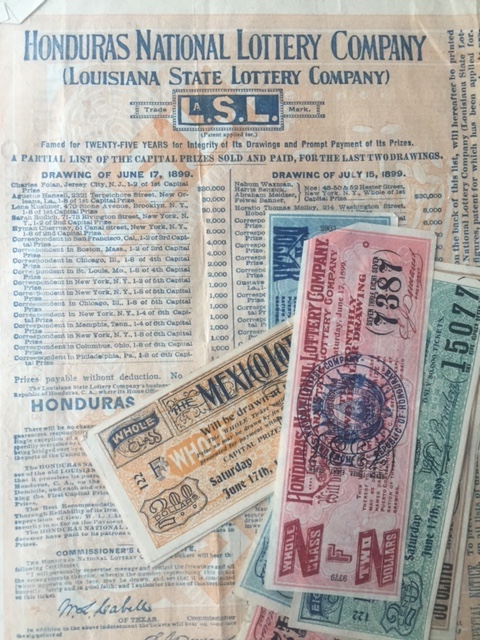
Conrad had one more trick. He relocated the Lottery to Honduras, and started sending pink circulars under the name the Honduras National Lottery Company by express mail, bypassing the post office. “We use the express companies in answering correspondents and sending lists of Prizes to the U.S.A.,” they said. “Reply by Express only.”

But it didn’t work. In 1892, the U.S. Supreme Court upheld the anti-lottery laws and Conrad announced that he would close shop. Wanamaker claimed victory. Morality and sound business practices had prevailed over the rebels. In 1895, green goods were also wiped out in the courts.

Too bad not all of Wanamaker’s schemes ended in victory. He was ridiculed for his most brilliant idea: Free rural delivery. One Republican editor wondered whether Wanamaker also wanted to “have the Government present every farmer with a free telephone and a free telegraph instrument.” Free rural delivery wasn’t enacted until after Wanamaker left office.

The robber baron Jay Gould himself denounced as socialistic Wanamekr’s plan to nationalize the telephone and telegraph systems and run them through the post office. Then it was over: Harrison lost to Grover Cleveland in the 1892 election, making Cleveland the only President to serve two non-consecutive terms. Wanamaker returned to his business, and lived until 1922, despite his youthful fears of consumption.

Chapter 14: The Road To Wellville

DEAR FRIEND: The Rascals, Rogues and Roues Who Made American Junk Mail, Chapter 26: Black Mail

By Ray Schultz

To the untutored, 1940 probably seemed like just another year ending in a zero. The movies Gone with the Wind and The Wizard of Oz were playing around the country. On the radio, one heard Frank Sinatra singing with the Tommy Dorsey band. But some people were not consoled by such entertainment: The Germans were overrunning Europe, the Jews were in peril.

In March 1939, a charitable group called the Committee of Mercy, had sent a direct mail letter to people of good will:

Dear Friend:

The situation of the intellectual Jews who are still living in Germany in a state of misery, humiliation and ill-treatment attains a degree of horror which cannot easily be described in words. They endure it with great courage. They say:

“We do not mind so much for ourselves. We have made the sacrifice of our lives and of our welfare. We let them take our properties, our wealth, our factories, etc……We do not ask any help for ourselves, but for pity’s sake save our children.”

It was an eloquent plea, but the letter went on to offer anti-Semitic readers a way out: WILL YOU HELP? it asked. Or if you do not care to assist the Jews, will you aid the tubercular, and pre-tubercular children in France?

It’s not known how many recipients took either option. Either way, the letter reminded them, without explicitly saying it, that there could be another war.

Soon there was. And Time magazine hammered it home, both on its pages and in its direct mail pieces. This is America’s year, it said in a letter dated Jan. 2, 1940 and signed by Time’s circulation manager Perry Prentice. It continued:

All over Europe the lights are going out. All over Europe the nights are dark with fear.

But here in America the nights are bright with the lights of a thousand factories as America starts back to work after the long depression — bright with the lights of a thousand laboratories whose discoveries may change the course of history and all the ways of our living — bright with the lights of forty-million homes, where Americans are newly confident that they can find and conquer new frontiers in the American way.

 Yes–this is America’s year — so this is the year you need TIME most.”

The letter went on to offer a subscription.

That was soon followed by:

Time has been banned in Germany! 

Banned in Russia! Banned in Italy! Banned in Japan!

But here in America, where men are still free to think and learn the truth — thousands upon thousands of new families are turning to TIME each week to help them make the confusing news and war and peace make sense.

In February, at the height of the Phony War, Time sent a a direct mail piece, saying:

This is the dullest war in history…

FOR PEOPLE WHO DON’T KNOW WHAT IT’S ALL ABOUT!

But it’s a tremendously exciting, moving, portentious war for those who know and understand what is really going on…

 …tremendously exciting for the readers of TIME.

Two months later, with Hitler now on the march, recipients read this stark reminder:

When kingdoms vanish in the night…

  – and nations wake to find the enemy within their gates..

Millions of people snap up each extra as it comes off the press and scan each headline in fear and horror – as puzzled children turn to parents for reassurance and explanation.

The real war had started. And in June, Time reported this

The Nazi Blitzkrieg has swept like a flame —

–over Norway, Denmark, Holland, Belgium, Luxembourg, Northern France.

 In eight short weeks kingdoms and governments have fallen, peoples have been subjugated, the balance of power of the whole world has changed.

 It cannot go on much longer, many experts say — the next hundred days should tell the story.

In September, Time continued on its roll.

Dear American

Ours is the tragic previlege–

     The tragic previlege of living and taking part in the greatest worldwide military crisis since Napoleon, the greatest American election crisis since Lincoln, the greatest economic crisis since Adam Smith.

     And in times like these, when the news is so confusing and so dramatic and so immediately important — no American need be reminded that keeping thoughtfully well-informed is a personal duty.              

Meanwhile, there was a struggle between isolationists like Charles A. Lindbergh, whose comments were tinged with anti-Semitism, and those who felt the U.S. had to help defeat Hitler. Among the latter was Henry Hoke, the 46 year-old Baltimore native and Wharton graduate who had befriended Louis Victor Eytinge. Hoke was ever on the alert for frauds who abused the medium, and he felt he had uncovered just such a group.

The Nazis.

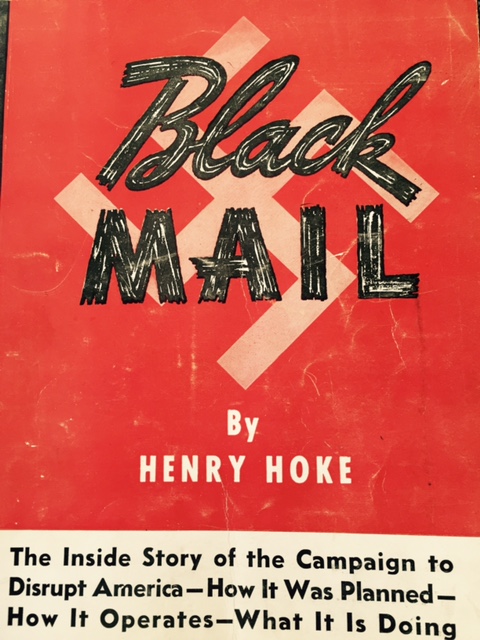
The Germans were using the U.S. mails to spread propaganda, and Hoke, whose son Pete had received pro-German circulars at Wharton, took it on himself to expose them. As he wrote later, in a book titled Black Mail, “the German government, through mail issued by specified agencies to selected lists, was attempting to divide the country so that the United States would be helplessly unprepared for future military attack.”

For instance, “the German Library of Information guided by Matthias F. Schmitz (assisted by George Sylvester Viereck), issued about 90,000 copies of a semi-weekly, well printed and written Facts in Review to ministers, school teachers, editors of college papers, legislators, publishers,” Hoke wrote in May 1940 in his magazine. “Purpose: to sell the National Socialist ideology and to prevent preparedness against attack.”

Then he added that “the German Railroads Information Office, guided by Ernest Schmitz, issued about 40,000 weekly mimeographed bulletins to hotel mangers, travel agencies, stock brokers, bankers and ‘small business men,’” to “convince Americans that the Nazi system of doing business was best.”

Hoke wasn’t done: “The American Fellowship Forum, guided by Friedrich E. Auhagen, assisted by George Sylvester Viereck, Lawrence Dennis, and others, issued pamphlets or bulletins to a ‘cultural class,’—educators, civic leaders, authors and a selected list of persons who might be sold the idea that the German mind was filled with nothing but the milk of human kindness for all humanity.”

It took courage to write that, even for an American tucked safely at home in Garden City, Long Island. E. Schmitz, from the German Railroads Information Office, wrote to demand that Hoke retract these “slanders,” and assured him that if he did, “a waiver will be given, releasing you and your publication from further claim.” Hoke noted that the letter “had been sent to my home…not to my office.”

Hoke published his exchange with Schmitz in a special mailing—“I refuse to be intimidated by you or by any German controlled organization. I refuse to have my family intimidated,” he wrote. And he got more outspoken as he realized the scope of the German operation.

“For the first time, it was possible to show how the Nazis had built a large mailing list (estimated at 250,000) of German Americans with relatives in Germany…how Japanese boats brought hulls full of printed material from Hamburg, Munich, Berlin…how these pieces were delivered under International Postal Union Treaties free of charge by the United States. (Under International Postal Treat, the country of origin retains the postage collected,” he wrote in Black Mail. “The country of delivery delivers free. A wash-out transaction to avoid bookkeeping).”

But the Germans were only part of it. Hoke found that Sen. Burton K. Wheeler, the Montana Democrat who had broken with Roosevelt over his court-packing plan, was sending out isolationist mail under his free Congressional frank. Analyzing the addressing on the envelopes, Hoke traced the pieces to a German group: the Steuben Society, Also sending seemingly pro-Hitler mail, for free, was Rep. Hamilton Fish (R-NY), who in 1938 had met with German Foreign Minister Joachim von Ribbentrop in Europe, and reportedly said that Germany’s demands in Poland were “just,” according to Hoke.

Hoke deplored the anti-Semitism shown by many isolationists. “On April 25, 1941, in Omaha, Nebraska, Charles B Hudson, violently anti-Semitic publisher, admitted to reporters that he had distributed isolationist speeches under the Congress free mailing franks of Senators Worth Clark of Idaho, Bennett Champ Clark of Missouri and Burton K. Wheeler of Montana, and Representatives Oliver of Maine and Bolton of Ohio,” he reported.

Hoke wrote to Wheeler: “Unaddressed franked mail under your signature and under that of former Representative Jacob Thorkelson of Montana, has been distributed by your violent adherent Donald Shea at his anti-Semitic meetings and by Nazi-loving, Jew-baiting Joe McWilliams at Christian Front meetings. Recipients were instructed to address the franked envelopes and dump them into the nearest postal box, without payment of postage.”

Of course, isolationists had a right to circulate their views, although not under franked mail, Hoke argued. Wheeler fought back. “I am not seriously concerned about Mr. Hoke’s misrepresentations,” he wrote in a letter. “In the first place, Mr. Hoke is interested in direct mail advertising, as he himself says, and is opposed to the use of the franking privilege on general principles.”

Wheeler then claimed that “Mr. Hoke makes no reference to the fact that those in Government who apparently favor our intervention in foreign war sent out under various Congressional franks some 2,00,000 pieces of mail all over the United States, much of it distributed by the pro-interventionist committees and organizations.”

Wheeler also falsely wrote that Hoke was employed by the Anti-Defamation League of the B’nai Brith, as if that discredited him. Meanwhile, Hoke reported that the supposedly good name of the Order of the Purple Heart was being used as a cover in the scheme.

Events moved quickly. FDR was elected to an unprecedented third term in November 1940. On June 2, 1941, Hoke wrote, “a friend beside a news ticker called me on the ‘phone to beat the headlines…’Henry, you ought to be glad to know,’ he said, ‘the President of the United States has just issued an executive order closing the German Railroads…the German Library of Information…and the German Consulates.’”

Hoke was pleased, although this crusade had practically wrecked his business. But he kept after the Nazi sympathizers, using the techniques of his trade to undo them. For example, friends wrote flattering letters to the appeasers, using dummy names, and soon received isolationist letters addressed to those names, fueling his investigative reporting. And more was to follow.

“We learned from a girl who worked in a locked and guarded room on the top floor of the Ford Building at N. 1710 Broadway in New York City that Ford Motor Car Company employees were compiling a master list of appeasers, anti-Semites, pro-Nazis and Fascists from fan mail addressed to Colonel Charles A. Lindbergh, to former Senator Rush Holt and to Representative Hamilton Fish,” Hoke wrote.

He added that “the lists, when compiled, were delivered to Bessie Feagin, circulation manager of Scribner’s Commentator. That explained how some of the dummy names used in writing to radio orators eventually got on the list of the American First Committee and Scribner’s Commentator. But why the Ford organization? But why…a lot of things?”

Feagin was eventually hauled before a grand jury, as were many others, including Hamilton Fish. “No one knows what Hamilton Fish told the Grand Jury on December 5, 1941,” Hoke said. “Someone was pulling every possible string to have the case buried.”

Two days passed. Then: “Sunday afternoon, December 7, 1941, just as our little family sat down to dinner…the flash we feared came over the radio…Pearl Harbor!”

Time wasted no time in getting letters out:

Dear American:

And now the news is happening to us!

Its unpredictable turns and changes are altering the whole course of your life — the job you work at, the town you live in, the clothes you wear and the food you eat.

The news is happening to you in the Pacific — and sudden developments in Malaya and the China Sea, at Singapore and off San Francisco, in Tokyo and Manila and the Dutch East Indies can change your life more than you can possibly change it yourself.

The news is happening to you across the Atlantic — where Russia bleeds Germany white, where American tanks fight the Axis in Libya, where Britain waits tense for an attempted invasion – and your life and my life, the safety of our families and the future of our children all wait on tomorrow’s news.

The news is happening to you at home — where new laws and new regulations pour out of Washington – where entire industries are changing over to war production, where uniforms fill the streets and the whole nation moves with a new unity and determination.

Yes, the news is the biggest things in our lives today – stirring and vital and very near us all. And it is very confusing.

And that is why this is the year you need TIME most.

Despite this development, and the collapse of the America First organization, the flow of isolationist mail continued, some letters containing vicious attacks on “the Jews.” George Sylvester Vierick was indicted by the Federal Grand Jury for failure to give a true statement of his activities in registering as a german agent, and held on $15,000 bail. (Nazi agent).

Hoke recorded the scene:

“11:30 P.M. Judge Lawes appears and the courtroom is filled with an air of dignity…and tension. The jury walks in a semi-circle at the side of the bench. Viereck stands before the jury and glares. The clerk reads each count and the foreman answers—‘Guilty’…six times. Vierecks lawyer asks that the jury be polled. Viereck glares at each juror as the question is put six times, an the answer six times is ‘Guilty.’ Seventy-to times Viereck hears his ‘fellow citizens’ say the word ‘Guilty.’ The big marshal standing behind George Sylvester Viereck takes out his handcuffs and the Nazi agent goes out through the back door. Court adjourned.”

It was the last blast for Viereck—and also for junk mail. As they had in World War names disappeared from iists—these men were unreachable. Not that it mattered– there were paper shortages that prevented mail pieces from being printed. And there was nobody to send them, for copywriters and list brokers were now in uniform. Except for the mail sent by charitable fundraisers, like the people who served coffee and donuts to servicemen, the business was on hold.

Chapter 27: The Veteran’s List



How Does A Gentleman Know a Cad?

By Ray Schultz

Ernest Hemingway committed suicide in 1961, and many people believed he had lost it as a writer by that time. First, there had been his 1950 novel, Across the River and Into the Trees. It was savaged by critics as self-parody; only Tennessee Williams thought it was among his poetic best.

Hemingway recovered in 1952 with The Old Man and the Sea, a short novel published to universal acclaim; it won him a Pulitzer and helped him snare the Nobel Prize for Literature. I especially love the scenes in which the boy brings food and coffee to the old man. But a certain revisionism soon crept in. Some critics deplored what they saw as the heavy handed symbolism of the old man carrying the mast of his boat, like Christ carrying his cross. I never bought that academic line. But it was the last book published in Hemingway’s lifetime, and readers wondered what he had been doing.

What he had been doing was working. In 1964, three years after his death, his widow Mary published A Moveable Feast, his memoir about his youthful days in Paris. I first read it at age 19, while working in a Navy photo lab. Here’s how it opens:

Then there was the bad weather. It would come in one day when the fall was over. We would have to shut the windows in the night against the rain and the cold wind would strip the leaves from the trees in the Place Contrescarpe. The leaves lay sodden in the rain and the wind drove the rain against the big green autobus at the terminal and the Café des Amateurs was crowded and the windows misted over from the heat and the smoke inside.

Imagine opening a book with the word “then,” a word Jonathan Franzen says a writer should never use. But who needs Franzen’s advice? A Moveable Feast contained some of the best prose Hemingway ever wrote, on a level with that of his short stories. I read on, enjoying paragraphs like this one, in which he enters a cafe:

It was a pleasant café, warm and clean and friendly, and I hung up my old waterproof on the coat rack to dry and put my worn and weathered felt hat on the tack above the bench and ordered a café au lait. The waiter brought it, and I took out a notebook from the pocket of the coat and a pencil and started to write. I was writing about up in Michigan and since it was a wild, cold, blowing day it was that sort of day in the story. I had already seen the end of fall come through boyhood, youth and young manhood, and in one place you could write about it better than in another. That was called transplanting yourself, I thought, and it could be as necessary with people as with other sorts of growing things. But in the story the boys were drinking and this made me thirsty and I ordered a rum St. James. This tasted wonderful on the cold day and I kept on writing, feeling very well and feeling the good Martinique rum warm me all through my body and my spirit.

Thirty or 40 years before the movie, that section transported me to the fantasy world depicted in Woody Allen’s Midnight in Paris. Obviously, it did the same for Allen and millions of other people.

Then there was this little scene about hunger, which Hemingway believed heightened his perception of the Cezanne paintings in the Louvre. Hemingway had just visited Shakespeare’s bookstore, where he all but admitted he was broke, and was handed a letter from a German publisher, containing 600 francs, a nice piece of change in those days.

Hemingway is angry at himself: You God-damn complainer. You dirty phone saint and martyr, I said to myself. You quit journalism of your own accord.

But now he has money. So, he writes, Hunger is healthy and the pictures do look better when you are hungry. Eating is wonderful too and do you know where you are going to eat right now?

 Lipp’s is where you are going to eat and drink too.

 It was a quick walk to Lipp’s and every place I passed that my stomach noticed as quickly as my eyes or my nose made the walk an added pleasure. There were few people in the brassiere and when I sat down on a bench against the wall with the mirror in back and a table in front and the waiter asked if I wanted beer I asked for a distingue, the big glass mug that held a liter, and for potato salad.

 The beer was very cold and wonderful to drink. The pommes a’ I’huile were firm and marinated and the olive oil delicious. I ground black pepper over the potatoes and moistened the bread in the olive oil. After the first heavy draft of beer I drank and ate very slowly. When the pommes a I’huile were gone I ordered another serving and a cervelas. This was a sausage like a heavy, wide frankfurter split in two and covered with a special mustard sauce.

I share these quotes merely to give you a sample of Hemingway’s writing—I offer no critical commentary. But admit it: Wouldn’t you want to be there?

But let’s get down to cases. This book also has its detractors. Gore Vidal, a writer I admire very much, hated “the spontaneity of his cruelty. The way he treated Fitzgerald, described in A Moveable Feast. The way he condescended to Ford Maddox Ford, one of the best novelists in our language.”

Vidal was right about the cruelty, and he would have known–look at some of the portraits in his own memoir Palimpsest . But those chapters were so funny. And both Ford and Fitzgerald  were fair game- they were world-renowned authors. Consider this exchange between Hemingway and Ford Maddox Ford as they drink at an outdoor table. Ford had just “cut” a man he identified as the writer Belloc. “Did you see me cut him?” he asks in a boastful way. Young Hemingway challenges him about it.

“A gentleman,” Ford explained, “will always cut a cad.”

 I took a quick drink of brandy.

 “Would he cut a bounder?” I asked.

 “It would be impossible for a gentleman to know a bounder.”

 “Then you can only cut someone you have known on terms of equality?” I pursued.

“Naturally.”

“How would you ever meet a cad?”

 “You might not know it, or the fellow could have become a cad.”

 “What is a cad?” I asked. “Isn’t he someone that one has to thrash within an inch of his life?”

 “Not necessarily,” Ford said.

 “Is Ezra (Pound) a gentleman?”

 “Or course not,” Ford said. “He’s an American”

Oh, how delicious.

And Fitzgerald? I revere him as an author, but the man had his tics, and Hemingway captured them. Take this scene, in which the two are traveling in Fitzgerald’s car, which has no roof, from Lyon to Paris, and are drenched in the rain, drinking wine all the way. Fitzgerald is convinced he has caught a fatal congestion, and they check into a hotel, and are dressed in their pajamas in the room while their clothes are being dried. Hemingway is reading a crime serial in a French newspaper.

On this evening in the hotel I was delighted that he was being so calm. I had mixed the lemonade and whisky and given it to him with two aspirins and he had swallowed the aspirins without protest and with admirable calm and was sipping his drink. His eyes were open now and were looking far away. I was reading the crime in the inside of the paper and was quite happy, too happy it seemed.

 “You’re a cold one, aren’t you?” Scott asked and looking a him I saw that I had been wrong in my prescription, if not in my diagnosis and that the whisky was working against us.

 “How do you mean, Scott?”

 “You can sit there and read that dirty French rag of a paper and it doesn’t mean a thing to you that I am dying.”

 “Do you want me to call a doctor?”

 “No. I don’t want a dirty French provincial doctor.”

“What do you want?”

 “I want my temperature taken. Then I want my clothes dried and for us to get on an express train for Paris and to go to the American hospital at Neuilly.”

That doesn’t happen. Fitzgerald who had just published The Great Gatsby, is finally persuaded by Hemingway that he is well (“I’ve always had remarkable recuperative powers”), and they get dressed and go down for dinner, where Scott passes out.

I’m sorry, but I still laugh when I read it.

By today’s standards, one may quibble with the portrait of Gertrude Stein: Hemingway wrote that he broke with her after walking in on an intimate scene between Stein and her partner. It’s a distasteful, stereotypical anecdote, if you will, but I believe there had to be more to it. There was growing professional tension between Stein and Hemingway. And Stein had plenty of nasty things to say about Hemingway, both his writing and masculinity, long before he wrote that account.

Hemingway also ridiculed an apparently gay writer who sat down with him, uninvited, while he was writing in a café. Well, nobody said Hemingway was a saint. Later, if you believe Kenneth Tynan, Hemingway had a friendly encounter with Tennessee Williams at a bar in Key West; they exchanged the names of doctors.

But back to A Moveable Feast. How did the physically declining writer achieve that level of prose? Biographers report that in 1956, when stopping at the Ritz Hotel in Paris, Hemingway was told that a trunk had been found that he’d stored there in 1927. To his delight, it contained his notebooks from that time.

Did Hemingway merely rearrange anecdotes written 30 years earlier that he discovered in the notebooks? Or did he truly write A Moveable Feast? in the 1950s based on information in the notebooks? That’s not clear, but I hope it’s the latter. Either way, he was preparing the book for publication, as he was The Dangerous Summer, on a bullfighting rivalry. Sitting there unpublished, not quite ready in his view, were three full-length books: Islands in the Stream, The Garden of Eden, and True At First Light (later repackaged as Under Kilimanjaro).

What had he been doing, indeed.

So yes, I’m a Hemingway fan. Do I also worship the macho man who reveled in what H.L. Mencken called “the armed pursuit of the lower fauna?” No, I compartmentalize that, just as I plan to compartmentalize the news, just out, that Hemingway signed on as a Soviet spy in the 1940s, although he never gave them anything. One must forgive him. just as one forgives John Dos Passos and James Gould Cozzens for being conservatives—it’s the work that’s important. Even Picasso was a Communist for a time. But who thinks about that when viewing his paintings?

Forget all the Life magazine hoopla. To see what kind of man Hemingway was, one must turn to Nelson Algren. In 1955, five years after he won the first National Book Award for his novel, The Man With The Golden Arm, Algren was in crisis. He was losing his beach house in Gary, Indiana, his passport had been seized because of his support for the Rosenbergs, his brief marriage (his second to the same woman) had ended, he regularly lost money gambling and his confidence as a writer had been shaken. Passing through Miami, he took a steamer to Havana; you didn’t need a passport to go to Cuba then. He called the Hemingways, and Mary Hemingway invited him out to their farm, Finca Vigia. Hemingway had been an early booster of Algren’s work, but they had never met. So Algren visited Hemingway, who was bed-ridden from injuries sustained in his 1953 plane crashes in Africa. To Algren, Hemingway looked more intellectual than he’d imagined. Algren, who had seen Disney’s The African Lion in Miami, insisted on showing the great hunter how big cats stalked prey. They talked about boxing, and Hemingway invited Algren for Christmas dinner the next day. Algren’s biographer, Bettina Drew, notes that Christmas at the Hemingways’ was just where he belonged…knowing he was accepted and respected for his writing, for what he was. The party was significant for Nelson because of the emotional affinity, far deeper than words, stirred by Hemingway.

Algren spent time alone with Hemingway prior to the dinner. Then, he reported, “Hemingway got out of bed painfully. He was fully dressed. There were guests waiting.” Algren recorded this scene in a remarkable 1965 book, titled Notes From A Sea diary: Hemingway All the Way, in which he wrote about his time as a passenger on a tramp steamer in the Pacific, in the form of a diary, and combined that with reflections on Hemingway and a counter attack against Hemingway’s critics. Here’s what he had to say about Hemingway and his guests:

He sat among them gravely serious. He carried an air of tranquility. He didn’t throw a punch at anybody. He didn’t stagger. He didn’t brag. He listened, perceived, and he liked having company. What he brought to a table of many guests was the feeling that everyone understood one another. I remember hearing Spanish spoken, and French, and of understanding not a word of what was said: and of knowing, when I spoke English, that some of the guests didn’t understand me. But because of Hemingway’s presence everything seemed understood.

His beautiful and moving writing aside, that’s how I think of Ernest Hemingway.

The Fuehrer’s Database

By Ray Schultz

Twitter received kudos this month when it said it would not assist in the creation of a Muslim registry. Of the nine companies queried, it was the only one to give a definite “no.”

Good for Twitter. But it made me wonder: Did a country ever use information technology to identify people by religion?

Sure it did. The Nazis utilized a metal punch-card sorting system to find Jews and send them to their deaths, Edwin Black writes in his 2001 book, IBM and the Holocaust.

In essence, the equipment leased to the Nazis by IBM’s German subsidiary, Deutsche Hollerith Maschinen Gesellschaft (or Dehomag), was a state-of-the-art mailing list system for that time.

With Dehomag’s help, the Nazis conducted a census, asking pointed questions about religion and ancestry, Black alleges.

“What emerged,” Black continues, “was a profession-by-profession, city-by-city, and indeed a block-by-clock revelation of the Jewish presence.” Moreover, by cross-sorting the columns, the Nazis could “identify who among the Jews would be its first targets for confiscation, arrest, imprisonment, and ultimately expulsion.”

Another effort occurred a few years later when Germany was about to launch the war; they even went through old church records to find Jews whose families had converted to Christianity generations before.

Later, the punch-cards were used to code the demises of the victims, and record which ones had received “special handling” (usually, extermination in a gas chamber), Black claims.

“All Auschwitz name information, including workers still alive, deaths, and transferees, was continuously punched into the camp’s Hollerith system,” Black charges. “Tabulated totals were wired each day to the SS Economics Administration and other offices in Berlin to process cards and lists for each inmate transferred.”

It’s not clear how much guilt is shared by IBM/Demohag. But one thing is certain: Technology can result in monstrous ends, especially when misused by states in partnership with the private sector.

Ivanka Live

By Ray Schultz

Ah, memories. Did you know that Ivanka Trump, the daughter of our next President, once spoke at a direct marketing event?

It happened on June 16, 2009 at DM Days in New York. And I covered it. Not that it was a big story—I can’t remember where, or even if, it was published. But it might be of some slight historical interest. So here’s my report, with not a word changed, not even the archaic term “DMer.”

Lessons From Ivanka Trump

With all respect, why do beleaguered DMers need lessons in living from 27 year-old Ivanka Trump?

It’s not that we disagree with any of the tips she offered this morning on how to succeed. But she’s Donald Trump’s daughter. What can she possibly know about adversity?

Granted, she’s been around enough self-made people to know what it takes (not that her dad qualifies). And she argued that it’s not easy being a Trump. “Much is given, much is expected,” she said.

She did make one pertinent observation about the downturn: “The last 18 months are the best education I’ve had to date, better than Wharton and operating in the hottest real estate marketing anyone’s seen.”

We’re still not sure why her real estate job in the Trump empire qualifies her as a speaker at DM Days. But here are some of her prescriptions:

  1. Make sure you love what you’re doing. 
  2. Be resilient. Ivanka has seen many successful people become despondent during the downturn, “unable to get out of their own way.
  3. Don’t be afraid to make cold calls.

We’d suggest that she collect these nostrums into a book. But she probably already has.