Sam Exits The Stage

By Ray Schultz

There were rumors months ago that Sam Shepard was ill. I suspected it was liver trouble caused by his reputed alcohol consumption. But it wasn’t: He died of Lou Gehrig’s disease, a malady caused by genetics. It was nothing he did to himself.

And I was saddened in several ways—for one, over the suffering he must have endured with that illness. As a Shepard character says of a deceased singer, “He was going out, and he knew it.” Then there was the loss of this figure who was on the cultural stage for over 50 years, whose work I and many other people enjoyed. Finally, it reminded me of the passing of time.

The first Sam Shepard play I saw was Forensic and the Navigators, at Theater Genesis, upstairs from Saint Mark’s Church on the Bowery. It was a snowy Saturday night in January 1968. The playwright Lanford Wilson showed up wearing jeans and sneakers.

The play started in darkness, with the cast singing a spiritual: “We’re gonna be born again, oh Lord.” Soon the two guys in the cast were being instructed on the proper way to prepare Rice Krispies—you could hear the cereal snapping, crackling and popping. Shepard’s future wife Olan Jones gave a lively performance. It ended with exterminators arriving. The small room filled up with steam and colored lights flashing through it. .

I have no idea whether Shepard ever took LSD, but this play was trippy. And it was funny—all that talk about the myth of the west obscured just how funny he was. In this way, Forensic and the Navigators was in line with the other one-acters he seemed to jot off, like Chicago and Icarus’ Mother. 

You have to remember the time. The Fillmore East was a block or two down 2nd Ave., and the East Village Other had its office there. You could get the best Danishes in the city in Ratner’s, the old dairy restaurant.

Shepard was a figure in the neighborhood. You’d see him at the luncheonette on 10th, buying a container of tea to take a rehearsal. And he was at the acid-drenched party at St. Mark’s church on New Year’s Eve 1969, dressed in full hippie regalia.

The first Western-themed play that I recall was The Unseen Hand, which was presented on a double bill with Forensic and the Navigators downtown in the spring of 1970. It was a futuristic play in which some cowboys are projected into a bleak Mars-like landscape. A character plaintively asks, “There’s no more trains?”

It was a fine companion piece to Forensic and the Navigators. But the new Western direction wasn’t clear at the time. What was obvious was that Shepard wanted to be more than a playwright: There he was in the lobby, playing drums with the Holy Modal Rounders.

I didn’t get it: would Pinter or Beckett do this? But I later realized that Shepard had a rock ‘n roll sensibility (not a trait I admired in a playwright). It came out in The Melodrama Play (a bad play), The Tooth of Crime (a great play) and Cowboy Mouth, the piece he wrote and performed in with Patti Smith.

And it emerged when he accompanied Bob Dylan on a tour. I wondered why a talent like Shepard had to cozy up to a rock star. But his onscreen presence in the resulting documentary led to his getting a role in Terrence Malick’s Days of Heaven, in which he was a quiet, haunting figure. And he was off on his movie career.

In between, Shepard wrote some of his best plays, like Buried Child and True West, for San Francisco’s Magic Theater. I can quote lines from memory (forgive me if I get them wrong). In Buried Child, a character says, “I was thrown out of Arizona. I don’t want to be thrown out of Illinois.”

In True West, in which two adult brothers battle it out, exchange roles and are pulled apart by their mother as they grapple on the floor, one rejects a dinner plate showing the capital of Montana. In effect, he says, “I don’t want to see Montana when I’m eating. When I’m eating, I’m here.”

We saw the original production of that classic, starring John Malkovich and Gary Sinese.

Shepard had a certain integrity as a writer. But at some point, I feared that he had lost his sense of humor. He made a film with Wim Wenders called Paris, Texas, a slow-moving work that was symbolized for me by the guitar going, “boiiiinnng!”

Later, Shepard and Wenders made a movie called Don’t Come Knocking, in which he played a Western movie star who escapes the set. It was savaged by the critics, but I kind of liked it. His mother, portrayed by Eva Marie Saint, keeps a scrapbook of his DWI arrests. It had some of that old anarchic spirit.

Contrary to reports that Shepard hated New York, he was often in the city. Andrea and I would go to a Moroccan place called Orlin on St. Mark’s Place at midnight to write headlines and eat pasta with potatoes and pesto.

Shepard would sometimes be there, eating by himself, reading a book. Maybe he’d have a drink with his meal Nobody treated him like a celebrity. He looked like a man who could survive and enjoy life on his own. Maybe that’s the Western spirit they’re always talking about.

DEAR FRIEND: The Rascals, Rogues and Roues Who Made American Junk Mail, Chapter 13: The Confederate Croupiers

By Ray Schultz

Born in 1837, the grandson of a Baptist minister, John Wanamaker was so good a student that one of his teachers said, “It is no use to send John to me any more; I have taught him all I know.” By rights, Wanamker should have gone into the family brick-building business, but he was diagnosed as a possible consumptive, and spent months in a Minnesota rest home. Filled with the “serious thoughts of one likely to die,” he left the family faith to join the Presbyterian church, then, that matter resolved and his health restored, turned to his livelihood.

In April 1861, as the city and country were buzzing about the Confederate attack on Fort Summer, Wanamaker, age 22, opened a ready-to-wear clothing store with his brother-in-law Nathan Brown: the Oak Hall Clothing Bazaar. Each man invested $2,000.

Soon, they were sending “four-page papers containing a good deal of miscellaneous and original reading matter, sandwiched between bright, readable advertising paragraphs, for instance, ‘A sad sign—to sign your name to a note; better buy your clothes at Oak Hall and pay cash,’” one historian wrote.

In 1969, the partners tried a larger store. And in 1877, after buying a parcel of land for $500,000, Wanamaker opened one of the country’s first department stores. It was heralded in a double-column advertisement in all the Philadelphia papers: “The Inauguration of the Dry Goods Business at the Grand Depot will take place Monday, March 12, from nine to six o’clock.”

Wanamaker hired a writer named J.E. Powers to write “daily store talk in bright, catchy sentences.” And he spent $300,000 a year on this advertising in a time when, as one historian noted, it was “not considered polite to advertise.” He also sent a 148-page mail order catalog containing “a list of the goods in every department in the store.”

The lifelong Sunday school teacher was a benign employer: Every staff member received two weeks vacation with full salary every summer–unusual for that time. And the company library was free for female workers.

Wanamaker was also active in politics. In 1888, he raised more than $200,000 for the Republican presidential candidate Benjamin Harrison, asking fellow businessmen, “What would you pay to be insured for a better year?” Later, he boasted, “We raised the money so quickly that the Democrats never knew anything about it.” That fall, Harrison unseated the sitting President Grover Cleveland, and Wanamker received the prize so often tendered to contributors and political hacks: The Postmaster Generalship.

As promised, Wanamaker approached this job as a businessman. “Gentleman, you want to run your post office as if there were another fellow across the street competing with you, and you were trying to get all of the business.” he said. But then he did something that was decidedly unbusinesslike—he tried to dump his largest customer: The Louisiana Library.

*****

Louisiana had been occupied since 1867 by federal troops, and run, one outraged Southern editor charged, “by corrupt Republicans, ignorant Negroes cooperating with a gang of white adventurers, strangers to our interests and our sentiments,” reflecting the racism rampant in the former Confederacy. Among the newcomers was a 31 year-old Baltimorean named Charles T. Howard.

Some people said Howard inflated his Confederate war record, but it didn’t matter, for in 1868 he had something in short supply in Louisiana: capital provided by the New York gambler John Morris, and he liberally dispensed it to the Republicans in the legislature. His hosts rewarded him with a 25-year charter to operate a lottery, and made it a crime for anyone else to start one. And the company was exempted from all taxes except for a $40,000-a-year contribution to the state educational fund.

At first, the Louisiana Lottery sold chances mostly through policy shops in the state: the daily drawings were “the special curse of the colored population,” one observer alleged. But this was a limited market. In 1873, in perhaps his wisest move,  Howard appointed Dr. Maxmilian A. Dauphin as president.

Dauphin was born in 1837 in Alsace Lorraine, and emigrated to the United States at age 16 with a brother. But the siblings separated soon after arriving, and Maxmilian ended up friendless in New Orleans. He attached himself to Dr. Sam Choppin, “then the center of one of the most brilliant social, professional and politicial coteries.” and under his sponsorship became a physician. Then he went into business.

Dauphin knew that the lottery would never realize its full potential until it dominated the Yankee market, which it did, within a few years. Next to New Orleans, Washington was the most lucrative city. The Lottery offered tickets at cigar stores, hotels, saloons and barber shops, and through bootblacks and newsboys in the streets. And, of course, it peddled them by mail, so many that Bin “D,” in the Washington post office was assigned to Dauphin, and clerks worked into the night, using “express wagons and furniture cars to haul the outgoing mail,” one account reported.

It was similar in New York and Chicago, where lottery agents mailed tens of thousands of packages a month, containing letters, certificates, logos, entry forms and tickets, and promises of “grand” and “extragavant” prizes.” One package sent in New York in 1880 said: .“No seed, no harvest.” Altogether, the Lottery’s mailings pulled in $30,000 a day, or almost $11 million a year. And they constituted 45 percent of the entire business of the New Orleans post office.

The Lottery could usually buy off anyone in its way, but it made a mistake when it offered payments of $25,000 a year to Anthony Comstock, made out to him personally. The vice crusader yelled, ““As long as I live and have my reason and health, your company shall never have another office open in New York.” No matter: business went on.

The drawings were held in an ancient hall in New Orleans, with an alligator paddling around in a pool outside. And they were under the “personal supervision” of two venerated Confederate generals: Jubal T. Early, who had torched Montgomery Blair’s house in Maryland during the war, and G.T. Beauregard, both dressed in Confederate gray and crowned with white hair.

General Beauregard “was of large stature, but the progress of years weighed heavily upon him, and his shoulders were bent so as to throw his florid face, with its full white hirsute covering, forward towards the floor. Gray-blue eyes, fierce and penetrating, gleamed beneath bushy, overhanging brows. A suit of Confederate gray clothing, well cut and near, covered the aged man.”

Then there was Jubal, “clad in black, and a handsome face crowned by now-white closely cropped hair was poised proudly sabove an elegant, dignified form,” aided by two small boys wearing knickers.

The generals were each paid tens of thousands of dollars a year to stand on stage once a month and “preside.” The drawings featured blindfolded boys from a local orphan asylum, and were conducted before men who were “redolent of rum and tobacco and poor bathing facilities, and had no taste or money for clean raiment,” according to one eyewitness account. “With the utmost solemnity, Croupier Early proceeded to blindfold the boy beside him,” wrote another witness. “Located near the brazen drum, Croupier Beauregard, with corresponding gravity, tied a white handkerchief over the eyes of his juvenile assistant.”

The drawing began. Jubal drew the white paper from the encircling black rubber tube. In measured tones he read the number, 48,146.” The voice of General Beauregard was likewise measured and somewhat harder in is timbre when he called the figures on the white slip of paper which he drew from the little black tube: ‘200’ he said.” What it meant was the holder of ticket 48,146 had won $200.”

Several larger prizes were drawn, including jackpots of $100,000 and $300,000, but no winner came up to claim them, causing groans in the gallery. With good reason: One third of the tickets in the drum were unsold, still owned by the Lottery, which meant that the bettors were playing against the house. And the house did well. Government lotteries in Europe distributed up to 85% of their ticket money in prizes; the Louisiana Lottery kept more than half.

In 1890, Congress passed yet another law making it a crime to use the mails to conduct a Lottery. Unlike previous bills, this one made it a crime even to patronize a lottery by mail. Harrison signed it, and Wanamaker vowed to enforce it.

Dauphin decided to bypass the mails, employing private express deliverers and in this way removing he criminal taint for customers. His ads advised players to “remit currency by express at our expense. Give full addresa and make signature plain.” But the pressure and his rich New Orleans diet must have gotten to him, for in December Dauphin died at age 53 after a brief illness. Charles Howard was dead, too, having been thrown from a horse.

Paul Conrad, former chief clerk of the Lottery and part owner of an ice company, took over. As Pattee and Nathan Read had done, he opened a Lottery office in Canada, then had circulars sent over the border to advertise the fact that “recent changes in the United States Postal regulations have rendered it preferable to more closely consult the interest of our Canadian patrons by establishing a branch office in Canada.”

At this point, the Supreme Court of Louisiana was deciding whether to renew the Lottery charter or put it on a ballot referendum. The court, heavily subsidized by the Lottery, ruled to renew, and Conrad quickly got out a mailing hailing the victory. And he rubbed it in Wanamaker’s face: The pamphlet contained return express envelopes addressed to the New Orleans National Bank, again bypassing the Post Office. Worse, it was designed to look like a newspaper, and was mailed at the second class rates for pubishers.

That tore it for Wanamaker. Employing the full machinery of law enforcement, postal authorities made 153 arrests. But they rarely netted anything more than a $500 fine. Still, the bad publicity had its effect: The flow of incoming envelopes slowed down to a trickle.

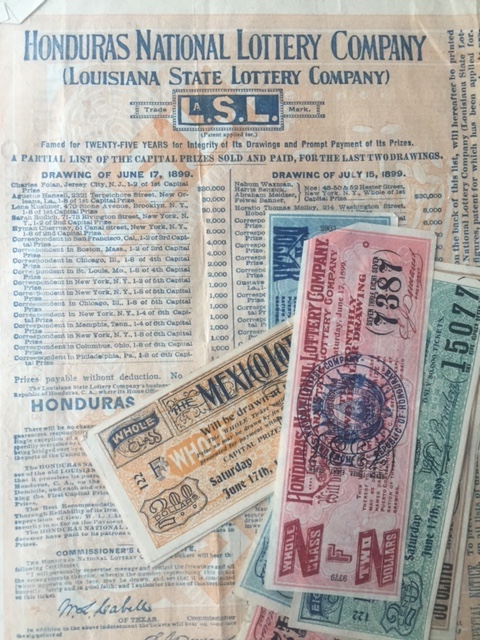
Conrad had one more trick. He relocated the Lottery to Honduras, and started sending pink circulars under the name the Honduras National Lottery Company by express mail, bypassing the post office. “We use the express companies in answering correspondents and sending lists of Prizes to the U.S.A.,” they said. “Reply by Express only.”

But it didn’t work. In 1892, the U.S. Supreme Court upheld the anti-lottery laws and Conrad announced that he would close shop. Wanamaker claimed victory. Morality and sound business practices had prevailed over the rebels. In 1895, green goods were also wiped out in the courts.

Too bad not all of Wanamaker’s schemes ended in victory. He was ridiculed for his most brilliant idea: Free rural delivery. One Republican editor wondered whether Wanamaker also wanted to “have the Government present every farmer with a free telephone and a free telegraph instrument.” Free rural delivery wasn’t enacted until after Wanamaker left office.

The robber baron Jay Gould himself denounced as socialistic Wanamekr’s plan to nationalize the telephone and telegraph systems and run them through the post office. Then it was over: Harrison lost to Grover Cleveland in the 1892 election, making Cleveland the only President to serve two non-consecutive terms. Wanamaker returned to his business, and lived until 1922, despite his youthful fears of consumption.

Chapter 14: The Road To Wellville

How Does A Gentleman Know a Cad?

By Ray Schultz

Ernest Hemingway committed suicide in 1961, and many people believed he had lost it as a writer by that time. First, there had been his 1950 novel, Across the River and Into the Trees. It was savaged by critics as self-parody; only Tennessee Williams thought it was among his poetic best.

Hemingway recovered in 1952 with The Old Man and the Sea, a short novel published to universal acclaim; it won him a Pulitzer and helped him snare the Nobel Prize for Literature. I especially love the scenes in which the boy brings food and coffee to the old man. But a certain revisionism soon crept in. Some critics deplored what they saw as the heavy handed symbolism of the old man carrying the mast of his boat, like Christ carrying his cross. I never bought that academic line. But it was the last book published in Hemingway’s lifetime, and readers wondered what he had been doing.

What he had been doing was working. In 1964, three years after his death, his widow Mary published A Moveable Feast, his memoir about his youthful days in Paris. I first read it at age 19, while working in a Navy photo lab. Here’s how it opens:

Then there was the bad weather. It would come in one day when the fall was over. We would have to shut the windows in the night against the rain and the cold wind would strip the leaves from the trees in the Place Contrescarpe. The leaves lay sodden in the rain and the wind drove the rain against the big green autobus at the terminal and the Café des Amateurs was crowded and the windows misted over from the heat and the smoke inside.

Imagine opening a book with the word “then,” a word Jonathan Franzen says a writer should never use. But who needs Franzen’s advice? A Moveable Feast contained some of the best prose Hemingway ever wrote, on a level with that of his short stories. I read on, enjoying paragraphs like this one, in which he enters a cafe:

It was a pleasant café, warm and clean and friendly, and I hung up my old waterproof on the coat rack to dry and put my worn and weathered felt hat on the tack above the bench and ordered a café au lait. The waiter brought it, and I took out a notebook from the pocket of the coat and a pencil and started to write. I was writing about up in Michigan and since it was a wild, cold, blowing day it was that sort of day in the story. I had already seen the end of fall come through boyhood, youth and young manhood, and in one place you could write about it better than in another. That was called transplanting yourself, I thought, and it could be as necessary with people as with other sorts of growing things. But in the story the boys were drinking and this made me thirsty and I ordered a rum St. James. This tasted wonderful on the cold day and I kept on writing, feeling very well and feeling the good Martinique rum warm me all through my body and my spirit.

Thirty or 40 years before the movie, that section transported me to the fantasy world depicted in Woody Allen’s Midnight in Paris. Obviously, it did the same for Allen and millions of other people.

Then there was this little scene about hunger, which Hemingway believed heightened his perception of the Cezanne paintings in the Louvre. Hemingway had just visited Shakespeare’s bookstore, where he all but admitted he was broke, and was handed a letter from a German publisher, containing 600 francs, a nice piece of change in those days.

Hemingway is angry at himself: You God-damn complainer. You dirty phone saint and martyr, I said to myself. You quit journalism of your own accord.

But now he has money. So, he writes, Hunger is healthy and the pictures do look better when you are hungry. Eating is wonderful too and do you know where you are going to eat right now?

 Lipp’s is where you are going to eat and drink too.

 It was a quick walk to Lipp’s and every place I passed that my stomach noticed as quickly as my eyes or my nose made the walk an added pleasure. There were few people in the brassiere and when I sat down on a bench against the wall with the mirror in back and a table in front and the waiter asked if I wanted beer I asked for a distingue, the big glass mug that held a liter, and for potato salad.

 The beer was very cold and wonderful to drink. The pommes a’ I’huile were firm and marinated and the olive oil delicious. I ground black pepper over the potatoes and moistened the bread in the olive oil. After the first heavy draft of beer I drank and ate very slowly. When the pommes a I’huile were gone I ordered another serving and a cervelas. This was a sausage like a heavy, wide frankfurter split in two and covered with a special mustard sauce.

I share these quotes merely to give you a sample of Hemingway’s writing—I offer no critical commentary. But admit it: Wouldn’t you want to be there?

But let’s get down to cases. This book also has its detractors. Gore Vidal, a writer I admire very much, hated “the spontaneity of his cruelty. The way he treated Fitzgerald, described in A Moveable Feast. The way he condescended to Ford Maddox Ford, one of the best novelists in our language.”

Vidal was right about the cruelty, and he would have known–look at some of the portraits in his own memoir Palimpsest . But those chapters were so funny. And both Ford and Fitzgerald  were fair game- they were world-renowned authors. Consider this exchange between Hemingway and Ford Maddox Ford as they drink at an outdoor table. Ford had just “cut” a man he identified as the writer Belloc. “Did you see me cut him?” he asks in a boastful way. Young Hemingway challenges him about it.

“A gentleman,” Ford explained, “will always cut a cad.”

 I took a quick drink of brandy.

 “Would he cut a bounder?” I asked.

 “It would be impossible for a gentleman to know a bounder.”

 “Then you can only cut someone you have known on terms of equality?” I pursued.

“Naturally.”

“How would you ever meet a cad?”

 “You might not know it, or the fellow could have become a cad.”

 “What is a cad?” I asked. “Isn’t he someone that one has to thrash within an inch of his life?”

 “Not necessarily,” Ford said.

 “Is Ezra (Pound) a gentleman?”

 “Or course not,” Ford said. “He’s an American”

Oh, how delicious.

And Fitzgerald? I revere him as an author, but the man had his tics, and Hemingway captured them. Take this scene, in which the two are traveling in Fitzgerald’s car, which has no roof, from Lyon to Paris, and are drenched in the rain, drinking wine all the way. Fitzgerald is convinced he has caught a fatal congestion, and they check into a hotel, and are dressed in their pajamas in the room while their clothes are being dried. Hemingway is reading a crime serial in a French newspaper.

On this evening in the hotel I was delighted that he was being so calm. I had mixed the lemonade and whisky and given it to him with two aspirins and he had swallowed the aspirins without protest and with admirable calm and was sipping his drink. His eyes were open now and were looking far away. I was reading the crime in the inside of the paper and was quite happy, too happy it seemed.

 “You’re a cold one, aren’t you?” Scott asked and looking a him I saw that I had been wrong in my prescription, if not in my diagnosis and that the whisky was working against us.

 “How do you mean, Scott?”

 “You can sit there and read that dirty French rag of a paper and it doesn’t mean a thing to you that I am dying.”

 “Do you want me to call a doctor?”

 “No. I don’t want a dirty French provincial doctor.”

“What do you want?”

 “I want my temperature taken. Then I want my clothes dried and for us to get on an express train for Paris and to go to the American hospital at Neuilly.”

That doesn’t happen. Fitzgerald who had just published The Great Gatsby, is finally persuaded by Hemingway that he is well (“I’ve always had remarkable recuperative powers”), and they get dressed and go down for dinner, where Scott passes out.

I’m sorry, but I still laugh when I read it.

By today’s standards, one may quibble with the portrait of Gertrude Stein: Hemingway wrote that he broke with her after walking in on an intimate scene between Stein and her partner. It’s a distasteful, stereotypical anecdote, if you will, but I believe there had to be more to it. There was growing professional tension between Stein and Hemingway. And Stein had plenty of nasty things to say about Hemingway, both his writing and masculinity, long before he wrote that account.

Hemingway also ridiculed an apparently gay writer who sat down with him, uninvited, while he was writing in a café. Well, nobody said Hemingway was a saint. Later, if you believe Kenneth Tynan, Hemingway had a friendly encounter with Tennessee Williams at a bar in Key West; they exchanged the names of doctors.

But back to A Moveable Feast. How did the physically declining writer achieve that level of prose? Biographers report that in 1956, when stopping at the Ritz Hotel in Paris, Hemingway was told that a trunk had been found that he’d stored there in 1927. To his delight, it contained his notebooks from that time.

Did Hemingway merely rearrange anecdotes written 30 years earlier that he discovered in the notebooks? Or did he truly write A Moveable Feast? in the 1950s based on information in the notebooks? That’s not clear, but I hope it’s the latter. Either way, he was preparing the book for publication, as he was The Dangerous Summer, on a bullfighting rivalry. Sitting there unpublished, not quite ready in his view, were three full-length books: Islands in the Stream, The Garden of Eden, and True At First Light (later repackaged as Under Kilimanjaro).

What had he been doing, indeed.

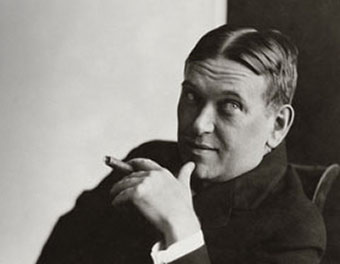
So yes, I’m a Hemingway fan. Do I also worship the macho man who reveled in what H.L. Mencken called “the armed pursuit of the lower fauna?” No, I compartmentalize that, just as I plan to compartmentalize the news, just out, that Hemingway signed on as a Soviet spy in the 1940s, although he never gave them anything. One must forgive him. just as one forgives John Dos Passos and James Gould Cozzens for being conservatives—it’s the work that’s important. Even Picasso was a Communist for a time. But who thinks about that when viewing his paintings?

Forget all the Life magazine hoopla. To see what kind of man Hemingway was, one must turn to Nelson Algren. In 1955, five years after he won the first National Book Award for his novel, The Man With The Golden Arm, Algren was in crisis. He was losing his beach house in Gary, Indiana, his passport had been seized because of his support for the Rosenbergs, his brief marriage (his second to the same woman) had ended, he regularly lost money gambling and his confidence as a writer had been shaken. Passing through Miami, he took a steamer to Havana; you didn’t need a passport to go to Cuba then. He called the Hemingways, and Mary Hemingway invited him out to their farm, Finca Vigia. Hemingway had been an early booster of Algren’s work, but they had never met. So Algren visited Hemingway, who was bed-ridden from injuries sustained in his 1953 plane crashes in Africa. To Algren, Hemingway looked more intellectual than he’d imagined. Algren, who had seen Disney’s The African Lion in Miami, insisted on showing the great hunter how big cats stalked prey. They talked about boxing, and Hemingway invited Algren for Christmas dinner the next day. Algren’s biographer, Bettina Drew, notes that Christmas at the Hemingways’ was just where he belonged…knowing he was accepted and respected for his writing, for what he was. The party was significant for Nelson because of the emotional affinity, far deeper than words, stirred by Hemingway.

Algren spent time alone with Hemingway prior to the dinner. Then, he reported, “Hemingway got out of bed painfully. He was fully dressed. There were guests waiting.” Algren recorded this scene in a remarkable 1965 book, titled Notes From A Sea diary: Hemingway All the Way, in which he wrote about his time as a passenger on a tramp steamer in the Pacific, in the form of a diary, and combined that with reflections on Hemingway and a counter attack against Hemingway’s critics. Here’s what he had to say about Hemingway and his guests:

He sat among them gravely serious. He carried an air of tranquility. He didn’t throw a punch at anybody. He didn’t stagger. He didn’t brag. He listened, perceived, and he liked having company. What he brought to a table of many guests was the feeling that everyone understood one another. I remember hearing Spanish spoken, and French, and of understanding not a word of what was said: and of knowing, when I spoke English, that some of the guests didn’t understand me. But because of Hemingway’s presence everything seemed understood.

His beautiful and moving writing aside, that’s how I think of Ernest Hemingway.

Scoundrels, Demagogues and Boobs

By Ray Schultz

You want politically incorrect? Try H.L. Mencken. I turned to the Sage of Baltimore to get perspective on the election, and he made me laugh, as always. So there is reason to live. Granted, things have changed in this country since his time, but it all sounds strangely familiar. What were Mencken’s politics? He hated everyone. Here was the man who called the New Deal “a milch cow with 125 million teats.” Yet the proud libertarian also despised fundamentalist Christians. If your group or state is skewered here, I can only repeat what a Republican told a Liberal the other day: “Toughen up.”

Nothing could have been further from the intent of Washington, Hamilton and even Jefferson than that the official doctrines of the nation in the year 1922, should be identical with the nonsense heard in the Chautauqua, from the evangelical pulpit, and on the stump. But Jackson and his merry men broke through the barbed wires thus so carefully strung, and ever since 1825 vox poluli has been the true voice of the nation. Today there is no longer any question of statesmanship, in any real sense, in our politics. The only way to success in American public life lies in flattering and kowtowing to the mob. A candidate for office, even the highest, must either adopt its current manias en bloc, or convince it hypocritically that he has done so, while cherishing reservations in petto. The result is that only two sorts of men stand any chance whatever of getting into actual control of affairs—first, glorified mob-men who genuinely believe what the mob believes, and secondly, shrewd fellows who are willing to make any sacrifice of conviction and self-respect in order to hold their jobs. One finds perfect examples of the first class in Jackson and (William Jennings) Bryan. One finds hundreds of specimens of the second among the politicians who got themselves so affectingly converted to Prohibition, and who voted and blubbered for it with flasks in their pockets.” (On Being An American, 1922)

***

On the steppes, Methodism has got itself all the estate and dignity of a state religion; it becomes a criminal offense to teach any doctrine in contempt of it. No civilized man, to be sure, is yet actually in jail for the crime; civilized men simply keep out of such bleak parking spaces for human Fords, as they keep out of Congress and Franz Josef Land. But the long arm of the Wesleyan revelation now begins to stretch forth toward Nineveh. The mountebank, Bryan, after years of preying upon the rustics on the promise that he would show them how to loot the cities, now reverses his collar and proposes to lead them in a jehad against what remains of American intelligence, already beleaguered in a few walled towns.

Not much gift for Vision is needed to imagine the main outlines of the ensuing Kultur. The city man, as now, will bear nine-tenths of the tax burden; the rural total immersionist will make all the laws. With Genesis firmly lodged in the Testament of the Fathers he will be ten times as potent as he is now and a hundred times as assiduous. No constitutional impediment will remain to cripple his moral fancy. The Wesleyan code of Kansas and Mississippi, Vermont and Minnesota will be forced upon all of us by the full military and naval might of the United States. Civilization will gradually become felonious everywhere in the Republic, as it already is in Arkansas. (The Husbandman, 1931)

***

Virginians, even the worst of them, show the effects of a great tradition. They hold themselves above other Southerners, and with sound pretension. If one turns to such a commonwealth as Georgia, the picture becomes far darker. There the liberated lower orders of whites have borrowed the worst commercial bounderism of the Yankee and superimposed it upon a culture that, at bottom, is but little removed from savagery. Georgia is at once the home of the cotton-mill sweater, of the Methodist parson turned Savonarola and of the lynching bee. A self-respecting European, going there to live, would not only find intellectual stimulation utterly lacking, he would actually feel a certain insecurity, as if the scene were the Balkans or the China Coast. (The Sahara of the Bozart, 1917).

***

At each election we vote in a new set of politicians, insanely assuming that they are better than the set turned out. And at each election we are, as they say in the Motherland, done in.

Of late the fraud has become so gross that the plain people begin to show a great restlessness under it. Like animals in a cage, they trot from one corner to another, endlessly seeking a way out. If the Democrats win one year, it is a pretty sure sign that they will lose the next year. State after state becomes doubtful, pivotal, skittish, even the solid South begins to break. (The Politician, 1924)

***

(The average American’s) docility and pusillanimity may be overestimated, and sometimes I think that they are overestimated by his present masters. They assume that there is absolutely no limit to his capacity for being put on and knocked about—that he will submit to any invasion of his freedom and dignity, however outrageous, so long as it is depicted in melodious terms. He permitted the late war to be “sold” to him by the methods of the grind-shop auctioneer. He submitted to conscription without any of the resistance shown by his brother democrats of Canada and Australia. He got no further than academic protests against the brutal usage he had to face in the army. He came home and found Prohibition foisted on him, and contented himself with a few feeble objurgations. He is a pliant slave of capitalism, and ever ready to help put down fellow-slaves who venture to revolt. But this very weakness, this very credulity and poverty of spirit, on some easily conceivable tomorrow, may convert him into a rebel of a peculiarly insane kind, and so beset the Republic from within with difficulties quite as formidable as those which threaten to afflict it from without.

What Mr. James N. Wood calls the corsair of democracy–that is, the professional mob-master, the merchant of delusions, the pumper-up of popular fears and rages–is still content to work for capitalism, and capitalism knows how to reward him to his taste. He is the eloquent statesman, the patriotic editor, the fount of inspiration, the prancing milch-cow of optimism. He becomes public leader, Governor, Senator, President. He is Billy Sunday, Cyrus K. Curtis, Dr. Frank Crane, Charles H. Hughes, Taft, Wilson, Cal Coolidge, General Wood, Harding. His, perhaps, is the best of trades under democracy–but it has its temptations! Let us try to picture a master corsair, thoroughly adept at pulling the mob nose, who suddenly bethought himself of that Pepin the Short who found himself mayor of the palace and made himself King of the Franks. There were lightnings along that horizon in the days of Roosevelt; there were thunder growls when Bryan emerged from the Nebraska steppes. One some great day of fate, as yet unrevealed by the gods, such a professor of the central democratic science may throw off his employers and set up a business for himself. When that day comes there will be plenty of excuse for black type on the front pages of the newspapers. (On Being an American, 1922).

***

Most of the rewards of the Presidency, in these days, have come to be very trashy. The President continues, of course, to be an eminent man, but only in the sense that Jack Dempsey, Lindbergh, Babe Ruth and Henry Ford have been eminent men.

The honors that are heaped upon a President are seldom of a kind to impress and content a civilized man. People send him turkeys, opossums, pieces of wood from the Constitution, goldfish, carved peach kernels, models of the state capitols of Wyoming and Arkansas, and pressed flowers from the Holy Land. Once a year some hunter in Montana or Idaho sends him 20 pounds of bear-steak, usually collect. It arrives in a high state, and has to be fed to the White House dog. (The Imperial Purple, 1931)

Calling Western Union

By Ray Schultz

Direct mailers have often tried and failed to find alternative delivery systems. But they were offered one in the early 20th century by a trusted brand name.

“The Western Union Telegraph Company has a complete messenger service for delivering telegrams,” manager J.A. Rudd told Printers’ Ink magazine in an interview published on Sept. 30, 1903.

That said, Rudd announced that this service had been expanded to include advertising matter. It would cover “more than 30,000 cities, towns and villages in every part of the United States.”

As Rudd explained, two developments drove this move. First, the company realized that its messengers had too much time on their hands.

“They came to the offices at eight in the morning, uniformed and ready for work, but the rush did not begin until eleven o’clock, and at three it was over,” Rudd said. “This left five or six hours of time during which they were unoccupied.”

Second was the fact that the Post Office had excluded some publications from second-class privileges.

“The express companies could not handle mail matter, and many publishers were at a loss for methods of distributing their periodicals,” Rudd explained.

So Western Union stepped into the breach, delivering samples, advertising literature, catalogs and “any other matter that we could profitably handle,” Rudd said. “Our service is not based on weight, like that of the Post Office, but on individual deliveries, and we are able to distribute small packages at rates far below those of the express companies.”

Case in point: “A publication weighing one pound, which is the minimum weight of most monthly magazines and trade journals,” Rudd said. “The government carries such a publication for one cent at second-class rates, or eight cents third-class. We deliver it for one cent, and get a signed receipt in each case. The latter is turned into the publisher.”

Rudd continued that, “for a publication weighing five pounds we charge four cents, saving a penny on second-class rates, and thirty-five cents on third-class, under which catalogues are mailed.”

And samples? One patent medicine seller “had a remedy which he was sending by mail, selling it at twenty-five cents,” Rudd said. “Postage came to twelve cents, eating up his profit. Consignments of this remedy were shipped to our distributing centres, and when the manufacturer received an order a bottle was delivered and twenty-five cents collected form the addressee. This service cost five cents, including return of money and receipt.”

Thanks to clients like this one, there was so much work that “we are now putting on boys who work wholly at delivering,” Rudd added.

Western Union even offered mailing lists. “We have made no attempt to furnish addresses to our customers, but our books contain thousands of cable addresses, and we also have lists of wholesale and retail houses throughout the country,” Rudd stated. “These lists, under certain conditions, are accessible to responsible customers.”

It’s not clear how long this service lasted. But there was one false note in Rudd’s presentation.

“There are thousands of people right here in New York who have never received a telegram, and delivery by telegraph messenger is an event,” Rudd said.

That’s a little dubious. As I recall, a telegram was a frightening thing for an average person to get—it usually meant a death in the family.

The Schlock That Wouldn’t Die

By Ray Schultz

I recently had breakfast with a filmmaker whose masterworks include 2000 Maniacs, The Gore Gore Girls, and Blood Feast, the first movie in which “people died with their eyes open.”

The producer of those splatter classics, now eating yogurt and cereal in a hotel coffee shop, was Herschell Gordon Lewis, a direct mail copywriter and an inspiration to anyone who wants to have fun as well as make a living.

“The technique I learned of how to cause an unsuspecting yokel to come into a theater has served me well in my dotage years in direct marketing,” he confessed.

I couldn’t resist asking how a person goes from being a footnote in movie history to a junk mail legend. Herschell had already worked as an English professor, a disk jockey, and a general ad person, when he started making low-budget gore flicks in Chicago in the 1960s (he just happened to own a half interest in a studio that did commercials and government training films). His first was Blood Feast, which was also the first movie in which fiends “reached in a girl’s mouth and pulled out her tongue.”

Hard to top, wouldn’t you say? But he tried, in follow-up blood fests like Color Me Blood Red and She Devils on Wheels. Men were sliced and diced, white-mini-skirted women were crucified (literally), and Lewis won himself a loyal cult following. A year or two ago, he showed up at a horror film festival in Milan to find the audience singing along—in English–with the opening song for 2,000 Maniacs:

There a story you should know

From a hundred years ago

And a hundred years we waited now to tell

Now them Yankees come along and they’ll listen to this song

They’ll quake in fear to hear this rebel yell

Yeah—ha!

Herschell wrote and sang the soundtrack song himself, and still gets a small royalty– “about $30 every six months, a symbol of what I call the Schlock That Wouldn’t Die.”

Unfortunately, Herschell’s film career faded as distributors went bankrupt and the big studios came in with “more advanced skills in killing people onscreen.” (They didn’t have to splatter ketchup on the walls). And his advertising business took a nose-dive when a client went belly-up owing six figures.

Reduced to arguing with schlemiels about $40 typesetting charges, Herschel was ready to listen when asked to write a direct mail package for the Women of the Century series of collector plates from the Bradford Exchange.

Talk about landing on your feet: He showed a knack for selling collector’s items, and was soon given other assignments by Bradford. By this time, Herschell had gotten another break (the most important one of his life): his marriage to Margot, an agency colleague, who now became his partner in charge of the business end.

The pair moved on to the Calhoun Collector’s Society, where their projects included The Creation, a 12-plate series telling the Genesis story, and the Bethlehem Christmas Plate, which has to rank somewhere near Blood Feast in the Lewis canon.

To get the Bethlehem plate off the ground, Margot found a porcelain factory in Israel near the Lebanese border, then tried to find someone to authenticate the plate. But the best she could do was the Archimandrite Gregorious, an Orthodox prelate whose role in life appeared to be greeting the tour busses and asking for money. His picture, complete with black robe and hat, appeared on the plates, although “we had to airbrush the sunglasses,” Herschell says.

But it sold. “After two years, the Archimandrite was recalled or fired or what I don’t know. But we kept using his name, and he was immortalized. Right now, as we talk, he is hanging on somebody’s wall.”

Herschell confessed that “it’s possible to develop cynicism based on some of the things we market successfully. But there’s a big difference between cynicism and contempt.” One thing that appalls him is when he sees copywriters treating financial offers “in a light-hearted manner. I say, ‘Hold it there, fella, people take their investments seriously. When you make a joke out of it, you make a joke out of your proposition.’”

POSTSCRIPT: Herschell returned to filmmaking late in his career. Whatever he did, he was first to admit that none of it would have been possible without Margot. Now there’s an enduring marriage.


DEAR FRIEND: The Rascals, Rogues and Roues Who Made American Junk Mail, Chapter 8: The Pride Of Park Row

By Ray Schultz

J. M. Pattee left Omaha for good—some say he was run out—in the summer of 1873. The Nebraska legislature had outlawed lotteries, effective Sept. 1, so he regrouped in New York, where he owned a brownstone near Central Park.

Not a man of idle nature, as one reporter put it, he ran a few scams in the city, then made his way to  Laramie and ingratiated himself with the right people. The Wyoming legislature passed a bill granting him a ten-year lottery license that could never be altered, and Pattee acted on it before the governor could sign it (which he never did).

It didn’t matter. The so-called Wyoming Lottery would operate entirely by mail. And Pattee could get away with it,for lawmakers had failed to keep lotteries like his out of the postal system.

Congress had tried in 1865 with a law defining “nonmailable matter”—everything from explosives to lottery materials. But it failed to specify letters or circulars, and what it meant the courts could never figure out.

Realizing their error, the lawmakers attempted  to clarify things in 1868 by prohibiting the mailing of “any letters or circulars concerning lotteries, so-called gift concerts, or other similar enterprises.” But this bill, too, was flawed in that it failed to set penalties for disobeying it.

In 1872, trying one more time, they forbade the mailing of “any letters or circulars concerning illegal lotteries, so-called gift concerts, or other similar enterprises, offering prizes, or concerning schemes devised and intended to deceive and defraud the public for the purpose of obtaining money under false pretenses.”

The blunder this time was that they had added the word “illegal.” How could a lottery chartered by a state or an institution be considered illegal?

Pattee knew that they would get it right sooner or later, and he knew he had to move beyond lotteries. He had doubtless heard of E.C. Allen, of Augusta, Maine, who in 1869 started Peoples’ Literary Companion, a paper filled with stories, homilies, recipes, songs and advertisements.

Other publishers followed Allen’s lead. A fellow Augustan named P.O. Vickery started Fireside Visitor, and W.W. Gannett followed with Comfort. Mailed to farmers whether they wanted them or not, these mail order papers were “the great business of the city, completely overshadowing everything else,” wrote Frank A. Munsey.

Pattee could do the arithmetic as well as anyone. He created The Times Illustrated, a promotional vehicle for the Wyoming Lottery. The cost was defrayed, in part, by paid advertisements for Red Cloud’s Great Indian Blood Purifier and other patent medicines.

He followed it with The Laramie News, in which he described Laramie and the local mining deposits: “There are within a hundred miles of Laramie City a hundred miles in length of gulches which will pay an average of five dollars per day in gold, for every day’s labor, and they can be worked with very little outlay of capital.”

Thus he sharpened his pen for a new venture—and just in time. On July 12, 1876, Congress enacted a new bill, dropping the term “illegal” when describing lotteries. Now it was unlawful to send any sort of lottery letter.

This bill turned out to be as hollow as the previous ones, but that wasn’t clear at first. Pattee cancelled his next lottery mailing, saying “times have been hard,” and accelerated a plan he apparently already had: He prepared a letter for fools who had won his previous lotteries and were now on his sucker’s list.

“On account of the new Postal law and the penalty for sending letters concerning lotteries through the mails, I have been obliged to make some other arrangement to pay off the small prizes of $1 and 50 cents as it would cost the party receiving them more than the amount to pay the express charges,” Pattee wrote under his own name.

Instead, he awarded shares in “one of the most extensive gold mines on this continent.” Additional shares could be had for $2 apiece.

“It is the richest gold mining country in the world,” Pattee wrote. “For miles away up in the heights of those tremendous elevations in the Big Horn Mountains glisten rich veins of gold quartz that run in golden ribbons at close intervals across their breasts. Some specimens of gold quartz have been found which assayed $47,000 to the ton—a mountain of gold ore.”

Pattee’s own employees turned against him. They sent a mailing to his “winner’s” list, offering for one dollar “a most complete exposure of this ‘arch swindler’s’ manner of defrauding the public during the past years.” They added that he planned to “foist upon those who have won good prizes in his last drawings, amongst whom we see your name, certain stock certificates…instead of the money they have RIGHTFULLY WON.”

The master returned to New York, where there was less danger of getting shot. He now worked only through designated criminals who would take the fall if there was trouble. One was N. Sherman Read, a tiny man known to friends as Nate. Pattee was married to Read’s sister Eunice, and they had often summered at Read’s resorts in New Jersey.  In 1876, now working for his brother-in-law, Read opened a lottery office on Nassau St. near Park Row.

Flanked on one side by City Hall, Park Row was home to newspapers and advertising agencies–and dozens of lottery shops. “Entering the office of any one of these so-called firms, the inquirer finds himself surrounded on all sides by a ground-glass partition,” a reporter wrote. And each one had a “hard-featured man peering through a wire netting under the sign ‘Cashier.’”

These offices also sent quantities of junk mail. The city’s best printers and engravers were two blocks south on Maiden Lane, and the largest post office in the country, a five-story granite block known as the Whale, stood on the triangular lot bordered by Park Row and Broadway.

Pattee made full use of these facilities, not only for his lotteries but for schemes like the Bullion Gold Mining Co. and Carburrus Gold Mining Company.

He also got to know his fellow mail fraud artists. Ellis and William Elias were driven out of Cincinnati for swindling, then made a fortune in New York running “dollar stores”—stores in which the shopper never knew what he was buying. They enjoyed a “very unenviable reputation,” the New York Times wrote.

The brothers operated a mail room in which men and girls sat at two rows of tables shaped in the letter “L,” addressing envelopes. Also to be found there was H.P. Jones, a former post office employee who was “discharged from P.O. for NY for embezzlement or helping himself to other peoples’ money.” A handwritten note signed by him was sent to 140,000 people in the fall of 1878:

“Dear Sir:

“A cousin of mine bearing the same name as yours, after the war was over, left his Regiment and I have not heard from him since. Now I do not know whether you are the same person or not but you can tell as soon as you see my signature to this letter.”

The note continued that a contest was about to be held, and that if the recipient agreed it would be rigged in his favor. Why this largesse? “I am sure that if a large prize was drawn by you and shown around that thousands of tickets could be sold in your County.”

A series of followup letters persuaded the sucker to pay $8 apiece for lottery tickets—a seemingly paltry sum by today’s standards—but the letters cost only a penny apiece to mail, and not much more to print. The Eliases had discovered the immutable law of junk mail—that a profit could be made even after expenses and the pilfering of cash-filled envelopes by postal workers.

Anyway, it was not their only business. They also ran several “stores,” including a jewelry store on Broadway and 21st St. (above which was their mail room). Their flagship was the Centre, a large outlet at 22nd St. and Broadway, in which they displayed gold and silver jewelry in cases. It operated on the same marketing principles as the junk mail business.

The Eliases promised in circulars that they could deliver “the most valuable articles to the purchaser at the same price as those of less cost,” but what they really offered was a lottery. The customers bought tickets in sealed envelopes from a cashier, who sat hidden in a teller’s cage. Most opened the envelopes to find that they had won cheap merchandise.

Operating on the border of legality, the pair had to pay occasional modest fines. But they “reaped a rich harvest from their numerous enterprises,” the New York Times reported. Ellis Elias alone had $300,000 in assets, including a country estate and $3,000 worth of trotting horses.

“A man who came in contact with the senior member of the Elias firm used to tell of seeing him exhibit a roll containing sixty one thousand dollar bills, one day, and when putting it back in his pocket heard him remark, pleasantly, that that was some that came in after he had got done expecting to make any money,” wrote George Rowell, whose ad agency was located at 41 Park Row.

Pattee could admire these accomplishments. And though they were competitors, he started working with Eliases on a matter that would benefit them both: The trading of names and addresses.

There was at this time no mailing list business per se. Some frauds wrote to small-town postmasters offering a dollar for the names of “all men (no women) as herein provided, who are permanent residents and who receive mail at your office.” Others asked customers for the names of their friends. “Any person, who will send us the Address of ten persons of their acquaintance, we will send free post-paid, a beautiful Chromo for their trouble, and Wholesale Price-list of Jewelry,” the City Novelty Co. promised in 1873.

Still another way was to copy names out of a city directory. But this was too much work for the average fraud—an easier method was to sell or rent names from each other. Pattee had 300,000, and he turned an unknown number of them over to the Eliases for a consideration.

This bartering of names quickly grew into a business. L’Orient Chemical Company of Bristol, Rhode Island, offered its letters to all comers in 1875.

By this time, using his list, Pattee had broadened his product offering. First, he went into stock brokerage with a Louisiana criminal named J.F. Barrett, using Andrew Simpson, his Maiden Lane printing foreman, as a front man. They mailed a newspaper called The New York Stock Exchange.

Next was an outfit called Heath & Co., The office was located a few doors away from a legitimate brokerage—Wm. Heath & Co. Victims received stock certificates and regular reports on how their investments were soaring, but requests to redeem the stock were never answered.

Then Pattee unveiled his masterpiece—the Silver Mountain Mining Co. For this, he hired a former postal agent named William R. McCall, who had also worked for the Eliases.

“Persons who invest a few dollars to develop the Mine may realize a fortune,” said the prospectus, which featured a map marked in several places by the word “ore.”

What they got, though, were regular reports and requests for more money to keep the mine running. Said one: “The Indians made their appearance last week, but have all but disappeared.”

It was the summer of Custer’s last stand and the lead-up to Hayes-Tilden presidential contest. The Brooklyn Bridge was being built—the noise could be heard on Park Row. And Pattee, like many other businessmen, coped with problems beyond his control. The Pennsylvania and New York Central Railroads stopped hauling mail cars because the post office had reduced their compensation by 10%. Then there was a nationwide rail strike. Meanwhile, he feuded with the Eliases. None of it stopped him from reaching the “zenith of his prosperity.”

But he was being watched.

Chapter 9: The Vice Crusader

Was Jesus An Advertising Man?

By Ray Schultz

It’s forgotten now, but one of the biggest sellers of the 1920s was Bruce Barton’s The Man Nobody Knows. It posited that if Jesus Christ returned to earth, he would be an advertising man.

With all respect to my friends in advertising, this I doubt. But the book was published in an optimistic era, in which business people were lionized.

You can get the drift from a direct mail letter for the book written by the great copywriter Robert Collier:

Jesus Christ ‘the founder of modern business?

Jesus a master of efficiency in organization, a born executive?

Jesus a sociable man, a cheerful, bright companion with a pat story on His lips…?

Jesus wording the best advertisements ever written?

This letter, and others like it, were accompanied by a brochure, asking: Was Jesus a Physical Weakling?

The painters have made Him look so—but He swung an adze and pushed a saw until He was thirty years old. He walked miles every day in the open air. He drove a crowd of hard-faced men out of the Temple.

It’s beautiful copy, but there’s one slur I don’t like: that Jesus “faced Jewish hatred and Roman power without a tremor.” The Catholic Church has said that Jews were not responsible for the death of Christ. (Thank you for that). For the record, the religious ones among us await the Moschiach, and nobody has predicted he will be an advertising man.

That said, Collier’s letter sold millions of books. But an upheaval was coming: the Great Depression. At that time, people viewed Jesus in a more traditional light: as minister to the poor and fallen.

As for Robert Collier, he was a direct mail legend, with or without help from the Messiah.

“Collier was first guy that really sold merchandise by mail,” said the direct marketing guru Bob Stone in 1997. “He came up with 10-day pre-trial guarantees, all things we use today. He was a merchandising genius. For example, he had a bunch of black raincoats that they couldn’t sell worth a damn. Who absolutely has to have a black raincoat? So he had a list of undertakers. and sold out entire stock. It was a lesson I never forgot.”

Stone met Collier at a conference in 1939. What was he like personally? “He wasn’t aloof , he was a loner. There’s a difference. He was a shy man. He was dedicated to the sale of merchandise. I don’t think he had a lot of pride. He had a merchandise business by selling those raincoats and hunting books, for himself mostly.”

One legend has it that Collier sold coal at some point. Finally, he joined P.F. Collier & Son Co., publishers of Colliers magazine and books like Harvard Classics, the Five-Foot Shelf of Books. It just so happened that P.F. Collier was his uncle, “but he had always told me he did not want me in the business until I could bring something to it they could get nowhere else,” Collier wrote. In I 931, Collier published his own book: the Robert Collier Letter Book,

And was he a believer in Jesus the businessman or Jesus the healer? This we don’t know.


‘I Have Not Yet Begun to Fight’

An eBook By Ray Schultz

In 1906, a Navy petty officer tried to enter a dance hall in Newport Rhode Island, and was turned away because of his uniform. Normally, that would have been the end of it, but Chief Yeoman Fred J. Buenzle was a wily old salt. He’d bought a 25 cent ticket when wearing a civilian coat and hat, and having paid that money, he felt he had a contract and could sue the Newport Amusement Association for failing to honor it.

Predictably, Buenzle lost the case right up through the appellate court. But in 1908, the Rhode Island General Assembly passed the Uniform Act, barring discrimination against men in uniform; the State Senate rapidly followed suit. And Buenzle, a man with broken service and at least one disciplinary case on his record, deserved the credit for it.

Why is this important now? Because service men and women still face obstacles (different ones). By pursuing that case, Buenzle did more for his fellow enlisted personnel than John Paul Jones, Stephen Decatur and anyone in the panoply of Naval legends.

So who was this unlikely hero? Here is his story.

Part I: Dirty Lubbers

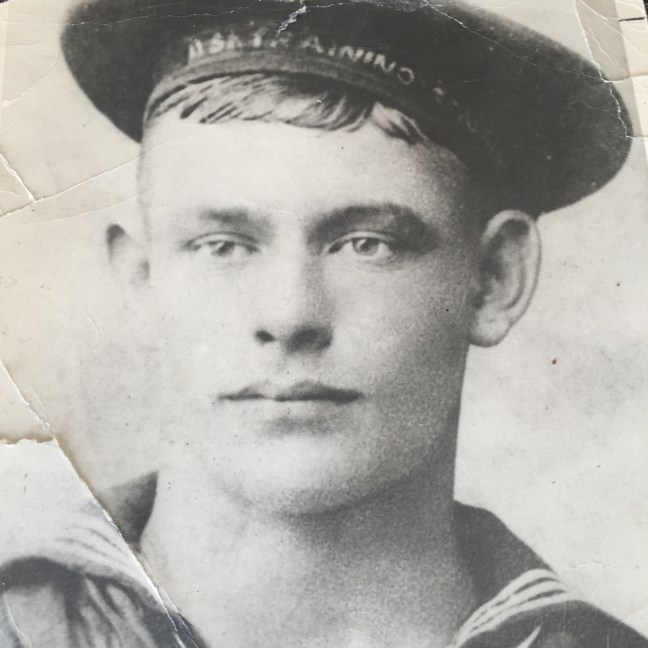
Fred Buenzle was born in 1873, in the Pennsylvania Dutch country, of parents who owned what he called a “commercial hotel.” He spent every night of his youth helping his father fill bottles of beer in the cellar, and was often overcome by the fumes. At 16, he enlisted as a boy apprentice in the U.S. Navy in to fulfill a childhood dream of going to sea (and probably to get out). His father disagreed with that decision, but signed the papers anyway.

The Navy Buenzle joined was not a very healthy place for enlisted men, though. As he put it, foreign mercenaries filled the ranks, while Americans wearing the uniform were disgraced at home. “New promises were made to the recruits, and the old-timers had to subsist on broken pledges,” Buenzle wrote in his 1939 memoir Bluejacket, a book I first read as a young sailor.

That was driven home on Buenzle’s very first day in the service. Before boarding the USS St. Louis, an old sailing ship at the Philadelphia Navy Yard, for the signing of his apprentice articles, he met an old sailor who tried to talk him out of signing. The problem, the old man stated, was not with the Navy—that was fine—but with the civilian populace.

“The dirty lubbers and crooks on shore won’t serve a man in uniform, not in any decent place they won’t! And you won’t be able to buy a good meal or a clean bed, or go to a theater. Only the dive-keepers and the trollops will give the sailorman a hand, my boy, and don’t say I didn’t warn you.”

Buenzle joined anyway, but that very night he came close to regretting he did. In full view of the crew, the captain of this hulk put a group of men in irons, a brutal punishment for minor offenses. “This incident of my first day in the Navy was my earliest lesson in the need of prompt and unquestioning obedience to any order received from a superior in rank or rate,” Buenzle wrote. “It made me also aware of the possibilities for tyranny at the hands of men clothed with absolute power, and of how easily a headache or any slight upon the dignity of the afterguard might be taken out upon the hapless lower ratings.”

About the only good thing that happened on the St. Louis was that Buenzle met some relics of another age, like Happy Dorgen, Baldy Tom Dunn, Jack Robinson (“a mighty liar), Basil Bono and the Hawaiian Kanaka, who told stories of a buried treasure.

As a youthful reader, I tended to view all this through a romantic haze. The base mess hall in Newport, Rhode Island periodically served what a yearbook described a typical Navy breakfast in the 1890s: boiled eggs (hard or soft), Navy beans and corn bread. I liked it because I felt it connected me to the past. In reality, Buenzle’s first meal aboard the St. Louis was a “tin-dish supper of boiled rice, molasses, hardtack and tea,” wrote New York Times reviewer James Thompson.

Following this interlude, Buenzle was sent to Newport, Rhode Island for apprentice training aboard the USS New Hampshire. But the ship was moored in “sewage crusted slough,” and an epidemic of typhoid fever broke out, causing the New Hampshire to be called “the floating coffin.” Training had to be continued onshore.

A month or two later, Buenzle set sail on an ancient vessel called the Portsmouth. It sailed from Newport to the Caribbean, stopping in New York, where “a half eagle was sufficient for a snug twenty-four hour liberty.” Buenzle soon found, though, that life at sea was hellish. Everything was damp, food was always cold, and there was plenty of deck duty, from which “all our clothing was sodden and the skin on hands and feet became bleached and tender,” he noted. Finding the port of Barbados to be a place with a “remarkable lack of points of interest,” Buenzle wrote of the lonely watches at sea during the early morning hours. “The boys,” he wrote, “hunch closer, and in whispered tones talk together of sharks at sea and sharks ashore, and of human wolves, and of the loneliest time in boyhood that each of them could remember.”

The young sailor next reported to the sailing frigate Lancaster, the new flagship of the Asiatic station. En route to Asia, he received his first disciplinary action for sleeping on watch. In 1893, at the age of 21, disgusted with being rousted out of wet hammocks at night, of eating cold mutton while officers ate delicacies, including desserts like cherry pie, and of the “pious pomposities,” of the officer corps, Buenzle took his discharge in Shanghai.

Part II: Buried Treasure

Buenzle’s first stop as a civilian was the American consulate where because he refused government passage back to the States, he had to waive the right to any further aid. But he was resourceful: When war broke out between China and Japan, he took a commission as a captain in the Chinese Army, and served as an instructor up the Yangtze River. There he met Merci Fabre, a friend of the Hawaiian Kanaka, and they went in search of the treasure described by the latter. They sailed from Shanghai to Hong Kong, then to the southern part of Formosa, where (if you believe it), they uncovered the treasure, ten thousand dollars in American and British money. When they tried to transport it in a fishing boat, though, the vessel capsized; Buenzle, who couldn’t swim, had a hard enough time saving his own neck. Twenty-two days later, without a dime of treasure, he was aboard a Canadian Pacific ship en route to the United States.

After a tenure as a special writer for the Philadelphia Times, Buenzle decided that civilian life could never match the peace of mind—i.e., the security—of the Navy. He re-enlisted aboard the sailing ship Monongahela with the rank of Ship’s Writer, First Class. But he soon learned that the Navy had changed. Aboard the battleship Brooklyn, a “new ship,” Buenzle found “young men who ha never before felt the swell of a ship beneath them. The old shellbacks remaining were in charge of gangways and lower decks.”

Buenzle had changed, too, and he had some strong views about Navy life. After sailing to Britain for Queen’s Victoria’s Jubilee in 1897 (“our uniform was more honored than it was in our own land”), he reported the USS Dolphin, and there met Assistant Secretary of the Navy Theodore Roosevelt. The two men discussed the plight of the enlisted man and together drafted a memorandum to the Secretary of the Navy. “We must make a determined effort to create a public opinion so strong and aggressive that every class of people in the United States who pretend to be patriotic Americans will not dare to erect a barrier against the uniformed men of our national defenses, whether there be any law governing the cases or not.”

Part III: Murder At Sea

Buenzle’s next post was on the battleship Iowa, part of the Great White Fleet, where he served as clerk to Captain William Thomas Sampson. Sampson was the president of the Court of Inquiry that investigated the sinking of the battleship Maine in Havana harbor; Buenzle was the stenographer. When war was declared, Sampson was promoted to Rear Admiral and given command of the North Atlantic Fleet. Buenzle accompanied him to the flagship New York.

Convinced that the enlisted men should be given some word of the events, Buenzle established a daily log, “The Squadron Bulletin,” and printed out 1,000 copies a day on a primitive duplicating machine. There was plenty to write about. First, the New York captured the Spanish merchantman Buenaventura. The booty was split among the crew, and Buenzle ended up with $300. Then, from the flying deck of the New York, he witnessed the destruction of the Spanish fleet as it tried to emerge from Santiago harbor; he even selected the volunteers who helped lieutenant Richmond Pearson Hobson sink the collier Merrimac in an effort to block the channel. “The fleet under my command offers the nation as a Fourth of July present, the whole of Cervera’s fleet,” Buenzle ghostwrote for Sampson.

Privately, Buenzle saw little reason to celebrate, though.

“ …It was impossible that they could feel lighthearted in the face of so much suffering,” he wrote in Bluejacket. “I never wanted to hear the word ‘war’ again; and I determined, on that day, while the air was yet filled with the sour tang of smokeless powder and the crash of exploding shells, that I would be glad to exchange my naval billet for the humblest calling on shore if there was any more murdering to be done on the sea.”

Part IV: Dogs and Sailors, Keep Out

After the war, Buenzle reported to Newport again, where as Chief Yeoman, he was named officer-in-charge of the Yeoman School. And it was in Newport that his campaign for the enlisted man fully materialized.

With the three hundred dollars he received from the capture of the Buenaventura, he launched Our Naval Apprentice, the Navy’s first station newspaper, in 1901. Its mission was to entertain the men and to fight the prejudice downtown. It eventually evolved into the Newport Navalog, a newspaper that published its last print issue last year.

Next, Buenzle filed his lawsuit against the Newport Amusement Association. “Painful remembrances of the many indignities heaped upon my comrades in the sea eservice had urged me to initiate the prosecute the case of my own expense,” Buenzle wrote. These included signs saying, “Dogs and sailors keep out,” and “No men in uniform allowed.”

In this, Buenzle had the support of officers like Rear Admiral Charles M. Thomas who handled his legal fund. But they were of little help during cross-examination. William C. Clarke, the president of the company, brought in some  lawyers, and they started out by claiming that Buenzle had violated Naval regulations by disguising his uniform when he purchased a dance-hall ticket.

“You expected to be refused when you presented that ticket in uniform, didn’t you?” the opposing counsel asked the sailor.

“Not exactly,” Buenzle said. “I wished to know if I would be refused. I wished to know if there was any discrimination, whether it was against me personally, for any personal disqualification, or whether it was against the uniform.”

“But you expected it, and you wanted to find that out. Answer my question. You expected to be refused admission, didn’t you?”

“I wasn’t sure. I heard the men were discriminated against for the blue blouse and the shirt sleeves, but I didn’t expect to be refused admission.”

“You did not.”

“I didn’t expect to be refused admission in a white shirt and a collar and tie, as any citizen, with only the difference of a rating badge and brass buttons.”

The court threw out Buenzle’s claim, stating that it was the “settled rule of law for many years, that a ticket of admission to a race-track, a theatre, a concert, or any such entertainment is a mere license, revocable at the will of the party issuing the same.” He was, however, entitled to get his 25 cents back.

That view was upheld on appeal by the Supreme Court of Rhode Island in February 1908. The higher court stated that “military and naval uniforms are not intended as a badge of social equality, but on the contrary they are evidences of rank and distinction…” Thus, Buenzle was entitled to a refund but not to damages for emotional distress.

The court added, though, that if “such discrimination is deemed to be a matter of grave public consequence, it rests with the law-making power to afford a proper remedy.”

Precisely. And what Clarke and company didn’t seem to realize is that Buenzle had the ear of his superiors, right up to President Theodore Roosevelt (who sent a check), and that he was a talented writer, well equipped for publicizing this controversy.

Roosevelt said: “I feel that it is the duty of every good citizen to endeavor in every shape and way to make it plain that he regards the uniform of the United States Navy…as a badge of honor, an therefore entitling the wear to honor so long as he behaves correctly.”

The Uniform Act was passed a short time later. And Buenzle was able to write that the greatest fight of his life ended with the flagrant signs being taken down and “shelved with other anachronisms.”

Part V: Home Is the Sailor

What could Buenzle do to top that? Write a book. He prospered as officer-in-charge of the Yeoman School, and in 1909, left Newport for sea duty. After retiring from the Navy in 1919, he settled in Palo Alto, California., where he opened a Naval history museum, and spent the rest of his time writing Bluejacket, which appeared in 1939. He lived in a small cottage, the grounds of which were landscaped with high-arched bridges, pads, ferns, cherry trees, and a small lagoon—all in the style of Japan and China, according to Captain Felix Riesenberg, who visited Bunezle in 1939 and wrote the introduction to Bluejacket. The home, filled with mementoes of the old sailing days, offered this sign for the visitor: “Home is the Sailor, Home from the Sea.”

Fred Buenzle died in 1946.

In my time, there was one man around who actually had known Buenzle: William E. Ragsdale, a retired Newporter and former officer-in-charge of the Yeoman School, who joined the Navy in 1907 and eventually made the rank of Lieutenant.

“There was no doubt about it, Buenzle was a great man,” he said in 1967. “When you spoke to him, he seemed to be lost in another world. He was preoccupied with his writing, and he was a very good writer. He was always writing something.

“I know of no man throughout my entire career who enjoyed the respect and worship of all the enlisted men, as Buenzle did. He as intelligent, and a gentleman all the way. He never did or said anything harsh or offensive.

“I was a student of the school when he was in charge, and I can tell you we all idolized him. He was the height for an enlisted man.”

An old man, deaf, but holding beautiful memories inside him, Buenzle said to Captain Riesenberg in 1939 of a model sailing ship he had built: “I have built her into the youth of one lifetime, the glories of liberties after long detentions over deep water She spells something now irrevocably gone!”

Fred Buenzle: A figure of the past but a voice for today.

Heartbreak Hotel

By Ray Schultz

The literary world rejoiced in November 1978 when The New Yorker published its first short story by Jean Stafford in a decade: An Influx of Poets. It meant Stafford was back. But it wasn’t what it seemed to be. The author, age 63, was in ill health, and had only four months to live. The story had been extracted by editor Robert Giroux from Stafford’s unfinished novel, The Parliament of Women.

So ended the career of one of the premier fiction writers of 20th Century America. Today, you can’t even find most of Stafford’s books in print, and it’s unlikely that she’s taught much in college. But she left a magnificent body of work. And An Influx of Poets was a great one to go out on.

Though she resembled an Eastern intellectual and had the wit to go with it, Jean Stafford grew up in a dysfunctional family in the West, first in California, and later in Colorado. Her father wrote Western stories under the name Jack Wonder.

Stafford, unhappy young brainiac that she was, wanted out. She graduated from the University of Colorado, but not before a friend named Lucy McKee shot herself in the head right in front of her. “I am almost ready to write about it, although I have really written about nothing else ever,” Stafford later admitted, according to Mary Davidson Mcconahay. Stafford’s next stop was Nazi-era Heidelberg, where she studied philology for several months.

Returning to the States, Stafford hooked up with Robert Lowell, the mentally unbalanced Boston poet. One drunken night, he smashed his car into a retaining wall, and Stafford was badly injured, her beautiful face damaged for life. She got little sympathy from Lowell or his wealthy family.

Despite that poor start, Stafford married Lowell in 1940, and commenced her life as “the subservient spouse of an obsessive artist,” as Bruce Bawer put it. First, she had to support Lowell emotionally when he was jailed for conscientious objection during World War II. Then she had to deal with his mental illness and religious obsession.

Yet Stafford was a serious artist in her own right. Her first novel, Boston Adventure (circa 1944), about her experiences with the Boston Brahmins, was a best-seller, and with the money she earned she bought a house in Maine for Lowell and herself. That turned into a nightmare, too, though, as you can tell from the gorgeous opening paragraph of An Influx of Poets.

THAT AWFUL SUMMER! Every poet in America came to stay with us. It was the first summer after the war, when people once again had gasoline and could go where they liked, and all those poets came to our house in Maine and stayed for weeks at a stretch, bringing wives or mistresses with whom they quarreled, and complaining so vividly about the wives and mistresses they’d left, or had been left by, that the discards were real presences, swelling the ranks, stretching the house, my house (my very own, my first and very own), to its seams. At night, after supper, they’d read from their own works until four o’clock in the morning, drinking Cuba Libres. They never listened to one another; they were preoccupied with waiting for their turn. And I’d have to stay up and clear out the living room after they went soddenly to bed—sodden but not too far gone to lose their conceit. And then all day I’d cook and wash the dishes and chop the ice and weed the garden and type my husband’s poems and quarrel with him.

The year 1947 was a big one for both members of this duo. Lowell published Lord Weary’s Castle, the Pulitzer-prize winning poetry collection that made his reputation. And Stafford came out with her second novel, The Mountain Lion (published while she was in the Payne Whitney clinic, according to her biographer ). While not as big a seller as Boston Adventure, The Mountain Lion is her best.

It tells the story of Ralph and Molly, siblings brought up in a stultifying atmosphere in California. Both children suffer from nosebleeds, the result of scarlet fever, and both are weird. The adults in this book are insufferable, including their widowed mother Mrs. Fawcett, and the preacher Mr. Follansbee. Ralph and Molly have a habit of rattling these authority figures by saying the wrong thing at the wrong time.

In one encounter, Ralph suggests that his mother has murdered her father, Grandfather Bonney, who even in death is an intolerable personality to the children.

But suddenly a mocking bird, in this broad daylight, began to sing. Mrs. Fawcett clasped her hands together and said “Oh!” as if the sound hurt her. Her large diamond ring, in the gesture, came into a ray of sunlight and two green needles shot out from the stone. Then Mr. Follansbee was across the room in one stride, shaking Ralph’s shoulder. “You little cad,” he said between his teeth, “you get down on your knees and beg your mother’s pardon. On your knees.”

For a moment he defied the minister by remaining motionless, but the long bony hand on his shoulder propelled him off the hassock and at last he knelt, not feeling sorry, feeling nothing but rage, as painful as a deep cut. He could not utter a word, though this delay was agonizing, and they were all watching him and they were all waiting. He could hear Mr. Follansbee breathing heavily. Then Molly, half under her breath said “I wish you were a fairy, Mr. Follansbee.” Rachel giggled, but Mr. Folansbee did not think this was funny and he snarled, “Why do you wish I were a fairy, young lady?” And Molly whispered with deadly hatred, ‘So you’d vanish.’

They end up in Colorado, staying with a half-uncle, growing stranger and more apart by the day.

Critics have compared The Mountain Lion to The Catcher in the Rye. Dare I say it, I think it’s even stronger. For one thing, it portrays two young people, male and female, with their different inner lives and their very complex relationship, a far more daunting task. For another, it is funnier, less whiny, more of a novel and less of a tour de force. “The Mountain Lion is written more in the vernacular mode of Mark Twain than the Jamesian mode that Stafford had adopted for her first novel,” Charlotte Margolis Goodman observes in her biography: “Jean Stafford: The Savage Heart.”

But this triumph was lost in personal turmoil. Stafford and Lowell went through a bitter divorce, and Stafford hated him for years. Later, though, Lowell offered this hint of reconciliation, according to Goodman:

Poor ghost, old love, speak

With your old voice

Of flaming insight

That kept us awake all night.

In one bed and apart…

Children Are Bored On Sunday

Having gone through two marriages, Stafford spent much of the 1950s living in small apartments in Westport, Conn., dreadfully isolated and poverty stricken. She was hospitalized often, her physical and psychiatric ailments exacerbated by her alcoholism.

But she heroically pushed on. After a modest reaction to her third novel, The Catherine Wheel, she came out with a collection of short fiction: Children Are Bored on Sunday. A sensation in literary circles, it showed that Stafford was a master of the short story. She had long since become a regular in The New Yorker, working with the legendary fiction editor Katherine White. It was the era of O’Hara and Cheever, and Stafford ranked with any of them.

The title story, her first in The New Yorker, is an unusually happy one for Stafford. A female intellectual, recovering from an illness and a loss of confidence, visits the Metropolitan Museum of Art alone one Sunday. There she spies Alfred Eisenburg, an arrogant male intellectual of whom she is wary.

She feared that seeing him might very well divert her from the pictures, not only because she was reminded of her ignorance of painting by the presence of someone who was (she assumed) versed in it but because her eyesight was now bound to be impaired by memory and conjecture, by the irrelevant mind-portraits of innumerable people who belonged to Eisenburg’s milieu. And almost at once, as she had predicted, the air separating her from the schoolboys below was populated with the images of composers, of painters, of writers who pronounced judgments in their individual argot, on Hindemith, Ernst, Sartre, on Beethoven, Rubens, Baudelaire, on Stalin and Freud and Kierkegaard, on Toynbee, Frazer, Thoreau, Franco, Salazar, Roosevelt, Maimonides, Racine, Wallace, Picasso, Henry Luce, Monsignor Sheen, the Atomic Energy Commission, and the movie industry. And she saw herself moving, shaking with apprehensions and martinis, and with the belligerence of a child who feels himself laughed at, through the apartments of Alfred Eisenburg’s friends, where the shelves were filled with everyone from Aristophanes to Ring Lardner where the walls were hung with reproductions of Seurat, Titian, Vermeer, and Klee, and where the record cabinets began with Palestrina and ended with Copland.

Oh, what prose. But she then realizes that Eisenburg himself is a reduced figure, and that he, too, has seen some hard times. They connect, go out for drinks and decide that they can help each other. To mingle their pain, their handshake seemed to promise them, was to produce a separate entity, like a child that could shift for itself, and they scrambled hastily toward this profound and pastoral experience.

That last phrase always gets me.

Of course, few of Stafford’s stories were that positive (or pastoral). Take the harrowing piece titled A Summer Day. Jim, an eight year-old Native American growing up in Missouri, finds himself abandoned when his “grandmother,” the woman caring for him, dies. He is sent without ceremony to an orphanage in Oklahoma because Mr. Wilkins, the preacher, had said it would be nice out here with other Indian boys and girls.

He makes the long train journey barefoot. And there is nobody waiting for him when he arrives. At the orphanage, where many children are sick, the administrators try to engage him, if only to get him registered. Granted, the names given to these functionaries are regrettable, although one may infer that they are the names assigned them by the children.

Miss Dreadfulwater asked some more questions—whether his tonsils were out, who Mr. Wilkins was, whether Jim thought he was a full-blood or half-breed or what. She finished finally and put the card back in the drawer, and then Miss Hornet said to Jim, “What would you like to do now? You’re free to do whatever you like till suppertime. It’s perfectly clear that you have no unpacking to do.”

 “Did he come just like this?” said Miss Dreadfulwater, astonished. “Really?”

 Miss Hornet ignored her and said, “What would you like to do?

 “I don’t know,” Jm said.

 “Of course you do,” she said sharply. “Do you want to play on the slide? Or the swings? None of the other children are out, but I should think a boy of eight could find plenty of ways to amuse himself.”

“I can,” he said. “I’ll go outside.”

 “He ought to go to bed,” said Miss Dreadfulwater. “You ought to put him to bed right now if you don’t want him to come down with it.”

Ask yourself: How can a discarded child amuse himself or go to bed when he has lost every shred of comfort and dignity he ever had? Other readers may choose different Stafford stories as their favorites. But A Summer Day is one of mine.

‘The New Yorker Married Us’

Stafford’s output faltered as the ‘50s went on, and she had the occasional rejection from The New Yorker. But she had one piece of good fortune: At loose ends in London, she took Katherine White’s advice to seek out A.J. Liebling, the rotund New Yorker staff journalist, who had left the States to lessen his tax burden.

White could not have foreseen what she had unleashed, as Goodman wrote. Soon Stafford was traveling to horse races with Liebling in chauffeured Rolls Royce’s while guzzling champagne, and he was having tweed suits made for her by his Saville Row tailor.

The pair soon became an item. And when work by both of them appeared in the same issue of the New Yorker. Liebling wrote to her, “The New Yorker married us.”

Yes, it did, although the formal wedding didn’t take place until April 1959. Stafford joked that Liebling was her first “entirely Jewish” husband, Lowell having had only a slight Jewish line in his family.

The literary couple moved into a dream apartment at 11th St. and Fifth Ave. in Greenwich Village, in what’s now called the Gold Coast. Stafford performed a signal service: Her tales about Earl Long, the governor of Louisiana and brother of the late Huey Long (she had spent considerable time in Louisiana with Lowell), inspired Liebling and New Yorker editor William Shawn. It led to one of Lieblng’s best books: The Earl of Louisiana.

Stafford’s writing dried up totally at this point. (Liebling’s output declined, too). But she had a reason, as quoted by Goodman: “Perhaps it’s too simple an explanation, but I was happy for the first time in my life.”

Why wouldn’t she be? Liebling could be moody, but he was benign and considerate. But this period of felicity lasted only four years. Liebling, a chronic overeater and drinker, died in 1963 at age 59, muttering in French in his final delirium. The devastated Stafford was on her own again.

There was one bit of solace: Liebling had left her his farm in the Springs of East Hampton. Later, when ill, she was able to sell some of the acreage, yet keep the house.

Sadly, Stafford couldn’t finish her fourth novel, and her short story output slowed. Perhaps emulating Liebling, she wrote A Mother in History, a non-fiction book on Lee Harvey Oswald’s mother. It sold well, but drew mixed notices. She also wrote children’s books and book reviews. But money was tight.

Stafford became cranky, and intolerant of the hippie generation. In 1969, though, she published The Collected Stories of Jean Stafford, and dedicated it to her now-retired mentor Katherine White. The book drew rave reviews. And early in 1970, Stafford learned that it had won her the Pulitzer Prize for fiction. Riding a wave of acclaim, she was offered speaking engagements and guest professorships, and recovered financially.

It was one of several grand moments Stafford had during her long career. But this, too, did not last long. Illness caught up with her, and her final decade was one of grinding struggle. In 1976, she had the stroke she’d always feared. One wonders what doctors thought when they saw this sickly woman in the emergency room: Could they have known what she had achieved?

Such is the life of a great writer. Only the strong and very talented need try it.