The Schlock That Wouldn’t Die

By Ray Schultz

I recently had breakfast with a filmmaker whose masterworks include 2000 Maniacs, The Gore Gore Girls, and Blood Feast, the first movie in which “people died with their eyes open.”

The producer of those splatter classics, now eating yogurt and cereal in a hotel coffee shop, was Herschell Gordon Lewis, a direct mail copywriter and an inspiration to anyone who wants to have fun as well as make a living.

“The technique I learned of how to cause an unsuspecting yokel to come into a theater has served me well in my dotage years in direct marketing,” he confessed.

I couldn’t resist asking how a person goes from being a footnote in movie history to a junk mail legend. Herschell had already worked as an English professor, a disk jockey, and a general ad person, when he started making low-budget gore flicks in Chicago in the 1960s (he just happened to own a half interest in a studio that did commercials and government training films). His first was Blood Feast, which was also the first movie in which fiends “reached in a girl’s mouth and pulled out her tongue.”

Hard to top, wouldn’t you say? But he tried, in follow-up blood fests like Color Me Blood Red and She Devils on Wheels. Men were sliced and diced, white-mini-skirted women were crucified (literally), and Lewis won himself a loyal cult following. A year or two ago, he showed up at a horror film festival in Milan to find the audience singing along—in English–with the opening song for 2,000 Maniacs:

There a story you should know

From a hundred years ago

And a hundred years we waited now to tell

Now them Yankees come along and they’ll listen to this song

They’ll quake in fear to hear this rebel yell

Yeah—ha!

Herschell wrote and sang the soundtrack song himself, and still gets a small royalty– “about $30 every six months, a symbol of what I call the Schlock That Wouldn’t Die.”

Unfortunately, Herschell’s film career faded as distributors went bankrupt and the big studios came in with “more advanced skills in killing people onscreen.” (They didn’t have to splatter ketchup on the walls). And his advertising business took a nose-dive when a client went belly-up owing six figures.

Reduced to arguing with schlemiels about $40 typesetting charges, Herschel was ready to listen when asked to write a direct mail package for the Women of the Century series of collector plates from the Bradford Exchange.

Talk about landing on your feet: He showed a knack for selling collector’s items, and was soon given other assignments by Bradford. By this time, Herschell had gotten another break (the most important one of his life): his marriage to Margot, an agency colleague, who now became his partner in charge of the business end.

The pair moved on to the Calhoun Collector’s Society, where their projects included The Creation, a 12-plate series telling the Genesis story, and the Bethlehem Christmas Plate, which has to rank somewhere near Blood Feast in the Lewis canon.

To get the Bethlehem plate off the ground, Margot found a porcelain factory in Israel near the Lebanese border, then tried to find someone to authenticate the plate. But the best she could do was the Archimandrite Gregorious, an Orthodox prelate whose role in life appeared to be greeting the tour busses and asking for money. His picture, complete with black robe and hat, appeared on the plates, although “we had to airbrush the sunglasses,” Herschell says.

But it sold. “After two years, the Archimandrite was recalled or fired or what I don’t know. But we kept using his name, and he was immortalized. Right now, as we talk, he is hanging on somebody’s wall.”

Herschell confessed that “it’s possible to develop cynicism based on some of the things we market successfully. But there’s a big difference between cynicism and contempt.” One thing that appalls him is when he sees copywriters treating financial offers “in a light-hearted manner. I say, ‘Hold it there, fella, people take their investments seriously. When you make a joke out of it, you make a joke out of your proposition.’”

POSTSCRIPT: Herschell returned to filmmaking late in his career. Whatever he did, he was first to admit that none of it would have been possible without Margot. Now there’s an enduring marriage.


Take The Best and Leave the Rest

By Ray Schultz

Max Shulman should be alive to see this. The creator of Dobie Gillis wrote a story in 1948 or so in which Dobie has to turn in an English paper or flunk out of college.

Fortunately, his girlfriend works in the library, and she loans him her pass. The night before the paper is due, he goes down into the deepest stacks, finds a dust-covered book of essays that hasn’t been checked out since 1920, copies one in its entirety and hands it in.

But this backfires. His professor is so impressed with the piece that he enters it into in a statewide competition. Dobie is a finalist, and wins a trip to the state capital. Then it turns out that one of the judges, a bearded, white-haired old man who can barely walk, is the author. Dobie has visions of the electric chair.

The winner is announced—it isn’t Dobie. But as he is leaving, the old man stops him and says, “Mr. Gillis. I’m very flattered that you chose my old essay to copy. Of course, you understand I couldn’t give you the prize.”

Such was college humor in the 1940s (as well as I can remember the story). And the punchline was that Dobie, who inspired a generation of high school goof-offs on TV, got away with plagiarism.

Not everyone does. You can be expelled from school, fired from your job, have your book recalled or be turned into a national laughingstock while your husband runs for president. But Benny Johnson has.

Remember Benny? He was fired by BuzzFeed in 2014 after readers found “41 instances of sentences or phrases copied word for word from other sites,” as editor Ben Smith put it in a blog post, according to Mashable. Unlike Dobie, who at least stole a distinguished essay, Benny allegedly copied listsicles and other trashy material.

It should have been a career destroyer. But he landed on his feet—he’s now working for IJReview. And he was outraged last May because Gawker threw in a little sneer about the plagiarism after he beat them on a story, according to Betsy Rothstein writing in The Daily Caller.

“This is the 4th time this year that Gawker has been forced to aggregate news that I broke,” he wrote on Facebook, according to Rothstein. “This must be hard for their editors who so joyously cheered my ‘demise’ in journalism. Every time they have to push one of my stories, they leave me a little love letter at the bottom of the article. Like Babe Ruth said, ‘It’s hard to beat a person who never gives up.’”

These days, there are two capital offenses in journalism: making up facts, and plagairism. If you believe the folklore, both practices were more common years ago, and you were just as likely to be fired for missing a story while sleeping off a hangover.

How did Benny survive in the age of instant online scrutiny? Probably because he draws traffic.

Well, far be it from me to deny redemption to Benny, or anyone. But spare me the excuse that he never went to J school, as some apologists have suggested. Do you have to go to J school to learn that it’s wrong to murder or steal? Most of us are taught in first grade not to copy our friend’s test papers.

Related posts:

41 Shades of Gray

Enough Storytelling—Let’s Tell the Truth

Time Was

By Ray Schultz

Time Inc, not even two years old and decades away from algorithms, sent personalized direct mail letters to businessmen in the 1920s. Take this piece identified in the files only as “before 25.” It went to Alexander Jones, of Market Street, Philadelphia. Since Time magazine debuted in 1923, that gives you some idea of the timeframe.

The letterhead says “Time,” and lists the address as East Thirty-ninth Street New York.” Here’s the direct mail letter:

 Dear Mr. Jones:

 Because TIME is particularly a magazine for people how are not “magazine readers”; for people who have little time to take up with new fads; it seemed to the publishers of TIME that the usual methods of subscription solicitation by mail and advertisements would not bring the new-magazine to the attention of those for whom it was primarily intended—the busy man and woman of affairs.

The publishers, therefore, asked a leading citizen and TIME subscriber in several large cities the great favor of suggesting the names of persons in his city to whom he thought the news-magazine would be of interest. Mr. Edward M. Bok in Philadelphia, Mr. William Allen White in Kansas, Mr. Robert Underwood Johnson in New York, Mr. Bernard M. Baruch, Mr. Otto Bannard were kind enough to give us the names of such people in their respective communities. The judgment of these men in this instance has been most effectively upheld.

The specimen issues of TIME sent to the busy persons whom they suggested have resulted in almost 100% enthusiastic subscribers—an unparalleled response. It is with a feeling of confidence that we have sent you the several issues of TIME. Whether or not you are in a position at the moment to enter a subscription we trust that TIME has afforded you as much pleasure in reading as we have had in sending them to you.

The enclosed card bears your name and address and requires only your signature to bring TIME for the next year. If you will return it promptly we shall take care to see that there is o gap in the delivery of your copies. The card is stamped ready for mailing. It will be a great pleasure to consider you as a subscriber.

Cordially yours,

 Briton Hadden

PRESIDENT


Alexander Jones Esq.,

Market Street,

Philadelphia, Pa.


Cleanse Thyself

By Ray Schultz

Suffering from cancer or leukemia? Had a stroke or two? Don’t despair, friend. You can reverse these illnesses with a common syrup: a miracle cure that can also help you rebound from heart attacks, diabetes and everything else right down to post-nasal drip.

So said a classic direct mail piece that promoted a “nine-day inner cleansing and blood wash.” It was sent some years ago by the brilliant copywriter Eugene Schwartz.

How could he get away with this baloney without bringing the Federal Trade Commission down on his head?

It’s simple. Gene never offered the actual products: Rather, he peddled a book that told about them. And under the so-called Mirror Image rule, you can’t get in trouble for selling a book as long as your marketing copy accurately describes what’s in the volume.

Granted, he didn’t mention the book until the second-to-last paragraph in the four-page letter signed by one I.E. Gaumont. And he qualified the offering with this notice on the bottom of the very first page:

“The statements contained in this book express the opinions of the author, who is not a medical doctor.” Who knows if he was forced into including that?

Gene Schwartz has been dead for over 20 years, but there is much to learn from his copywriting approach: it wasn’t wordsmithing, but vision, to steal a phrase from the late Andi Emerson.

Mind you, Gene believed in naturalistic healing, claiming that it helped him recover from his own stroke in 1978. And his “authors” were real people, who believed in the cures they were hyping.

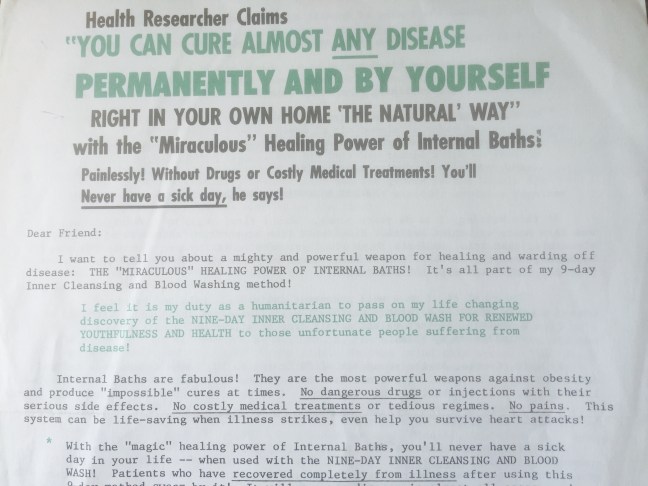
Who was Gene Schwartz? The six-foot-four legend from Montana was known as much for his art collection and service on museum boards as he was for his direct mail copy. (Click here for his bio). But he was one of the greatest copywriters who ever lived. And here he is at his best. (There’s a bad visual of the letter at the bottom).

Health Researcher Claims

“YOU CAN CURE ALMOST ANY DISEASE PERMANENTLY AND BY YOURSELF

RIGHT IN YOUR OWN HOME ‘THE NATURAL WAY’ WAY” with the “Miraculous” healing Power of internal Baths:

Painlessly! Without Drugs or Costly, Medical Treatments! You’ll Never have a sick day, he says!

Dear Friend:

I want to tell you about a mighty and powerful weapon for healing and warding off disease: THE “MIRACULOUS” HEALING POWER OF internal BATHS! It’s all part of my 9-day Inner Cleansing and Blood Washing method!

I feel it is my duty as a humanitarian to pass on my life changing discovery of the NINE-DAY INNER CLEANSING AND BLOOD WASH FOR RENEWED YOUTHFULNESS AND HEALTH TO those unfortunate people suffering from disease!

Internal Baths are fabulous! They are the most powerful weapons against obesity and produce “impossible” cures at times. No dangerous drugs or injections with their serious side effects. No costly medical treatments or tedious regimes No pains. This system can be life-saving when illness strikes, even help you survive heart attacks!

*With the “magic” healing power of Internal Baths, you’ll never have a sick day in your life – when used with the NINE-Day CLEANSING AND Blood WASH! Patients who have recovered completely from illness after using this 9-day method swear by it! It will conquer disease in almost all cases, and free your body of accumulated poisons that make you sick, in only 9 days!

Here’s what happens during the 9 days of cleansing:

*It will rid your body of poisonous wastes (toxins) that have accumulated and formed a lining around your intestinal wall – causing disease

*It will reverse the aging process, and increase your longevity by 20 years!

*It will reduce your weight without dieting or the use of drugs – and keep you slim during your lifetime!

*It is a positive way to avoid ever having a heart attack. It may keep you alive even if you’ve had a heart attack or stroke!

*It will heal arthritis if not in the advanced stages!

*It will lessen the intake of insulin by diabetics!

*It will restore masculine vigor and put energy back in your sex life!

*It will overcome low blood sugar!

*It will aid in normalizing high blood sugar!

*It will overcome post nasal drip!

*It will overcome an urge to urinate too frequently

…and still that’s just the beginning!

SECRET DISCOVERY REVEALED!

At this writing, I am 84 years young. When I first began my investigations, I was in a state of broken health. I suffered from bronchitis, shortness of breath, sinusitis, gastritis, acidosis, high blood pressure, constipation, chronic fatigue, backache, obesity, and hay fever. Then, about 35 years ago I discovered the NINE-DAY CLEANSING AND BLOOD WASH!

Today, at 84, I am a well preserved individual, hale and hearty, mind sharp as a razor and productive. I am erect in stature, with a youthful 34-inch waist, a full crop of silver-white hair an no wrinkles on my face.

My wife, Connie, at the young age of 70 “going on 50,” hasn’t been to a medical doctor in about 20 years. I did not have occasion to see a doctor until I was 65 when I thought it best to start having check-ups. I’ve only had one brief illness in 3 years.

What is the secret!

Inner cleansing! You see, my studies revealed to me that many illnesses seem connected with cell stagnation. If your nose is “stuffed up” or congested, or if you experience congestion in your throat or chest, it indicates that there is an accumulation of stagnant matter within you…sinus trouble, bronchitis, asthma, or colitis, is the result of stagnation. So are arthritis and skin eruptions.

All this can be prevented by giving the body an opportunity to cleanse and purify itself, and then rebuilding the body and its cells with proper nourishment.

FOUR NATURAL BLOOD WASHING FOODS WITH HEALING POWER!

During the 9 “Cleansing Days,” you’ll be eating certain foods I recommend. During this time, you will also begin the action which will effect a good, thorough wash of your bloodstream. You’ll simply begin to sip certain fresh juices.

What are these foods? There are several, but during my years of research. I have singled out FOUR NATURAL BLOOD-WASHING FOODS WITH HEALING POWER that play an important part in healing, curing, and preventing disease.

You may be skeptical, but remember, the NINE-DAY Inner Cleansing and Blood Wash which I take yearly, has warded off common ailments and most pernicious diseases. It has kept me in the best of health throughout the years..and I am 84. If I merely told you the names of these foods you might not be impressed. But wait till you see what doctors, nutritionists, scientists, researchers, an users themselves say!

BLOOD WASHING FOOD #1: NATURE’S CURATIVE WONDER FOOD!

One of these foods, a common syrup, is in my opinion, an Unheralded Cancer Fighter. I believe it will not only close the door on cancer in general, but is especially helpful in cases of leukemia, strokes, ulcers, arthritis, varicose veins, and menopause 

*James P. was in a state of broken health, unable to do even the lightest work. He was suffering from a growth in the bowels, blocked bronchial tubes, constipation, indigestion, pyorrhea, sinus trouble, and weak nerves. In addition, he was losing weight, and his hair and turned white – despite medical treatment. On hearing of a remarkable cure with this syrup, he decided to try it himself. And not only did the growth in his bowels disappear, together with all the other troubles, but his hair actually regained its original color (he was over 60 at the time). 

Others, apparently, have had the same remarkable results, including a man with a fibroid growth of the tongue, and another with cancer of the knee. Reputedly, tumors in various parts of the body have withered away without any other measures than taking this syrup. (No cancer cure is claimed, and reputable medical help is advised, of course, in all cases.)

*A “MIRACLE RECOVERY” FROM TWO STROKES! It is widely thought that when a person has had two strokes the third will be fatal – and yet it need not be so. Mr. K., an elderly man, had had two strokes and was completely paralyzed on one side. He then tried this syrup. The result was that he recovered the use of all his limbs and became completely fit, much to the astonishment of his doctor.

*SPECTACULAR CURES OF ARTHRITIS! Elaine B., 60, had severe arthritis in her knees and hip joints. She was in a great deal of pain and was unable to walk without assistance. Finally, she tried this syrup. One week later, she could swing her legs and flex her knees painlessly! Mr. J., an elderly man, could barely hobble with canes. After using this syrup for four weeks, he threw away his canes!

This common syrup can be obtained at any health food store or supermarket at negligible cost. There is nothing like it for prevention of these diseases I always take my quota of this syrup every day. I strongly recommend that you do the same. It’s a must! Several men who had been denied driver’s licenses because of heart trouble were put on treatment with this syrup. After six weeks they got their licenses. A woman afflicted with recurrent heart attacks took this syrup and the attacks subsided!

BLOOD WASHING FOOD #2: A WONDER BEVERAGE!

It has been said that there are a number of ailments that will automatically disappear after taking this beverage in a certain manner. It is made of the most health-giving fruit that exists.

It has been said that there are a number of ailments that will automatically disappear after taking this beverage in a certain manner. It is made of the most health-giving fruit that exists.

Reduction of weight without dieting will be achieved permanently if this beverage is taken a few times a day. It will burn up the surplus fat. It retards the onset of old age…renders the urine normal thus counteracting a too-frequent urge to urinate)…it promotes digestion because it is very much like a digestive juice! 

Observers have been quite astonished to see how forgetfulness in old people partially or wholly disappears through the practice of taking this beverage. Excessive bleeding can be reduced to a minimum in the case of an operation, and the healing process greatly quickened, if the patient takes this beverage. In cases of frequent nose-bleeding due to some unknown cause, a drink of this beverage with each meal will soon put a stop to the trouble. Sore throats – even of the streptococcus type – can be cured with astonishing rapidity, often in one day, by taking this beverage as a gargle. Tickling coughs and laryngitis will rapidly disappear. It regulates menstruation and is very beneficial to women. Belching can be cured or greatly lessened by taking this beverage.

BLOOD WASHING FOOD #3: A FOOD FOR HEALING!

Here is another syrup that is a most effective remedy for insomnia, emphysema, shortness of breath, sinusitis, asthma, and chronic fatigue. Combined with a certain beverage I tell you about it, it is most beneficial to those suffering from various heart troubles, hay fever, colitis, arthritis, neuritis, and many other common ailments. It is a natural laxative, and one of nature’s most powerful germ killers.

Russian medico-scientists have shown that it will cure a condition as serious as gastric ulcers. One doctor wrote: “In heart weakness I have (this syrup) to have a marked effect in reviving heart action and keeping the patients alive.”

BLOOD WASHING FOOD #4: A 3,000-YEAR-OLD MIRACLE MEDICINE!

This vegetable is the oldest known “home remedy.” It has long been used to rid the body of parasites and in the healing of disease. According to an old news item, “in test tube experiments Virile bacilli that can be killed only after hours of boiling in water die, after one hour of exposure to (this vegetable).”

This vegetable’s almost miraculous antiseptic power is an aid of high blood pressure, asthma, emphysema, colds, gas, gall stones, bronchitis, infections, hardening of the arteries, mucus, elimination, sinus trouble, and many other maladies. It has been widely used in restoring masculine vigor. It clears the blood of excess sugar as effectively as an oral drug. It has remarkable preventive powers and healing powers and offers protection against heart disease.

POWERFUL WEAPONS YOU CAN USE TO OVERCOME MAJOR DISEASES!

The diligent use of these 4 foods, with their extensive curative properties, healing powers, and remarkable preventive powers, will aid tremendously in “healing the body” in my opinion. They are all part of my NINE-DAY INNER CLEANSING AND BLOOD WASH FOR RENEWED YOUTHFULNESS AND HEALTH!

SEND TODAY FOR FREE TRIAL COPY!

Mail the enclosed card for your FREE trial copy. You have 15 days to discover all the incredible health-building secrets that will bring amazing youthfulness to your body: honor the invoice for four easy payments $6.98 pus applicable state tax, postage handling – or return the book and owe nothing.

 Sincerely yours

 I.E. Gaumont

 REWARD BOOKS

Health & Self Improvement

 IMPORTANT NOTICE [appearing at bottom of first page of letter):

The statements contained in this book express the opinions of the author, who is not a medical doctor. These opinions may, in certain cases, be contrary to those of the medial professions, and are based on experiences which may not be representative of results that can be expected for others. The publisher suggests that you do not attempt to make a self-diagnosis based on the symptoms referred to. Many of those symptoms can be caused be more than one condition, and these conditions cannot be self-diagnosed by the lay person. Where cancer may be involved, early diagnosis and treatment may be critical. In all cases, early diagnosis and treatment by a competent medical practitioner is advisable and, in some case, may be essential.schwartz letter
Golden Cities

By Ray Schultz

Geographic segmentation was no big thing fifty years ago. What was new was the ability to tailor the copy to the area. Take this direct mailing done by Time magazine.

The letters contained a sort of glorified Johnson Box at the top, printed in gold, asking questions that concerned the reader’s city. Below that box, they were the same.

Here are two samples. One focuses on Boston, the other on Cleveland. I assume that other cities were also targeted, but I only have these two letters.

To put things in context, these pieces were dated Feb. 17, 1964 ten days after the Beatles arrived in America and eight days before Cassius Clay, soon to be Muhammad Ali, won the heavyweight championship. Lyndon Johnson had been president for three months in the wake of the Kennedy assassination, and later that year would win a full term by beating Barry Goldwater.

The envelopes were postmarked Lincoln, Nebraska and were identified in the Time archive by the cities to which they were going.

Did the computer play a role in this direct mail campaign? Hard to say. Time Inc did conduct personalized computer mailings to doctors that very year, but it was a long time before this became a regular practice.

Let’s start with the Boston version. Is there anyone there who remembers these worries? Old-timers will recall that the MBTA was called the M.T.A. in those days.

Who will be Ted Kennedy’s opponent in the Senate contest? / What is the outlook for Boston’s tax rate? / When will we have an answer to the nagging on-street parking problem—are theft-proof meters the solution? / Why should the M.T.A. be extended to the South Shore? / Where will the Celtics finish the season? / How corrupt is Massachusetts—and can the crime commission do anything to correct it?

 Now here’s the Cleveland variation.

Who will be Ohio’s favorite son at the Democratic National Convention? / What are the prospects for this year’s Cleveland Indians team? / When did the term “diffusion” come up in connection with school integration? / Where is the first apartment building in Erieview to be erected?  / Why are Shaker Heights residents protesting the proposed construction of the Clark Freeway? / How does Senator Stephen Young feel about John Glenn’s 1960 voting record?

What follows is the body of the direct mail letter, which was identical in each case:

February 17, 1964

Dear Reader: 

Questions like these, of largely local interest illustrate something that’s also true of national or international issues. It’s essential to have more than just a few raw facts; it’s important to know the background.

These same questions also help show why, in reporting the news from every field, TIME has always done something more than give a plain recital of the facts. Naturally it starts of with the eyewitness story; but when the event is big news, the eyewitness may be standing too close to get the full significance. TIME stands back, examines the causes, digs out other pertinent facts, relates it to other events. TIME also knows the personalities involved.

As a way of following the news, TIME makes sense – because it makes sense of the news.  

It’s not just the international news that you find all the more understandable. To give a few examples from other fields – if a report on a dramatic discovery takes you beyond the door that’s just been unlocked, you’re beginning to understand the real meaning of the discovery itself. Events in Washington can be better judged if the issues are clearly spelled out. Explore, instead of just recount, new developments in education and you od justice to their fundamental importance.

In TIME’s other news departments also, even in the briefest reports, you find you get more out of the news, because TIME looks at sit with a penetrating, appraising eye.

It’s the reason why many leaders in business and the professions in communities across the country vote TIME their favorite magazine the most important magazine in the U.S. today. TIME reports with the intelligence, accuracy, and consciousness that the leadership community needs and demands.

If, so far, you’ve only read an occasional copy of TIME, we hope you’ll take advantage of an invitation we offer here and now to read TIME regularly at a special introductory rate. Return the card and we’ll send you

20 weeks of TIME For $1.97 (that’s only 10 cents a copy).

No need to sign or check it. Just drop it in the mail – today.

Cordially,

Putney Westerfield

Circulation Director

DEAR FRIEND: The Rascals, Rogues and Roues Who Made American Junk Mail Chapter 3: ‘We Accidentally Met With Your Address…’

By Ray Schultz

History doesn’t tell us much about A. Paisley. All we know is that he lived in Gloucester, Mass., and that a letter was sent to him there in 1837. When Paisley opened the “envelope,” a folded-over sheet sealed by a red-wax wafer, he found a promotion from Sylvester’s Exchange & Commission of New York.

“I beg leave to submit to your attention to the annexed – Our brilliant Schemes to be drawn in the month of March either of which professes attractions far superior to any Scheme yet laid before you,” announced the handwritten note. “Early notice is thus given that my most distant correspondents may not be disappointed.”

Behold an early example of junk mail. Like today’s ad letters, it was full of hype, promising that the advertused lotteries were ““beautiful, grand, splendid and brilliant.” It even had what is now called a privacy policy: “All communications strictly confidential.”

In 1827, Congress passed a law prohibiting local postmasters from working as lottery agents—no longer could they dispense handbills in return for a percentage of the sales. So the lottery barons started mailing directly to the rubes; by 1830, if you believe the later claims, they even had an agency in New York to facilitate this “circular advertising.”

So great was the moral outcry against lotteries that most northern states gave up theirs. But tickets for border and Southern state lotteries were sold in shops and by mail by firms like Wood, Eddy & Co., of Wilmington; Egerton & Bros. of Baltimore; and the combine of Archibald McIntyre and John Barentse Yates, of New York. And these men decided that they had to educate their customers on how to buy by mail. Egerton & Bros. explained that “we invariably answer letters by return mail, enclosing the Tickets in a proper envelope, observing the strictest confidence and after the Drawing is over we send the Official Printed Drawing, duly certified to by the State Officer, and Managers with a written explanation of the result.” Smallwood Co. promised that its tickets would be returned in “strong safety envelopes.”

The average person learned that he had mail when he saw his name in a newspaper listing. Or he found out when he visited the post office, usually part of a dark general store with tools and bacon hanging from the ceiling. Then he had to pay for the letter.

Most mail was dropped into the system without postage; the recipient had to pay, and few did. Why would they? Some unpaid letters were sent as jokes—the victim would pay 25 cents for an envelope full of manure. General Zachary Taylor refused to pay for the letter informing him he had been nominated for the Presidency of the United States. Even the lottery companies wouldn’t pay: “No unpaid letters received in our office,” B.B. Mars & Co. of Baltimore warned customers:

This changed when Congress passed the Postal Reform Act of 1855. Magazines and newspapers excepted, senders now had to pay in advance. And the lottery operators were happy to inform people about it. “From and after 1st April 1855, prepayment, either by stamps, stamped envelope, or in money, is compulsory,” Emory & Co. advised its customers. With this system in place, the lottery promoters papered the country with offers, almost all containing an apology:

“Trusting you will not find us intrusive…”

“We crave your indulgence for intruding on your valuable time…”

“We accidentally met with your address…”

Chapter 4: Gospel Mail

Then As Now

By Ray Schultz

Is there no getting away from advertising? It pops up everywhere online, even in the middle of content, instead of being gated off. And it’s annoying even for someone who works on the fringes of the business

But it’s nothing new. In this brief paragraph, Frank Presbrey describes the ad acene in the 1860s, before the telephone or even electricity. It’s from The History and Development of Advertising, his 1929 classic:

A merchant would hire a man to stand and look fixedly at a placarded announcement; many would stop and read what seemed so interesting to him. At busy street corners boys were distributing handbills, while others went from hosue to house. Every horse car had packages of them tied to the rods in the cars so that passengers could pull them off. Drugstore counters had piles of free almanacs carrying advertisements for patent medicines. (A generation later one patent-medicine house—Ayer—is said to have distributed 25,000,000 almanacs in a year.) Advertising cards were common in the saloons of river steamers and other excursion boats. Novels contained an assortment of advertisements in the back pages—an old practice. Advertising assailed the eye to an extent which then was sensational.


Trump’s Brand of Content

By Ray Schultz

Content is king, and Donald Trump is the king of content. So said The New York Times in an article two weeks ago.

“Mr. Trump is not running a campaign in the modern sense…Rather, he oversees a prolific content production studio that has accomplished what every major media conglomerate is trying to pull off with mixed success,” Jim Rutenberg wrote in the Times.

That was, of course, before the Orlando massacre, and Trump’s emotional meltdown, in which he seemed to blame Barack Obama for the attack. But it still stands.

Trump isn’t big on position papers. Instead, he gives us is stream-of-consciousness spewing–every bleat and gurgle that come out of his mouth. Who cares if they add up to incandescent BS?

Well, there must be a buck in it. Two Rubio retainers, Alex Conant and Will Holley, have opened an agency devoted to Trumpspeak: Firehouse Strategies, Rutenberg reports. Blowing hot air will soon be a mainstream marketing tactic.

But Trump isn’t the first “hypnotic, post-literacy” verbal artist. There was one before him.

Adolf Hitler.

Mind you, I’m not comparing Trump, a common bigot, to Hitler, whose crimes were the most monstrous in human history. What we’re talking about here is communications.

“Together with his actual ability to manipulate an audience, Hitler also showed an intuitive sense which amounted to genius that the spoken word was going to be of core significance than the written word in the coming years, “wrote in A.N. Wilson in “Hitler,” a sincere but slight bio of the monster.

Just as Trump eschews paper documents, so did Hitler.

“From the beginnings of Communism in the early nineteenth century to its crisis or unraveling in the 1970s, Communism remained, among other things, a doctrine whose texts, like the Koran or the Talmud, could be endlessly re-perused by the Doctors of the Church, and interpreted in a literary way,” writes Wilson, who coined the “post literacy” phrase. “They belonged to the vanishing world of the text; Hitler belonged to the oral future, the future which contained Walt Disney, television and cinema.”

According to Wilson, Hitler said that “the greatest revolutions in this world have never been directed by a pen! [The irony appears heavier in German, because the word for pen is feather.] No, the only thing the pen has been able to do is provide theoretical foundations. But the power which has always set rolling the greatest religious and political avalanches in history from time immemorial has been the magic power (die Zauberkraft] of the spoken word.'”

Wilson continues: “Zauberkraft. From the beginning he saw himself as a magician. In fact, his sense of the power of the spoken word, the word blared through a loud-hailer, the word broadcast on radio and in film, was very far form being some ancient truth which had rolled down the ages from time immemorial.”

And Hitler didn’t have to know much to do it.

“He made clever use of his reading, but that reading was extremely limited,” Wilson wrote. “Indeed, it was the very fact of his limitations which gave him such strength. He had few abilities and it was these which carried him along.”

Sounds familiar doesn’t it?


DEAR FRIEND: The Rascals, Rogues and Roues Who Made American Junk Mail, Chapter 11: The Crooked Road to the End

By Ray Schultz

Flush with success, J.M. Pattee decided he needed a vacation, so he took his family to Saratoga Springs, a resort almost 200 miles north of New York City. But it was bad timing: He was going out one morning when he saw Anthony Comstock coming up the steps.

Pattee panicked and ran, not knowing that Comstock was there only to give a speech. But the vice crusader had spotted him. “He is a remarkably nervous man, and seems to be always in fear; having at times a wild, frightened look, as though he expected to be arrested every moment,” Comstock observed.

And Comstock did want to arrest Pattee. He next confronted his prey at the Simpson & Co. Brokerage in New York. A side door opened, and Comstock saw “a little gray-haired old man with gold spectacles on, bob out, and then instantly dodge back into the dark room, and attempt to quietly close the door, as to attract no attention.”

Pattee “reached out his hand to shake hands, and becoming very much excited, repeated over and over again, how glad he was to see me, stuttering out, ‘Well—I—am—devilish—glad to see you.’” In Comstock’s account, Pattee denied that he had any business in the office. “Well, well, I only have an office room here,” he allegedly said. Comstock entered a back room, and saw several employees stuffing envelopes.

Meanwhile, Pattee was indicted in Wyoming for sending false advertisements from the territory for the Seminole Gold and Silver Company. His lawyer, a former U.S. attorney named Col. George Bliss, described his client as a “man of wealth and reputation,” and made the incredible lying claim that Pattee had never been in Wyoming. Pattee escaped extradition.

Frustrated, Comstock staged another raid against Pattee’s brother-in-law Nate Read (“American, Protestant, Married, Swindler”), seizing over a million names and addresses. Bliss got them returned to Pattee, and soon Read was sending letters to that list from Canada.

These pieces described the Royal New Brunswick Popular Monthly Gift Soiree as “the only legal Gift Drawing in the whole Dominion of Canada.” And they claimed that “hundreds of clerks, working-men, merchants and farmers have paid off a mortgage on a house or farm—may have added to his mercantile stock or bank account—may have settled a number of old debts or refurnished his house, making happy and comfortable his family—all through a lucky ticket bought from us,”

This was rubbish, Comstock knew, but he was powerless to stop it. Instead, he took to vilifying Pattee in books like Frauds Exposed. “I have yet to find the first person who ever received one dollar from him in return for money sent,” he wrote.

Pattee, though, was getting tired of the chase. In 1880, beset by legal bills, he sold or lost his house in New York, and started residing in hotels in the east 40’s. Nate Read was arrested in Canada in 1884 and promptly jumped bail to the U.S.

What became of the man who had discovered the most basic law of junk mail, that a person who had fallen for one scheme was ripe for another? Pattee moved to St. Louis, and set up an office on Olive St. But his business was short-lived, for he died in 1888 at age 64 of “softening of the brain.” Thanks to his various scams, though, he left his wife an estate of comfortable proportions.

And Comstock? By the time he died in 1915, he was widely viewed as a crank and an enemy of the First Amendment. “The fight for the young!” Heyward Broun wrote. “The phrase was always on Comstock’s lips…But, with the passing years, may it not have become a formula with which he sustained himself, unconscious that its relation to his work was growing increasingly remote?”

Comstock had changed in one respect. When younger, he had railed against direct mail. Under his leadership, though, the Society for the Prevention of Vice sent it to ask for “sympathy, co-operation, and such financial assistance as you may be disposed to give.”

But some things remained the same. In 1906, 38 years after their first encounter, Comstock again arrested the pornographer Charles Conroy. The ledger tells it all: age 66, Irish Cath., Scheme to defraud by mail. Tombs in default of $2,500 bail.

Chapter 12: Montgomery Ward Raises The Barn


DEAR FRIEND: The Rascals, Rogues And Roues Who Made American Junk Mail Chapter 1: Crooked Colonials

By Ray Schultz

It started when the country was thinly settled, with only a few towns scattered along the coast. Most mail arrived by ship, and was dumped on tables in taverns, where anyone could read it. Colonists who needed goods had to ride miles through the mud to buy them. Or, they could order them by mail from England, a proccess that took months.

But one sharp operator, the Philadelphia printer Benjamin Franklin, found a way around this. Franklin sold products from his general store by mail through his newspaper: the Gazette (“The widow READ…continues to make and sell her well-known ointment for the ITCH”), and he published a mail order book catalog,, promising “the same justice as if present.”

Then, having proven that the local postmaster kept bad book books, Franklin was given his job, and later named co-postmaster of all the Colonies. In that role, he improved delivery, ensuring better service and profits for the Crown. But he didn’t do it out of altruism, nor for the Crown. Rather, the job “facilitated the correspondence that improvd my newspaper, increas’d the number demanded, as well as the advertisements inserts, so that it came to afford me a comfortable income.”

Franklin also started a lottery, the main way of financing roads and buildings in Colonial America. Washington ran one, so did Jefferson, and they were “fostered by Christian communities”—even the clergy played them. But there soon were too many, and the amateurs in charge were unable to cope with this market reality. So they hired promoters, and asked them to “advertise in the Papers, and have Hand bills struck off, and dispersed thro your neighborhood.”

They shouldn’t have asked. These promoters started papering the cities with handbills, caring little if some ended up floating in rivers, and even less if the pieces contained a grain of truth. Whereas early lottery handbills specified the precise number of blanks (losing tickets), the new ones vowed that there were “not two Blanks to a Prize.”

Outright lying wasn’t their only innovation. Soon, they had country postmasters tacking handbills on their walls. Trapped in some backwater, the postmaster would receive a letter and a packet of handbills from a faraway company. This practice started in the 1700s and lasted well into the next century.

“For the information of your place and vicinity, I have taken the liberty of enclosing a few Bills showing the present very interesting and brilliant situation of the Grand State Lottery of Maryland, of which only one drawing now remains to complete,” J.I. Cohen, Jr. of Baltimore wrote to postmasters in 1824. Many postmasters tacked the enclosed handbills on the wall or handed them out to townspeople, in return for a percentage on the tickets sold.

In 1825, Allen’s Lucky Office of New York put out a handbill saying that that a $25,000 lottery jackpot had been shared by “a patriotic soldier who had lost a leg in the service of his country.” In many towns, rubes who fell for a line like this could buy lottery tickets from the postmaster. But Allen’s Lucky Office invited direct contact: “Orders from the Country, (post paid) promptly attended to.” In this way it would get the names of customers. And it could mail them over and over without anyone knowing.

Chapter 2: Of Honesty And Virtue