What’s In the Box

By Ray Schultz

When asked to define a Johnson Box, copywriter Bill Jayme said the purpose was to summarize a direct mail letter, “just as 19th century English writers like Dickens would say at the top, ‘Chapter 10, in which Mr. McGruder discovers Emily in a Compromising Position with the Director’s Son.'”

That more or less nails it. Less certain is who actually invented the box. The alleged creator, Frank Johnson, always disclaimed ownership, although others gave him credit for it. Well, here’s a letter by Johnson, featuring an actual…Johnson Box. (You’ll notice that we’re not calling it a Jayme Box or a Baring-Gould Box). Scroll to the bottom to see the actual letter.

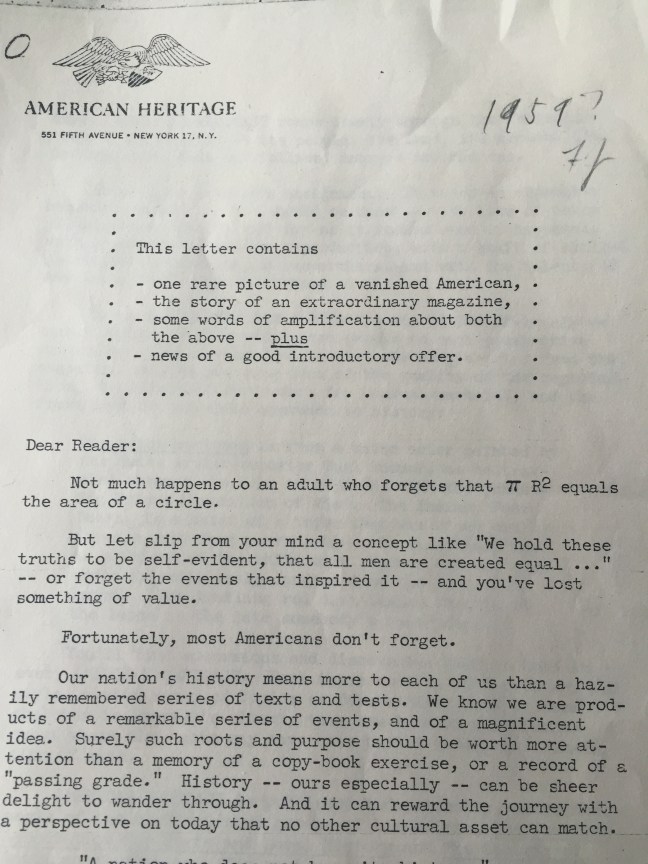
As always with Frank Johnson, the four-page letter for American Heritage magazine, apparently sent in 1959 or ‘60, is a helluva piece of writing. It starts with the box:

This letter contains 

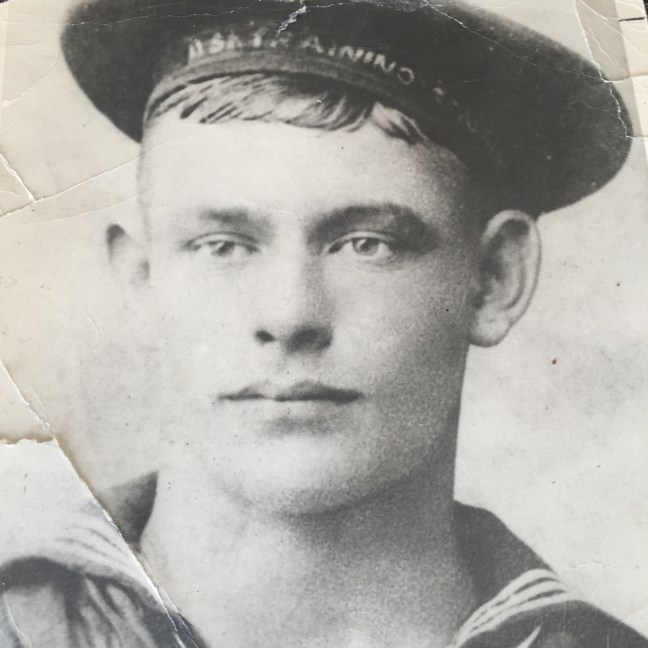
  • one rare picture of a vanished American,
  • the story of an extraordinary magazine,
  • some words of amplification about both the above – plus
  • news of a good introductory offer.

Dear Reader:

 Not much happens to an adult who forgets that π R2 equals the area of a circle.

 But let slip from your mind a concept like “We hold these truths to be self-evident, that all men are created equal…” – or forget the events that inspired it – and you’ve lost something of value.

 Fortunately, most Americans don’t forget.

 Our nation’s history means more to each of us than a hazily remembered series of texts and tests. We know we are products of a remarkable series of events, and of a magnificent idea. Surely such roots and purpose should be worth more attention than a memory of a copy-book exercise, or a record of a “passing grade.” history – ours especially – can be sheer delight to wander through. And it can reward the journey with a perspective on today that no other cultural asset can match.

 “A national who does not know its history,” said George Santayana, “is doomed to repeat it.”

 AMERICAN HERITAGE is a magazine designed to help you know your history better – and to know it with a growing sense of pleasure.

 So if you agree that a sense of history is an asset worth cultivating, then we suggest you will find this magazine a colorful and accurate chart for a wonderful trip through time. AMERICAN HERITAGE roams freely through the whole history of our country – its people, its land, its growth, its triumphs, its fads and follies, manners and madness.

This is an extensive assignment. It takes an expansive magazine to do it as it should be done – with lots of color illustrations to show history as it looked when it happened, with good papers for fine reproduction, with a staff of skilled journalistic-historians and researchers, and with the talents of America’s front-rank historians as its authors.

So a copy of AMERICAN HERITAGE costs $3.95; obviously we cannot afford to fire off a free sample to each prospective subscriber. We have sent along just one sample print from the magazine, to give you some idea of the quality of the reproduction, the extent of our search for unusual material, and the fresh look of our whole approach to history:

The print enclosed is from a water color painted by the Swiss artist-reporter Carl Bodmer, as he traveled through the West in 1832-33, with the junketing Prince Maximilian of Wied. The Indian, Four Bears, is a chief of a tribe that was wiped out by disease only four years later. He was identified as a friend of the white man. Bodmer did not say whose friendly scalp dangled from the Indian’s lance. (The trailing red disc behind the tip of the lance is the late somebody’s hair piece.)

You’ll find excursions and discoveries such as this in every AMERICANHERITAGE. Each issue covers, with accuracy and style, a wide range of topics – from a first look at some skeleton in America’s closet, to a new look at some famous event where the facts may have been buried under an accumulation of myth.

AMERICAN HERITAGE is published independently, under the aegis of two distinguished groups of historians, The American Association for State and Local History and The Society of American Historians. The senior editor is Bruce Catton, most honored of all students of the Civil War; Dr. Allan Nevins, dean of American historians, heads the Advisory Board. Contributors include America’s foremost writers of lively history.

The August issue will continue the tour of the past with 15 articles and picture features, including

A Tax on Whiskey? Never! By Gerald Carson. A timely piece on an old but still explosive issue. In 1794 the farmers of Western Pennsylvania claimed that country whiskey, that honored rural elixir, was being unmercifully slapped by the tax collectors. The locals were walloping the revenue men and firing up the stills with equal ferocity – until George Washington (who turned out some pretty good rye of his own at his Mount Vernon still) used Federal force to settle “The Whiskey Rebellion.”

End of a Friendship by Charles Seymour, ex-president of Yale. In a personal memoir, Col. Edward House, key man in the Wilson administration and by the President’s own christening “my second personality,” tells for the first time, why he thinks he fell out with Wilson.

The Man Who Invented Panama, an interview by Commentator Eric Sevareid with Philippe Bunau-Varilla, the man who pushed through the Panama Canal.

The Action Off Flamborough Head by Oliver Warner. An important item in each issue of AMERICAN HERITAGE is an extract (not a condensation) from some good new history book. The August selection (from Warner’s forthcoming “Great Sea Battles”) tells of the moonlight sea duel off the Yorkshire coast between Joan Paul Jones and Britain’s Captain Pearson. Jones termed the conditions that night “really deployable.” But he won – and soon was neglected. Pearson lost and was knighted.

Like to read further? More than 330,000 subscribers will. We’ve found that 96% of them save every copy of AMERICAN HERITAGE. It’s written, illustrated, printed, and packaged to last. For example, it comes in hard covers, like a fine book, and with no advertising to date its contents.

In each magazine you’ll find 112 editorial pages and at least 100 illustrations – more than a third in color The pictorial array consists of tintypes, paintings, posters, old charts and notebooks, photographs, etchings, and daguerreotypes — many of them never published before. The August issue has two articles containing rare illustrations:

A portfolio of Japanese water colors (circa 1855), showing how the first Westerners in Japan looked to their Oriental hosts; and some rare on-the-spot sketches of the great Chicago Fire of 1871, with captions written by an eyewitness.

In appearance and content, AMERICAN HERITAGE is unusual. So is its $3.95-a-copy price tag. But matched against books of comparably quality (you can’t compare it to the usual magazine), the single-copy price is a real bargain. Our current introductory offer is better than that:

You buy three issues—and get six.

Ordinarily, a year’s subscription would be $15. Bought one-by-one over the course of the next year, the tab for these same six issues would be $23.70. But by ordering now, your six issues can cost you just half that — $11.85, the retail cost of three.

To subscribe at this introductory price, fill in and mail the postpaid order card. You need not pay anything until after you have seen your first copy. Then you have a choice of three monthly installments of $3.95 each … or a single payment of $11.85. (The order card explains all the options.)

If at any time you feel that AMERICAN HERITAGE does not do at least as creditable job for America’s history and your interest as we promised you, you can cancel your subscription and we will refund the amount of the undelivered portion.

The August issue can begin to show you why AMERICAN HERITAGE has won the acclaim of so many critics, and the loyalty of so many readers. Mail the order card today? Your first copy is boxed, and can be in your hands within a few weeks.

And thank you.

Sincerely,

James Parton

Publisher
2016-04-27 08.21.20


‘I Have Not Yet Begun to Fight’

An eBook By Ray Schultz

In 1906, a Navy petty officer tried to enter a dance hall in Newport Rhode Island, and was turned away because of his uniform. Normally, that would have been the end of it, but Chief Yeoman Fred J. Buenzle was a wily old salt. He’d bought a 25 cent ticket when wearing a civilian coat and hat, and having paid that money, he felt he had a contract and could sue the Newport Amusement Association for failing to honor it.

Predictably, Buenzle lost the case right up through the appellate court. But in 1908, the Rhode Island General Assembly passed the Uniform Act, barring discrimination against men in uniform; the State Senate rapidly followed suit. And Buenzle, a man with broken service and at least one disciplinary case on his record, deserved the credit for it.

Why is this important now? Because service men and women still face obstacles (different ones). By pursuing that case, Buenzle did more for his fellow enlisted personnel than John Paul Jones, Stephen Decatur and anyone in the panoply of Naval legends.

So who was this unlikely hero? Here is his story.

Part I: Dirty Lubbers

Fred Buenzle was born in 1873, in the Pennsylvania Dutch country, of parents who owned what he called a “commercial hotel.” He spent every night of his youth helping his father fill bottles of beer in the cellar, and was often overcome by the fumes. At 16, he enlisted as a boy apprentice in the U.S. Navy in to fulfill a childhood dream of going to sea (and probably to get out). His father disagreed with that decision, but signed the papers anyway.

The Navy Buenzle joined was not a very healthy place for enlisted men, though. As he put it, foreign mercenaries filled the ranks, while Americans wearing the uniform were disgraced at home. “New promises were made to the recruits, and the old-timers had to subsist on broken pledges,” Buenzle wrote in his 1939 memoir Bluejacket, a book I first read as a young sailor.

That was driven home on Buenzle’s very first day in the service. Before boarding the USS St. Louis, an old sailing ship at the Philadelphia Navy Yard, for the signing of his apprentice articles, he met an old sailor who tried to talk him out of signing. The problem, the old man stated, was not with the Navy—that was fine—but with the civilian populace.

“The dirty lubbers and crooks on shore won’t serve a man in uniform, not in any decent place they won’t! And you won’t be able to buy a good meal or a clean bed, or go to a theater. Only the dive-keepers and the trollops will give the sailorman a hand, my boy, and don’t say I didn’t warn you.”

Buenzle joined anyway, but that very night he came close to regretting he did. In full view of the crew, the captain of this hulk put a group of men in irons, a brutal punishment for minor offenses. “This incident of my first day in the Navy was my earliest lesson in the need of prompt and unquestioning obedience to any order received from a superior in rank or rate,” Buenzle wrote. “It made me also aware of the possibilities for tyranny at the hands of men clothed with absolute power, and of how easily a headache or any slight upon the dignity of the afterguard might be taken out upon the hapless lower ratings.”

About the only good thing that happened on the St. Louis was that Buenzle met some relics of another age, like Happy Dorgen, Baldy Tom Dunn, Jack Robinson (“a mighty liar), Basil Bono and the Hawaiian Kanaka, who told stories of a buried treasure.

As a youthful reader, I tended to view all this through a romantic haze. The base mess hall in Newport, Rhode Island periodically served what a yearbook described a typical Navy breakfast in the 1890s: boiled eggs (hard or soft), Navy beans and corn bread. I liked it because I felt it connected me to the past. In reality, Buenzle’s first meal aboard the St. Louis was a “tin-dish supper of boiled rice, molasses, hardtack and tea,” wrote New York Times reviewer James Thompson.

Following this interlude, Buenzle was sent to Newport, Rhode Island for apprentice training aboard the USS New Hampshire. But the ship was moored in “sewage crusted slough,” and an epidemic of typhoid fever broke out, causing the New Hampshire to be called “the floating coffin.” Training had to be continued onshore.

A month or two later, Buenzle set sail on an ancient vessel called the Portsmouth. It sailed from Newport to the Caribbean, stopping in New York, where “a half eagle was sufficient for a snug twenty-four hour liberty.” Buenzle soon found, though, that life at sea was hellish. Everything was damp, food was always cold, and there was plenty of deck duty, from which “all our clothing was sodden and the skin on hands and feet became bleached and tender,” he noted. Finding the port of Barbados to be a place with a “remarkable lack of points of interest,” Buenzle wrote of the lonely watches at sea during the early morning hours. “The boys,” he wrote, “hunch closer, and in whispered tones talk together of sharks at sea and sharks ashore, and of human wolves, and of the loneliest time in boyhood that each of them could remember.”

The young sailor next reported to the sailing frigate Lancaster, the new flagship of the Asiatic station. En route to Asia, he received his first disciplinary action for sleeping on watch. In 1893, at the age of 21, disgusted with being rousted out of wet hammocks at night, of eating cold mutton while officers ate delicacies, including desserts like cherry pie, and of the “pious pomposities,” of the officer corps, Buenzle took his discharge in Shanghai.

Part II: Buried Treasure

Buenzle’s first stop as a civilian was the American consulate where because he refused government passage back to the States, he had to waive the right to any further aid. But he was resourceful: When war broke out between China and Japan, he took a commission as a captain in the Chinese Army, and served as an instructor up the Yangtze River. There he met Merci Fabre, a friend of the Hawaiian Kanaka, and they went in search of the treasure described by the latter. They sailed from Shanghai to Hong Kong, then to the southern part of Formosa, where (if you believe it), they uncovered the treasure, ten thousand dollars in American and British money. When they tried to transport it in a fishing boat, though, the vessel capsized; Buenzle, who couldn’t swim, had a hard enough time saving his own neck. Twenty-two days later, without a dime of treasure, he was aboard a Canadian Pacific ship en route to the United States.

After a tenure as a special writer for the Philadelphia Times, Buenzle decided that civilian life could never match the peace of mind—i.e., the security—of the Navy. He re-enlisted aboard the sailing ship Monongahela with the rank of Ship’s Writer, First Class. But he soon learned that the Navy had changed. Aboard the battleship Brooklyn, a “new ship,” Buenzle found “young men who ha never before felt the swell of a ship beneath them. The old shellbacks remaining were in charge of gangways and lower decks.”

Buenzle had changed, too, and he had some strong views about Navy life. After sailing to Britain for Queen’s Victoria’s Jubilee in 1897 (“our uniform was more honored than it was in our own land”), he reported the USS Dolphin, and there met Assistant Secretary of the Navy Theodore Roosevelt. The two men discussed the plight of the enlisted man and together drafted a memorandum to the Secretary of the Navy. “We must make a determined effort to create a public opinion so strong and aggressive that every class of people in the United States who pretend to be patriotic Americans will not dare to erect a barrier against the uniformed men of our national defenses, whether there be any law governing the cases or not.”

Part III: Murder At Sea

Buenzle’s next post was on the battleship Iowa, part of the Great White Fleet, where he served as clerk to Captain William Thomas Sampson. Sampson was the president of the Court of Inquiry that investigated the sinking of the battleship Maine in Havana harbor; Buenzle was the stenographer. When war was declared, Sampson was promoted to Rear Admiral and given command of the North Atlantic Fleet. Buenzle accompanied him to the flagship New York.

Convinced that the enlisted men should be given some word of the events, Buenzle established a daily log, “The Squadron Bulletin,” and printed out 1,000 copies a day on a primitive duplicating machine. There was plenty to write about. First, the New York captured the Spanish merchantman Buenaventura. The booty was split among the crew, and Buenzle ended up with $300. Then, from the flying deck of the New York, he witnessed the destruction of the Spanish fleet as it tried to emerge from Santiago harbor; he even selected the volunteers who helped lieutenant Richmond Pearson Hobson sink the collier Merrimac in an effort to block the channel. “The fleet under my command offers the nation as a Fourth of July present, the whole of Cervera’s fleet,” Buenzle ghostwrote for Sampson.

Privately, Buenzle saw little reason to celebrate, though.

“ …It was impossible that they could feel lighthearted in the face of so much suffering,” he wrote in Bluejacket. “I never wanted to hear the word ‘war’ again; and I determined, on that day, while the air was yet filled with the sour tang of smokeless powder and the crash of exploding shells, that I would be glad to exchange my naval billet for the humblest calling on shore if there was any more murdering to be done on the sea.”

Part IV: Dogs and Sailors, Keep Out

After the war, Buenzle reported to Newport again, where as Chief Yeoman, he was named officer-in-charge of the Yeoman School. And it was in Newport that his campaign for the enlisted man fully materialized.

With the three hundred dollars he received from the capture of the Buenaventura, he launched Our Naval Apprentice, the Navy’s first station newspaper, in 1901. Its mission was to entertain the men and to fight the prejudice downtown. It eventually evolved into the Newport Navalog, a newspaper that published its last print issue last year.

Next, Buenzle filed his lawsuit against the Newport Amusement Association. “Painful remembrances of the many indignities heaped upon my comrades in the sea eservice had urged me to initiate the prosecute the case of my own expense,” Buenzle wrote. These included signs saying, “Dogs and sailors keep out,” and “No men in uniform allowed.”

In this, Buenzle had the support of officers like Rear Admiral Charles M. Thomas who handled his legal fund. But they were of little help during cross-examination. William C. Clarke, the president of the company, brought in some  lawyers, and they started out by claiming that Buenzle had violated Naval regulations by disguising his uniform when he purchased a dance-hall ticket.

“You expected to be refused when you presented that ticket in uniform, didn’t you?” the opposing counsel asked the sailor.

“Not exactly,” Buenzle said. “I wished to know if I would be refused. I wished to know if there was any discrimination, whether it was against me personally, for any personal disqualification, or whether it was against the uniform.”

“But you expected it, and you wanted to find that out. Answer my question. You expected to be refused admission, didn’t you?”

“I wasn’t sure. I heard the men were discriminated against for the blue blouse and the shirt sleeves, but I didn’t expect to be refused admission.”

“You did not.”

“I didn’t expect to be refused admission in a white shirt and a collar and tie, as any citizen, with only the difference of a rating badge and brass buttons.”

The court threw out Buenzle’s claim, stating that it was the “settled rule of law for many years, that a ticket of admission to a race-track, a theatre, a concert, or any such entertainment is a mere license, revocable at the will of the party issuing the same.” He was, however, entitled to get his 25 cents back.

That view was upheld on appeal by the Supreme Court of Rhode Island in February 1908. The higher court stated that “military and naval uniforms are not intended as a badge of social equality, but on the contrary they are evidences of rank and distinction…” Thus, Buenzle was entitled to a refund but not to damages for emotional distress.

The court added, though, that if “such discrimination is deemed to be a matter of grave public consequence, it rests with the law-making power to afford a proper remedy.”

Precisely. And what Clarke and company didn’t seem to realize is that Buenzle had the ear of his superiors, right up to President Theodore Roosevelt (who sent a check), and that he was a talented writer, well equipped for publicizing this controversy.

Roosevelt said: “I feel that it is the duty of every good citizen to endeavor in every shape and way to make it plain that he regards the uniform of the United States Navy…as a badge of honor, an therefore entitling the wear to honor so long as he behaves correctly.”

The Uniform Act was passed a short time later. And Buenzle was able to write that the greatest fight of his life ended with the flagrant signs being taken down and “shelved with other anachronisms.”

Part V: Home Is the Sailor

What could Buenzle do to top that? Write a book. He prospered as officer-in-charge of the Yeoman School, and in 1909, left Newport for sea duty. After retiring from the Navy in 1919, he settled in Palo Alto, California., where he opened a Naval history museum, and spent the rest of his time writing Bluejacket, which appeared in 1939. He lived in a small cottage, the grounds of which were landscaped with high-arched bridges, pads, ferns, cherry trees, and a small lagoon—all in the style of Japan and China, according to Captain Felix Riesenberg, who visited Bunezle in 1939 and wrote the introduction to Bluejacket. The home, filled with mementoes of the old sailing days, offered this sign for the visitor: “Home is the Sailor, Home from the Sea.”

Fred Buenzle died in 1946.

In my time, there was one man around who actually had known Buenzle: William E. Ragsdale, a retired Newporter and former officer-in-charge of the Yeoman School, who joined the Navy in 1907 and eventually made the rank of Lieutenant.

“There was no doubt about it, Buenzle was a great man,” he said in 1967. “When you spoke to him, he seemed to be lost in another world. He was preoccupied with his writing, and he was a very good writer. He was always writing something.

“I know of no man throughout my entire career who enjoyed the respect and worship of all the enlisted men, as Buenzle did. He as intelligent, and a gentleman all the way. He never did or said anything harsh or offensive.

“I was a student of the school when he was in charge, and I can tell you we all idolized him. He was the height for an enlisted man.”

An old man, deaf, but holding beautiful memories inside him, Buenzle said to Captain Riesenberg in 1939 of a model sailing ship he had built: “I have built her into the youth of one lifetime, the glories of liberties after long detentions over deep water She spells something now irrevocably gone!”

Fred Buenzle: A figure of the past but a voice for today.

Heartbreak Hotel

By Ray Schultz

The literary world rejoiced in November 1978 when The New Yorker published its first short story by Jean Stafford in a decade: An Influx of Poets. It meant Stafford was back. But it wasn’t what it seemed to be. The author, age 63, was in ill health, and had only four months to live. The story had been extracted by editor Robert Giroux from Stafford’s unfinished novel, The Parliament of Women.

So ended the career of one of the premier fiction writers of 20th Century America. Today, you can’t even find most of Stafford’s books in print, and it’s unlikely that she’s taught much in college. But she left a magnificent body of work. And An Influx of Poets was a great one to go out on.

Though she resembled an Eastern intellectual and had the wit to go with it, Jean Stafford grew up in a dysfunctional family in the West, first in California, and later in Colorado. Her father wrote Western stories under the name Jack Wonder.

Stafford, unhappy young brainiac that she was, wanted out. She graduated from the University of Colorado, but not before a friend named Lucy McKee shot herself in the head right in front of her. “I am almost ready to write about it, although I have really written about nothing else ever,” Stafford later admitted, according to Mary Davidson Mcconahay. Stafford’s next stop was Nazi-era Heidelberg, where she studied philology for several months.

Returning to the States, Stafford hooked up with Robert Lowell, the mentally unbalanced Boston poet. One drunken night, he smashed his car into a retaining wall, and Stafford was badly injured, her beautiful face damaged for life. She got little sympathy from Lowell or his wealthy family.

Despite that poor start, Stafford married Lowell in 1940, and commenced her life as “the subservient spouse of an obsessive artist,” as Bruce Bawer put it. First, she had to support Lowell emotionally when he was jailed for conscientious objection during World War II. Then she had to deal with his mental illness and religious obsession.

Yet Stafford was a serious artist in her own right. Her first novel, Boston Adventure (circa 1944), about her experiences with the Boston Brahmins, was a best-seller, and with the money she earned she bought a house in Maine for Lowell and herself. That turned into a nightmare, too, though, as you can tell from the gorgeous opening paragraph of An Influx of Poets.

THAT AWFUL SUMMER! Every poet in America came to stay with us. It was the first summer after the war, when people once again had gasoline and could go where they liked, and all those poets came to our house in Maine and stayed for weeks at a stretch, bringing wives or mistresses with whom they quarreled, and complaining so vividly about the wives and mistresses they’d left, or had been left by, that the discards were real presences, swelling the ranks, stretching the house, my house (my very own, my first and very own), to its seams. At night, after supper, they’d read from their own works until four o’clock in the morning, drinking Cuba Libres. They never listened to one another; they were preoccupied with waiting for their turn. And I’d have to stay up and clear out the living room after they went soddenly to bed—sodden but not too far gone to lose their conceit. And then all day I’d cook and wash the dishes and chop the ice and weed the garden and type my husband’s poems and quarrel with him.

The year 1947 was a big one for both members of this duo. Lowell published Lord Weary’s Castle, the Pulitzer-prize winning poetry collection that made his reputation. And Stafford came out with her second novel, The Mountain Lion (published while she was in the Payne Whitney clinic, according to her biographer ). While not as big a seller as Boston Adventure, The Mountain Lion is her best.

It tells the story of Ralph and Molly, siblings brought up in a stultifying atmosphere in California. Both children suffer from nosebleeds, the result of scarlet fever, and both are weird. The adults in this book are insufferable, including their widowed mother Mrs. Fawcett, and the preacher Mr. Follansbee. Ralph and Molly have a habit of rattling these authority figures by saying the wrong thing at the wrong time.

In one encounter, Ralph suggests that his mother has murdered her father, Grandfather Bonney, who even in death is an intolerable personality to the children.

But suddenly a mocking bird, in this broad daylight, began to sing. Mrs. Fawcett clasped her hands together and said “Oh!” as if the sound hurt her. Her large diamond ring, in the gesture, came into a ray of sunlight and two green needles shot out from the stone. Then Mr. Follansbee was across the room in one stride, shaking Ralph’s shoulder. “You little cad,” he said between his teeth, “you get down on your knees and beg your mother’s pardon. On your knees.”

For a moment he defied the minister by remaining motionless, but the long bony hand on his shoulder propelled him off the hassock and at last he knelt, not feeling sorry, feeling nothing but rage, as painful as a deep cut. He could not utter a word, though this delay was agonizing, and they were all watching him and they were all waiting. He could hear Mr. Follansbee breathing heavily. Then Molly, half under her breath said “I wish you were a fairy, Mr. Follansbee.” Rachel giggled, but Mr. Folansbee did not think this was funny and he snarled, “Why do you wish I were a fairy, young lady?” And Molly whispered with deadly hatred, ‘So you’d vanish.’

They end up in Colorado, staying with a half-uncle, growing stranger and more apart by the day.

Critics have compared The Mountain Lion to The Catcher in the Rye. Dare I say it, I think it’s even stronger. For one thing, it portrays two young people, male and female, with their different inner lives and their very complex relationship, a far more daunting task. For another, it is funnier, less whiny, more of a novel and less of a tour de force. “The Mountain Lion is written more in the vernacular mode of Mark Twain than the Jamesian mode that Stafford had adopted for her first novel,” Charlotte Margolis Goodman observes in her biography: “Jean Stafford: The Savage Heart.”

But this triumph was lost in personal turmoil. Stafford and Lowell went through a bitter divorce, and Stafford hated him for years. Later, though, Lowell offered this hint of reconciliation, according to Goodman:

Poor ghost, old love, speak

With your old voice

Of flaming insight

That kept us awake all night.

In one bed and apart…

Children Are Bored On Sunday

Having gone through two marriages, Stafford spent much of the 1950s living in small apartments in Westport, Conn., dreadfully isolated and poverty stricken. She was hospitalized often, her physical and psychiatric ailments exacerbated by her alcoholism.

But she heroically pushed on. After a modest reaction to her third novel, The Catherine Wheel, she came out with a collection of short fiction: Children Are Bored on Sunday. A sensation in literary circles, it showed that Stafford was a master of the short story. She had long since become a regular in The New Yorker, working with the legendary fiction editor Katherine White. It was the era of O’Hara and Cheever, and Stafford ranked with any of them.

The title story, her first in The New Yorker, is an unusually happy one for Stafford. A female intellectual, recovering from an illness and a loss of confidence, visits the Metropolitan Museum of Art alone one Sunday. There she spies Alfred Eisenburg, an arrogant male intellectual of whom she is wary.

She feared that seeing him might very well divert her from the pictures, not only because she was reminded of her ignorance of painting by the presence of someone who was (she assumed) versed in it but because her eyesight was now bound to be impaired by memory and conjecture, by the irrelevant mind-portraits of innumerable people who belonged to Eisenburg’s milieu. And almost at once, as she had predicted, the air separating her from the schoolboys below was populated with the images of composers, of painters, of writers who pronounced judgments in their individual argot, on Hindemith, Ernst, Sartre, on Beethoven, Rubens, Baudelaire, on Stalin and Freud and Kierkegaard, on Toynbee, Frazer, Thoreau, Franco, Salazar, Roosevelt, Maimonides, Racine, Wallace, Picasso, Henry Luce, Monsignor Sheen, the Atomic Energy Commission, and the movie industry. And she saw herself moving, shaking with apprehensions and martinis, and with the belligerence of a child who feels himself laughed at, through the apartments of Alfred Eisenburg’s friends, where the shelves were filled with everyone from Aristophanes to Ring Lardner where the walls were hung with reproductions of Seurat, Titian, Vermeer, and Klee, and where the record cabinets began with Palestrina and ended with Copland.

Oh, what prose. But she then realizes that Eisenburg himself is a reduced figure, and that he, too, has seen some hard times. They connect, go out for drinks and decide that they can help each other. To mingle their pain, their handshake seemed to promise them, was to produce a separate entity, like a child that could shift for itself, and they scrambled hastily toward this profound and pastoral experience.

That last phrase always gets me.

Of course, few of Stafford’s stories were that positive (or pastoral). Take the harrowing piece titled A Summer Day. Jim, an eight year-old Native American growing up in Missouri, finds himself abandoned when his “grandmother,” the woman caring for him, dies. He is sent without ceremony to an orphanage in Oklahoma because Mr. Wilkins, the preacher, had said it would be nice out here with other Indian boys and girls.

He makes the long train journey barefoot. And there is nobody waiting for him when he arrives. At the orphanage, where many children are sick, the administrators try to engage him, if only to get him registered. Granted, the names given to these functionaries are regrettable, although one may infer that they are the names assigned them by the children.

Miss Dreadfulwater asked some more questions—whether his tonsils were out, who Mr. Wilkins was, whether Jim thought he was a full-blood or half-breed or what. She finished finally and put the card back in the drawer, and then Miss Hornet said to Jim, “What would you like to do now? You’re free to do whatever you like till suppertime. It’s perfectly clear that you have no unpacking to do.”

 “Did he come just like this?” said Miss Dreadfulwater, astonished. “Really?”

 Miss Hornet ignored her and said, “What would you like to do?

 “I don’t know,” Jm said.

 “Of course you do,” she said sharply. “Do you want to play on the slide? Or the swings? None of the other children are out, but I should think a boy of eight could find plenty of ways to amuse himself.”

“I can,” he said. “I’ll go outside.”

 “He ought to go to bed,” said Miss Dreadfulwater. “You ought to put him to bed right now if you don’t want him to come down with it.”

Ask yourself: How can a discarded child amuse himself or go to bed when he has lost every shred of comfort and dignity he ever had? Other readers may choose different Stafford stories as their favorites. But A Summer Day is one of mine.

‘The New Yorker Married Us’

Stafford’s output faltered as the ‘50s went on, and she had the occasional rejection from The New Yorker. But she had one piece of good fortune: At loose ends in London, she took Katherine White’s advice to seek out A.J. Liebling, the rotund New Yorker staff journalist, who had left the States to lessen his tax burden.

White could not have foreseen what she had unleashed, as Goodman wrote. Soon Stafford was traveling to horse races with Liebling in chauffeured Rolls Royce’s while guzzling champagne, and he was having tweed suits made for her by his Saville Row tailor.

The pair soon became an item. And when work by both of them appeared in the same issue of the New Yorker. Liebling wrote to her, “The New Yorker married us.”

Yes, it did, although the formal wedding didn’t take place until April 1959. Stafford joked that Liebling was her first “entirely Jewish” husband, Lowell having had only a slight Jewish line in his family.

The literary couple moved into a dream apartment at 11th St. and Fifth Ave. in Greenwich Village, in what’s now called the Gold Coast. Stafford performed a signal service: Her tales about Earl Long, the governor of Louisiana and brother of the late Huey Long (she had spent considerable time in Louisiana with Lowell), inspired Liebling and New Yorker editor William Shawn. It led to one of Lieblng’s best books: The Earl of Louisiana.

Stafford’s writing dried up totally at this point. (Liebling’s output declined, too). But she had a reason, as quoted by Goodman: “Perhaps it’s too simple an explanation, but I was happy for the first time in my life.”

Why wouldn’t she be? Liebling could be moody, but he was benign and considerate. But this period of felicity lasted only four years. Liebling, a chronic overeater and drinker, died in 1963 at age 59, muttering in French in his final delirium. The devastated Stafford was on her own again.

There was one bit of solace: Liebling had left her his farm in the Springs of East Hampton. Later, when ill, she was able to sell some of the acreage, yet keep the house.

Sadly, Stafford couldn’t finish her fourth novel, and her short story output slowed. Perhaps emulating Liebling, she wrote A Mother in History, a non-fiction book on Lee Harvey Oswald’s mother. It sold well, but drew mixed notices. She also wrote children’s books and book reviews. But money was tight.

Stafford became cranky, and intolerant of the hippie generation. In 1969, though, she published The Collected Stories of Jean Stafford, and dedicated it to her now-retired mentor Katherine White. The book drew rave reviews. And early in 1970, Stafford learned that it had won her the Pulitzer Prize for fiction. Riding a wave of acclaim, she was offered speaking engagements and guest professorships, and recovered financially.

It was one of several grand moments Stafford had during her long career. But this, too, did not last long. Illness caught up with her, and her final decade was one of grinding struggle. In 1976, she had the stroke she’d always feared. One wonders what doctors thought when they saw this sickly woman in the emergency room: Could they have known what she had achieved?

Such is the life of a great writer. Only the strong and very talented need try it.

Hooray for Hollywood

By Ray Schultz

What will advanced civilizations think when they stumble upon this artifact 200 years from now: A 1959 or 1960 catalog from Frederick’s of Hollywood?

It has all the items you’d expect from Frederick’s, from padded bras to waist cinchers. But it also offers dresses, shoes, pants, vitamins, beauty aids, a portable gym and playing cards.

You won’t find fashions by Dior or Balenciaga here. The whole idea is to make 1950s housewives look like the reigning Hollywood sex goddesses: Marilyn Monroe and Jayne Mansfield. For those who can’t or won’t go that route, there are loose, concealing garments.

The cover says it all: “Now Showing from Frederic’s of Hollywood starring You!” And it emphasizes the Hollywood setting: “Frederic’s Glamorous new address: at 6608 Hollywood Blvd.”

For all the talk of glamour, the catalog is hardly glossy. The inside pages are on newsprint, and they’re black and white. The color cover is on slightly heavier stock.

The order tells us a lot about how mail order operated in those days. There’s no mention of credit cards. The only payment options offered are:

PREPAID, I enclosed $______________

*If your entire order is under $10.00, enclosed only 50 cents to cover postage and handling.

*If your order is OVER $10.00 enclosed postage and handling fee separately for each item, in the following amount: Bras, Girdles and Panties – 40 cents each, All other items – 50 cents each.

Revolving Credit Club. I enclose $___________the amount I have selected as my monthly membership payment. (See chart on page 33 and fill out form.) California credit customers please use special application form available on request

C.O.D.* I enclose $2 on each item and will pay postman the balance. No C.O.D. orders shipped without deposit.

*C.O.D. orders over $20.00 and less than $50.00 require $5.00 deposit.

*C.O.D. orders over $50.00 require $10.00 deposit.

*No C.O.D. orders shipped to General Delivery addresses.

*C.O.D. orders accepted only within continental U.S.A.

Three Swipes And You’re Out

By Ray Schultz

Now I’m not trying to influence anyone’s vote in Tuesday’s New York Democratic primary, but I have to stick up for Hillary Clinton in one respect. People are laughing at her because she had to swipe her Metrocard five times to get through a subway turnstile a couple of weeks ago.

Are they out of their minds? Sometimes it takes me ten swipes, and I’m a lifelong New Yorker who rides the subway almost every day.

Face it, we have a dysfunctional fare-collection system in this town. It starts with the card dispensers. Often, they’ll tell you that they can’t take cash or credit cards, or both. That means you have to stand on a long line and deal with a surly booth attendant.

Then you finally get your card filled. And you swipe it at the turnstile. And you swipe it again while people on the line offer advice. Go slower. Or faster. Then, on the sixth try, the machine responds and says: “Insufficient funds.” But you just put ten bucks on the card, and you haven’t ridden anywhere yet!

So it’s back to the booth attendant. He recalibrates the card, and waves you through the gate. You haven’t wasted all that much time, but your blood pressure has risen to a dangerous level.

The attendants, by the way, are unfailingly polite to tourists. But they seem to have a sixth sense about who the native New Yorkers are, and treat them like dirt.

Let’s not discuss what happens once you’re inside the gate. The platform is so packed that if a single person sneezes, two or three travelers will fall to their deaths on the tracks. Then there’s the rats. One was videotaped climbing on a sleeping person the other day—on the train!

Are you riding to the Hudson Yards, the first new subway station opened in 25 years? It’s already leaking there, and the elevators don’t work. And things will probably be worse when the Second Ave. subway, consisting of only three new stops, opens years behind schedule.

So let the idiots laugh. If Hillary’s a chump, we all are.

I have a dream. It’s 1916. I hand in a nickel at the spanking-new station on the 4th Ave. line in Brooklyn. A shiny new BRT (or BMT) Standard train pulls in. I sit down on one of the cushioned wicker seats, and the train starts its smooth ride under the streets.

Need I say it, 1916 was also an election year, but to the best of my knowledge, nobody asked President Woodrow Wilson to exhibit his subway-riding skill. He probably never rode a subway in his life.

Quality TIME

By Ray Schultz

Time magazine liked to flatter prospects in its direct mail pieces. The message was that only smart people read Time, and that you had to be in that category to even be asked to subscribe. And the flattery must have worked, because it appeared in many forms over the years, sometimes subtly, at other times boldly.

Take this letter sent in the fall of 1955. It was identified in an in-house note, posted over the letter, as a House List Copy Test. The note also included these tidbits:

Pick one Letter

Pick One Envelope

IBM Check Card

JP

78-$6.87

It’s not clear now why this direct mail prospecting test went to the house list—maybe the file was of Life and/or Fortune subscribers—or what the IBM Check Card was.

And we don’t know why someone wrote “’69” on the note. Can we conclude that this test did well, and that the letter was still being mailed in 1969? That’s doubtful, but no matter. Here it is: another engaging piece of direct mail copy from the wordsmiths at Time.

Dear Reader:

 How would you like to be described? Pick one:

 “The kind of person who reads comics.”

 “The kind who reads business papers.”

 “The kind who doesn’t read anything.”

 “The kind who reads whodunits.”

 “The kind who reads TIME.”

 There’s nothing to be ashamed of in any of these characterizations — except the third. But I think that most people, if they had to be described in only one of those ways — would choose the final one.

 Why? Because reading TIME has become a hallmark in the U.S. and throughout the world. It has come to mean that you are ambitious to know more, to earn more, to participate more actively in the “action and passion of our times.”

 Reading TIME means that a man is “constructively discontented” – that he is anti-smug, that he doesn’t think he knows it all, that he is ,in short, young in mind and heart and spirit.

 But how has this come about? Why is this magazine so widely approved and respected?

 Because of the men and women who read TIME.

Because for more than thirty years these readers have been demanding standards so high that TIME has had to keep getting better and better.

Because these readers have shown their loyalty to TIME in the most eloquent possible way – by renewing their subscriptions year after year after year.

And finally, because of who these readers are. TIME’s subscribers are leaders of business, the professions and government. They are people active in clubs and civic organizations, people who travel a great deal, people of influence.

When you become a TIME reader, you join, for example:

 –leading architects, who vote TIME their first-choice magazine … top engineers – who say TIME is their favorite publication … college deans who vote TIME their favorite magazine. And you join the most valued executive customers of U.S. industries – who say Time is the magazine they consider most important.

In short, wherever you find a group of men or women remarkable for high standards of achievement, TIME turns out to be the magazine they prefer.

You should be reading it too.

 Cordially,

Bernhard M. Auer

Circulation Director

P.S. The enclosed card offers you a special rate on an introductory subscription to TIME. If mailed at once, it can bring you TIME for less than nine cents a week delivered to your door.

Gay Talese Has a Cold

By Ray Schultz

Oh, for heaven’s sake. Haven’t the Twitter twits got anything better to do than beat up on 84 year-old Gay Talese?

Talese got himself in trouble last week by saying, in effect, that he was not, as a young journalist, inspired by any female reporters—an admission that created a firestorm in social media.

He made the remarks during a panel at Boston University. And he was promptly given a failing grade.

Jerks, fools, classroom-bound jackasses…get a life.

Here’s what happened. You tell me if our nonfiction master deserves to be pilloried.

As reported by Sridhar Pappu in The New York Times, the poet Verandah Porche put Talese on the spot by asking, “In addition to Nora Ephron, who were the women who write who were most, who have inspired you most?”

Pappu continues, using transcripts provided by Boston University:

“‘Did I hear you say what women have inspired me most?’ Mr. Talese said.

“‘As writers.

“‘As writers,’ Mr. Talese said. ‘Uh, I’d say Mary McCarthy was one. I would, um, [pause] think [pause] of my generation [pause] um, none. I’ll tell you why. I’m not sure it’s true, it probably isn’t true anymore, but my — when I was young, maybe 30 or so, and always interested in exploratory journalism, long-form, we would call it, women tended not, even good writers, women tended not to do that. Because being, I think, educated women, writerly women, don’t want to, or do not feel comfortable dealing with strangers or people that I’m attracted to, sort of the offbeat characters, not reliable.”

It was a classic “gotcha” moment, almost as if Trump or Hillary had been caught in a gaffe. Talese, who does not own a cell phone, found out that he was infamous from a redcap at Penn Station, and then from his wife Nan, a prominent writer and book editor.

He tried to clarify his remarks in an interview with Pappu , mentioning that he once wanted to write like Carson McCullers. (A very high bar to set). But the flap was only beginning.

Roxanne Gay tweeted, “I hope no one expected Talese, who doesn’t wear jeans, to think well of women.” (Huh?) There were wildly inaccurate headlines saying that Talese admires no female writers at all. Some self-publicists have charged that he hates women.

Let’s step back for a minute. What I think Talese was trying to say in Boston was that there weren’t many women journalists around when he was young, especially any doing long-form literary journalism. And if so, he was right, particularly on the paper he worked on, that Gray Lady, The New York Times.

Granted, there were a few women in the business. In those days, if the folklore is correct, the stereotypical female reporter was a wizened person who smoked cigarettes as she hunched over a typewriter.

On some papers, female writers were called “sob sisters,” because they were given human-interest stories to cover, and had free reign to write emotion-charged copy. Thus, the best writing in newspapers was not on the front page, but in the women’s section and the sports columns.

I’d argue that Talese, while he clearly transcended it, came right out of that sob-sister tradition: Although a fine reporter, he distinguished himself more as a writer than a scoop artist. And I have a confession to make: As a teenager, when I knew him only by his byline, I thought Talese was a woman. Who else would have a name like Gay, and who else could write these deeply sensitive portraits of people?

Then I learned that Gay is short for Gaetano, and that he happens to be a man. And, yes, he has tended to write about men—Sinatra, DiMaggio, Floyd Patterson, the heads of the so-called Bonanno crime family. And nobody has done it better.

As for his performance in Boston. I suspect that Talese is uncomfortable on stage: He’s too much the reporter. Asked a tough question, he floundered for a moment.

If he had been prepared for that query, which I bet was designed to cause the exact effect that it did, he could have named Janet Malcolm, Lillian Ross, Janet Flanner or Joan Didion, whether or not he had read them. And he would have gotten away with it, given the superficial level of this discussion.

But he was set up—and caught. And now a deadly academic sensibility is creeping into it. Every time you turn around, someone is naming yet another female writer Talese should have read when he was climbing out on girders to report on the Verrazano Narrows Bridge. Why not Scheherazade, as one wag suggested?

It has turned into a feeding storm. It’s so easy for these coddled literary poseurs to attack a man formed in another era. They are, as author Katie Roiphe implied to ABC News, trying to police people’s inspirational influences.

Let’s not forget that Talese still writes deeply sensitive profiles that younger writers should emulate, and that his critics can learn something from him about accuracy.

For more about Gay Talese, click here.

Grecian Formula

By Ray Schultz

Frank Johnson once joked that nobody, not even the editors, could define the mission of Horizon magazine. And it followed that they could not explain Horizon Books.

But they tried. Here’s a letter written in the 1960s by Johnson himself—for the HORIZON Book of Ancient Greece, offering a replica of a Greek “kylix.” It seems understandable enough.

Dear Reader:

The Greeks had a way with them.

For example, I don’t believe you can read your copy of The HORIZON Book of Ancient Greece without feeling again a strong sense of kinship with those long-gone people. Their ideas of reason and freedom and art are still, across the long years, ours.

We hope and believe you’ll thoroughly enjoy the book. All of us here who worked on it became happily immerse in our topic, and rather regret its completion. So saying, here is pictured a somewhat unexpected result of our own emotional involvement.

If you never saw a Greek “kylix” … now you have.

And If you would like to own one, in perfect facsimile … now you can. At quite a bargain.

Let me explain: In the course of our researches on Greek art for the book, we arrived at a carefully guarded storage room in the cavernous basement of The Metropolitan Museum of Art. There, acquired through the Rogers Fund I 1908, were some of the contents of a nameless warrior’s tomb, discovered in 1895 at Montefortino, near Arcevia in Northern Italy.

He was buried around 400-300 N.C. And whether he was Greek or Etruscan, his cherished wine-drinking equipment certainly was of Greek design and manufacture. With him, among other objects, were a silver pitcher (oninochoe), badly deteriorated; a handsome silver ladle; a big, flat-bottom drinking vessel (skyphos), also deteriorated; an two beautiful preserved silver drinking bowls – – “kylites,” in the plural. Quite possibly these treasures were war booty.

I don’t know how to explain why the kylix made such an impression on several of us, except to say that it’s one of those small things you have seen on occasion in museums and wanted to own – – not because it’s “priceless,” but because it’s perfection of a sort…It’s a two-handled bowl, 5-3/8” in diameter, 7-1/2” across the handles.

You’ll find the handles were utilitarian as well as graceful. One’s thumbs fit solidly across them, we’d guess for two-fisted wine drinking. The intaglio design at the center is fern leaves, fish-net weights, and honeysuckle. No one quite knows why the small nipple is there. Perhaps it’s just that the Greeks were anthropomorphic on occasion.

As with many archaeological objects, your guess about the details is as good as anyone’s. Since the Greeks often mixed water with their wine before drinking it, one of us non-archaeologists thinks the little bead served as a jigger. Cover it with wine, fill to the brim with water?

I do know the design is so good that it richly deserves emulation. With the Metropolitan Museum’s consent and cooperation, we asked the Gorham Company of Providence – – “America’s Leading Silversmiths since 1813” is their proud slogan – – to reproduce the kylix.

The cross-section…is from one of Gorham’s blueprints, made under the close supervision of Mr. J. Russell Price, their Director of Design. Since all of us wanted it to be an exact copy, not an approximation – – as are most reproductions – – the task challenged even Gorham’s silversmiths. They have followed the exact curve of the original walls, a painstaking job because of the varying camber and thickness and the undercut at the rim; and have made a dental-wax impression of the original intaglio, to get it precisely right without harming the original.

…At any rate, we thought you and some of the other owners of our book might like to own a superb copy of this rare and little-known classic Greek object. To us, it says a lot about the Green artists’ unmatched simplicity of design and facility of proportion.

The kylix seems to us to be primarily an art object. But of course it can be “used” for anything from candy to olives to ashes to – if you will – wine and water. It can make a most original gift, for Christmas or a wedding or a thank-you.

But the kylix has been costly to reproduce. So we will have less than 2,000 available this year, to be ready in a few weeks. Quite possibly, that’s all there will ever be. And it will never be generally available. The three names stamped inside its base bespeak its quality: The Metropolitan Museum of Art; the Gorham hallmark; and the HORIZON logotype.

This is the only notice about the kylix we can send you. It goes only to owners of The HORIZON Book of Ancient Greece. We are advised that both its quality and cost call for a price of $25 to $30. But our business is publishing. If the cost of such an amiable diversion detracts from the pleasure of it for you, we shouldn’t bother.

So until they are gone, you may have a kylix, boxed and postpaid, for $17.95. See the enclosed form and envelope. If you’d like one, it’s best you mail your order quickly We must ask for your check with your order, but of course the kylix is returnable. (Once you see it, I can’t believe you won’t want to keep it.)

Sincerely,

Darby Perry

For American Heritage

What Looked Good Then


By Ray Schultz

Think back to a hundred years ago. Woodrow Wilson was President, Jess Willard was heavyweight champ and a terrible world war was being fought in Europe (one that we’d soon be fighting, too). But business went on—especially B2B business. And there were new tools for targeting customers. We’ve mentioned this before, but here’s the Scientific American story that described the cutting-edge technology of the time—metal punch-cards. It may sound primitive now, but it lasted right into the 1960s, and probably even longer for some backwards companies. Here’s the report in its entirety, from the Nov. 18, 1916 issue:

 The Doom of the Hand-Picked Mailing List

Suppose you were at the head of the sales force of a large jobbing house, and in planning your fall campaign wanted a list of all dealers who had bought a thousand dollars last year and had paid promptly when due. And suppose your accounting department were sufficiently up to date to possess a card ledger. What would you do?

The chances are that you would get a clerk to plough through that card ledger and pick out all the cards on which the postings showed the conditions in question to have been met. Then a week later you would chase another man through the cards on a still-hunt for a class of smaller customers, and he would find several buyers of the first class who had been overlooked, and who had consequently been mortally insulted by the failure of your first flight of agents to call.

In addition to this inaccuracy, the compiling of handpicked lists from a card file consumes a lot of time. This appears to be of no great moment in the case cited, except in so far as the clerk’s time is money. But imagine a valued customer, in any line of trade, kept cooling his heels for a couple of hours while the index was examined, card by card, for a property meeting all of his rather complex requirements. His state of mind would probably be such as to indicate clearly to the seller the wisdom of the invention of a San Francisco man which has made obsolete the time-killing and patience-trying business of thumbing over the card index for information.

The theory of this device is simple enough. Each question which the cards are designed to answer about the names appearing on them is assigned a definite position; and in that position on each card appears a little round hole. As long as the hole stays there, the card answers the question by “No”; as the course of business reveals the fact that the answer should be “Yes,” the card is modified to make it so—the hole is removed.

The reader will laughingly ask how to remove a hole By his ingenious reply the inventor has at the same time solved the urgent problem of how to make the card speak up and tell its story. The way to remove a hole, he argues, is to swallow it up in a bigger one; and then of course the way to find whether it has been removed is to put something in it that would fit the original opening and see whether it still fits.

Let us look at a concrete instance to see how the thing works. We illustrate the card used by a large California land company in the classification of its inquiries. As in every case the holes are in uniformly spaced rows and columns. Beside each appears, in words or when necessary by key number, an indication of the information which it gives. In addition each hole carries a number corresponding to tits position. It is found convenient to group in the same row or column holes which give information in the same field; it is then frequently possible to use general headings which abbreviate the headings of the individual holes

 It is plain that with all the cards in a drawer punched in the same way, the entire collection may be locked in place by the insertion of a rod into one of the series of superposed holes thus provided. But if on any card one of the holes be enlarged, an effort to lock the cards by the use of this hole will leave that particular card free to move. This leads us to the modus operandi of the new file.

Initially all the holes are intact, all the questions answered “No.” As a posting is made or information developed which makes the correct answer “Yes, a long, narrow hand-punch is applied to the hole, joining it with the on immediately below it. Thus the card illustrated states that Mr. Roe has inquired for a small tract of improved land in San Joaquin County suitable for residence and dry farming. He will be especially interested in terms and school facilities, and has a friend in the neighborhood. He wants land suitable for poultry and small fruits.

The first time a small tract of improved land in San Joaquin County is placed in the hands of this concern the drawer containing these records of inquiries is placed upon a table. In the drawer front are holes corresponding to those in the cards. In the positions 12, 23, 33, metal rods are thrust right through the drawer from front to back, after which the drawer is turned upside down. Every card which has not had all three holes 12, 23, 33, extended by the slot punch will be locked in place by the three roads; every card which has these three slots, on the other hand, will at once slide down and project below the others. By rods through one or two of the bottom row of holes, which is there for just this purpose, the projecting cards are prevented from siding back when the drawer is righted. The rods which served to separate these cards from the body of the file are then withdrawn, and the selected cards may be removed one by one and examined.

It will be seen that any single item can be selected by using a single rod, or that any combination of items, however complicated, may be secured by using a quantity of rods. It is a simple matter, for instance, to pick out all inquiries who want to rent a large unimproved tract convenient to a school; all stock purchased within a given period for given departments from given manufacturers and retailing within a given price range; or to discover whether an employee exists who has a high record of sales and personal efficiency who speaks Spanish and Portuguese, who is a Catholic and single, who has a high school education and is familiar with the details of certain departments of the business. How long, under the old systems, would it take the president of the Steel Corporation, for instance, to find such an employee to send to South America? The punch holes would locate him or deny his existence in two minutes.

This appears to be the file without restriction. In the one drawer the records are responsive to alphabetical, chronological, geographical, numerical or topical selection without disarrangement, delay or confusion. The holes may occupy the entire card or they may be placed at the bottom of a larger ledger card, with space above for postings. And if you ask the file a foolish question, it refuses to answer—that is, it “throws a blank.” Thus if you try to locate all names living in Boston and in New York, the Boston rod locks all the New Yorkers, the New York rod locks all Bostonians, and both these lock all other cards. A similar result will follow any impossible classification which may be attempted.

Swimming With the Big Fishes

By Ray Schultz

What does it take to be a top marketing performer? A focus on customer relationships and a willingness to spend money on technology, according to a survey by Salesforce.

Of the 4,000 firms surveyed, 48% of the high performers are substantially increasing their spending on marketing tools and technology, compared with 23% of the moderate performers and 27% of the underperformers.

How does Salesforce define high performers and moderates? As follows:

High performers , who represent 18% of the firms surveyed, are extremely satisfied with the results of their marketing investments. Moderate performers, 68% of the whole, are only moderately satisfied. And the underperformers are “slightly or not at all satisfied.”

What do these folks worry about?

The top performers fret most about keeping pace with their customers, producing original content and talent acquisition. In contrast, the purported “moderate” performers are concerned about budget constraints, building customer relationships and new business development.

That’s very enlightening, but I wonder: Just how scientific is it when you’re asking a company to rate its own performance?

Pessimists can call themselves “underperformers,” and still deserve a higher rating. And optimists may not be doing as well as they think.

That said, here’s what the survey found. Overall, 35% of all marketers consider customer satisfaction their first measure of success. For 33%, it’s revenue growth and 24% cite customer acquisition.

At the same time, 37% list brand awareness as a top priority, compared with 34% who seek higher levels of customer engagement and 25% who cite social media engagement.

Based on the survey, digital marketing now gets 70% of the average marketing budget, compared with 62% in 2011. And the total is expected to hit 75% by 2021.

That said, here are some best practices that emerge from the survey. High performers are:

  • 8.8 times more likely to adopt a customer journey strategy as part of the overall business strategy.
  • 13.7 times more likely than the others to integrate their business systems to obtain a single view of the customer.
  • 34.4 times more likely to be excellent at creating personalized omni-customer experiences.
  • 10.7 times more likely to use predictive intelligence.
  • 7.2 times more likely to use web personalization.
  • 2.8 times more likely to substantially increase spending on marketing tools and technology.
  • 9.7 times more likely to be actively mapping the customer journey.
  • 3.3 times more likely to lean on CRM tools.

Got it all? Now here’s a couple of additional state to keep in mind: 63% of the high rollers are implementing digital transformation across the company, compared with 23% of the moderate performers and 8% of the underperformers.

Similar percentages excel at collaborating with other business units.

And not that this is any revelation, but 91% use data to segment or target advertising.

Salesforce surveyed 4,000 marketers, 32% of them in the U.S., 11% in Canada and 11% in the United Kingdom. Smaller percentages are in Germany, Japan, Brazil, Australia, France, the Netherlands and Scandinavia.