Was Jesus An Advertising Man?

By Ray Schultz

It’s forgotten now, but one of the biggest sellers of the 1920s was Bruce Barton’s The Man Nobody Knows. It posited that if Jesus Christ returned to earth, he would be an advertising man.

With all respect to my friends in advertising, this I doubt. But the book was published in an optimistic era, in which business people were lionized.

You can get the drift from a direct mail letter for the book written by the great copywriter Robert Collier:

Jesus Christ ‘the founder of modern business?

Jesus a master of efficiency in organization, a born executive?

Jesus a sociable man, a cheerful, bright companion with a pat story on His lips…?

Jesus wording the best advertisements ever written?

This letter, and others like it, were accompanied by a brochure, asking: Was Jesus a Physical Weakling?

The painters have made Him look so—but He swung an adze and pushed a saw until He was thirty years old. He walked miles every day in the open air. He drove a crowd of hard-faced men out of the Temple.

It’s beautiful copy, but there’s one slur I don’t like: that Jesus “faced Jewish hatred and Roman power without a tremor.” The Catholic Church has said that Jews were not responsible for the death of Christ. (Thank you for that). For the record, the religious ones among us await the Moschiach, and nobody has predicted he will be an advertising man.

That said, Collier’s letter sold millions of books. But an upheaval was coming: the Great Depression. At that time, people viewed Jesus in a more traditional light: as minister to the poor and fallen.

As for Robert Collier, he was a direct mail legend, with or without help from the Messiah.

“Collier was first guy that really sold merchandise by mail,” said the direct marketing guru Bob Stone in 1997. “He came up with 10-day pre-trial guarantees, all things we use today. He was a merchandising genius. For example, he had a bunch of black raincoats that they couldn’t sell worth a damn. Who absolutely has to have a black raincoat? So he had a list of undertakers. and sold out entire stock. It was a lesson I never forgot.”

Stone met Collier at a conference in 1939. What was he like personally? “He wasn’t aloof , he was a loner. There’s a difference. He was a shy man. He was dedicated to the sale of merchandise. I don’t think he had a lot of pride. He had a merchandise business by selling those raincoats and hunting books, for himself mostly.”

One legend has it that Collier sold coal at some point. Finally, he joined P.F. Collier & Son Co., publishers of Colliers magazine and books like Harvard Classics, the Five-Foot Shelf of Books. It just so happened that P.F. Collier was his uncle, “but he had always told me he did not want me in the business until I could bring something to it they could get nowhere else,” Collier wrote. In I 931, Collier published his own book: the Robert Collier Letter Book,

And was he a believer in Jesus the businessman or Jesus the healer? This we don’t know.


What’s In the Box

By Ray Schultz

When asked to define a Johnson Box, copywriter Bill Jayme said the purpose was to summarize a direct mail letter, “just as 19th century English writers like Dickens would say at the top, ‘Chapter 10, in which Mr. McGruder discovers Emily in a Compromising Position with the Director’s Son.'”

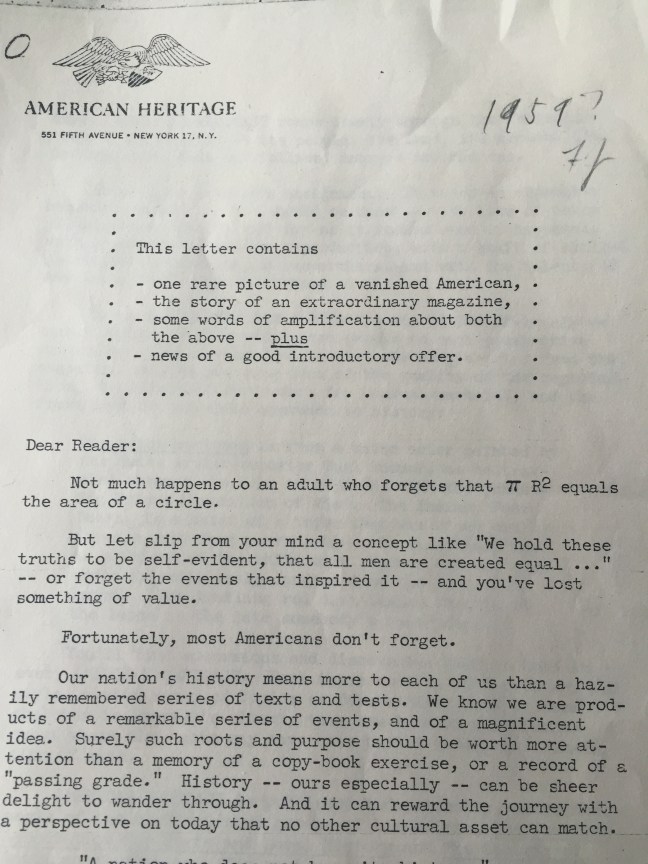
That more or less nails it. Less certain is who actually invented the box. The alleged creator, Frank Johnson, always disclaimed ownership, although others gave him credit for it. Well, here’s a letter by Johnson, featuring an actual…Johnson Box. (You’ll notice that we’re not calling it a Jayme Box or a Baring-Gould Box). Scroll to the bottom to see the actual letter.

As always with Frank Johnson, the four-page letter for American Heritage magazine, apparently sent in 1959 or ‘60, is a helluva piece of writing. It starts with the box:

This letter contains 

  • one rare picture of a vanished American,
  • the story of an extraordinary magazine,
  • some words of amplification about both the above – plus
  • news of a good introductory offer.

Dear Reader:

 Not much happens to an adult who forgets that π R2 equals the area of a circle.

 But let slip from your mind a concept like “We hold these truths to be self-evident, that all men are created equal…” – or forget the events that inspired it – and you’ve lost something of value.

 Fortunately, most Americans don’t forget.

 Our nation’s history means more to each of us than a hazily remembered series of texts and tests. We know we are products of a remarkable series of events, and of a magnificent idea. Surely such roots and purpose should be worth more attention than a memory of a copy-book exercise, or a record of a “passing grade.” history – ours especially – can be sheer delight to wander through. And it can reward the journey with a perspective on today that no other cultural asset can match.

 “A national who does not know its history,” said George Santayana, “is doomed to repeat it.”

 AMERICAN HERITAGE is a magazine designed to help you know your history better – and to know it with a growing sense of pleasure.

 So if you agree that a sense of history is an asset worth cultivating, then we suggest you will find this magazine a colorful and accurate chart for a wonderful trip through time. AMERICAN HERITAGE roams freely through the whole history of our country – its people, its land, its growth, its triumphs, its fads and follies, manners and madness.

This is an extensive assignment. It takes an expansive magazine to do it as it should be done – with lots of color illustrations to show history as it looked when it happened, with good papers for fine reproduction, with a staff of skilled journalistic-historians and researchers, and with the talents of America’s front-rank historians as its authors.

So a copy of AMERICAN HERITAGE costs $3.95; obviously we cannot afford to fire off a free sample to each prospective subscriber. We have sent along just one sample print from the magazine, to give you some idea of the quality of the reproduction, the extent of our search for unusual material, and the fresh look of our whole approach to history:

The print enclosed is from a water color painted by the Swiss artist-reporter Carl Bodmer, as he traveled through the West in 1832-33, with the junketing Prince Maximilian of Wied. The Indian, Four Bears, is a chief of a tribe that was wiped out by disease only four years later. He was identified as a friend of the white man. Bodmer did not say whose friendly scalp dangled from the Indian’s lance. (The trailing red disc behind the tip of the lance is the late somebody’s hair piece.)

You’ll find excursions and discoveries such as this in every AMERICANHERITAGE. Each issue covers, with accuracy and style, a wide range of topics – from a first look at some skeleton in America’s closet, to a new look at some famous event where the facts may have been buried under an accumulation of myth.

AMERICAN HERITAGE is published independently, under the aegis of two distinguished groups of historians, The American Association for State and Local History and The Society of American Historians. The senior editor is Bruce Catton, most honored of all students of the Civil War; Dr. Allan Nevins, dean of American historians, heads the Advisory Board. Contributors include America’s foremost writers of lively history.

The August issue will continue the tour of the past with 15 articles and picture features, including

A Tax on Whiskey? Never! By Gerald Carson. A timely piece on an old but still explosive issue. In 1794 the farmers of Western Pennsylvania claimed that country whiskey, that honored rural elixir, was being unmercifully slapped by the tax collectors. The locals were walloping the revenue men and firing up the stills with equal ferocity – until George Washington (who turned out some pretty good rye of his own at his Mount Vernon still) used Federal force to settle “The Whiskey Rebellion.”

End of a Friendship by Charles Seymour, ex-president of Yale. In a personal memoir, Col. Edward House, key man in the Wilson administration and by the President’s own christening “my second personality,” tells for the first time, why he thinks he fell out with Wilson.

The Man Who Invented Panama, an interview by Commentator Eric Sevareid with Philippe Bunau-Varilla, the man who pushed through the Panama Canal.

The Action Off Flamborough Head by Oliver Warner. An important item in each issue of AMERICAN HERITAGE is an extract (not a condensation) from some good new history book. The August selection (from Warner’s forthcoming “Great Sea Battles”) tells of the moonlight sea duel off the Yorkshire coast between Joan Paul Jones and Britain’s Captain Pearson. Jones termed the conditions that night “really deployable.” But he won – and soon was neglected. Pearson lost and was knighted.

Like to read further? More than 330,000 subscribers will. We’ve found that 96% of them save every copy of AMERICAN HERITAGE. It’s written, illustrated, printed, and packaged to last. For example, it comes in hard covers, like a fine book, and with no advertising to date its contents.

In each magazine you’ll find 112 editorial pages and at least 100 illustrations – more than a third in color The pictorial array consists of tintypes, paintings, posters, old charts and notebooks, photographs, etchings, and daguerreotypes — many of them never published before. The August issue has two articles containing rare illustrations:

A portfolio of Japanese water colors (circa 1855), showing how the first Westerners in Japan looked to their Oriental hosts; and some rare on-the-spot sketches of the great Chicago Fire of 1871, with captions written by an eyewitness.

In appearance and content, AMERICAN HERITAGE is unusual. So is its $3.95-a-copy price tag. But matched against books of comparably quality (you can’t compare it to the usual magazine), the single-copy price is a real bargain. Our current introductory offer is better than that:

You buy three issues—and get six.

Ordinarily, a year’s subscription would be $15. Bought one-by-one over the course of the next year, the tab for these same six issues would be $23.70. But by ordering now, your six issues can cost you just half that — $11.85, the retail cost of three.

To subscribe at this introductory price, fill in and mail the postpaid order card. You need not pay anything until after you have seen your first copy. Then you have a choice of three monthly installments of $3.95 each … or a single payment of $11.85. (The order card explains all the options.)

If at any time you feel that AMERICAN HERITAGE does not do at least as creditable job for America’s history and your interest as we promised you, you can cancel your subscription and we will refund the amount of the undelivered portion.

The August issue can begin to show you why AMERICAN HERITAGE has won the acclaim of so many critics, and the loyalty of so many readers. Mail the order card today? Your first copy is boxed, and can be in your hands within a few weeks.

And thank you.

Sincerely,

James Parton

Publisher

2016-04-27 08.21.20


Bogus Blurbs

By Ray Schultz

Ladies Home Journal is not known for its investigative journalism. In 1906, though, it published a story titled, The Inside Story of a Sham, about phony testimonials in patent medicine ads, exposing the inside workings of a highly fraudulent business.

The article started with the fact that the medicine sellers brazenly used real peoples’ names without their permission. For example, a Senator whose signature appeared in ads wrote that he had not endorsed the product, and that he had never even received the sample that supposedly was sent to him. Another notable threatened legal action if the medicine sellers didn’t stop quoting him by name. Author Mark Sullivan wanted to know: How did the medicine sellers get these peoples’ signatures? Here’s what he uncovered. (Note: we’ve maintained his spelling).

I found that there are three men, rivals in trade, who make a business of securing these indorsements for “patent medicines” from prominent men. They are known as “testimonial-brokers.” The best-known and most successful of the three was approached one day last spring by a man who represented a well-known “patent medicine.” The medicine man states his case: he was about to extend the advertising of his “medicine” and he wanted testimonials. In short, he put it to the testimonial-getter concretely by saying that he wanted signed testimonials from, say, one hundred Members of Congress, Governors, and men high in the Army and Navy. The testimonial-getter was perfectly at home in this situation. He figured on the contract as an architect would estimate on a house.

Confirming my talk with Mr. _________, I will undertake to obtain testimonials from Senators at seventy-five dollars each, and from Congressman at forty dollars on a prearranged contract. A contract for not less than $5,000 would meet my requirements in the testimonial line.

I can put your matter in good shape shortly after Congress meets if we come to an agreement. We can’t get Roosevelt, but we can get men and women of national reputation, and we can get their statements in convincing form and language.

 Here it was then—an actual business!

 The next point I wanted to find out was: Who gets the seventy-five dollars or the forty dollars? Not the Senator or Congressman, I found. It is true that there are a few public men who have a financial interest in “patent medicines”; but none sells his name outright for seventy-five or forty dollars. The testimonial-getter explained this:

 “The knowing how to approach each individual is my stock in trade. Only a man of wide acquaintance of men and things could carry it out. Often I employ women. Women know how to get around public men. For example, I know that Senator A.________has a poverty-stricken cousin who works as a seamstress. I go to her and offer her twenty-five dollars to get the Senator’s signature to a testimonial.
But most of it I do through newspaper correspondents here in Washington. Take the Senator from some Southern State. That Senator is very dependent on the Washington correspondent of the leading newspaper in his State. By the dispatches which that correspondent sends back the Senator’s career is made or marred. So I go to that correspondent. I offer him fifty dollars to get the Senator’s testimonial. The Senator may squirm , but he’ll sign all right. Then there are a number of easy-going Congressmen who needn’t be seen at all. I can sign their names in anything and they’ll stand for it. And there are always a lot of poverty-stricken, broken-down Army veterans hanging around Washington. For a few dollars they’ll go to their old Army officers on a basis of an old acquaintance’ sake, and get testimonials.”

Assuming that was true, it doesn’t say much for the journalistic ethics of those home-town correspondents.

Just as bad, in Sullivan’s view, were the unauthorized testimonials from ordinary people. In one case, a woman said that she “had never used the ‘medicine’ she was advertised to indorse., but that a man had called on her, offered to have a dozen photographs of her taken at the best gallery in her city, and she could have them all free of charge if she would sign the letter and let her photograph be printed. She did, and she got the photographs, but she had never had the ailment spoken of in the advertisement, and had never tasted a drop of the “medicine.”

Well, at least she got the photos. Many people got nothing. And some victims had their names used because they were actually taking the medicines, and were so zonked that they didn’t care if their names were used. Sullivan explains:

 Where the “testimonials” seemed genuine, I found that either the cocaine or the morphine in the “medicine” soothed the pain of the victim, or the strychnine or alcohol exhilarated the taker. But as to a genuine case of actual good gone or help received, except fancied, I could not find a single one of all those I investigated.

Well, so much for honesty in that supposedly golden time, but it didn’t go on for long: The Pure Food and Drug Act was passed that same year, and put most of the patent medicine sellers out of business (along with some testimonial brokers, no doubt). Still, online scam artists post fraudulent testimonials even now. Ladies’ Home Journal should look into it.


The Spanish Dance

By Ray Schultz

On Thursday, my wife Andrea and I had one of those rare experiences at Carnegie Hall: A piano recital by the young Spanish pianist Jose Menor. The concert was devoted to Enrique Grenados’ Goyescas, a suite of piano pieces inspired by Goya’s sketches of everyday life in Spain. And in transporting the audience on this hundredth anniversary of the composer’s death, Menor showed that he may be a worthy replacement for the late Alicia de Larrocha as the leading interpreter of Grenados in our time.

But my purpose here isn’t to write a piece of musical criticism. It’s to tell you a very personal story.

The time was Labor Day Weekend in 2001. Idly browsing in Barnes & Noble, we bought a Pablo Cassals CD titled Legendary Casals Performances, Early Recordings 1925-1928. It featured pieces by Chopin, Saint-Saens, Popper, Bach and Debussy, all played in that rich, warm, golden tone that only Cassals achieved on the cello, with piano accompaniment.

We played it once or twice, then forgot about it. Who had the time? A week later, planes flew into the World Trade Center, and the buildings came crashing down. Notwithstanding that a neighbor was killed in the event (Glenn Winuk, a lawyer and volunteer fireman who tried to save others and had, in fact, done the same thing during the 1993 Trade Center attack), we were a mile or two away, and could make no claim of suffering. But we were depressed and anxious, as were most people in New York (and, we suspect, the rest of the country).

Drawn back to dead European men, as they say, we returned to the Cassals CD. And the seventh piece on the CD reduced both of us: On the CD cover, it was titled, simply, Spanish Dance, although it’s really Spanish Dance No. 5. Written by Granados, the selection starts in a minor key. Then, switching from cello to piano, it ascends to a sixth major chord, and then up to the seventh, before eventually returning to the minor.

Neither of us is well-educated in music. But when the piece swooped upwards and hit those major chords, we felt that life, however fragile, would go on for a time, and that we had to enjoy these moments. I often think of that epiphany when spreading cream cheese on a bagel on Sunday morning.

Yeah, I know, a cynic shouldn’t indulge in this kind of sappiness. But we tend to forget what it was like in the aftermath of 9/11. Wusses that we are, we got emotional over very little. And Grenados helped bring us around. Maybe it was the tinny sound of the almost 80 year-old Cassals recording. How could you not think of your grandparents and the world they lived in?

The months passed. And as we returned to shopping (as commanded by our president), we decided to delve into Enrique Grenados. We learned that he was born in 1867 in Spain, and was a piano virtuoso and a varied composer, bringing a touch of modernism to his particular Spanish music.

Born in 1923, the renowned pianist Alicia de Larrocha grew up hearing about him, although she didn’t play the “real Grenados” until after the Spanish Revolution. “He was a very sensitive, very romantic man, with big eyes and…well, you know that kind of man in that period of history,” she said in an interview with David Dubal for his classic book Reflections from the Keyboard. “Very romantic, very sensitive, and poetic—yes, and a very good-looking man. Very good-looking. Beautiful eyes. So he had many, many romances and many, many women fell in love with him. And, I wouldn’t say my mother was really in love with him, but she had some admiration and something for him that was very strong.”

Dubal asked de Larrocha to compare playing Goyescas and Issac Albeniz’s Iberia.

“They are so different,” she answered. “Goyescas is very difficult but it requires a different technique. You have to adapt your technique for Goyescas and forget Goyescas when you go to Iberia. But in a way, perhaps Goyescas is more pianistic. Grenados was a great, great pianist and it was easy for him to play. Albeniz, at the time he was writing Iberia, was not playing, so it was more intellectual.”

Thus inspired, we bought several more Grenados CDs, most by de Larrocha, went to concerts, and achieved at least a passing understanding of Grenados’ catalogue. And we mourned de Larrocha’a passing in 2009.

But we learned something about a year after 9/11. And there’s no way to make sense of it. It was that Enrique Grenados died in 1916 when a ferry boat he was on in the English Channel was torpedoed by a German U boat. He drowned trying to save his wife.

How very strange that Grenados perished in a military attack on civilians, an act of terrorism by a state, if you will. And here we were, cluelessly using him to comfort us after a terrorist attack in New York.

What does this coincidence mean? Most likely, as R. Crumb’s Mr. Natural says to Flakey Foont, it “don’t mean sheeitt.” But it has strengthened what will be a lifetime devotion to Enrique Grenados.

And we wonder: Did Grenados have any kind of premonition when he wrote those chords in Spanish Dance No. 5 in 1890? What would have he have made of the Spanish Civil War, which he could have well lived to see? We’ll never know. But Spanish Dance No. 5, and the rest of Grenados’ body of work, has sustained us through good and bad times ever since. Is it any mystery that we feel what can only be described as gratitude?

Note: The particular recording we cherish doesn’t seem to be available on YouTube. But here’s a 1916 version by Cassals—and an identical arrangement.


The Girl With the Guys

By Ray Schultz

Of all the writers I’ve known in direct marketing, none was more talented and charming than Joan Throckmorton.

Joan, who died in 2003, was a brilliant direct mail copywriter, and a prolific author and speaker. But she was also a gracious woman, with a certain wry reserve.

She was born in Evanston Hospital, something she had in common with the DM legend Bob Stone, and grew up in Florida. She arrived in New York in the early 1950s, and was hired by Doubleday, because friends and former classmates worked there. Her first assignment was in the art department.

“My job was literally to do character counts on new books, and all the scut work, and also to work with some of our illustrators and artists,” she said in an interview in her home in Pound Ridge, NY in 1997.

She particularly recalled one young artist who would hand her a drawing and say, “Joan, I drew you this butterfly.” After she had thanked him and he’d left, she’d promptly discard it.

He was Andy Warhol. “If I had kept some of those butterflies, I would be in a lot better financial position today,” Joan laughed. Another artist was Ted Gorey, whose ghoulish Victorian drawings later made him famous.

Eventually, Joan moved on. “Because I was a writer and an English major who wanted to write, I was allowed to go downstairs to what they called Sherman’s Alley. Charley Book Club Sherman ran the Doubleday Book Club promotions. He was known throughout the company as a vociferous, harsh, cookie-scary boss, but maybe he had a heart of gold, and I rather thought he did.”

Joan worked on club mailings. “I was Mystery Guild and Catholic Book Club. I did a few Literary Guilds here and there. Literary Guild was, as always, a high-end club. We worked with the editors, and that’s how I started to write, mostly with the thrillers., where you do sort of a film trailer or preview, the monthly club announcement. That was my introduction to direct mail.”

Most book club prospecting was done in space ads at that time. But there were also monthly selection mailings. “The package consisted of pretty much what it consists of now: a plain white out envelope identifying the club,” Joan said. “Sometimes it may have had copy lines, very simple lines, club announcements and not a series of flyers. We had a small list of many fewer books, alternate selections, that we changed and updated. Today we have many more.”

She continued that the prevailing wisdom then was that the information age was on its way, “the information age when people would be given more to read about, more data input than they could handle, due to new electronic methodologies, one of which was the photo facsimile of newspapers, not to mention the purple-inked Xerox machine.”

Making Your Own Clothes

Work aside, Joan’s early life in New York was right out of My Sister Eileen.

“I started at Doubleday at $55 a week, and we got an extra bonus at Christmas of about $20, with taxes taken out,” Joan said. “That was it. Now how did you live in those days? You lived like they’re living today—two and three people in an apartment. No real privacy. Once a week, you would go out to dinner with a friend when you didn’t have a date, and you’d have a nice meal at a modestly priced restaurant. If you had a date (the women never paid in those days0 you might go to a modestly priced little French restaurant, or to a Third Ave. bar and hang out with your mixed groups of friends. And we had lots of parties. But nobody had any money.”

In contrast to women with their $55 salaries, men started at $65 to $70 a week—not bad money at the time, Joan said. “We’re talking in weekly terms,” she added. “Nobody could understand anything more than that.”

On those tight budgets, young working women usually made their own clothes. “We sewed—we either rented or one of us had a sewing machine,” Joan remembered. “We made clothes so we’d look decent in the office.”

But Joan was a talented writer, and she jumped around, even though she was advised against it. “They’d say, ‘Why would you want to leave? You’re doing well.’”

Joan noted, though, that “we had quite a hard time for women to get promoted, so I went over to Time Inc. and applied for a job to Life Promotions. And there I worked with Bill Herringbone, and the publisher, a young guy named Andy Heiskell. Wendell Forbes was down the hall, and Bob Fisler was over in Time, and we all knew each other. Later, I became Andy Heiskell’s assistant. And I moved to being promotion director for Sports Illustrated when Bob Fisler left that book.”

Sports Illustrated was a daring start-up for the time. “In those days, they said sports was tennis and golf. It wasn’t. Tex Maule was there early, and we were doing a lot more cogent advertising. But there was no professional basketball. Pro football was just getting started, and I was dating one of the guys on CBS, so I got to know all of the New York Giants football team, which was nice for a young gal working for Sports Illustrated. It was really wild and crazy—Frank Gifford, Kyle Rote, the whole bunch.

As copywriter, Joan also worked on the first Life book—The Life Cookbook. “By today’s standards, it was a pretty antiquated-looking book, but it was a life-sized book and I did the promotions for it,” Joan said.

Time Inc was a fun place to work. “Two weeks wouldn’t go by without some floor party—a big birthday party,” she went on. “Ad salesmen met at the 3G’s across the street at 5:30, and drink, drink, drink. There were people falling down elevator shafts, being caught in embarrassing positions,” she laughed.

It was easy to party: The work day went from 9 to 5, and maybe they’d stay until 5:30 or 6 when busy. There was no weekend work.

Joan’s next stop was American Heritage, where her sometime boss at Time was now in residence: Frank Johnson.

“Frank was quite a character, not a ladies’ man, a wonderful guy,” she said. “A perfectionist, a tough guy, and Bill Jayme was writing for us, too. Jayme and Frank were very close. And Frank was a good red pencilier, on anybody’s copy. Tough, tough guy to work with.”

Later, Joan worked for Time Life Books and later on Look magazine at Cowles. “That’s where I got to know Pat Carbine and that group—the Ms. Magazine group,” she said.

Finally, Joan went out on her own and had an illustrious freelance career, writing thousands of effective packages, columns for DM News and Direct and books.

I richly enjoyed our interview in ’97. We sat in her home office, a small room with a desk and computer, a zebra painting on the wall, and large stacks of catalogs. Joan’s husband Sheldon Satin, a customer service consultant, was at work in the office next door. You could see the autumn foliage outside the window.

In the end, Joan had mixed feelings about some of her experiences–for example, Andy Heiskell’s birthday dinner at age 80, thrown by the Time Life Alumni Society. Heiskell had been chairman of Time for 30 years.

Joan felt a certain loyalty, but “they were all tall men in Navy blue blazers,” she recalled. “Just wasps—no blacks, no Jews. All the women had lovely little dresses on, and they were all wives. I thought: All the good and bad things rolled up into one.”
Blowing Smoke

By Ray Schultz

The liquor peddlers we covered last week may seem like the ultimate marketing lowlifes. But there is an even worse group.

The tobacco pushers. They’ve used promotion, advertising, direct mail and every known discipline to hook smokers. And while we’re all responsible for our own vices, they helped kill many people.

Prior to 1900, most tobacco was either chewed or rolled at home in cigarette papers, like marijuana today. The rare person who smoked consumed an average of 16 cigarettes per year, and most women did not smoke at all.

Then mass production came into play, enabling tobacco companies to produce thousands of cigarettes in the time it previously took a smoker to roll one.

Smokes were now available by the pack in every town in the country. And, thanks to lobbyists, tobacco was exempted from the Pure Food an Drug Act of 1906. The result? The tobacco kings avoided the regulations that plagued the manufacturers of patent medicines and many other products.

But the biggest boost to the prosperity of the cancer merchants came with the development of mass advertising. By the mid-1920s, brand names like Lucky Strike and Camel were plastered on billboards and on the pages of magazines. They depicted smoking as an attractive pastime, and linked it to sporting activities and romance. An early Chesterfield ad showed a pretty young girl telling her boyfriend, “Blow some my way.”

The tobacco lords were not merely competing with each other to sell cigarettes, they were creating a market that never before existed. In a few years, thanks to subliminal advertising and popularization of smoking by movie and sports idols, millions of men, women and children picked up the habit. Then the coffin nail sellers received an unexpected bonus: mass addiction. As we now know, the physical habit is equaled by a psychological dependence so powerful that people light up cigarettes without even thinking about it.

Once they realized it, the ciggie manufacturers wasted no time in exploiting this fact. For starters, they aimed their advertising at young non-smokers instead of at people who were already hooked. They targeted women. And they sent thousands of free cartons to veterans’ hospitals and servicemen stationed overseas. Not only did they receive good publicity for these charitable ventures, they gained new lifetime customers among the soldiers who received the handouts.

As for health, their attitude seemed to be symbolized by the copy in one of their ads: “Not a Cough in a Carload.”

Even in the ‘20s, there were indications that smoking was harmful, but the tobacco men worked hard to suppress such information. In 1936, a medical researcher exhibiting a cancerous lung remarked that such a case was so rare it might never be seen again. It wasn’t until the early ‘50s, when the first generation of heavy smokers started dying off en masse, that scientists were able to show a definite relationship between smoking and respiratory disease, especially lung cancer.

The tobacco industry sold its composite of poisons for over 50 years with only the slightest interference from regulators. But eventually, as 77 million workdays were lost and 360,000 deaths were reported due to smoking-related illnesses each year, the problem became too big for any government to ignore. In 1964, after painstaking research, the U.S. Surgeon General’s Advisory Committee on Smoking and Health released a historic report linking smoking with the spiraling death rate from cancer and heart disease. Unlike previous efforts, this one spelled it all out, for anybody who wanted to see it—it was also excerpted in almost every newspaper and magazine in the country.

Don’t think the tobacco firms rolled over. Almost out of nowhere, two “scientific” articles appeared, one in True magazine and another in the National Enquirer, purporting to show that cigarette smoking wasn’t bad for you at all—that it was much safer, in fact, than walking across the street or trying to fix a faulty electrical appliance The articles were widely reprinted, and copies were mailed, under True magazine’s letterhead, to 500,000 consumers.

Who mailed them? An FTC investigation revealed that it was the Tobacco Institute. The author of the article, Stanley Frank, was no scientist: This prehistoric content writer had previously done some articles on sports and other lightweight topics.

Meanwhile, the nicotine cartel carried on a backchannel fight to prevent the FTC from banning cigarette advertising on television. This went on for a few years until a New York attorney named John F. Banzhaf III petitioned the Federal Communications Commission, claiming that if cigarette companies were going to be allowed to advertise on the air then anti-smoking groups should be given equal time to refute them, under the FCC’s Fairness Doctrine.

The industry deployed its biggest legal guns, but lost, right up to the Supreme Court. The airwaves were deluged with anti-smoking commercials. And sales plummeted.

At this point, the tobacco trust decided that it should take its advertising off the air, because then the prime tine anti-smoking spots would also cease. So it sent its lobbyists out to support such a ban. And it promised to not target the young.

The ban went into effect on January 2, 1971, in accord with the Public Health Smoking Act of 1970. Some anti-smoking people saw it as a victory.

But they were deluding themselves. The networks stopped showing the antismoking commercials in prime time, and cigarette sales shot up almost as quickly as they had gone down.

What’s more, the smoke purveyors saved hundreds of millions of dollars by not running TV advertising. And they diverted these funds into other types of marketing. For example, they came up with the Virginia Slims Tennis Tournament, which won the endorsement of some of the biggest names in sports, while also gaining prime-time TV coverage (with the name Virginia Slims prominently displayed in color around the court). They also started mailing out free samples, just as they had done years before, but the FTC put a halt to it.

We’ll stop there. People of a certain age will recall that restaurants, bars and theaters were so full of smoke that the eyes burned. Things are better now in that way thanks to smoking restrictions, but you can still see young people puffing away on the street, especially women.

It’s impossible to scare them. But I’ve seen enough friends and colleagues die of lung cancer and emphysema, usually wearing inhalers for their last several years.

In the end, the cigarette marketers are worse than their liquor counterparts. An adult can enjoy an occasional glass of alcohol or enhance a meal with a good wine; why, it’s said that a daily glass of wine can improve your coronary health.

I can’t remember seeing any such reports about cigarettes (at least not credible ones). So no credit is due the swine who market the evil weed.


Drunken Youth

By Ray Schultz

Oh, our poor young people. Parents who worry about them often ask if liquor advertisers target youth.

Of course they do, you fools. Where else are they going to get new customers? The Boomers may drink more as they sink into dementia, but there’s a certain churn.

Rolling Stone magazine put it best in an ad in the Liquor Handbook some 30 years ago:

“Meet over 2 ½ million young adults who read Rolling Stone…They’re affluent, they’re thirsty, they’re deciding right now what they’ll be drinking for the next 20 years. Who needs ‘em?? You do: they’re your future.”

By the way, this was around the time the magazine ran a lurid article on teenage alcoholism. Talk about having it both ways.

Has anything changed?

When Prohibition was repealed in 1932, alcohol was less of a problem for both young and old. Fewer than a third of the American people drank at all and statistics on the damage from steady boozing were only a fraction of what they later became (perhaps because there was less research being done).

This changed in the 1950’s, when now-prosperous ex-G.I..’s created the home entertainment revolution. Booze was now more acceptable in the home, and millions of people set up bars in their houses to serve it.

Alcohol was also seen as more chic. And why wouldn’t it be? Liquor flowed once every eight minutes on television, according to the Christian Science Monitor.

Then as now, the most common kind of liquor advertising showed sexy young people enjoying a drink. They could have been playing with toy boats, as in a Smirnoff’s ad, or sitting around a fireplace. The message was that a person who drank the beverage being advertised would enjoy wealth, sex and social status like the people in the ad.

Which was pure rot. A person who made a career out of swilling what the people in the ad were drinking would not only get further away from wealth, sex and social status, but could end up with no wife, no house, no worldly possessions whatsoever.

Naturally, liquor companies soft-peddled that sad fact. But they hinted at it in occasional ads that seemed to appeal directly to alcoholism. For example, Smirnoff’s showed a bottle of vodka lying smashed on the ground, with a caption reading, “Did you ever see a grown man cry?”

That wasn’t the worst of it. As we now know, liquor advertising was (and still is) full of subliminal messages, which the industry pretended to only dimly understand. One person who understood them was Professor Wilson Byron Key, a former advertising executive, who wrote the book Subliminal Seduction.

In Senate hearings, Key showed slides of several full-color ads in national magazines. To the astonishment of the Senatorial audience, he pointed out various nightmare images such as death’s heads and devils masks, plus assorted sexual imagery, and the letters S-E-X, all superimposed on the ice cubes in the glasses.

If the reader looked carefully enough at the ice cubes floating in almost any liquor ad, he, too, would see macabre and sexually provocative images winking at him. “The subliminal content appears to be about two things—sex and death,” Professor Key said. He then explained that most people will never even realize that they are seeing such a thing, but that it will register in their subconscious, so that at a later time, when they are shopping in a liquor store, they will find themselves looking for a certain brand without knowing why. “These are subliminal stimuli, not perceived at any conscious level,” he added. “They are perceived at the unconscious level.”

The liquor industry claimed that these masterpieces of hallucinogenic art were just that—hallucinations. “They’re ordinary ice cubes,” one ad writer said. But Key debunked that. “If you have ever been around commercial photography, you would know that this is an impossibility. You can’t photograph ice. The stuff melts under hot lights.” As far as the professor was concerned, these images were most skillfully air-brushed in.

Granted, these ads weren’t all directed at the young. But many new products were. For example, vintners learned that young people were drinking wine to supplement their marijuana. In response, Ernest and Julio Gallo, introduced pop wines like Ripple and Boone’s Farm Apple Wine, and the Heublein Corporation brought out Annie Green Springs wine. When wine faded, and the love generation turned to harder booze, the wineries switched their focus to the teenage audience. Heublein introduced Hereford Cows, an alcoholic milkshake available in flavors like chocolate, strawberry and banana.

Think about that the next time you want to criticize Millennials for their drinking habits.

What’s more, people barely old enough to drink and vote were not the only prime market. The Gallos created a libation called Thunderbird after reading marketing reports that said black consumers were fond of mixing white port wine with lemon juice. Thunderbird sold 2.5 million cases during its first year. It’s not clear who bought them, but the product later became a staple on interracial skid rows across the country.

Is it true that the industry had nobody in mind for these ads and products? If you believe that, you shouldn’t work in marketing.

“An industry that spends over $500 million a year on advertising certainly has a good idea of who buys its products and why,” said Dr. Eugene Noble, director of the National Institute on Alcoholism and Alcohol Abuse, back in those halcyon days.

It still does.

The Man From Mars

By Ray Schultz

Scientists believe that life may exist on some of the ice-covered moons of Jupiter and Saturn, and many say that it may have once been present on Mars.

Here’s a hint that could help prove their case. In the 1950s, Time magazine wrote that a Martian visited Earth.

Wait—let me qualify that. It wasn’t the magazine that said it, but a direct mail piece sent to prospective subscribers. Either way, this may have important consequences for the human race, so I here reproduce the letter:

This is His Excellency, the Ambassador from Mars.

You’ve probably never heard of his unexpected visit to America, for it was a very hushed-up affair. (But just don’t be surprised anymore when you see, or hear of, flying saucers. Don’t even be surprised if you should bump into a Martian on the street.)

His Excellency arrived in Washington one evening recently, in a shiny flying saucer that put down on the Mall near the Lincoln Memorial. His mission was to find out as much as possible about the Earth people: whether they were friendly or unfriendly, barbaric or reasonable civilized, and so forth. And since the atmospheric pressure here wasn’t really suitable for a Martian, he had to get all this important information in just a few hours.

But he didn’t have much luck, right from the start!

He rushed over to the Pentagon to learn about carrier jets and atomic subs, tanks and super bombers and grand strategies (and also to invite a few of the officers for a ride in his saucer), but the sentry thought he was a newspaperman playing a joke, and wouldn’t pay any attention to him – or even let him talk to a general on the phone.

He ran to the State Department to ask about treaties and tariffs and the United Nations, but a brusque young charge-d’affairs told him to come back after Easter … and the guards wouldn’t even let him near the White House.

So he walked into the National Art Gallery looking for the paintings and statues and frescoes and tapestries that have delighted art lovers for centuries, but the doorman said he wasn’t properly dressed and wouldn’t let him in.

And so it went, everywhere he turned. On the Hill everyone was too busy to be bothered . . . the British Ambassador was out of town … the Russian representative simply said, “Nyet” … and even one of the city’s most famous scientists was reluctant to have him pay a visit without a clearance.

Soon, his Excellence became discouraged. He wasn’t angry at the situation; he just realized that he had come down a century too soon. For cabinet members, protocol experts, admirals and even science-fiction writers were simply too startled for words.

Reluctantly, the Ambassador trudged his way back to his waiting flying saucer – his mission unaccomplished. Suddenly, something happened that made all the difference in the … ah … universe! He picked up a battered, thumbed-through copy of a weekly news-magazine called TIME that was lying in the grass just in front of his saucer. And, glancing quickly through its pages, he became so excited that he shouted “Eureka” – and roared off into the sky. And all the way up to Mars he had one of the most thrilling rides he’d ever taken, reading about …

… the ups and downs of the President’s program on its way through Congress … about great industrial plant that built cars and planes and things called refrigerators and washing machines …

… about the problems in Europe, and the restlessness in the Middle East, trouble from a vast nation called Russia, and battles going on in a small country called Indo-China, a boom going on in a large country called Canada …

… and about books and plays and wide-eyed movies and color television, and about all the strange and wonderful, generous and greedy, good and bad people who were doing and saying the things that other people wanted to know about.

He learned so much about the people and governments and problems and opportunities on the Earth that by the time his saucer had reached Mars, he was able to turn in a full and revealing report on the things that were going on in our world.

* * *

Now, just because I am enclosing with this little story a return card which entitles you to receive TIME at a special introductory rate it does not mean that I think you don’t know much about the news – or that reading TIME will assure you of becoming an Ambassador Extraordinary the way his Excellency eventually did.

But it does mean – that you’ll find TIME as valuable and interesting as do the more than 1,000,000 American families who wouldn’t miss their copy of TIME for the … ah … world.

And that after a few issues you will understand what actor Charles Laughton meant when he said:

“When I open TIME and read about anything whatever, I know that you have certainly been into the subject and found out all about it inside out, upside down, back, front and sideways.”

So because TIME can be especially helpful to you in the news-filled days ahead, won’t you give TIME a trial and accept this special invitation to try TiME for:

27 weeks for only $1.97

–eight cents for a world of information and enlightenment every week.

No need to send money now – we’ll gladly bill you later. But this is the only time I can offer you this reduced Introductory Rate, so please sign the enclosed card and mail it back to me at our expense today.

 Cordially,

Bernard M. Auer

Circulation Director

It’s not clear who wrote this direct mail piece, or what the exact date was. I suspect it was 1954 or 1955, since that $1.97 offer then dominated in prospecting pieces.

But the Time team tried to update it later, and penciled in changes on the copy I Xeroxed. Atomic subs were changed to nuclear, tanks to missiles and super bombers to rockets. At the end of that paragraph, in which the Ambassador is spurned by everyone, someone wrote, “And NASA wouldn’t give him any lunar trips.”

Further down, the British Ambassador who was out of town was changed to the Chinese Ambassador who wouldn’t speak to a non-Marxist, famous scientists became newscasters and a clearance became a press pass. Admirals were changed to Congressmen. Wide-eyed movies became professional football. And the 1,000,000 American families was increased to 4,450,000 families.

I’m not sure if these copy changes hit the mails, or if the Martian Ambassador ever returned to Earth.

More on Hiroshima Mon Amour

By Ray Schultz

I was afraid this would happen. A few weeks ago, I did an item about Time Inc sending a small strip of film from the movie Hiroshima Mon Amour in a mailing. A friend in the circ business asked for the actual letter.

I couldn’t find it at first–I wrote the original piece from memory–but I have since located a Xerox in a cardboard box. So here’s the original 1960 copy from Time. The envelope had a light green panel featuring many small Time logos, and a line saying, “Film Enclosed.” Handwriting on the envelope identifies the piece as “Hiroshima Mon Amour 1960.”

* * *

Dear Reader:

These six frames of film are from the much-discussed French film, “Hiroshima, Mon Amour”, directed by Alain Resnais and described by TIME as “the acknowledged masterpiece of the New Wave of Gallic moviemakers.”

After you have held the strip up to the light and caught the spirit of this “intense original and ambitious piece of cinema”, you may or may not decide to see the film. (The locale shifts between France and Japan; the sub-titles are in English). We think you’d find it an interesting experience.

But the real reason for this letter is to tell you how to get more out of every new movie you see, every new book you read, every new place you visit, and just about every conversation you find yourself taking part in —

— by giving yourself the extra advantage of becoming a regular reader of TIME.

For people who read TIME can’t help but bring to every activity the background and insight they’ve gained from following the wonderfully varied story of the news and the people who make it.

In the case of this film, for example – you would start out several laps ahead – with a firm grasp of the new goals and the new techniques that imaginative movie directors are exploring now…with a sharp awareness of the current unrest in Japan, the spoken and unspoken attitudes that underlie the actions of the characters you watch. And the same point applies to almost every else you do. Just think about it…

Are you planning a trip? Going to the theater? Following the election campaign? Helping a youngster to choose the right school?

As a TIME reader, you’ll have bases for comparison…facts to bolster your private judgments…and easy familiarity with the whole broad subject, whether it’s music or books or business, science or sport or the arts.

Just because of what it is, TIME enhances, enriches and adds meaning to almost all your experience. It truly equips the Twentieth Century citizen to get more out of all the ways of life that are open to him in this infinitely complex world.

So if you are not now reading TIME as a subscriber with the continuity and flow that can only come from reading it every week, I hope you’d like to start now.

The enclosed card will bring you TIME for 27 weeks (a full six months) for only $1.97 – a saving of $1.66 under the regular subscription price and $4.78 under the newsstand price. If you will simply sign it and mail it, we will start your subscription promptly and bill you later, after your first copies arrive.

Cordially,

Rhett Austell

Circulation Manager


Privacy in the 19th Century

By Ray Schultz

There’s one small error in the white paper, Privacy and Advertising Mail, by the UC Berkeley School of Law.

The paper quotes a 1917 editorial: “Mail solicitation of business by printed circular has become an intolerable annoyance, to which all are subjected whose addresses appear in the directory or the telephone books.”* And it states that this was “an unusually early instance of stated concerns about advertising mail.”

That’s not quite true. Critics were complaining about junk mail long before 1917. And they sometimes referred to what we now call the privacy issue.

In 1875, in a article titled, “Fancy Advertising,” The New York Times reported on a man whose letter and Post Office boxes were “daily ‘made the recipients’… of a lot of envelopes, which he is put to the trouble of opening, and which he finds contain only advertisements of articles that he does not want to buy, or of companies or professional persons that he does not wish to employ.”

That piece didn’t mention mailing lists, but the vice crusader Anthony Comstock touched on the subject in 1880, in his book Frauds Exposted, when writing about lotteries and other types of frauds. “Any person who ever wrote a letter to a lottery, or other advertised scheme, is liable to have a large circle of correspondents,” he wrote. “The name once obtained must go the round of the fraternity, and, when thus used, is either kept for a new scheme by the same fraud or else sold to another one of the brotherhood.”

Case in point: The use of boarding school catalogues. “At last the child reaches the school, and his or her name appears upon the roll and is printed in the catalogue,” Comstock wrote. “These catalogues are sought for by those who send circulars through the mails advertising obscene and unlawful wares.”

Comstock added that names could also be had by “buying old letters from other dealers for the sake of the names, or by sending circulars to postal clerks and others through the country, offering prizes for a list of the names of youth of both sexes twenty-one years of age, or by purchasing addressed envelopes of those who make a business of collecting names, and then addressing envelopes to supply parties doing business through the mails.”

Granted, Comstock was more upset over what people were being offered by mail than how: privacy was a secondary issue. And legislators failed to mention privacy when they banned lotteries from the mail in 1890. But the subject came up again in a whole new context.

Medical Privacy

In 1904, Ladies Home Journal reported on the letters sent by women to patent medicine advertisers.

“Not one in a thousand of these letters ever reaches the eye of the ‘doctor’ to whom they are addressed,” the article said. “There wouldn’t be hours enough in the day to read them even if he had the desire. On the contrary, these letters from women of a private and delicate nature are opened and read by young men and girls; they go through not fewer than eight different hands before they reach a reply; each in turn reads them, and if there is anything ‘spicy’, you will see the heads of two or three girls get together and enjoy (!) the ‘spice.’ Very often these ‘spicy bits’ are taken home and shown to the friends and families of these girls and men! Time and again have I seen this done: time and again have I been handed over a letter by one of the young fellows with the remark; “Read this: isn’t that rich/” only to read of the recital of some trouble into which a young girl has fallen, or some mother’s sacred story of her daughter’s fall!”

Worse, these “sacredly confidential” letters were offered through letter brokers—“clearing-houses where patent-medicine frauds and quack doctors exchange, sell, and rent letters,” wrote Samuel Hopkins Adams in Collier’s magazine in 1906. (In effect, he was describing the early mailing list business).

This came to an end, too, but not because anyone objected to the misuse of personal information. In 1906, Congress passed the Pure Food and Drug Act, requiring that patent medicine advertisers list their ingredients and not make exaggerated claims. Many firms went out of business.

But the sale and trading of names survived, and it was duly noted—before 1917. In 1913, The Kansas City Star wrote, “It probably does not occur to (the average man) that by buying something by mail he has made his name a commodity in itself and become a target for commercial correspondents as long as he lives and probably long after a tombstone has been erected to him on some grassy hillside.”

 *Richard B. Kielbowicz, Origins of the Junk-Mail Controversy: A
Media Battle over Advertising and Postal Policy, 5(2) JOURNAL OF
POLICY HISTORY 248, 253 (1993).

Click here for a related article.