DEAR FRIEND: The Rascals, Rogues And Roues Who Made American Junk Mail Chapter 1: Crooked Colonials

By Ray Schultz

It started when the country was thinly settled, with only a few towns scattered along the coast. Most mail arrived by ship, and was dumped on tables in taverns, where anyone could read it. Colonists who needed goods had to ride miles through the mud to buy them. Or, they could order them by mail from England, a proccess that took months.

But one sharp operator, the Philadelphia printer Benjamin Franklin, found a way around this. Franklin sold products from his general store by mail through his newspaper: the Gazette (“The widow READ…continues to make and sell her well-known ointment for the ITCH”), and he published a mail order book catalog,, promising “the same justice as if present.”

Then, having proven that the local postmaster kept bad book books, Franklin was given his job, and later named co-postmaster of all the Colonies. In that role, he improved delivery, ensuring better service and profits for the Crown. But he didn’t do it out of altruism, nor for the Crown. Rather, the job “facilitated the correspondence that improvd my newspaper, increas’d the number demanded, as well as the advertisements inserts, so that it came to afford me a comfortable income.”

Franklin also started a lottery, the main way of financing roads and buildings in Colonial America. Washington ran one, so did Jefferson, and they were “fostered by Christian communities”—even the clergy played them. But there soon were too many, and the amateurs in charge were unable to cope with this market reality. So they hired promoters, and asked them to “advertise in the Papers, and have Hand bills struck off, and dispersed thro your neighborhood.”

They shouldn’t have asked. These promoters started papering the cities with handbills, caring little if some ended up floating in rivers, and even less if the pieces contained a grain of truth. Whereas early lottery handbills specified the precise number of blanks (losing tickets), the new ones vowed that there were “not two Blanks to a Prize.”

Outright lying wasn’t their only innovation. Soon, they had country postmasters tacking handbills on their walls. Trapped in some backwater, the postmaster would receive a letter and a packet of handbills from a faraway company. This practice started in the 1700s and lasted well into the next century.

“For the information of your place and vicinity, I have taken the liberty of enclosing a few Bills showing the present very interesting and brilliant situation of the Grand State Lottery of Maryland, of which only one drawing now remains to complete,” J.I. Cohen, Jr. of Baltimore wrote to postmasters in 1824. Many postmasters tacked the enclosed handbills on the wall or handed them out to townspeople, in return for a percentage on the tickets sold.

In 1825, Allen’s Lucky Office of New York put out a handbill saying that that a $25,000 lottery jackpot had been shared by “a patriotic soldier who had lost a leg in the service of his country.” In many towns, rubes who fell for a line like this could buy lottery tickets from the postmaster. But Allen’s Lucky Office invited direct contact: “Orders from the Country, (post paid) promptly attended to.” In this way it would get the names of customers. And it could mail them over and over without anyone knowing.

Chapter 2: Of Honesty And Virtue


DEAR FRIEND: The Rascals, Rogues and Roues Who Made American Junk Mail, Chapter 8: The Pride Of Park Row

By Ray Schultz

J. M. Pattee left Omaha for good—some say he was run out—in the summer of 1873. The Nebraska legislature had outlawed lotteries, effective Sept. 1, so he regrouped in New York, where he owned a brownstone near Central Park.

Not a man of idle nature, as one reporter put it, he ran a few scams in the city, then made his way to  Laramie and ingratiated himself with the right people. The Wyoming legislature passed a bill granting him a ten-year lottery license that could never be altered, and Pattee acted on it before the governor could sign it (which he never did).

It didn’t matter. The so-called Wyoming Lottery would operate entirely by mail. And Pattee could get away with it,for lawmakers had failed to keep lotteries like his out of the postal system.

Congress had tried in 1865 with a law defining “nonmailable matter”—everything from explosives to lottery materials. But it failed to specify letters or circulars, and what it meant the courts could never figure out.

Realizing their error, the lawmakers attempted  to clarify things in 1868 by prohibiting the mailing of “any letters or circulars concerning lotteries, so-called gift concerts, or other similar enterprises.” But this bill, too, was flawed in that it failed to set penalties for disobeying it.

In 1872, trying one more time, they forbade the mailing of “any letters or circulars concerning illegal lotteries, so-called gift concerts, or other similar enterprises, offering prizes, or concerning schemes devised and intended to deceive and defraud the public for the purpose of obtaining money under false pretenses.”

The blunder this time was that they had added the word “illegal.” How could a lottery chartered by a state or an institution be considered illegal?

Pattee knew that they would get it right sooner or later, and he knew he had to move beyond lotteries. He had doubtless heard of E.C. Allen, of Augusta, Maine, who in 1869 started Peoples’ Literary Companion, a paper filled with stories, homilies, recipes, songs and advertisements.

Other publishers followed Allen’s lead. A fellow Augustan named P.O. Vickery started Fireside Visitor, and W.W. Gannett followed with Comfort. Mailed to farmers whether they wanted them or not, these mail order papers were “the great business of the city, completely overshadowing everything else,” wrote Frank A. Munsey.

Pattee could do the arithmetic as well as anyone. He created The Times Illustrated, a promotional vehicle for the Wyoming Lottery. The cost was defrayed, in part, by paid advertisements for Red Cloud’s Great Indian Blood Purifier and other patent medicines.

He followed it with The Laramie News, in which he described Laramie and the local mining deposits: “There are within a hundred miles of Laramie City a hundred miles in length of gulches which will pay an average of five dollars per day in gold, for every day’s labor, and they can be worked with very little outlay of capital.”

Thus he sharpened his pen for a new venture—and just in time. On July 12, 1876, Congress enacted a new bill, dropping the term “illegal” when describing lotteries. Now it was unlawful to send any sort of lottery letter.

This bill turned out to be as hollow as the previous ones, but that wasn’t clear at first. Pattee cancelled his next lottery mailing, saying “times have been hard,” and accelerated a plan he apparently already had: He prepared a letter for fools who had won his previous lotteries and were now on his sucker’s list.

“On account of the new Postal law and the penalty for sending letters concerning lotteries through the mails, I have been obliged to make some other arrangement to pay off the small prizes of $1 and 50 cents as it would cost the party receiving them more than the amount to pay the express charges,” Pattee wrote under his own name.

Instead, he awarded shares in “one of the most extensive gold mines on this continent.” Additional shares could be had for $2 apiece.

“It is the richest gold mining country in the world,” Pattee wrote. “For miles away up in the heights of those tremendous elevations in the Big Horn Mountains glisten rich veins of gold quartz that run in golden ribbons at close intervals across their breasts. Some specimens of gold quartz have been found which assayed $47,000 to the ton—a mountain of gold ore.”

Pattee’s own employees turned against him. They sent a mailing to his “winner’s” list, offering for one dollar “a most complete exposure of this ‘arch swindler’s’ manner of defrauding the public during the past years.” They added that he planned to “foist upon those who have won good prizes in his last drawings, amongst whom we see your name, certain stock certificates…instead of the money they have RIGHTFULLY WON.”

The master returned to New York, where there was less danger of getting shot. He now worked only through designated criminals who would take the fall if there was trouble. One was N. Sherman Read, a tiny man known to friends as Nate. Pattee was married to Read’s sister Eunice, and they had often summered at Read’s resorts in New Jersey.  In 1876, now working for his brother-in-law, Read opened a lottery office on Nassau St. near Park Row.

Flanked on one side by City Hall, Park Row was home to newspapers and advertising agencies–and dozens of lottery shops. “Entering the office of any one of these so-called firms, the inquirer finds himself surrounded on all sides by a ground-glass partition,” a reporter wrote. And each one had a “hard-featured man peering through a wire netting under the sign ‘Cashier.’”

These offices also sent quantities of junk mail. The city’s best printers and engravers were two blocks south on Maiden Lane, and the largest post office in the country, a five-story granite block known as the Whale, stood on the triangular lot bordered by Park Row and Broadway.

Pattee made full use of these facilities, not only for his lotteries but for schemes like the Bullion Gold Mining Co. and Carburrus Gold Mining Company.

He also got to know his fellow mail fraud artists. Ellis and William Elias were driven out of Cincinnati for swindling, then made a fortune in New York running “dollar stores”—stores in which the shopper never knew what he was buying. They enjoyed a “very unenviable reputation,” the New York Times wrote.

The brothers operated a mail room in which men and girls sat at two rows of tables shaped in the letter “L,” addressing envelopes. Also to be found there was H.P. Jones, a former post office employee who was “discharged from P.O. for NY for embezzlement or helping himself to other peoples’ money.” A handwritten note signed by him was sent to 140,000 people in the fall of 1878:

“Dear Sir:

“A cousin of mine bearing the same name as yours, after the war was over, left his Regiment and I have not heard from him since. Now I do not know whether you are the same person or not but you can tell as soon as you see my signature to this letter.”

The note continued that a contest was about to be held, and that if the recipient agreed it would be rigged in his favor. Why this largesse? “I am sure that if a large prize was drawn by you and shown around that thousands of tickets could be sold in your County.”

A series of followup letters persuaded the sucker to pay $8 apiece for lottery tickets—a seemingly paltry sum by today’s standards—but the letters cost only a penny apiece to mail, and not much more to print. The Eliases had discovered the immutable law of junk mail—that a profit could be made even after expenses and the pilfering of cash-filled envelopes by postal workers.

Anyway, it was not their only business. They also ran several “stores,” including a jewelry store on Broadway and 21st St. (above which was their mail room). Their flagship was the Centre, a large outlet at 22nd St. and Broadway, in which they displayed gold and silver jewelry in cases. It operated on the same marketing principles as the junk mail business.

The Eliases promised in circulars that they could deliver “the most valuable articles to the purchaser at the same price as those of less cost,” but what they really offered was a lottery. The customers bought tickets in sealed envelopes from a cashier, who sat hidden in a teller’s cage. Most opened the envelopes to find that they had won cheap merchandise.

Operating on the border of legality, the pair had to pay occasional modest fines. But they “reaped a rich harvest from their numerous enterprises,” the New York Times reported. Ellis Elias alone had $300,000 in assets, including a country estate and $3,000 worth of trotting horses.

“A man who came in contact with the senior member of the Elias firm used to tell of seeing him exhibit a roll containing sixty one thousand dollar bills, one day, and when putting it back in his pocket heard him remark, pleasantly, that that was some that came in after he had got done expecting to make any money,” wrote George Rowell, whose ad agency was located at 41 Park Row.

Pattee could admire these accomplishments. And though they were competitors, he started working with Eliases on a matter that would benefit them both: The trading of names and addresses.

There was at this time no mailing list business per se. Some frauds wrote to small-town postmasters offering a dollar for the names of “all men (no women) as herein provided, who are permanent residents and who receive mail at your office.” Others asked customers for the names of their friends. “Any person, who will send us the Address of ten persons of their acquaintance, we will send free post-paid, a beautiful Chromo for their trouble, and Wholesale Price-list of Jewelry,” the City Novelty Co. promised in 1873.

Still another way was to copy names out of a city directory. But this was too much work for the average fraud—an easier method was to sell or rent names from each other. Pattee had 300,000, and he turned an unknown number of them over to the Eliases for a consideration.

This bartering of names quickly grew into a business. L’Orient Chemical Company of Bristol, Rhode Island, offered its letters to all comers in 1875.

By this time, using his list, Pattee had broadened his product offering. First, he went into stock brokerage with a Louisiana criminal named J.F. Barrett, using Andrew Simpson, his Maiden Lane printing foreman, as a front man. They mailed a newspaper called The New York Stock Exchange.

Next was an outfit called Heath & Co., The office was located a few doors away from a legitimate brokerage—Wm. Heath & Co. Victims received stock certificates and regular reports on how their investments were soaring, but requests to redeem the stock were never answered.

Then Pattee unveiled his masterpiece—the Silver Mountain Mining Co. For this, he hired a former postal agent named William R. McCall, who had also worked for the Eliases.

“Persons who invest a few dollars to develop the Mine may realize a fortune,” said the prospectus, which featured a map marked in several places by the word “ore.”

What they got, though, were regular reports and requests for more money to keep the mine running. Said one: “The Indians made their appearance last week, but have all but disappeared.”

It was the summer of Custer’s last stand and the lead-up to Hayes-Tilden presidential contest. The Brooklyn Bridge was being built—the noise could be heard on Park Row. And Pattee, like many other businessmen, coped with problems beyond his control. The Pennsylvania and New York Central Railroads stopped hauling mail cars because the post office had reduced their compensation by 10%. Then there was a nationwide rail strike. Meanwhile, he feuded with the Eliases. None of it stopped him from reaching the “zenith of his prosperity.”

But he was being watched.

Chapter 9: The Vice Crusader

DEAR FRIEND: The Rascals, Rogues and Roues Who Made American Junk Mail, Chapter 7: Ode To A Crook

By Ray Schultz

James Monroe Pattee was “a diamond in the rough, as sharp as pointed steel and as far seeing as the wisest of ancient seers.” That was his opinion, anyway. To others, he was nothing but a common swindler.

Born in New Hampshire in 1823, Pattee grew up on a farm, but he “injured himself by over exertion so as to unfit him for manual labor.” From there, the path led straight to mail fraud.

At 30, having run a “writing school” in Boston, Pattee headed west and created land promotions that were “too sharp to be honest.” In 1866 he ran his first lottery for the Nevada City, California school system, raising $500 for the schools and one can only guess how much for himself.

But there was a more promising locale. Two days before delivering the Gettysburg Address, Abraham Lincoln was asked to decide the eastern terminal of the transcontinental railroad: The choices were Omaha, on the West bank of the Missouri River, and Council Bluffs, Iowa, on the East. Lincoln allegedly pointed to Council Blufs on a map, and said, “I’ve got a quarter-section of land right across there, and if I fix it there they will say that I have done it to benefit my land. But I will fix it there anyhow.”

It was the wrong choice. The developer, Thomas C. Durant had no desire to build a bridge across the Missouri, so he pretended to misunderstand, and the terminal was built in Omaha after Lincoln’s demise By 1871, the town had a roundhouse and a pork-packing plan, but it didn’t have a library, and Pattee, who had last visited Omaha in 1854, when there were “few residents of European ancestry,” decided to get it one: with a lottery. “I pledge my honor as a man that I have done everything in my power to build up such a library that the people of this city may hereafter remember and respect me,” he told the crowd prior to the drawing..

Those poor fools. The drawing went on for days, and the grand prize was won by a bookeeper in Boston, whose existence was never proven. But Omaha finally had a library—of sorts—over L.B. Williams’ dry goods store. “For this beneficient gift, our children and our children’s children will call him blessed forever,” one resident wrote, neglecting to mention that few people used it.

More to the point, people wondered how much Pattee had skimmed off the top, and they asked similar questions after his next two lotteries: For a Catholic hospital and the unbuilt Nebraska State Orphan Asylum.

Pattee promised that the latter scheme had been approved by the “highest authority of the State and best business men.” But the city clerk J.M. McCune wrote to an inquirer that the city councilmen had “no connection whatever with the scheme to which you refer, and do not countenance anything of a like character.” The Omaha Republican denounced the “Pattee lottery swindles,” although it was still accepting Pattee’s advertising money.

For the Orphan Asylum drawing, Pattee staged gala prize drawing at Redick”s Opera House, a building he owned, with music by the Germania band. And he was joined onstage by some of the city’s finest men as such things went in Omaha, like Judge John R. Porter, a double-chinned man with a balding head and a sour expression, who swore in the officials.

Pattee, then around 50, was a thin man “of common size and ordinary mould,” with neatly combed gray hair and a salt-and-pepper beard. “Look at him and you see nothing wonderful,” said a biographical sketch. But he knew how to work a crowd.

“I have only to say to you this morning that as there are a large number of prizes, as time is precious, as people all over the country are waiting anxiously to hear the flash of lightning over the telegraph wires, that speechmaking will be short,” he said. “I have the pleasure of announcing to you that notwithstanding the false stories that have been put forth, that I have succeeded, and am able to go forward and fulfill my contract with every patron and purchaser of tickets.”

That, of course, was a matter of opinion. The lottery drawing over, the $75,000 grand prize supposedly won by a man in Iowa, Pattee left town. He was planning to visit his children at school in Heidelberg, he said. But first he had some business in Leavenworth, Kansas, and one can guess what it was: Levenworth was about to start a “Grand Gift Concert” to raise money for a juvenile reform school.

But the Lottery King was in for a surprise. A warrant from Omaha caught up with him there, and he was returned to Nebraska and hauled before the very man who had sworn in the officials at the drawing: Judge Porter. Then the tedious process got underway.

Pattee’s own clerk charged that he had sold “duplicate and in some cases, even triplicate tickets,” including identical booklets to two men in Nevada. And other evidence was introduced.

Not to worry—Pattee could afford the best lawyers. He was free on bond within minutes, and out of town within hours. But he clearly decided it was time to revaluate his business plan.

Fortunately, Pattee had built a mailing list with hundreds of thousands of names—of suckers and of people who had done as instructed in the ads: “For balance of Prises send for Circular.” To these souls he now sent a steady stream of mail.

In Omaha, he had delivered these letters to the post office in a storeroom on 15th St., and from there they were carted to the Union Pacific terminal on 10th. Next, they were loaded into mail cars, and transported west through the Platte River Valley, or east over the new Missouri River Bridge.

Some went to cities, and were delivered to private mailboxes by uniformed postmen. Others found their way to rural general stores. These audiences were separated by geography, economics and way of life, but they shared one thing: That they wanted something for nothing. Pattee gave them nothing for something. “The people wanted to be humbugged and it was my business to do it,” he said.

Chapter 8: The Pride Of Park Row


DEAR FRIEND: The Rascals, Rogues and Roues Who Made American Junk Mail, Chapter 12: Montgomery Ward Raises the Barn

By Ray Schultz

Of all of our myths, none is more cherished than the one that life was wonderful for settlers on the Great Plains. They had land, thanks to the Homestead Act of 1862, and that’s all they needed (that and pianos for sing-alongs).

But it wasn’t so. Some lived in hovels, not in the Victorian homes we envision. The conditions were harsh, the weather terrifying. Worse, the farmers had little human contact. Some had hallucinations, others committed suicide. This was powerfully captured by Willa Cather in My Antonia. “I knew it was homesickness that had killed Mr. Shimerda,” the narrator writes. His exhausted spirit was “tired of cold and crowding and the struggle with the ever-falling snow.”

But what of those who did survive? They worked their farms. And when they needed seeds, tools, clothes or even coffee, they went miles to general stores which also served as post offices. And there they were gouged.

In 1872, 40 Midwestern farmers received what probably was the first piece of direct mail they’d ever seen. If the store owners had any idea what it was, they may not have handed it over—it threatened their interests. Not that there was any secret about it: It was headlined: “Grangers supplied by the Cheapest Cash House in America.”

“At the Earnest Solicitation of Many Granges we have consented to open a House devoted to furnishing Farmers and Mechanics throughout the Northwest with all kinds of Merchandise at Wholesale prices. Few indeed realize the extent to which the cost of living in this country is increased by the expense incidental to the distribution of goods under the older methods in vogue.” Attached was a price sheet, listing various staples.

The farmers could be forgiven for thinking it was too good to be true. But it was on the level. The letter had been sent from Chicago by a 39 year-old entrepreneur named Aaron Montgomery Ward. And whatever it lacked in style, it made up in sincerity. Ward was one of the first consumerists. He wanted to help the farmer (and, of course, make a small profit for himself).

Born in New Jersey in 1843, Ward grew up in Michigan, worked in factories and a general store, then held a series of sales jobs. At age 22, he was hired by the Marshall Fields department store in Chicago. Fields had a lucrative side business, selling merchandise wholesale to general stores by mail. Ward was handed this plum, and he came to know farmers and how badly they were robbed by almost everyone they did business with.

Ward had an epiphany: he envisioned a department store by mail. He bought some wholesale merchandise, lost it in the Chicago Fire of 1871, then started over. Scoffers ridiculed him for thinking that products could be sold sight unseen, and that women in particular would forego “the pleasurable excitement of shopping.”

But Ward knew better, and he had an advantage that even Marshal Fields lacked: He had the National Grange, the farmer’s organization, in his pocket. The Grange let him use its name and membership list, and Ward got himself appointed as purchasing agent for the Illinois Grange, which enabled him to get better prices for himself.

Of course, the Grange connection gave Ward something just as precious: access to the farmers. Attending their monthly meetings, Grangers were likely to find that the entertainment of the evening was a mustachioed figure—Ward himself. He assured the farmers that the pictures and words in his catalog were accurate; to prove it, he displayed the goods. There was one more thing: he gave a money-back guarantee.

In two years, Ward moved from a single sheet to a 32-page catalog that offered “notions, hose and gloves, hat trimmings, toilet goods, letter paper, needles, cutlery, jewelry and watches, fans and parasols, stereoscopes and albums, trunks and traveling bags, harness, Grange regalia, goods, clothing, hats and caps, boots and shoes,” according to Ward Catalogue No. 11, from 1874. And in time, he published his “big” books, omnibus catalogs that carried everything from underwear to stoves.

As time went on, Ward mailed also almanacs and tiny pocket catalogs, like one titled “4 Ways to get a copy of Montgomery Ward & Co’s Big Catalogue No. 73,” circa 1904. This was a form of prospecting: It was too expensive to mail the big book to non-customers or people who had not showed an interest.

“The average farmer feels like spending when, after he has sold his stock or grain and paid up his taxes, he finds a good fat roll still in his pockets,” Ward wrote. “If the mail order man’s literature is on the spot at the time, ten to one he will reap the benefit.”

Some operators encouraged the farmers themselves to try their hand at starting a mail order business. They offered products that a person might sell from his kitchen table—books like, “Why God Lets the Devil Exist.”

By 1888, Ward had a rival for the title of the farmer’s savior: Richard Sears. But Sears didn’t see himself as anyone’s savior. He was a hustler, one in a line. His father James had gone to California for the Gold rush of 1849, and came back broke. Sears went to work at 16 to help support his family, and eventually became a station manager for the Minneapolis St. Louis Railroad. He came upon a carton of watches refused by a local jewelry store, and sold them for a $2 markup to agents along the line. And he went on from there.

There was one major difference between Ward and Sears. Ward built his business with “missionary fervor and a deep desire to help each customer. Sears did it as an opportunist—for money, excitement and the joy of selling,” wrote the renowned mail order historian Cecil Hoge.

And yet, “as the firm grew, Sears made a special effort to keep the personal touch,” Daniel J. Boorstin wrote. “For some time, even after the typewriter had come into general use, letters sent out by the company were handwritten out of respect for the feelings of the farm clientele who were sometimes offended to receive a letter that was ‘machine-made.’”

Sears sent personal letters, like this one to J.W. Bull, of West Virginia, on March 24, 1894:

Dear Sir:

About three weeks ago we sent out a special offer, offering as a present a $100.00 organ to the first one to order our $5.95 watch, and a $50.00 gold filled watch, as a present, to the first order received from each state. Up to the present time we have received no order from your state, so we write you confidentially under two cent stamp. If you will fill out the enclosed order blank immediately and send to us, with $5.95 for watch described, we will see that you get “at least” a very nice present at once.

As for Ward, he was not only a consumerist, he was an environmentalist. In 1890, he sued the city of Chicago for allowing its lakefront to be defiled with scaffolding and garbage.

Did the Ward and Sears catalogs really change the way people shopped? Oh, yes: the Main St. general stores were driven out of business, and the owners hated the men who had done this to them. O.E. McIntyre later joked, “I’m working for Sears, but don’t tell my mom—she thinks I’m playing piano in a call house.”

Chapter 13: The Confederate Croupiers

The Ten Girl Company

By Ray Schultz

At a time when most firms would not even hire female secretaries, women were sending direct mail—in some cases to survive. The proof is these letters mailed around the turn of the 20th Century.

In Chicago, a group called The Ten Girl Company sent “Gold Plated Handy Pins” to individuals, relying on an honor system for payment.

THE TEN GIRL COMPANY greets you and sends you with this letter six pair of their Gold Plated Handy Pins. The price we have made is 30 cents for the six pair and we hope that you can use them at that price, which is a great deal less than the stores are asking for them.

The Ten pointed out that we are not objects of charity, but have to make a living and our little company of girls, has not enough capital to sell their goods in a regular way.

 We hope you will enclose three 10 cent pieces in the stamped envelope and mail it; if not, please be kind enough to put in the pins and return them. You don’t even need to write your name on the envelope, as the number tells us who pays for the pins.

 Begging your pardon for troubling you and thanking you in advance for your kindness, we remain,

 Yours for business, THE TEN GIRL COMPANY (1900)

 P.S. We hope you will let us hear from you promptly, for if you don’t, we cannot send out any more pins.

Some of our feminine pioneers were mendicants: They sent letters asking for small sums of money, usually quarters or other coins. But others had burgeoning little businesses.

Beulah Hubbard, of Passaic, New Jersey, mailed cards offering silk ties. The cards, featuring her photo, stated, How Would You Like to Earn Your Own Living at My Age?

If you had to, I suppose you would do just as I am doing—GET busy.

 “I am selling Neck Ties for my living and I want to supply You. I can supply you almost any color or combination of colors—Try me. Or will send Ladies Jabot if you prefer.

 If, when you get my tie, you don’t say it is as good a bargain as you ever saw at form 50 cents to $1.00, return the tie and I will send back your money.

I honestly believe you can sell lots of these Ties at from 50c to $1.00.

 $3.00 a dozen is my price to agents, prepaid.

 Second Fold Here….(triangle) last fold here…Put 25 cents here I NEED THE MONEY

 YOU’LL TRUST ME—WON’T YOU?

 You use ties every day. I can’t convey an adequate idea of just how pretty my ties are. A picture won’t bring out the delicate colorings nor the silky texture, so I say, if you are not in every way pleased, I will return your money. I can furnish Ladies Jabots if you prefer. Say which.

Then there were letters with serious propositions. This one, dated July 8, 1892, is from the Women’s Land Syndicate:

Dear Friend:

 The enclosed circular we trust will explain our plans and prospects fully. In it we have endeavored to show facts as they now exist on which we base our opinion that south Waukegan will have a population of at least 50,000, and when that point is reached our lots which cost the Syndicate $500,000 will be worth from three and one half to four million dollars.

 That our Profit-Sharing Investment Bonds are considered an exceptionally profitable investment is evidence by the large number being sold to some of the most prominent financiers in the country. A Wall Street (New York) banker has made his wife a present of one hundred of them and we could name a dozen other less prominent bankers that have purchased for their wives.

 You will notice in our circular what Mr. Jas. B. Hobbs, one of Chicago’s prominent bankers, has to say about us. Also Gen. Singleton, a man who has made more than a million dollars out of his shrewd investments.

 We are W.C.T.U. women, some of us having labored for years in the cause. We know these Bonds are sure to prove very profitable and therefore we naturally prefer to have them owned as far as possible by white ribboners.

 It is now evident that all our bonds will be sold before August 1st, so this will be your last opportunity to secure one or more in case you desire to do so.

You should therefore write us at once stating the exact number of Bonds you would like, enclosing a small deposit, and we ail reserve them for you until you can arrange to make the payment. They are $10 each and are sold only to women.

 As this will probably be our last announcement before the Bonds are all sold, we wish to say we are greatly indebted to the Union Signal for its generous aid, and to the many temperance workers who are assisting us all over the country.

 Thanking you in anticipation of an immediate reply, stating the number of Bonds you will want, if any, we are,

 Yours very truly…


The Vice Crusader

By Ray Schultz

Manhattanites were awakened on Friday, March 9, 1877 by the sounds of rain, gale-force wind and breaking glass. But that was nothing compared to the storm that hit N. Sherman Read around noon: His office door slammed open, and police and federal marshals came in, led by the bull-like vice crusader Anthony Comstock.

Comstock looked at the envelopes being addressed. Just as he thought—the Wyoming Lottery. He ordered his men to ransack the place. Within an hour, Read and two assistants were seated in the 26th Precinct, watching as a score of other lottery operators were brought in. Police followed with dripping boxes of envelopes and circulars.

Before he could interrogate the prisoners, Comstock had to deal with jurisdictional problems, the kind of thing he often overlooked in his zeal. But he finally started asking questions. Just what were they up to? And what was their link to the man who controlled “the bogus lottery and mining schemes that are now being advertised through this country and Canada”—the one known as J.M. Pattee?

Never heard of him, the suspects said. But Comstock had.

Comstock, like Pattee, grew up on a New England farm, but emerged with a different world view. Pattee exploited human weakness, Comstock refused to tolerate it even when it was legal. At 17, he broke into a tavern, “opened the faucets and drained off on to the floor every drop of liquor in the place.”

His life had not been a happy one. His mother died when he was 10—there would be no more warm cherry pie following all-day church services on Sunday—and his brother Samuel was killed at Gettysburg. Anthony enlisted to take his place, and returned from the war, in which he distinguished himself (when he wasn’t lecturing his fellow soldiers on morals), to face another setback: His father had lost the family farm.

Comstock moved to Manhattan and took a job as a dry goods clerk, living like many single men in rooming houses. There he noticed something that almost drove him to tears: His fellow boarders were fond of “obscene pictures and literature.”

Oh, the shame. Comstock found out where these books were sold, a basement on Warren St., and went there to buy one himself. This act of entrapment completed, he alerted police, who somehow found the time to deal with this offense while people were being murdered in the street, and they arrested the seller: Charles Conroy.

Not much came of it. But Comstock instigated other arrests, and in this way made a name for himself. In 1872, with the help of wealthy moralists, he was named secretary of the newly formed YMCA Committee for the Suppression of Vice, and started keeping a ledger.

When Conroy was arrested for the second time, Comstock recorded his age (36), his ancestry (Irish), his religion (Catholic), his education (Common), his offense (obscene books and circulars) and the disposition of his case (“Through mismanagement of Police & ignorance of law he was discharged”).

Nothing was too trivial for his notice: He even lashed out at 16 year-old John Gordon (“education poor”): “As some 40 ladies were leaving the Harlem boat at Fulton Market slip, this scoundrel jumped up on the fish crates lying on slip and made a gross exhibition of himself.”

But there were more important things in the offing–like a proposed measure to ban obscenity from the mails. This bill was delayed because Congress was mired in a growing national scandal–-Credit Mobilier, the financing arm of the Union Pacific, had bribed several Congressmen, and they had winked at cost overruns. Some of the people associated with it, like Durant, were well-known in Omaha when Pattee was running lotteries there.

Comstock refused to accept this delay. He went to Washington, and toured Congressional offices with his collection of mail order erotica. Historians disagree on his impact, but on March 2, the House passed the bill later known as the Comstock Act, and weeks later Comstock was appointed as an unpaid special agent of the post office.

Now empowered by a badge, Comstock took it upon himself to decide what obscenity was, and he saw it in everything from birth control literature to fine art; Madame Restell, the famed midwife and procurer, committed suicide after her brutal encounter with him.

But his most consistent target was Charles Conroy, who in Newark in 1874, found himself being collared by the vice crusader for the third time.

The pornographer couldn’t take any more. “While whining in pathetic tones, Conroy plunged his dirk into my face, severing four arteries,” wrote Comstock, who completed the arrest at gunpoint, and then was guided home by “the same One who has ever kept me.”

Wearing muttonchop whiskers to disguise the scar tissue, Comstock took to entrapping malefactors by mail. For example, he would request a catalog of birth control devices, then arrest the sender when it arrived. But the joke was on him: These same concerns rented his name out, and the mailbox he used was now stuffed with junk mail.

Comstock correctly concluded that anyone who replied to an advertisement “is liable to have a large circle of correspondents. The name once obtained must go the round of the fraternity, and, when thus used, is either kept for a new scheme by the same fraud or else sold to another one of the brotherhood.”

But there was a more egregious fraud going on, and Comstock was urged to fight it by an unlikely supporter. The New York Times, which had condemned his practice of entrapping people, now recanted. “If Anthony Comstock’s decoy system of obtaining evidence is ever justifiable, it is so when employed against the thieving lottery concerns,” it said in an editorial.

The call to duty had been sounded. And Comstock, who professed to live by the Talmudic saying, “Where no man is, be thou a man,” was ready. He nabbed several felons on this rainy March day. But where was the mastermind himself? Comstock was aware of Pattee’s existence, as shown by that night’s ledger entry:

“John M. Pattee.

Age: 55.

Nationality: American`

Religion: Protestant.

Education: Common

Married

Children: 4”

What did it mean? He summed it up in one line:

“The aliases and fraudulent schemes of this man are almost legion.”

Epilogue:

The next chapter was more about Pattee (whom Comstock was never able to nail) than it was about Comstock. But it ended on this note:

By the time he died in 1915, Comstock was widely viewed as a crank and an enemy of the First Amendment. “The fight for the young!” Heyward Broun wrote. “The phrase was always on Comstock’s lips…But, with the passing years, may it not have become a formula with which he sustained himself, unconscious that its relation to his work was growing increasingly remote?”

Comstock had changed in one respect. When younger, he had railed against direct mail. Under his leadership, though, the Society for the Prevention of Vice sent junk mail to donors, asking for “sympathy, co-operation, and such financial assistance as you may be disposed to give.”

But some things remained the same. In 1906, 38 years after their first encounter, Comstock again arrested the pornographer Charles Conroy. The ledger tells it all: age 66, Irish Cath., Scheme to defraud by mail. Tombs in default of $2,500 bail.

(From Dear Friend, The Rascals, Rogues and Roues Who Made American Junk Mail, Copyright 2016 by Ray Schultz)

Was Jesus An Advertising Man?

By Ray Schultz

It’s forgotten now, but one of the biggest sellers of the 1920s was Bruce Barton’s The Man Nobody Knows. It posited that if Jesus Christ returned to earth, he would be an advertising man.

With all respect to my friends in advertising, this I doubt. But the book was published in an optimistic era, in which business people were lionized.

You can get the drift from a direct mail letter for the book written by the great copywriter Robert Collier:

Jesus Christ ‘the founder of modern business?

Jesus a master of efficiency in organization, a born executive?

Jesus a sociable man, a cheerful, bright companion with a pat story on His lips…?

Jesus wording the best advertisements ever written?

This letter, and others like it, were accompanied by a brochure, asking: Was Jesus a Physical Weakling?

The painters have made Him look so—but He swung an adze and pushed a saw until He was thirty years old. He walked miles every day in the open air. He drove a crowd of hard-faced men out of the Temple.

It’s beautiful copy, but there’s one slur I don’t like: that Jesus “faced Jewish hatred and Roman power without a tremor.” The Catholic Church has said that Jews were not responsible for the death of Christ. (Thank you for that). For the record, the religious ones among us await the Moschiach, and nobody has predicted he will be an advertising man.

That said, Collier’s letter sold millions of books. But an upheaval was coming: the Great Depression. At that time, people viewed Jesus in a more traditional light: as minister to the poor and fallen.

As for Robert Collier, he was a direct mail legend, with or without help from the Messiah.

“Collier was first guy that really sold merchandise by mail,” said the direct marketing guru Bob Stone in 1997. “He came up with 10-day pre-trial guarantees, all things we use today. He was a merchandising genius. For example, he had a bunch of black raincoats that they couldn’t sell worth a damn. Who absolutely has to have a black raincoat? So he had a list of undertakers. and sold out entire stock. It was a lesson I never forgot.”

Stone met Collier at a conference in 1939. What was he like personally? “He wasn’t aloof , he was a loner. There’s a difference. He was a shy man. He was dedicated to the sale of merchandise. I don’t think he had a lot of pride. He had a merchandise business by selling those raincoats and hunting books, for himself mostly.”

One legend has it that Collier sold coal at some point. Finally, he joined P.F. Collier & Son Co., publishers of Colliers magazine and books like Harvard Classics, the Five-Foot Shelf of Books. It just so happened that P.F. Collier was his uncle, “but he had always told me he did not want me in the business until I could bring something to it they could get nowhere else,” Collier wrote. In I 931, Collier published his own book: the Robert Collier Letter Book,

And was he a believer in Jesus the businessman or Jesus the healer? This we don’t know.


What’s In the Box

By Ray Schultz

When asked to define a Johnson Box, copywriter Bill Jayme said the purpose was to summarize a direct mail letter, “just as 19th century English writers like Dickens would say at the top, ‘Chapter 10, in which Mr. McGruder discovers Emily in a Compromising Position with the Director’s Son.'”

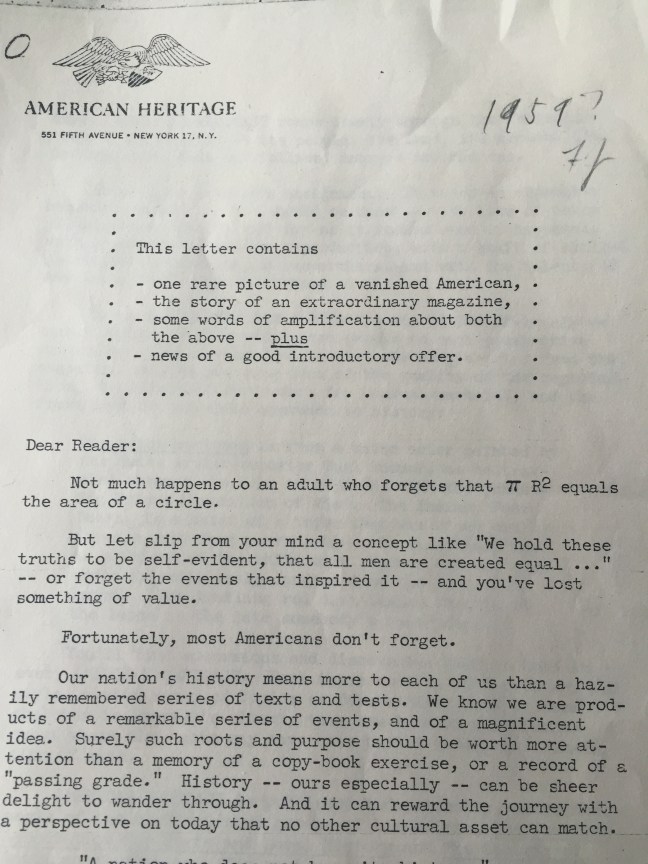
That more or less nails it. Less certain is who actually invented the box. The alleged creator, Frank Johnson, always disclaimed ownership, although others gave him credit for it. Well, here’s a letter by Johnson, featuring an actual…Johnson Box. (You’ll notice that we’re not calling it a Jayme Box or a Baring-Gould Box). Scroll to the bottom to see the actual letter.

As always with Frank Johnson, the four-page letter for American Heritage magazine, apparently sent in 1959 or ‘60, is a helluva piece of writing. It starts with the box:

This letter contains 

  • one rare picture of a vanished American,
  • the story of an extraordinary magazine,
  • some words of amplification about both the above – plus
  • news of a good introductory offer.

Dear Reader:

 Not much happens to an adult who forgets that π R2 equals the area of a circle.

 But let slip from your mind a concept like “We hold these truths to be self-evident, that all men are created equal…” – or forget the events that inspired it – and you’ve lost something of value.

 Fortunately, most Americans don’t forget.

 Our nation’s history means more to each of us than a hazily remembered series of texts and tests. We know we are products of a remarkable series of events, and of a magnificent idea. Surely such roots and purpose should be worth more attention than a memory of a copy-book exercise, or a record of a “passing grade.” history – ours especially – can be sheer delight to wander through. And it can reward the journey with a perspective on today that no other cultural asset can match.

 “A national who does not know its history,” said George Santayana, “is doomed to repeat it.”

 AMERICAN HERITAGE is a magazine designed to help you know your history better – and to know it with a growing sense of pleasure.

 So if you agree that a sense of history is an asset worth cultivating, then we suggest you will find this magazine a colorful and accurate chart for a wonderful trip through time. AMERICAN HERITAGE roams freely through the whole history of our country – its people, its land, its growth, its triumphs, its fads and follies, manners and madness.

This is an extensive assignment. It takes an expansive magazine to do it as it should be done – with lots of color illustrations to show history as it looked when it happened, with good papers for fine reproduction, with a staff of skilled journalistic-historians and researchers, and with the talents of America’s front-rank historians as its authors.

So a copy of AMERICAN HERITAGE costs $3.95; obviously we cannot afford to fire off a free sample to each prospective subscriber. We have sent along just one sample print from the magazine, to give you some idea of the quality of the reproduction, the extent of our search for unusual material, and the fresh look of our whole approach to history:

The print enclosed is from a water color painted by the Swiss artist-reporter Carl Bodmer, as he traveled through the West in 1832-33, with the junketing Prince Maximilian of Wied. The Indian, Four Bears, is a chief of a tribe that was wiped out by disease only four years later. He was identified as a friend of the white man. Bodmer did not say whose friendly scalp dangled from the Indian’s lance. (The trailing red disc behind the tip of the lance is the late somebody’s hair piece.)

You’ll find excursions and discoveries such as this in every AMERICANHERITAGE. Each issue covers, with accuracy and style, a wide range of topics – from a first look at some skeleton in America’s closet, to a new look at some famous event where the facts may have been buried under an accumulation of myth.

AMERICAN HERITAGE is published independently, under the aegis of two distinguished groups of historians, The American Association for State and Local History and The Society of American Historians. The senior editor is Bruce Catton, most honored of all students of the Civil War; Dr. Allan Nevins, dean of American historians, heads the Advisory Board. Contributors include America’s foremost writers of lively history.

The August issue will continue the tour of the past with 15 articles and picture features, including

A Tax on Whiskey? Never! By Gerald Carson. A timely piece on an old but still explosive issue. In 1794 the farmers of Western Pennsylvania claimed that country whiskey, that honored rural elixir, was being unmercifully slapped by the tax collectors. The locals were walloping the revenue men and firing up the stills with equal ferocity – until George Washington (who turned out some pretty good rye of his own at his Mount Vernon still) used Federal force to settle “The Whiskey Rebellion.”

End of a Friendship by Charles Seymour, ex-president of Yale. In a personal memoir, Col. Edward House, key man in the Wilson administration and by the President’s own christening “my second personality,” tells for the first time, why he thinks he fell out with Wilson.

The Man Who Invented Panama, an interview by Commentator Eric Sevareid with Philippe Bunau-Varilla, the man who pushed through the Panama Canal.

The Action Off Flamborough Head by Oliver Warner. An important item in each issue of AMERICAN HERITAGE is an extract (not a condensation) from some good new history book. The August selection (from Warner’s forthcoming “Great Sea Battles”) tells of the moonlight sea duel off the Yorkshire coast between Joan Paul Jones and Britain’s Captain Pearson. Jones termed the conditions that night “really deployable.” But he won – and soon was neglected. Pearson lost and was knighted.

Like to read further? More than 330,000 subscribers will. We’ve found that 96% of them save every copy of AMERICAN HERITAGE. It’s written, illustrated, printed, and packaged to last. For example, it comes in hard covers, like a fine book, and with no advertising to date its contents.

In each magazine you’ll find 112 editorial pages and at least 100 illustrations – more than a third in color The pictorial array consists of tintypes, paintings, posters, old charts and notebooks, photographs, etchings, and daguerreotypes — many of them never published before. The August issue has two articles containing rare illustrations:

A portfolio of Japanese water colors (circa 1855), showing how the first Westerners in Japan looked to their Oriental hosts; and some rare on-the-spot sketches of the great Chicago Fire of 1871, with captions written by an eyewitness.

In appearance and content, AMERICAN HERITAGE is unusual. So is its $3.95-a-copy price tag. But matched against books of comparably quality (you can’t compare it to the usual magazine), the single-copy price is a real bargain. Our current introductory offer is better than that:

You buy three issues—and get six.

Ordinarily, a year’s subscription would be $15. Bought one-by-one over the course of the next year, the tab for these same six issues would be $23.70. But by ordering now, your six issues can cost you just half that — $11.85, the retail cost of three.

To subscribe at this introductory price, fill in and mail the postpaid order card. You need not pay anything until after you have seen your first copy. Then you have a choice of three monthly installments of $3.95 each … or a single payment of $11.85. (The order card explains all the options.)

If at any time you feel that AMERICAN HERITAGE does not do at least as creditable job for America’s history and your interest as we promised you, you can cancel your subscription and we will refund the amount of the undelivered portion.

The August issue can begin to show you why AMERICAN HERITAGE has won the acclaim of so many critics, and the loyalty of so many readers. Mail the order card today? Your first copy is boxed, and can be in your hands within a few weeks.

And thank you.

Sincerely,

James Parton

Publisher

2016-04-27 08.21.20


‘I Have Not Yet Begun to Fight’

An eBook By Ray Schultz

In 1906, a Navy petty officer tried to enter a dance hall in Newport Rhode Island, and was turned away because of his uniform. Normally, that would have been the end of it, but Chief Yeoman Fred J. Buenzle was a wily old salt. He’d bought a 25 cent ticket when wearing a civilian coat and hat, and having paid that money, he felt he had a contract and could sue the Newport Amusement Association for failing to honor it.

Predictably, Buenzle lost the case right up through the appellate court. But in 1908, the Rhode Island General Assembly passed the Uniform Act, barring discrimination against men in uniform; the State Senate rapidly followed suit. And Buenzle, a man with broken service and at least one disciplinary case on his record, deserved the credit for it.

Why is this important now? Because service men and women still face obstacles (different ones). By pursuing that case, Buenzle did more for his fellow enlisted personnel than John Paul Jones, Stephen Decatur and anyone in the panoply of Naval legends.

So who was this unlikely hero? Here is his story.

Part I: Dirty Lubbers

Fred Buenzle was born in 1873, in the Pennsylvania Dutch country, of parents who owned what he called a “commercial hotel.” He spent every night of his youth helping his father fill bottles of beer in the cellar, and was often overcome by the fumes. At 16, he enlisted as a boy apprentice in the U.S. Navy in to fulfill a childhood dream of going to sea (and probably to get out). His father disagreed with that decision, but signed the papers anyway.

The Navy Buenzle joined was not a very healthy place for enlisted men, though. As he put it, foreign mercenaries filled the ranks, while Americans wearing the uniform were disgraced at home. “New promises were made to the recruits, and the old-timers had to subsist on broken pledges,” Buenzle wrote in his 1939 memoir Bluejacket, a book I first read as a young sailor.

That was driven home on Buenzle’s very first day in the service. Before boarding the USS St. Louis, an old sailing ship at the Philadelphia Navy Yard, for the signing of his apprentice articles, he met an old sailor who tried to talk him out of signing. The problem, the old man stated, was not with the Navy—that was fine—but with the civilian populace.

“The dirty lubbers and crooks on shore won’t serve a man in uniform, not in any decent place they won’t! And you won’t be able to buy a good meal or a clean bed, or go to a theater. Only the dive-keepers and the trollops will give the sailorman a hand, my boy, and don’t say I didn’t warn you.”

Buenzle joined anyway, but that very night he came close to regretting he did. In full view of the crew, the captain of this hulk put a group of men in irons, a brutal punishment for minor offenses. “This incident of my first day in the Navy was my earliest lesson in the need of prompt and unquestioning obedience to any order received from a superior in rank or rate,” Buenzle wrote. “It made me also aware of the possibilities for tyranny at the hands of men clothed with absolute power, and of how easily a headache or any slight upon the dignity of the afterguard might be taken out upon the hapless lower ratings.”

About the only good thing that happened on the St. Louis was that Buenzle met some relics of another age, like Happy Dorgen, Baldy Tom Dunn, Jack Robinson (“a mighty liar), Basil Bono and the Hawaiian Kanaka, who told stories of a buried treasure.

As a youthful reader, I tended to view all this through a romantic haze. The base mess hall in Newport, Rhode Island periodically served what a yearbook described a typical Navy breakfast in the 1890s: boiled eggs (hard or soft), Navy beans and corn bread. I liked it because I felt it connected me to the past. In reality, Buenzle’s first meal aboard the St. Louis was a “tin-dish supper of boiled rice, molasses, hardtack and tea,” wrote New York Times reviewer James Thompson.

Following this interlude, Buenzle was sent to Newport, Rhode Island for apprentice training aboard the USS New Hampshire. But the ship was moored in “sewage crusted slough,” and an epidemic of typhoid fever broke out, causing the New Hampshire to be called “the floating coffin.” Training had to be continued onshore.

A month or two later, Buenzle set sail on an ancient vessel called the Portsmouth. It sailed from Newport to the Caribbean, stopping in New York, where “a half eagle was sufficient for a snug twenty-four hour liberty.” Buenzle soon found, though, that life at sea was hellish. Everything was damp, food was always cold, and there was plenty of deck duty, from which “all our clothing was sodden and the skin on hands and feet became bleached and tender,” he noted. Finding the port of Barbados to be a place with a “remarkable lack of points of interest,” Buenzle wrote of the lonely watches at sea during the early morning hours. “The boys,” he wrote, “hunch closer, and in whispered tones talk together of sharks at sea and sharks ashore, and of human wolves, and of the loneliest time in boyhood that each of them could remember.”

The young sailor next reported to the sailing frigate Lancaster, the new flagship of the Asiatic station. En route to Asia, he received his first disciplinary action for sleeping on watch. In 1893, at the age of 21, disgusted with being rousted out of wet hammocks at night, of eating cold mutton while officers ate delicacies, including desserts like cherry pie, and of the “pious pomposities,” of the officer corps, Buenzle took his discharge in Shanghai.

Part II: Buried Treasure

Buenzle’s first stop as a civilian was the American consulate where because he refused government passage back to the States, he had to waive the right to any further aid. But he was resourceful: When war broke out between China and Japan, he took a commission as a captain in the Chinese Army, and served as an instructor up the Yangtze River. There he met Merci Fabre, a friend of the Hawaiian Kanaka, and they went in search of the treasure described by the latter. They sailed from Shanghai to Hong Kong, then to the southern part of Formosa, where (if you believe it), they uncovered the treasure, ten thousand dollars in American and British money. When they tried to transport it in a fishing boat, though, the vessel capsized; Buenzle, who couldn’t swim, had a hard enough time saving his own neck. Twenty-two days later, without a dime of treasure, he was aboard a Canadian Pacific ship en route to the United States.

After a tenure as a special writer for the Philadelphia Times, Buenzle decided that civilian life could never match the peace of mind—i.e., the security—of the Navy. He re-enlisted aboard the sailing ship Monongahela with the rank of Ship’s Writer, First Class. But he soon learned that the Navy had changed. Aboard the battleship Brooklyn, a “new ship,” Buenzle found “young men who ha never before felt the swell of a ship beneath them. The old shellbacks remaining were in charge of gangways and lower decks.”

Buenzle had changed, too, and he had some strong views about Navy life. After sailing to Britain for Queen’s Victoria’s Jubilee in 1897 (“our uniform was more honored than it was in our own land”), he reported the USS Dolphin, and there met Assistant Secretary of the Navy Theodore Roosevelt. The two men discussed the plight of the enlisted man and together drafted a memorandum to the Secretary of the Navy. “We must make a determined effort to create a public opinion so strong and aggressive that every class of people in the United States who pretend to be patriotic Americans will not dare to erect a barrier against the uniformed men of our national defenses, whether there be any law governing the cases or not.”

Part III: Murder At Sea

Buenzle’s next post was on the battleship Iowa, part of the Great White Fleet, where he served as clerk to Captain William Thomas Sampson. Sampson was the president of the Court of Inquiry that investigated the sinking of the battleship Maine in Havana harbor; Buenzle was the stenographer. When war was declared, Sampson was promoted to Rear Admiral and given command of the North Atlantic Fleet. Buenzle accompanied him to the flagship New York.

Convinced that the enlisted men should be given some word of the events, Buenzle established a daily log, “The Squadron Bulletin,” and printed out 1,000 copies a day on a primitive duplicating machine. There was plenty to write about. First, the New York captured the Spanish merchantman Buenaventura. The booty was split among the crew, and Buenzle ended up with $300. Then, from the flying deck of the New York, he witnessed the destruction of the Spanish fleet as it tried to emerge from Santiago harbor; he even selected the volunteers who helped lieutenant Richmond Pearson Hobson sink the collier Merrimac in an effort to block the channel. “The fleet under my command offers the nation as a Fourth of July present, the whole of Cervera’s fleet,” Buenzle ghostwrote for Sampson.

Privately, Buenzle saw little reason to celebrate, though.

“ …It was impossible that they could feel lighthearted in the face of so much suffering,” he wrote in Bluejacket. “I never wanted to hear the word ‘war’ again; and I determined, on that day, while the air was yet filled with the sour tang of smokeless powder and the crash of exploding shells, that I would be glad to exchange my naval billet for the humblest calling on shore if there was any more murdering to be done on the sea.”

Part IV: Dogs and Sailors, Keep Out

After the war, Buenzle reported to Newport again, where as Chief Yeoman, he was named officer-in-charge of the Yeoman School. And it was in Newport that his campaign for the enlisted man fully materialized.

With the three hundred dollars he received from the capture of the Buenaventura, he launched Our Naval Apprentice, the Navy’s first station newspaper, in 1901. Its mission was to entertain the men and to fight the prejudice downtown. It eventually evolved into the Newport Navalog, a newspaper that published its last print issue last year.

Next, Buenzle filed his lawsuit against the Newport Amusement Association. “Painful remembrances of the many indignities heaped upon my comrades in the sea eservice had urged me to initiate the prosecute the case of my own expense,” Buenzle wrote. These included signs saying, “Dogs and sailors keep out,” and “No men in uniform allowed.”

In this, Buenzle had the support of officers like Rear Admiral Charles M. Thomas who handled his legal fund. But they were of little help during cross-examination. William C. Clarke, the president of the company, brought in some  lawyers, and they started out by claiming that Buenzle had violated Naval regulations by disguising his uniform when he purchased a dance-hall ticket.

“You expected to be refused when you presented that ticket in uniform, didn’t you?” the opposing counsel asked the sailor.

“Not exactly,” Buenzle said. “I wished to know if I would be refused. I wished to know if there was any discrimination, whether it was against me personally, for any personal disqualification, or whether it was against the uniform.”

“But you expected it, and you wanted to find that out. Answer my question. You expected to be refused admission, didn’t you?”

“I wasn’t sure. I heard the men were discriminated against for the blue blouse and the shirt sleeves, but I didn’t expect to be refused admission.”

“You did not.”

“I didn’t expect to be refused admission in a white shirt and a collar and tie, as any citizen, with only the difference of a rating badge and brass buttons.”

The court threw out Buenzle’s claim, stating that it was the “settled rule of law for many years, that a ticket of admission to a race-track, a theatre, a concert, or any such entertainment is a mere license, revocable at the will of the party issuing the same.” He was, however, entitled to get his 25 cents back.

That view was upheld on appeal by the Supreme Court of Rhode Island in February 1908. The higher court stated that “military and naval uniforms are not intended as a badge of social equality, but on the contrary they are evidences of rank and distinction…” Thus, Buenzle was entitled to a refund but not to damages for emotional distress.

The court added, though, that if “such discrimination is deemed to be a matter of grave public consequence, it rests with the law-making power to afford a proper remedy.”

Precisely. And what Clarke and company didn’t seem to realize is that Buenzle had the ear of his superiors, right up to President Theodore Roosevelt (who sent a check), and that he was a talented writer, well equipped for publicizing this controversy.

Roosevelt said: “I feel that it is the duty of every good citizen to endeavor in every shape and way to make it plain that he regards the uniform of the United States Navy…as a badge of honor, an therefore entitling the wear to honor so long as he behaves correctly.”

The Uniform Act was passed a short time later. And Buenzle was able to write that the greatest fight of his life ended with the flagrant signs being taken down and “shelved with other anachronisms.”

Part V: Home Is the Sailor

What could Buenzle do to top that? Write a book. He prospered as officer-in-charge of the Yeoman School, and in 1909, left Newport for sea duty. After retiring from the Navy in 1919, he settled in Palo Alto, California., where he opened a Naval history museum, and spent the rest of his time writing Bluejacket, which appeared in 1939. He lived in a small cottage, the grounds of which were landscaped with high-arched bridges, pads, ferns, cherry trees, and a small lagoon—all in the style of Japan and China, according to Captain Felix Riesenberg, who visited Bunezle in 1939 and wrote the introduction to Bluejacket. The home, filled with mementoes of the old sailing days, offered this sign for the visitor: “Home is the Sailor, Home from the Sea.”

Fred Buenzle died in 1946.

In my time, there was one man around who actually had known Buenzle: William E. Ragsdale, a retired Newporter and former officer-in-charge of the Yeoman School, who joined the Navy in 1907 and eventually made the rank of Lieutenant.

“There was no doubt about it, Buenzle was a great man,” he said in 1967. “When you spoke to him, he seemed to be lost in another world. He was preoccupied with his writing, and he was a very good writer. He was always writing something.

“I know of no man throughout my entire career who enjoyed the respect and worship of all the enlisted men, as Buenzle did. He as intelligent, and a gentleman all the way. He never did or said anything harsh or offensive.

“I was a student of the school when he was in charge, and I can tell you we all idolized him. He was the height for an enlisted man.”

An old man, deaf, but holding beautiful memories inside him, Buenzle said to Captain Riesenberg in 1939 of a model sailing ship he had built: “I have built her into the youth of one lifetime, the glories of liberties after long detentions over deep water She spells something now irrevocably gone!”

Fred Buenzle: A figure of the past but a voice for today.

Heartbreak Hotel

By Ray Schultz

The literary world rejoiced in November 1978 when The New Yorker published its first short story by Jean Stafford in a decade: An Influx of Poets. It meant Stafford was back. But it wasn’t what it seemed to be. The author, age 63, was in ill health, and had only four months to live. The story had been extracted by editor Robert Giroux from Stafford’s unfinished novel, The Parliament of Women.

So ended the career of one of the premier fiction writers of 20th Century America. Today, you can’t even find most of Stafford’s books in print, and it’s unlikely that she’s taught much in college. But she left a magnificent body of work. And An Influx of Poets was a great one to go out on.

Though she resembled an Eastern intellectual and had the wit to go with it, Jean Stafford grew up in a dysfunctional family in the West, first in California, and later in Colorado. Her father wrote Western stories under the name Jack Wonder.

Stafford, unhappy young brainiac that she was, wanted out. She graduated from the University of Colorado, but not before a friend named Lucy McKee shot herself in the head right in front of her. “I am almost ready to write about it, although I have really written about nothing else ever,” Stafford later admitted, according to Mary Davidson Mcconahay. Stafford’s next stop was Nazi-era Heidelberg, where she studied philology for several months.

Returning to the States, Stafford hooked up with Robert Lowell, the mentally unbalanced Boston poet. One drunken night, he smashed his car into a retaining wall, and Stafford was badly injured, her beautiful face damaged for life. She got little sympathy from Lowell or his wealthy family.

Despite that poor start, Stafford married Lowell in 1940, and commenced her life as “the subservient spouse of an obsessive artist,” as Bruce Bawer put it. First, she had to support Lowell emotionally when he was jailed for conscientious objection during World War II. Then she had to deal with his mental illness and religious obsession.

Yet Stafford was a serious artist in her own right. Her first novel, Boston Adventure (circa 1944), about her experiences with the Boston Brahmins, was a best-seller, and with the money she earned she bought a house in Maine for Lowell and herself. That turned into a nightmare, too, though, as you can tell from the gorgeous opening paragraph of An Influx of Poets.

THAT AWFUL SUMMER! Every poet in America came to stay with us. It was the first summer after the war, when people once again had gasoline and could go where they liked, and all those poets came to our house in Maine and stayed for weeks at a stretch, bringing wives or mistresses with whom they quarreled, and complaining so vividly about the wives and mistresses they’d left, or had been left by, that the discards were real presences, swelling the ranks, stretching the house, my house (my very own, my first and very own), to its seams. At night, after supper, they’d read from their own works until four o’clock in the morning, drinking Cuba Libres. They never listened to one another; they were preoccupied with waiting for their turn. And I’d have to stay up and clear out the living room after they went soddenly to bed—sodden but not too far gone to lose their conceit. And then all day I’d cook and wash the dishes and chop the ice and weed the garden and type my husband’s poems and quarrel with him.

The year 1947 was a big one for both members of this duo. Lowell published Lord Weary’s Castle, the Pulitzer-prize winning poetry collection that made his reputation. And Stafford came out with her second novel, The Mountain Lion (published while she was in the Payne Whitney clinic, according to her biographer ). While not as big a seller as Boston Adventure, The Mountain Lion is her best.

It tells the story of Ralph and Molly, siblings brought up in a stultifying atmosphere in California. Both children suffer from nosebleeds, the result of scarlet fever, and both are weird. The adults in this book are insufferable, including their widowed mother Mrs. Fawcett, and the preacher Mr. Follansbee. Ralph and Molly have a habit of rattling these authority figures by saying the wrong thing at the wrong time.

In one encounter, Ralph suggests that his mother has murdered her father, Grandfather Bonney, who even in death is an intolerable personality to the children.

But suddenly a mocking bird, in this broad daylight, began to sing. Mrs. Fawcett clasped her hands together and said “Oh!” as if the sound hurt her. Her large diamond ring, in the gesture, came into a ray of sunlight and two green needles shot out from the stone. Then Mr. Follansbee was across the room in one stride, shaking Ralph’s shoulder. “You little cad,” he said between his teeth, “you get down on your knees and beg your mother’s pardon. On your knees.”

For a moment he defied the minister by remaining motionless, but the long bony hand on his shoulder propelled him off the hassock and at last he knelt, not feeling sorry, feeling nothing but rage, as painful as a deep cut. He could not utter a word, though this delay was agonizing, and they were all watching him and they were all waiting. He could hear Mr. Follansbee breathing heavily. Then Molly, half under her breath said “I wish you were a fairy, Mr. Follansbee.” Rachel giggled, but Mr. Folansbee did not think this was funny and he snarled, “Why do you wish I were a fairy, young lady?” And Molly whispered with deadly hatred, ‘So you’d vanish.’

They end up in Colorado, staying with a half-uncle, growing stranger and more apart by the day.

Critics have compared The Mountain Lion to The Catcher in the Rye. Dare I say it, I think it’s even stronger. For one thing, it portrays two young people, male and female, with their different inner lives and their very complex relationship, a far more daunting task. For another, it is funnier, less whiny, more of a novel and less of a tour de force. “The Mountain Lion is written more in the vernacular mode of Mark Twain than the Jamesian mode that Stafford had adopted for her first novel,” Charlotte Margolis Goodman observes in her biography: “Jean Stafford: The Savage Heart.”

But this triumph was lost in personal turmoil. Stafford and Lowell went through a bitter divorce, and Stafford hated him for years. Later, though, Lowell offered this hint of reconciliation, according to Goodman:

Poor ghost, old love, speak

With your old voice

Of flaming insight

That kept us awake all night.

In one bed and apart…

Children Are Bored On Sunday

Having gone through two marriages, Stafford spent much of the 1950s living in small apartments in Westport, Conn., dreadfully isolated and poverty stricken. She was hospitalized often, her physical and psychiatric ailments exacerbated by her alcoholism.

But she heroically pushed on. After a modest reaction to her third novel, The Catherine Wheel, she came out with a collection of short fiction: Children Are Bored on Sunday. A sensation in literary circles, it showed that Stafford was a master of the short story. She had long since become a regular in The New Yorker, working with the legendary fiction editor Katherine White. It was the era of O’Hara and Cheever, and Stafford ranked with any of them.

The title story, her first in The New Yorker, is an unusually happy one for Stafford. A female intellectual, recovering from an illness and a loss of confidence, visits the Metropolitan Museum of Art alone one Sunday. There she spies Alfred Eisenburg, an arrogant male intellectual of whom she is wary.

She feared that seeing him might very well divert her from the pictures, not only because she was reminded of her ignorance of painting by the presence of someone who was (she assumed) versed in it but because her eyesight was now bound to be impaired by memory and conjecture, by the irrelevant mind-portraits of innumerable people who belonged to Eisenburg’s milieu. And almost at once, as she had predicted, the air separating her from the schoolboys below was populated with the images of composers, of painters, of writers who pronounced judgments in their individual argot, on Hindemith, Ernst, Sartre, on Beethoven, Rubens, Baudelaire, on Stalin and Freud and Kierkegaard, on Toynbee, Frazer, Thoreau, Franco, Salazar, Roosevelt, Maimonides, Racine, Wallace, Picasso, Henry Luce, Monsignor Sheen, the Atomic Energy Commission, and the movie industry. And she saw herself moving, shaking with apprehensions and martinis, and with the belligerence of a child who feels himself laughed at, through the apartments of Alfred Eisenburg’s friends, where the shelves were filled with everyone from Aristophanes to Ring Lardner where the walls were hung with reproductions of Seurat, Titian, Vermeer, and Klee, and where the record cabinets began with Palestrina and ended with Copland.

Oh, what prose. But she then realizes that Eisenburg himself is a reduced figure, and that he, too, has seen some hard times. They connect, go out for drinks and decide that they can help each other. To mingle their pain, their handshake seemed to promise them, was to produce a separate entity, like a child that could shift for itself, and they scrambled hastily toward this profound and pastoral experience.

That last phrase always gets me.

Of course, few of Stafford’s stories were that positive (or pastoral). Take the harrowing piece titled A Summer Day. Jim, an eight year-old Native American growing up in Missouri, finds himself abandoned when his “grandmother,” the woman caring for him, dies. He is sent without ceremony to an orphanage in Oklahoma because Mr. Wilkins, the preacher, had said it would be nice out here with other Indian boys and girls.

He makes the long train journey barefoot. And there is nobody waiting for him when he arrives. At the orphanage, where many children are sick, the administrators try to engage him, if only to get him registered. Granted, the names given to these functionaries are regrettable, although one may infer that they are the names assigned them by the children.

Miss Dreadfulwater asked some more questions—whether his tonsils were out, who Mr. Wilkins was, whether Jim thought he was a full-blood or half-breed or what. She finished finally and put the card back in the drawer, and then Miss Hornet said to Jim, “What would you like to do now? You’re free to do whatever you like till suppertime. It’s perfectly clear that you have no unpacking to do.”

 “Did he come just like this?” said Miss Dreadfulwater, astonished. “Really?”

 Miss Hornet ignored her and said, “What would you like to do?

 “I don’t know,” Jm said.

 “Of course you do,” she said sharply. “Do you want to play on the slide? Or the swings? None of the other children are out, but I should think a boy of eight could find plenty of ways to amuse himself.”

“I can,” he said. “I’ll go outside.”

 “He ought to go to bed,” said Miss Dreadfulwater. “You ought to put him to bed right now if you don’t want him to come down with it.”

Ask yourself: How can a discarded child amuse himself or go to bed when he has lost every shred of comfort and dignity he ever had? Other readers may choose different Stafford stories as their favorites. But A Summer Day is one of mine.

‘The New Yorker Married Us’

Stafford’s output faltered as the ‘50s went on, and she had the occasional rejection from The New Yorker. But she had one piece of good fortune: At loose ends in London, she took Katherine White’s advice to seek out A.J. Liebling, the rotund New Yorker staff journalist, who had left the States to lessen his tax burden.

White could not have foreseen what she had unleashed, as Goodman wrote. Soon Stafford was traveling to horse races with Liebling in chauffeured Rolls Royce’s while guzzling champagne, and he was having tweed suits made for her by his Saville Row tailor.

The pair soon became an item. And when work by both of them appeared in the same issue of the New Yorker. Liebling wrote to her, “The New Yorker married us.”

Yes, it did, although the formal wedding didn’t take place until April 1959. Stafford joked that Liebling was her first “entirely Jewish” husband, Lowell having had only a slight Jewish line in his family.

The literary couple moved into a dream apartment at 11th St. and Fifth Ave. in Greenwich Village, in what’s now called the Gold Coast. Stafford performed a signal service: Her tales about Earl Long, the governor of Louisiana and brother of the late Huey Long (she had spent considerable time in Louisiana with Lowell), inspired Liebling and New Yorker editor William Shawn. It led to one of Lieblng’s best books: The Earl of Louisiana.

Stafford’s writing dried up totally at this point. (Liebling’s output declined, too). But she had a reason, as quoted by Goodman: “Perhaps it’s too simple an explanation, but I was happy for the first time in my life.”

Why wouldn’t she be? Liebling could be moody, but he was benign and considerate. But this period of felicity lasted only four years. Liebling, a chronic overeater and drinker, died in 1963 at age 59, muttering in French in his final delirium. The devastated Stafford was on her own again.

There was one bit of solace: Liebling had left her his farm in the Springs of East Hampton. Later, when ill, she was able to sell some of the acreage, yet keep the house.

Sadly, Stafford couldn’t finish her fourth novel, and her short story output slowed. Perhaps emulating Liebling, she wrote A Mother in History, a non-fiction book on Lee Harvey Oswald’s mother. It sold well, but drew mixed notices. She also wrote children’s books and book reviews. But money was tight.

Stafford became cranky, and intolerant of the hippie generation. In 1969, though, she published The Collected Stories of Jean Stafford, and dedicated it to her now-retired mentor Katherine White. The book drew rave reviews. And early in 1970, Stafford learned that it had won her the Pulitzer Prize for fiction. Riding a wave of acclaim, she was offered speaking engagements and guest professorships, and recovered financially.

It was one of several grand moments Stafford had during her long career. But this, too, did not last long. Illness caught up with her, and her final decade was one of grinding struggle. In 1976, she had the stroke she’d always feared. One wonders what doctors thought when they saw this sickly woman in the emergency room: Could they have known what she had achieved?

Such is the life of a great writer. Only the strong and very talented need try it.