Was Jesus An Advertising Man?

By Ray Schultz

It’s forgotten now, but one of the biggest sellers of the 1920s was Bruce Barton’s The Man Nobody Knows. It posited that if Jesus Christ returned to earth, he would be an advertising man.

With all respect to my friends in advertising, this I doubt. But the book was published in an optimistic era, in which business people were lionized.

You can get the drift from a direct mail letter for the book written by the great copywriter Robert Collier:

Jesus Christ ‘the founder of modern business?

Jesus a master of efficiency in organization, a born executive?

Jesus a sociable man, a cheerful, bright companion with a pat story on His lips…?

Jesus wording the best advertisements ever written?

This letter, and others like it, were accompanied by a brochure, asking: Was Jesus a Physical Weakling?

The painters have made Him look so—but He swung an adze and pushed a saw until He was thirty years old. He walked miles every day in the open air. He drove a crowd of hard-faced men out of the Temple.

It’s beautiful copy, but there’s one slur I don’t like: that Jesus “faced Jewish hatred and Roman power without a tremor.” The Catholic Church has said that Jews were not responsible for the death of Christ. (Thank you for that). For the record, the religious ones among us await the Moschiach, and nobody has predicted he will be an advertising man.

That said, Collier’s letter sold millions of books. But an upheaval was coming: the Great Depression. At that time, people viewed Jesus in a more traditional light: as minister to the poor and fallen.

As for Robert Collier, he was a direct mail legend, with or without help from the Messiah.

“Collier was first guy that really sold merchandise by mail,” said the direct marketing guru Bob Stone in 1997. “He came up with 10-day pre-trial guarantees, all things we use today. He was a merchandising genius. For example, he had a bunch of black raincoats that they couldn’t sell worth a damn. Who absolutely has to have a black raincoat? So he had a list of undertakers. and sold out entire stock. It was a lesson I never forgot.”

Stone met Collier at a conference in 1939. What was he like personally? “He wasn’t aloof , he was a loner. There’s a difference. He was a shy man. He was dedicated to the sale of merchandise. I don’t think he had a lot of pride. He had a merchandise business by selling those raincoats and hunting books, for himself mostly.”

One legend has it that Collier sold coal at some point. Finally, he joined P.F. Collier & Son Co., publishers of Colliers magazine and books like Harvard Classics, the Five-Foot Shelf of Books. It just so happened that P.F. Collier was his uncle, “but he had always told me he did not want me in the business until I could bring something to it they could get nowhere else,” Collier wrote. In I 931, Collier published his own book: the Robert Collier Letter Book,

And was he a believer in Jesus the businessman or Jesus the healer? This we don’t know.


A Rolling Stone Gathers No Moss

By Ray Schultz

I should have known better than to get involved with Mo Moss. A few years ago, trying to do him a favor, I hired his troubled son Yale as an editorial intern. He spent the summer texting his girlfriends, and in the fall, I had to tell him there was no job for him.

Mo called me right up. “You’re dead in this industry!” he said. “If you ever show up at a conference, I’ll bring you down!”

I’d heard that several times from Mo, as had many other people. Thus, Mo was the last person I expected to receive a Silver Apple Award, but he got one last year, probably due to a clerical error.

There he was, well-tanned from sunning himself in his new home in Tampa, his pony tail now silver. We greeted each other warmly, and his wife Wendy gave me a peck on the cheek. You couldn’t help but feel good for the old crook.

In his acceptance speech, though, Mo launched into a bitter tirade about how he should have gotten the award years ago. “For what I’ve done, I deserve to be in the Hall of Fame,” he said.

A dreadful pall descended over the event, and even the excellent wine failed to relieve it. A day or two later, Yale Moss called and demanded to see me. I wanted nothing to do with Yale (or with Mo), but my judgment failed me, and I visited him at the new Data Shack.

As you may recall, the old Data Shack was in a Quonset hut on the side of the Ridgewood, Queens subway yards. It has since been torn down for a condominium, and Yale now works in a desk-share place in Williamsburg.

His corner of it seems to be a small sliver of a long conference table, but it’s all he needs to sell Mo’s old Proclivities Database, an out-of-date list of bulimics, alcoholics, opioid abusers, and Mlllennials who have moved back in with their parents.

We sat down on a pair of couches, and drank hot chocolate laced with hot shots of caffeine. Yale, dressed in a knit hat, a Bernie Sanders sweatshirt and shorts, said, “I’ve never liked you. But here’s the deal. We need you to help get my dad into the DMA Hall of Fame.”

I thought about that for a minute, my head reeling from the caffeine. Obviously, this was going to be a pro bono project.

“Yale, that’s not so easily done,” I said. “It’s not like the Silver Apples–even the greatest direct marketers sometimes don’t get in until after they’re dead.”

“Are you saying my dad isn’t a great direct marketer?” He glared at me in a threatening way. (He’s a full foot taller than Mo).

“Not at all, Yale. All I’m saying is that it will be tough to do even for someone with Mo’s, uh, accomplishments.”

“Spread a little money around,” he answered. “Let me know what your expenses are.”

I’d never heard of anyone buying their way into the Hall, and I sure wasn’t going to lay out my own cash, assuming I even had any.  But I figured I could at least fill out the application, so I Googled Mo to get some material, and came up with the following:

1984: Federal Trade Commission vs. Data Shack, Data Hut, Wendy Moss Lifestyles, Mo Moss, Moe Moss, Wendy Moss, et al. Re: False Advertising

1988: Supreme Court of New York: Uni-Mail Lists vs. the Data Hut, Illegal List Conversion

1988: Supreme Court of New York: Prescott Lists vs. The Data Shack; theft of mailing lists

1988: U.S. District Court, Southern District of New York, R.L. Polk vs. The List Hut; List Abuse, theft of property

1994: NY Attorney General vs. List Hut, Wendy Moss Lifestyles; commercial fraud; $350,000 settlement

1994, U.S. Bankruptcy Court: Moss Equities d/b/a/ The Data Hut, the Data, Shack, Wendy Moss Lifestyles. Chapter 13. Assets: $8,750, Debits: $1.75 million

1994: DM News: “Moss Bankrupt; List Managers Burned”

1998, U.S. Attorney General vs. Data Shack, Mo Moss, Hy Moss, Wendell Moss; John Doe, civil issue; misrepresentation; consent decree

2004—U.S. District Court, Middle District Florida, InfoGroup vs. The Data Shack; nonpayment $85,009

2004, U.S. Bankruptcy Court, Middle District Florida, Moss Properties, d/b/a/ the Data Hut, the Data Shack, Chapter 11. Assets: $300, Debits: $85,009

2008: Tampa, Hillsborough Circuit Court, John and Brenda Stevens vs. Mo and Wendy Moss, illegal construction

What a record: About the only “positive” reference was a Chief Marketer article titled, “Big Data, the Big Lie: Why You Need the Proclivities Database,” that I had ghosted for Mo.

I filled out the application as best I could, wondering when I became an unpaid employee of the Data Shack. Then I waited for the Hall of Fame entrants to be announced. Mo didn’t even make the long list.

Yale called me. “You’re dead in this industry!” he said. “If you ever show up at a conference, I’ll bring you down!”

Thanks, Yale. Strangely, there were no hard feelings in Tampa: At Christmas, Mo sent me a large tin of caramel popcorn. We’ll try again next year.


What’s In the Box

By Ray Schultz

When asked to define a Johnson Box, copywriter Bill Jayme said the purpose was to summarize a direct mail letter, “just as 19th century English writers like Dickens would say at the top, ‘Chapter 10, in which Mr. McGruder discovers Emily in a Compromising Position with the Director’s Son.'”

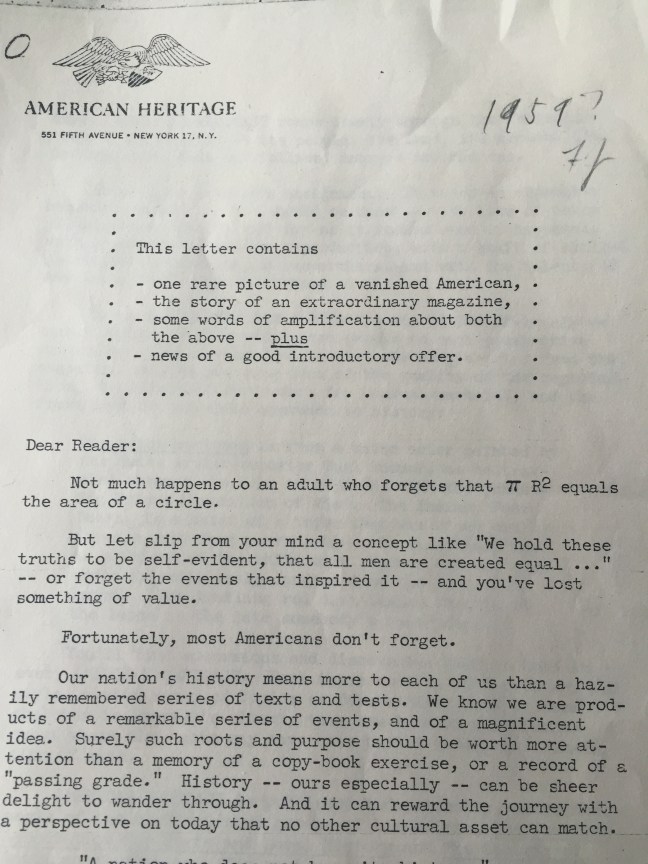
That more or less nails it. Less certain is who actually invented the box. The alleged creator, Frank Johnson, always disclaimed ownership, although others gave him credit for it. Well, here’s a letter by Johnson, featuring an actual…Johnson Box. (You’ll notice that we’re not calling it a Jayme Box or a Baring-Gould Box). Scroll to the bottom to see the actual letter.

As always with Frank Johnson, the four-page letter for American Heritage magazine, apparently sent in 1959 or ‘60, is a helluva piece of writing. It starts with the box:

This letter contains 

  • one rare picture of a vanished American,
  • the story of an extraordinary magazine,
  • some words of amplification about both the above – plus
  • news of a good introductory offer.

Dear Reader:

 Not much happens to an adult who forgets that π R2 equals the area of a circle.

 But let slip from your mind a concept like “We hold these truths to be self-evident, that all men are created equal…” – or forget the events that inspired it – and you’ve lost something of value.

 Fortunately, most Americans don’t forget.

 Our nation’s history means more to each of us than a hazily remembered series of texts and tests. We know we are products of a remarkable series of events, and of a magnificent idea. Surely such roots and purpose should be worth more attention than a memory of a copy-book exercise, or a record of a “passing grade.” history – ours especially – can be sheer delight to wander through. And it can reward the journey with a perspective on today that no other cultural asset can match.

 “A national who does not know its history,” said George Santayana, “is doomed to repeat it.”

 AMERICAN HERITAGE is a magazine designed to help you know your history better – and to know it with a growing sense of pleasure.

 So if you agree that a sense of history is an asset worth cultivating, then we suggest you will find this magazine a colorful and accurate chart for a wonderful trip through time. AMERICAN HERITAGE roams freely through the whole history of our country – its people, its land, its growth, its triumphs, its fads and follies, manners and madness.

This is an extensive assignment. It takes an expansive magazine to do it as it should be done – with lots of color illustrations to show history as it looked when it happened, with good papers for fine reproduction, with a staff of skilled journalistic-historians and researchers, and with the talents of America’s front-rank historians as its authors.

So a copy of AMERICAN HERITAGE costs $3.95; obviously we cannot afford to fire off a free sample to each prospective subscriber. We have sent along just one sample print from the magazine, to give you some idea of the quality of the reproduction, the extent of our search for unusual material, and the fresh look of our whole approach to history:

The print enclosed is from a water color painted by the Swiss artist-reporter Carl Bodmer, as he traveled through the West in 1832-33, with the junketing Prince Maximilian of Wied. The Indian, Four Bears, is a chief of a tribe that was wiped out by disease only four years later. He was identified as a friend of the white man. Bodmer did not say whose friendly scalp dangled from the Indian’s lance. (The trailing red disc behind the tip of the lance is the late somebody’s hair piece.)

You’ll find excursions and discoveries such as this in every AMERICANHERITAGE. Each issue covers, with accuracy and style, a wide range of topics – from a first look at some skeleton in America’s closet, to a new look at some famous event where the facts may have been buried under an accumulation of myth.

AMERICAN HERITAGE is published independently, under the aegis of two distinguished groups of historians, The American Association for State and Local History and The Society of American Historians. The senior editor is Bruce Catton, most honored of all students of the Civil War; Dr. Allan Nevins, dean of American historians, heads the Advisory Board. Contributors include America’s foremost writers of lively history.

The August issue will continue the tour of the past with 15 articles and picture features, including

A Tax on Whiskey? Never! By Gerald Carson. A timely piece on an old but still explosive issue. In 1794 the farmers of Western Pennsylvania claimed that country whiskey, that honored rural elixir, was being unmercifully slapped by the tax collectors. The locals were walloping the revenue men and firing up the stills with equal ferocity – until George Washington (who turned out some pretty good rye of his own at his Mount Vernon still) used Federal force to settle “The Whiskey Rebellion.”

End of a Friendship by Charles Seymour, ex-president of Yale. In a personal memoir, Col. Edward House, key man in the Wilson administration and by the President’s own christening “my second personality,” tells for the first time, why he thinks he fell out with Wilson.

The Man Who Invented Panama, an interview by Commentator Eric Sevareid with Philippe Bunau-Varilla, the man who pushed through the Panama Canal.

The Action Off Flamborough Head by Oliver Warner. An important item in each issue of AMERICAN HERITAGE is an extract (not a condensation) from some good new history book. The August selection (from Warner’s forthcoming “Great Sea Battles”) tells of the moonlight sea duel off the Yorkshire coast between Joan Paul Jones and Britain’s Captain Pearson. Jones termed the conditions that night “really deployable.” But he won – and soon was neglected. Pearson lost and was knighted.

Like to read further? More than 330,000 subscribers will. We’ve found that 96% of them save every copy of AMERICAN HERITAGE. It’s written, illustrated, printed, and packaged to last. For example, it comes in hard covers, like a fine book, and with no advertising to date its contents.

In each magazine you’ll find 112 editorial pages and at least 100 illustrations – more than a third in color The pictorial array consists of tintypes, paintings, posters, old charts and notebooks, photographs, etchings, and daguerreotypes — many of them never published before. The August issue has two articles containing rare illustrations:

A portfolio of Japanese water colors (circa 1855), showing how the first Westerners in Japan looked to their Oriental hosts; and some rare on-the-spot sketches of the great Chicago Fire of 1871, with captions written by an eyewitness.

In appearance and content, AMERICAN HERITAGE is unusual. So is its $3.95-a-copy price tag. But matched against books of comparably quality (you can’t compare it to the usual magazine), the single-copy price is a real bargain. Our current introductory offer is better than that:

You buy three issues—and get six.

Ordinarily, a year’s subscription would be $15. Bought one-by-one over the course of the next year, the tab for these same six issues would be $23.70. But by ordering now, your six issues can cost you just half that — $11.85, the retail cost of three.

To subscribe at this introductory price, fill in and mail the postpaid order card. You need not pay anything until after you have seen your first copy. Then you have a choice of three monthly installments of $3.95 each … or a single payment of $11.85. (The order card explains all the options.)

If at any time you feel that AMERICAN HERITAGE does not do at least as creditable job for America’s history and your interest as we promised you, you can cancel your subscription and we will refund the amount of the undelivered portion.

The August issue can begin to show you why AMERICAN HERITAGE has won the acclaim of so many critics, and the loyalty of so many readers. Mail the order card today? Your first copy is boxed, and can be in your hands within a few weeks.

And thank you.

Sincerely,

James Parton

Publisher

2016-04-27 08.21.20


Hooray for Hollywood

By Ray Schultz

What will advanced civilizations think when they stumble upon this artifact 200 years from now: A 1959 or 1960 catalog from Frederick’s of Hollywood?

It has all the items you’d expect from Frederick’s, from padded bras to waist cinchers. But it also offers dresses, shoes, pants, vitamins, beauty aids, a portable gym and playing cards.

You won’t find fashions by Dior or Balenciaga here. The whole idea is to make 1950s housewives look like the reigning Hollywood sex goddesses: Marilyn Monroe and Jayne Mansfield. For those who can’t or won’t go that route, there are loose, concealing garments.

The cover says it all: “Now Showing from Frederic’s of Hollywood starring You!” And it emphasizes the Hollywood setting: “Frederic’s Glamorous new address: at 6608 Hollywood Blvd.”

For all the talk of glamour, the catalog is hardly glossy. The inside pages are on newsprint, and they’re black and white. The color cover is on slightly heavier stock.

The order tells us a lot about how mail order operated in those days. There’s no mention of credit cards. The only payment options offered are:

PREPAID, I enclosed $______________

*If your entire order is under $10.00, enclosed only 50 cents to cover postage and handling.

*If your order is OVER $10.00 enclosed postage and handling fee separately for each item, in the following amount: Bras, Girdles and Panties – 40 cents each, All other items – 50 cents each.

Revolving Credit Club. I enclose $___________the amount I have selected as my monthly membership payment. (See chart on page 33 and fill out form.) California credit customers please use special application form available on request

C.O.D.* I enclose $2 on each item and will pay postman the balance. No C.O.D. orders shipped without deposit.

*C.O.D. orders over $20.00 and less than $50.00 require $5.00 deposit.

*C.O.D. orders over $50.00 require $10.00 deposit.

*No C.O.D. orders shipped to General Delivery addresses.

*C.O.D. orders accepted only within continental U.S.A.

Quality TIME

By Ray Schultz

Time magazine liked to flatter prospects in its direct mail pieces. The message was that only smart people read Time, and that you had to be in that category to even be asked to subscribe. And the flattery must have worked, because it appeared in many forms over the years, sometimes subtly, at other times boldly.

Take this letter sent in the fall of 1955. It was identified in an in-house note, posted over the letter, as a House List Copy Test. The note also included these tidbits:

Pick one Letter

Pick One Envelope

IBM Check Card

JP

78-$6.87

It’s not clear now why this direct mail prospecting test went to the house list—maybe the file was of Life and/or Fortune subscribers—or what the IBM Check Card was.

And we don’t know why someone wrote “’69” on the note. Can we conclude that this test did well, and that the letter was still being mailed in 1969? That’s doubtful, but no matter. Here it is: another engaging piece of direct mail copy from the wordsmiths at Time.

Dear Reader:

 How would you like to be described? Pick one:

 “The kind of person who reads comics.”

 “The kind who reads business papers.”

 “The kind who doesn’t read anything.”

 “The kind who reads whodunits.”

 “The kind who reads TIME.”

 There’s nothing to be ashamed of in any of these characterizations — except the third. But I think that most people, if they had to be described in only one of those ways — would choose the final one.

 Why? Because reading TIME has become a hallmark in the U.S. and throughout the world. It has come to mean that you are ambitious to know more, to earn more, to participate more actively in the “action and passion of our times.”

 Reading TIME means that a man is “constructively discontented” – that he is anti-smug, that he doesn’t think he knows it all, that he is ,in short, young in mind and heart and spirit.

 But how has this come about? Why is this magazine so widely approved and respected?

 Because of the men and women who read TIME.

Because for more than thirty years these readers have been demanding standards so high that TIME has had to keep getting better and better.

Because these readers have shown their loyalty to TIME in the most eloquent possible way – by renewing their subscriptions year after year after year.

And finally, because of who these readers are. TIME’s subscribers are leaders of business, the professions and government. They are people active in clubs and civic organizations, people who travel a great deal, people of influence.

When you become a TIME reader, you join, for example:

 –leading architects, who vote TIME their first-choice magazine … top engineers – who say TIME is their favorite publication … college deans who vote TIME their favorite magazine. And you join the most valued executive customers of U.S. industries – who say Time is the magazine they consider most important.

In short, wherever you find a group of men or women remarkable for high standards of achievement, TIME turns out to be the magazine they prefer.

You should be reading it too.

 Cordially,

Bernhard M. Auer

Circulation Director

P.S. The enclosed card offers you a special rate on an introductory subscription to TIME. If mailed at once, it can bring you TIME for less than nine cents a week delivered to your door.

Grecian Formula

By Ray Schultz

Frank Johnson once joked that nobody, not even the editors, could define the mission of Horizon magazine. And it followed that they could not explain Horizon Books.

But they tried. Here’s a letter written in the 1960s by Johnson himself—for the HORIZON Book of Ancient Greece, offering a replica of a Greek “kylix.” It seems understandable enough.

Dear Reader:

The Greeks had a way with them.

For example, I don’t believe you can read your copy of The HORIZON Book of Ancient Greece without feeling again a strong sense of kinship with those long-gone people. Their ideas of reason and freedom and art are still, across the long years, ours.

We hope and believe you’ll thoroughly enjoy the book. All of us here who worked on it became happily immerse in our topic, and rather regret its completion. So saying, here is pictured a somewhat unexpected result of our own emotional involvement.

If you never saw a Greek “kylix” … now you have.

And If you would like to own one, in perfect facsimile … now you can. At quite a bargain.

Let me explain: In the course of our researches on Greek art for the book, we arrived at a carefully guarded storage room in the cavernous basement of The Metropolitan Museum of Art. There, acquired through the Rogers Fund I 1908, were some of the contents of a nameless warrior’s tomb, discovered in 1895 at Montefortino, near Arcevia in Northern Italy.

He was buried around 400-300 N.C. And whether he was Greek or Etruscan, his cherished wine-drinking equipment certainly was of Greek design and manufacture. With him, among other objects, were a silver pitcher (oninochoe), badly deteriorated; a handsome silver ladle; a big, flat-bottom drinking vessel (skyphos), also deteriorated; an two beautiful preserved silver drinking bowls – – “kylites,” in the plural. Quite possibly these treasures were war booty.

I don’t know how to explain why the kylix made such an impression on several of us, except to say that it’s one of those small things you have seen on occasion in museums and wanted to own – – not because it’s “priceless,” but because it’s perfection of a sort…It’s a two-handled bowl, 5-3/8” in diameter, 7-1/2” across the handles.

You’ll find the handles were utilitarian as well as graceful. One’s thumbs fit solidly across them, we’d guess for two-fisted wine drinking. The intaglio design at the center is fern leaves, fish-net weights, and honeysuckle. No one quite knows why the small nipple is there. Perhaps it’s just that the Greeks were anthropomorphic on occasion.

As with many archaeological objects, your guess about the details is as good as anyone’s. Since the Greeks often mixed water with their wine before drinking it, one of us non-archaeologists thinks the little bead served as a jigger. Cover it with wine, fill to the brim with water?

I do know the design is so good that it richly deserves emulation. With the Metropolitan Museum’s consent and cooperation, we asked the Gorham Company of Providence – – “America’s Leading Silversmiths since 1813” is their proud slogan – – to reproduce the kylix.

The cross-section…is from one of Gorham’s blueprints, made under the close supervision of Mr. J. Russell Price, their Director of Design. Since all of us wanted it to be an exact copy, not an approximation – – as are most reproductions – – the task challenged even Gorham’s silversmiths. They have followed the exact curve of the original walls, a painstaking job because of the varying camber and thickness and the undercut at the rim; and have made a dental-wax impression of the original intaglio, to get it precisely right without harming the original.

…At any rate, we thought you and some of the other owners of our book might like to own a superb copy of this rare and little-known classic Greek object. To us, it says a lot about the Green artists’ unmatched simplicity of design and facility of proportion.

The kylix seems to us to be primarily an art object. But of course it can be “used” for anything from candy to olives to ashes to – if you will – wine and water. It can make a most original gift, for Christmas or a wedding or a thank-you.

But the kylix has been costly to reproduce. So we will have less than 2,000 available this year, to be ready in a few weeks. Quite possibly, that’s all there will ever be. And it will never be generally available. The three names stamped inside its base bespeak its quality: The Metropolitan Museum of Art; the Gorham hallmark; and the HORIZON logotype.

This is the only notice about the kylix we can send you. It goes only to owners of The HORIZON Book of Ancient Greece. We are advised that both its quality and cost call for a price of $25 to $30. But our business is publishing. If the cost of such an amiable diversion detracts from the pleasure of it for you, we shouldn’t bother.

So until they are gone, you may have a kylix, boxed and postpaid, for $17.95. See the enclosed form and envelope. If you’d like one, it’s best you mail your order quickly We must ask for your check with your order, but of course the kylix is returnable. (Once you see it, I can’t believe you won’t want to keep it.)

Sincerely,

Darby Perry

For American Heritage

What Looked Good Then


By Ray Schultz

Think back to a hundred years ago. Woodrow Wilson was President, Jess Willard was heavyweight champ and a terrible world war was being fought in Europe (one that we’d soon be fighting, too). But business went on—especially B2B business. And there were new tools for targeting customers. We’ve mentioned this before, but here’s the Scientific American story that described the cutting-edge technology of the time—metal punch-cards. It may sound primitive now, but it lasted right into the 1960s, and probably even longer for some backwards companies. Here’s the report in its entirety, from the Nov. 18, 1916 issue:

 The Doom of the Hand-Picked Mailing List

Suppose you were at the head of the sales force of a large jobbing house, and in planning your fall campaign wanted a list of all dealers who had bought a thousand dollars last year and had paid promptly when due. And suppose your accounting department were sufficiently up to date to possess a card ledger. What would you do?

The chances are that you would get a clerk to plough through that card ledger and pick out all the cards on which the postings showed the conditions in question to have been met. Then a week later you would chase another man through the cards on a still-hunt for a class of smaller customers, and he would find several buyers of the first class who had been overlooked, and who had consequently been mortally insulted by the failure of your first flight of agents to call.

In addition to this inaccuracy, the compiling of handpicked lists from a card file consumes a lot of time. This appears to be of no great moment in the case cited, except in so far as the clerk’s time is money. But imagine a valued customer, in any line of trade, kept cooling his heels for a couple of hours while the index was examined, card by card, for a property meeting all of his rather complex requirements. His state of mind would probably be such as to indicate clearly to the seller the wisdom of the invention of a San Francisco man which has made obsolete the time-killing and patience-trying business of thumbing over the card index for information.

The theory of this device is simple enough. Each question which the cards are designed to answer about the names appearing on them is assigned a definite position; and in that position on each card appears a little round hole. As long as the hole stays there, the card answers the question by “No”; as the course of business reveals the fact that the answer should be “Yes,” the card is modified to make it so—the hole is removed.

The reader will laughingly ask how to remove a hole By his ingenious reply the inventor has at the same time solved the urgent problem of how to make the card speak up and tell its story. The way to remove a hole, he argues, is to swallow it up in a bigger one; and then of course the way to find whether it has been removed is to put something in it that would fit the original opening and see whether it still fits.

Let us look at a concrete instance to see how the thing works. We illustrate the card used by a large California land company in the classification of its inquiries. As in every case the holes are in uniformly spaced rows and columns. Beside each appears, in words or when necessary by key number, an indication of the information which it gives. In addition each hole carries a number corresponding to tits position. It is found convenient to group in the same row or column holes which give information in the same field; it is then frequently possible to use general headings which abbreviate the headings of the individual holes

 It is plain that with all the cards in a drawer punched in the same way, the entire collection may be locked in place by the insertion of a rod into one of the series of superposed holes thus provided. But if on any card one of the holes be enlarged, an effort to lock the cards by the use of this hole will leave that particular card free to move. This leads us to the modus operandi of the new file.

Initially all the holes are intact, all the questions answered “No.” As a posting is made or information developed which makes the correct answer “Yes, a long, narrow hand-punch is applied to the hole, joining it with the on immediately below it. Thus the card illustrated states that Mr. Roe has inquired for a small tract of improved land in San Joaquin County suitable for residence and dry farming. He will be especially interested in terms and school facilities, and has a friend in the neighborhood. He wants land suitable for poultry and small fruits.

The first time a small tract of improved land in San Joaquin County is placed in the hands of this concern the drawer containing these records of inquiries is placed upon a table. In the drawer front are holes corresponding to those in the cards. In the positions 12, 23, 33, metal rods are thrust right through the drawer from front to back, after which the drawer is turned upside down. Every card which has not had all three holes 12, 23, 33, extended by the slot punch will be locked in place by the three roads; every card which has these three slots, on the other hand, will at once slide down and project below the others. By rods through one or two of the bottom row of holes, which is there for just this purpose, the projecting cards are prevented from siding back when the drawer is righted. The rods which served to separate these cards from the body of the file are then withdrawn, and the selected cards may be removed one by one and examined.

It will be seen that any single item can be selected by using a single rod, or that any combination of items, however complicated, may be secured by using a quantity of rods. It is a simple matter, for instance, to pick out all inquiries who want to rent a large unimproved tract convenient to a school; all stock purchased within a given period for given departments from given manufacturers and retailing within a given price range; or to discover whether an employee exists who has a high record of sales and personal efficiency who speaks Spanish and Portuguese, who is a Catholic and single, who has a high school education and is familiar with the details of certain departments of the business. How long, under the old systems, would it take the president of the Steel Corporation, for instance, to find such an employee to send to South America? The punch holes would locate him or deny his existence in two minutes.

This appears to be the file without restriction. In the one drawer the records are responsive to alphabetical, chronological, geographical, numerical or topical selection without disarrangement, delay or confusion. The holes may occupy the entire card or they may be placed at the bottom of a larger ledger card, with space above for postings. And if you ask the file a foolish question, it refuses to answer—that is, it “throws a blank.” Thus if you try to locate all names living in Boston and in New York, the Boston rod locks all the New Yorkers, the New York rod locks all Bostonians, and both these lock all other cards. A similar result will follow any impossible classification which may be attempted.

Body Armor

By Ray Schultz

This week’s historical piece addresses a delicate subject: corsets. Or, rather, corsets and content.

In 1929, Charis of St. Paul sent a brochure for its “superior foundation garment.” The fold-out piece featured spot color, and photos of women wearing the patented corset (although it never used that term).

The only response mechanism is a St. Paul address and phone number, so this was obviously a local effort. The garment couldn’t be bought in a store, or ordered by mail—instead, it was delivered in person by a Charis representative.

Here’s how content was done 87 years ago. The cover asks the question, “What has become of the middle-aged woman?” And the copy on the flip page answers the question:

What has become of the Middle-aged” Woman?

The pathetic, “middle-aged” woman of yesterday is the mature, young woman of today. Instead of a drab, monotonous existence, she leads a useful, interesting life.

For the active, smartly dressed, modern woman, whose figure has matured with her years, CHARIS is a superior foundation garment from every point of view.

To begin with , CHARIS is adjustable, so that the wearer as she puts it on, can improve her figure wherever desired. Ungraceful development of waist, hips or thighs can be corrected, the abdomen flattened—creating smart youthful lines from bust to knees. This re-proportioning of the figure is accomplished without any restriction of movement. The garment can be worn continuously with perfect comfort.

CHARIS is light in weight and contains a minimum of boning, yet it provides exactly the physical support most mature women need. An important feature is the Inner Belt, which supports the abdomen in correct position, affording protection against strain and depleted vitality.

CHARIS is a patented garment. The advantages of its adjustable feature cannot be secured elsewhere.

You can examine CHARIS in the private of your home whenever convenient. This superior garment is not sold in stores but will be brought directly to you by a representative of this company. To secure further information, including free demonstration if desired, please communicate with the address on the back of this leaflet.

The following pages contain full-page photos of variations, with descriptions:

Observe how CHARIS controls and reproportions the well developed figure, without restriction of movement. In addition to producing attractive, youthful lines CHARIS permits perfect physical relaxation with comfort in any position. Continued use of CHARIS will usually effect a permanent reduction in bust and hip measurements.

For the women of average figure, the garment illustrated below is a particularly desirable model. It is made with the convenient Midway Opening (midway between center front and underarm). Notice the smooth, youthful contour and this garment creates. This and other models can be had with cool net or rayon top for summer.

The unique adjustability and complete superior of CHARIS make it a desirable garment for every woman—slender or stout. There are odd and even sizes, 32 to 56 bust. Detachable shoulder straps are a great convenience. The garment launders beautifully and gives long services. A wide selection of models and materials is provided.

The rear cover shows a fully dressed woman (presumably Mrs. Charis, if there was one), and asks the question: “Will you let her help YOU, too?”

At the risk of seeming lurid, there was one curious historical detail: The garments featured clips for holding up stockings, which were worn in each of the photos.


The Girl With the Guys

By Ray Schultz

Of all the writers I’ve known in direct marketing, none was more talented and charming than Joan Throckmorton.

Joan, who died in 2003, was a brilliant direct mail copywriter, and a prolific author and speaker. But she was also a gracious woman, with a certain wry reserve.

She was born in Evanston Hospital, something she had in common with the DM legend Bob Stone, and grew up in Florida. She arrived in New York in the early 1950s, and was hired by Doubleday, because friends and former classmates worked there. Her first assignment was in the art department.

“My job was literally to do character counts on new books, and all the scut work, and also to work with some of our illustrators and artists,” she said in an interview in her home in Pound Ridge, NY in 1997.

She particularly recalled one young artist who would hand her a drawing and say, “Joan, I drew you this butterfly.” After she had thanked him and he’d left, she’d promptly discard it.

He was Andy Warhol. “If I had kept some of those butterflies, I would be in a lot better financial position today,” Joan laughed. Another artist was Ted Gorey, whose ghoulish Victorian drawings later made him famous.

Eventually, Joan moved on. “Because I was a writer and an English major who wanted to write, I was allowed to go downstairs to what they called Sherman’s Alley. Charley Book Club Sherman ran the Doubleday Book Club promotions. He was known throughout the company as a vociferous, harsh, cookie-scary boss, but maybe he had a heart of gold, and I rather thought he did.”

Joan worked on club mailings. “I was Mystery Guild and Catholic Book Club. I did a few Literary Guilds here and there. Literary Guild was, as always, a high-end club. We worked with the editors, and that’s how I started to write, mostly with the thrillers., where you do sort of a film trailer or preview, the monthly club announcement. That was my introduction to direct mail.”

Most book club prospecting was done in space ads at that time. But there were also monthly selection mailings. “The package consisted of pretty much what it consists of now: a plain white out envelope identifying the club,” Joan said. “Sometimes it may have had copy lines, very simple lines, club announcements and not a series of flyers. We had a small list of many fewer books, alternate selections, that we changed and updated. Today we have many more.”

She continued that the prevailing wisdom then was that the information age was on its way, “the information age when people would be given more to read about, more data input than they could handle, due to new electronic methodologies, one of which was the photo facsimile of newspapers, not to mention the purple-inked Xerox machine.”

Making Your Own Clothes

Work aside, Joan’s early life in New York was right out of My Sister Eileen.

“I started at Doubleday at $55 a week, and we got an extra bonus at Christmas of about $20, with taxes taken out,” Joan said. “That was it. Now how did you live in those days? You lived like they’re living today—two and three people in an apartment. No real privacy. Once a week, you would go out to dinner with a friend when you didn’t have a date, and you’d have a nice meal at a modestly priced restaurant. If you had a date (the women never paid in those days0 you might go to a modestly priced little French restaurant, or to a Third Ave. bar and hang out with your mixed groups of friends. And we had lots of parties. But nobody had any money.”

In contrast to women with their $55 salaries, men started at $65 to $70 a week—not bad money at the time, Joan said. “We’re talking in weekly terms,” she added. “Nobody could understand anything more than that.”

On those tight budgets, young working women usually made their own clothes. “We sewed—we either rented or one of us had a sewing machine,” Joan remembered. “We made clothes so we’d look decent in the office.”

But Joan was a talented writer, and she jumped around, even though she was advised against it. “They’d say, ‘Why would you want to leave? You’re doing well.’”

Joan noted, though, that “we had quite a hard time for women to get promoted, so I went over to Time Inc. and applied for a job to Life Promotions. And there I worked with Bill Herringbone, and the publisher, a young guy named Andy Heiskell. Wendell Forbes was down the hall, and Bob Fisler was over in Time, and we all knew each other. Later, I became Andy Heiskell’s assistant. And I moved to being promotion director for Sports Illustrated when Bob Fisler left that book.”

Sports Illustrated was a daring start-up for the time. “In those days, they said sports was tennis and golf. It wasn’t. Tex Maule was there early, and we were doing a lot more cogent advertising. But there was no professional basketball. Pro football was just getting started, and I was dating one of the guys on CBS, so I got to know all of the New York Giants football team, which was nice for a young gal working for Sports Illustrated. It was really wild and crazy—Frank Gifford, Kyle Rote, the whole bunch.

As copywriter, Joan also worked on the first Life book—The Life Cookbook. “By today’s standards, it was a pretty antiquated-looking book, but it was a life-sized book and I did the promotions for it,” Joan said.

Time Inc was a fun place to work. “Two weeks wouldn’t go by without some floor party—a big birthday party,” she went on. “Ad salesmen met at the 3G’s across the street at 5:30, and drink, drink, drink. There were people falling down elevator shafts, being caught in embarrassing positions,” she laughed.

It was easy to party: The work day went from 9 to 5, and maybe they’d stay until 5:30 or 6 when busy. There was no weekend work.

Joan’s next stop was American Heritage, where her sometime boss at Time was now in residence: Frank Johnson.

“Frank was quite a character, not a ladies’ man, a wonderful guy,” she said. “A perfectionist, a tough guy, and Bill Jayme was writing for us, too. Jayme and Frank were very close. And Frank was a good red pencilier, on anybody’s copy. Tough, tough guy to work with.”

Later, Joan worked for Time Life Books and later on Look magazine at Cowles. “That’s where I got to know Pat Carbine and that group—the Ms. Magazine group,” she said.

Finally, Joan went out on her own and had an illustrious freelance career, writing thousands of effective packages, columns for DM News and Direct and books.

I richly enjoyed our interview in ’97. We sat in her home office, a small room with a desk and computer, a zebra painting on the wall, and large stacks of catalogs. Joan’s husband Sheldon Satin, a customer service consultant, was at work in the office next door. You could see the autumn foliage outside the window.

In the end, Joan had mixed feelings about some of her experiences–for example, Andy Heiskell’s birthday dinner at age 80, thrown by the Time Life Alumni Society. Heiskell had been chairman of Time for 30 years.

Joan felt a certain loyalty, but “they were all tall men in Navy blue blazers,” she recalled. “Just wasps—no blacks, no Jews. All the women had lovely little dresses on, and they were all wives. I thought: All the good and bad things rolled up into one.”
The Ink Blots

By Ray Schultz

Long ago, 100 years ago to be exact, direct mailers used geographic blooters to engage prospects. They thus provided a service while getting their commercial message across, according to an ad in Postage magazine.

Here’s the ad copy from the April 1916 issue:

POATES GEOGRAPHICAL SERIES OF BLOTTERS

Here are two samples of the Poates Geographical Blotters, the series of which covers over 60 subjects as per the list below. There is a blotter for each week of the year, and a few for good measure.

Maps on blotters is on our own original idea, the first subjects having been put on the market in 1914.

In connection with Direct-Advertising By Mail, you won’t find a better business solicitor. Advertising experts tell us that $240,000,000 is wasted every year by putting out matter that nobody reads; or if read, it is soon thrown away and forgotten.

Persistent Direct by Mail Advertising wins out in the end. When the first blotter is used up, a new one is sent out, with a new map and a new “ad,” and by and by results are obtained.

Our experience has shown that geographical blotters are seventy-five percent efficient as advertising media, instead of thirty per cent efficient as is the case with the ordinary printed circular. No matter what message you wish to send or what goods you have to sell, our blotters will tell the story in an interesting manner, and tell it over and over again.

Besides being seventy-five percent efficient, our geographical blotters are inexpensive, considering that maps are printed in three and four colors, and that we act as the advertising agent in arranging the material so that it shall be typographically attractive and convincing.

All this service, the blotters, the map and the printing we furnish for $6.50 per thousand. It pays to try this method of making announcements to customers A map always pleases and interests and has educational value, and it is known that a man’s mail will reach him where no mortal can.

We will be glad to send samples of these blotters to all readers of Postage, on request.

Yours for efficiency and success,

P.L. DIVER, Treasurer for

L.L. POATES PUBLISHING COMPANY

NEW YORK

Note: Maps were offered of all 48 states (at that time), along with “Porto Rico (2 styles)”, Mexico (2 styles), Panama Canal (2 styles), and San Francisco and New York City with two styles apiece. You could also get Europe and the European War Zone.

And here’s one thing you should know about the ad. The editor of Postage, Louis Victor Eytinge, was a convicted murderer, then serving time in Arizona. P.L. Diver was the woman he married upon his release. The marriage unraveled in about five years.