The Old Data Shack Switcheroo

In April, I reluctantly attended the 100th birthday of Rose Taylor, the matriarch  of the Taylor cyber crime family.

I had no desire to visit their damp Quonset hut next to the subway yards, nor to see Rose’s son Sonny getting drunk while she was engaged in furtive conversations with her other son Sid.

And what were they trying to pull? On her last birthday six months before, Rose was announced as being 98. She had added two years to her age, like a teenager pretending to be an adult.

But this was to be a double celebration. The Taylors revealed that  Mo Moss was buying their firm, the Data Shack, its name and all its assets (except for the Quonset hut).

“I’m tired of just making money. I want to build something.” Mo said.

It’s not clear that he built anything, but thanks to the Taylors he was soon was able to stop worrying that he was making money.

We shared a limo back to town, and Mo’s son Yale said, “I don’t like it.”

Yale was right. At home in Florida, Mo reviewed the Data Shack’s Undesirables database, and realized it was identical to his Proclivities database. He was buying his own stolen email list.

A week later, the Taylors announced the gala opening of the Data Hut, in the same location as the Data Shack. And it offered all of the same products. I skipped that event.

Mo felt like a fool. But he knows how to play the game. He trademarked the name before the Taylors could get to it and announced the grand opening of his new brand: The Data Hut.

Then Yale had another idea. He asked his father-in-law, the real estate magnate Hal Hall, for permission, and it was granted immediately.

That very night, bulldozers rolled over the Quonset hut that housed the Data Shack and then the Data Hut. The Hall real estate arm started building a condo on the site the next morning.

As usual, though, the Taylors had the last word, although it’s not clear what good it did them. They sent an email to Hal, saying, “Thanks for demolishing the place: We were going to do it ourselves. Do we owe you any money?”

There is no resemblance between these characters and real people living or dead.

Keep Phishing In The Family

Scrolling through my inbox one night, I was alarmed to see this notice: “Invoice. Past Due.” I clicked on it, and found I was being dunned $700 for mac ‘n cheese. 

Now I am very fond of mac ‘n cheese, but I have never ordered it in $700 lots.

Oh, you fool: I’ve been covering phishing as a reporter for years, and should have known better than to click through to something like this. 

And they weren’t done with me. They called on the phone, and a thuggish voice that sounded strangely familiar, said, “You owe us $700. Pay up now or we’ll sue your ass.”

This time, my reporter’s instincts kicked in and I  said, “I have to pay by check. Where do I send it?” The voice showed no hesitation at all in giving me an address in Ridgewood, Queens. 

Wow—I had succeeded in getting the address of a phishing operation, and it wasn’t even in Moscow. I decided to push my luck. 

“Who should I make it out to?” I asked. 

“Taylor Securities,” the voice said. 

So–it was the Taylor family. I might have known. I promptly notified a detective who specializes in online fraud, and he agreed to meet me at the location. 

I set out for Ridgewood the next day, with visions of the Pulitizer Prize in my head. But I got off the subway one stop too early, and had to walk miles before I arrived at the address.  

I was suffering from fatigue and extreme dehydration by the time I reached the location: a two-story slum factory building. I went upstairs in the freight elevator, and was immediately confronted by the goon Sonny Taylor. 

“What are you doing here?” he asked. 

“I came to discuss my bill,” I said. 

“I need your customer number and password,” he said. 

“Oh, come off it, Sonny,” I ‘said. “What kind of scam are you guys running?”

He moved toward me and said,  “You could end up on the train tracks.”

His brother Sid Taylor stuck his head out of a back room, and said, “Who gave this fake news artist our address?” Then I thought I heard him say, “Waste him.” 

Just in time, my detective friend walked in with a federal investigator and two uniformed officers.  They announced that three members of the Taylor family were wanted for questioning: Sid, Sonny and their CEO, one Rose Taylor. 

I soon found out that Rose Taylor was their 97 year-old mother. “You lousy crooked cops!” she snarled as they led her out. Then she kicked Sonny in the shins and said, “you stupid oaf.” 

As often happens, Sid seemed to have disappeared during this melee.

There was no room for me in the cop’s car, so I found my way into a narrow subway entrance where I and everyone else went through the gate for free.

The Pulitzer committee still hasn’t contacted me. But I did get a call from someone who sounded like Sid Taylor. He told me I should send my check to a post office box in Hackensack, New Jersey. 

(Of course, any resemblance to persons living or dead, or to any companies, is strictly coincidental).

The Goon Squad

By Ray Schultz

Business took me to Boston recently, and as usual I sprang for the Acela train because I insist on luxury when a client is paying the bill. I was in the club car enjoying coffee and a danish when Sonny Taylor, the simian cyber criminal, came in and ordered three vodkas. 

Now nobody would mistake Sonny for a teenager, but the server asked for ID, and Sonny exploded in a rage, hurling threats and obscene language. 

I snuck back to my seat in the next car, thankful he hadn’t seen me. At length, Sonny came in with three Diet Cokes and sat down next to two men I hadn’t noticed before: his brother, the formerly late Sid Taylor, and the gravel-voiced attorney and fixer Erwin Forrest. How did I end up on a train with this trio? 

I tried to bury my face in my laptop, but somewhere around New Haven, Sid noticed me and called out, “Scoop,” his unaffectionate nickname for me.

“You thought old Sid was dead didn’t you?” he chortled. “Another factual error by the man who invented them.”

That riled me up. 

“I reported you were believed to be dead,” I said. “I always thought it was a trick to get the FBI off your trail. How come you’re not in jail right now?” 

Sonny glared at me menacingly, and Erwin said, “I have instructed my client not to answer that question.” 

Sid quickly said, “Let’s forget the past. We’re all older now. I have a new product, and I’ll give you the exclusive story on it.”

I didn’t know why I deserved this honor. But before I could refuse it, Sid handed me an announcement promoting the new Undesirables database of boozers, scofflaws, slot machine addicts and other miscreants.

“This looks just like Mo Moss’s Proclivities database,” I observed. “Did you steal this from Mo?”

Sonny glared at me again, and I was afraid he would throw me through the train window. But Sid acted like he was impressed.  

“You’ve gotten smarter in your old age,” he said. “Did you go back to college or something?”

He explained that he was licensing the Proclivities list from Mo and repackaging it for his own clientele.

 “In that case, Mo is ripping you off,” I said. “Most of the people on it are dead.” 

“I take back what I said about you being smarter. Some of them are still alive, and I have NFT opportunities to offer them.”

“And you’re planning to amortize the cost by renting out the email names?” I asked. 

“Very good,” Sid said, clapping his hands. “You are smart after all. How would you like to come and work for me?”

“I’d rather starve to death on the street.”

The conversation lagged as I read the incomprehensible announcement. Finally, I asked, “Why are you going to Boston?” 

“I have instructed my client not to answer that question,” Erwin said. 

The rest of the ride was tense, and I was glad to get off the train at Back Bay. 

Ace reporter that I am, though, I soon solved two mysteries: 

  1. The Gang of Three was in Boston to negotiate a plea deal with the U.S. Attorney for the Eastern District of Massachusetts. Sid somehow escaped jail, but Sonny will have to do time once they’ve settled cases with nine other jurisdictions, including two in foreign countries. 
  2. As I suspected, Sid had hacked and stolen the entire Proclivities database. Mo Moss said, “I’m suing those bastards.” 

Days later, I received a letter from the “law” offices of Erwin Forrest, threatening me with a defamation suit if I wrote anything derogatory about the Taylor family.

I am not planning any other train trips at this time. 

(Note: Thankfully, there is no resemblance between these characters and real persons, living or dead.)

Lunch With The Old Gang In Boca

By Ray Schultz

Earlier this fall, braving my first plane ride since the pandemic: I flew to Boca Raton to help Mo Moss with his futile annual effort to get into the Inc 500. In lieu of payment, Mo treated me to lunch in an outdoor place in Boca, and pointed out various celebrity criminals who were eating there, like the one who invented automatic debiting that you can never stop as long as you live. 

Suddenly one of them came over to us: A bear of a man I recognized as Sonny Taylor. Mo introduced us, but fortunately Sonny did not remember my name or face. The last time I saw him, he threatened to break my back over something I wrote about him. 

“You owe me $40,000,” he said gruffly to Mo. 

“What for?” Mo asked. 

“I’m being sued by Walmart for breach of contract, and they were once a client of yours. Somebody’s got to pay.”

“Go fuck yourself,” Mo said. 

“You could end up in a swamp,” Sonny said. 

I was ready to leave at this point, but instead Mo and Sonny started talking business. Sonny needed the emails of 1 million chain smokers, preferably hooked  on opioids.

“I’ve got them,” Mo said. 

They negotiated a price on the spot. And when it ended, Mo said, “I’ll have my lawyer contact you about the Walmart suit.”

“Why are you caving in to this extortion attempt?” I asked Mo when Sonny had left.

“I need the list order. I’ll pay him $10,000. It’s a cost of doing business.”    

“Do you really have that many smokers?”

“No, but he won’t know the difference.” 

I watched Sonny return to his table, then noticed a desiccated-looking man wearing a knit cap, sunglasses and an inhaler, seated in a wheel chair. It couldn’t have been his father, because I wrote the old man’s obituary 15 years ago. 

“Who is that man in the wheelchair?” I asked Mo. 

“I don’t know. Probably a client.”

“Who wheels his client around in a wheelchair?”

“It doesn’t pay to ask questions,” Mo said. 

We had dessert, and I typed up the flawed Inc 500 data. Then I flew back to New York (at my own expense), and Mo returned to Tampa. 

A couple of weeks later, Mo emailed me a link to this local story:

Man Busted In Florida For Digital Fraud

A Florida man was arrested Wednesday for his alleged role in an international conspiracy to sell fraudulent pennystocks online. 

Sonny Taylor, age 65, of Boca Raton, was booked after a brief armed standoff outside his home at the Luxuria condominiums. 

Police are also looking for an unidentified man in a wheelchair, who fled on foot. They believe he may be Taylor’s brother Sidney, age 70, long thought to be dead but still on the wanted lists of the FBI  and Interpol.”

I nearly choked on my Starbucks Americano. Sid Taylor was reported dead 20 years ago, believed to be eaten by crocodiles in Central America. 

 “Is this true? I emailed Mo. 

“It’s him,” he replied. 

Well, it figures: There’s no way Sonny could have come up with an online scam on his own, especially one that pulled in $100 million, as the story said. But he was clearly going to take the rap for it. Sid was still missing, the last I heard.   

As for Mo, he failed to make the Inc 500, the Inc 1000, or even the Inc 100,000, as far as that goes. 

Note: Any resemblance between these characters and living persons is strictly coincidental.

The Last Rebbes – Epilogue

There is a reason this account stops in 1974 and does not continue as a full-fledged history of the Hasidim: I had a couple of chopped-up articles out on the subject, but then gave up on the idea of doing anything more. This narrative mostly consists of verbatim notes I wrote up in 1973-74 on cheap yellow paper, then retyped into my computer over the last couple of years, editing along the way.

I don’t present this as a great work of journalism. But it’s a document of sorts: It tells the story of my encounters with the Hasidim at a particular moment in history: the era of Watergate and the Yom Kippur war, and the aging of the great Rebbes. 

Almost 50 years have passed, and there are sad postscripts to several of the stories. 

Samuel Shrage died of a heart attack in 1976. There were charges within Hasidic ranks that the African-American ambulance attendants took their sweet time and let him die. I couldn’t believe that, but his death saddened me. 

A summer or two later, I was in CBGB’s, the Bowery punk-rock club. As Patti Smith was shrieking onstage, I ran into David the Lubavitch dropout. He was very unfriendly, and said, “Stop asking me how I am.” I concluded based on his attire and the venue that he had not returned to Lubavitch. 

In 1979, the Satmar Rebbe died at age 92. Given the state of his health, I suspected the Satmar were already used to getting along without him. Later, I learned that the movement split into two groups, with different leadership.

There also was change at Lubavitch, although it took longer to unfold. In 1991, the Rebbe and his caravan of cars were driving back to Crown Heights from Montefiore Cemetery, when the last car in the procession hit and killed Gavin Cato, a seven-year-old African-American child. This precipitated riots and conflict in which a young Jewish man, Yankel Rosenbaum, was stabbed to death. These tragic events exacerbated stresses that had existed as far back as the 1960s. 

The Rebbe died in 1994. And the Lubavitch movement also split into two groups, at least intellectually—those who believed the late Rebbe was the messiah and those didn’t. The Bobover Rebbe died in 2000, and his movement, too, eventually broke into two groups.

Historians may uncover the truth behind these splits. But I have my own theory: that the job in each case had become too big for one man. 

The passing of the Satmar, Lubavitch and Bobover Rebbes marked the end of an epoch. These were the leaders who pulled together small groups of Holocaust survivors and new adherents who had nowhere else to turn, helping them get a toehold in America, and rebuilt their communities in the face of grave poverty and other problems, all the while giving tirelessly of themselves as they entered old age. Hopefully, no future Rebbes will face such harrowing challenges. 

That’s why this account is called The Last Rebbes. 

Of course, other leaders also performed remarkable feats during that time. And both younger and older Rebbes continue to lead their congregations today. But Schneerson, Teitelbaum and Halberstam were giants by any measure. 

As for me, you might wonder if this experience turned me into a Hasid. It didn’t. A skeptic and a bohemian I could never submit to the kind of regimented religious life pursued by Hasidic Jews: 

But I did feel drawn to Judaism, on whatever level–my wife and I would sometimes show up at Friday night services at a Conservative synagogue, just to feel like we belonged.

But there were limits.

While a Zionist, I had long been bothered by the Haredi’s outsize political influence in Israel, and the Orthodox rabbinate’s power to determine who is a Jew and to pass on the legitimacy of marriages. It’s one thing to voluntarily choose a religious way of life—it’s another to be compelled to observe even small elements of it. Surely, there must be room in the Jewish tent for converts, non-believers, Reform Jews, Conservative Jews, individuals whose fathers were Jewish but not their mothers, gays, lesbians, the transgendered and other outliers. 

People of a certain bent might also question the tendency of the Orthodox in the U.S. to support Republican candidates and to align on issues with the religious right. 

Late in 1974, I was on the Broadway Limited train from New York to Chicago, when men wearing black coats and hats boarded in Ohio. Not Hasidim—Amish. I did a double take. My traveling companion sarcastically said. “There’s your next article.”

Please, no—I’d had enough of black-coated religious groups for a time and was in fact fleeing New York to escape the probable reaction to my article. But one thing became clear as the years went by and I grew even more ambivalent about the politics and my own belief structure: I missed the Hasidim. 

Boxing In Old Havana

By Ray Schultz

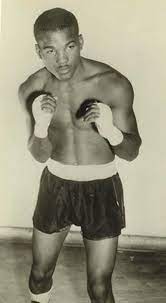
Havana, an old-world city known in folklore for its vice and political turmoil, was the dateline for at least two big stories in 1952. In March, the 1930s strong man Fulgencio Batista returned to power in a coup. In December, Kid Gavilan of Camaguey defended his world welterweight title against Billy Graham at the Gran Stadium. “The weather was hot—and Gavilan’s attack was as torrid,” the New York Times said. And nestled in the crowd was a 15 year-old amateur boxer named Angel Fortez Garcia. 

One of several Cuban fighters starting out in the ‘50s, Garcia was a future friend and peer of Sugar Ramos, Jose Napoles, Luis Rodriguez, Benny Kid Paret, Jose Legra, Florentino Fernandez, Doug Vaillant and many more. Two things set Garcia apart from most of them, though. One was his background. Paret fought to escape the Santa Clara sugar cane fields, Ramos, from Matanzas, because his father promised him extra food. Garcia was the son of an Army officer. He grew up in “a nice place in a well-kept suburb of Havana, a good neighborhood,” Chino Govin said. “There were six kids, a happy family.”

What had attracted him to boxing? “Some fights I saw on TV,” Garcia told me, and that was no doubt true. But I suspect he was also drawn to the money and the good times.

The other difference was his ring name. While Garcia admired Gavilan, the first Cuban champ since Kid Chocolate in the 1930s, he was more influenced by the man who had twice beaten Gavilan: Sugar Ray Robinson. Yet instead of calling himself Sugar (as Ramos did), Garcia or someone around him came up with a variation that fit better with his name: He would be Angel Robinson Garcia. 

Having won all his amateur fights, Garcia turned pro in July 1955, kayoing Roberto Garcia in a one-round featherweight bout in Havana, and he won four more before losing to Renaldo Marquez in Santa Clara. He was then 18 years old. “At the preliminary stage, he only lost one fight,” Chino Govin said. “The decision was a robbery. He fought the same guy three more times.” 

The next year was even better. Garcia scored 17 straight wins, many in distant towns, and topped it off by beating Trini Ruiz in ten rounds in Havana. He was fighting main events within 18 months of turning pro, and that meant something in Havana, that “hot and radiant” city, as Carlos Eire described it, where an upcoming pugilist was a celebrity.  “But Havana was not in the United States,” Eire continued. “That was the beauty of it, and the horror. So much freedom, so little freedom. Freedom to be reckless, but no genuine freedom from woe. Plenty of thrills, and an overabundance of risks, large and small. But so little margin for error, and so few safety nets.” 

Not that Garcia felt he needed a safety net. Ever the tough guy, he fought Chico Morales in Santiago de Cuba after sleeping all night in a theater and then on a park bench. Exhausted from that, and from a 14-hour bus ride, he went to the weigh-in, made the weight, then chowed down on “eggs, bacon, sausages and a little cheese, cold milk and lots of coffee” in a pub, the Italian writer Dario Torromeo reported. And he won the fight, although it is not listed on his record, Torromeo added.  

In May 1957, age 20, Garcia faced Orlando (Baby) Echevarria, a rugged southpaw, for the Cuban junior lightweight crown. He was inspired because Sugar Ray Robinson, at age 35, had just kayoed Gene Fullmer with a perfect left hook to win the world middleweight title for the fourth time.  

“The sensational victory in the rematch against Gene Fullmer has enthused the manner of Angel ‘Robinson’ Garcia, who talked of emulating his great idol in his combat on Saturday,” Diario De La Marina noted. 

“‘I have prepared myself to make an intelligent fight and gain a rapid victory like my great idol Sugar Ray Robinson,’ Garcia said. ‘I have decided to demonstrate to the fanatics who have seen my last encounters and think I committed many errors. The opportunity has come to my door.’” 

Garcia failed to kayo Echevarria, but he outpointed him in 12 rounds, and in his next bout that October beat Guillermo Medina with “a lot of left jabbing and moves,” Chino Govin said. Kid Gavilan’s legendary trainer, Yamil Chade, was impressed with Garcia, and at some point became his manager. 

Batista, meanwhile, was working with the gangster Meyer Lansky to build casinos and collect a “personal share of the gaming industry’s profits,” historians Dick Cluster and Rafael Hernandez wrote. One obstacle in his path was the 26th of July movement led by Castro. These rebels had stormed the Moncada army base on July 26, 1953, and were now fighting the regime from the Sierra Maestra mountains. There were frequent explosions and blackouts in Havana.  

In February 1958, Batista opened a City of Sports, the centerpiece of which was a $2 million indoor arena adorned with pink marble from the province of Pinar del Rio. The inaugural week was to start with the annual Gran Premio automobile race and end with an all-star boxing card. This would feature world lightweight champ Joe (Old Bones) Brown vs. the light-skinned Baby Echevarria, Garcia’s recent foe, in a non-title bout that would be broadcast to the States.  

Batista should have thought it through a little better. The previous year’s Gran Premio winner, Juan Manuel Fangio of Argentina, was standing in his hotel lobby the day before the meet when he felt a gun in his back, Sports Illustrated reported. Moments later, reporters received this call:  “This is the 26th of July speaking. We kidnapped Fangio.” 

The race went on anyway, and what happened next had nothing to do with Castro. A  race car skidded on an oil slick on the Malecon, Havana’s oceanfront highway, and hurtled into the unprotected crowd at 100 mph. Seven people were killed, their empty shoes “a stark indictment of heedless and irresponsible men,” a reporter wrote. Fangio watched it on TV with his captors, who released him after the race. 

Another politician might have cancelled the boxing program. Not Batista. It went on under armed guard, and 12,000 people, everyone from Joe Louis to the cowboy star Gene Autry, were there to see Cuba humiliated. Two Cubans, Oscar Suarez and Jose Ramon Flores, lost to Mexicans, Flores sustaining a cerebral hemorrhage. Then Echeverria got in the ring with Joe Brown. He landed the first punch, but Brown floored him with a right and finished him when he got up—Old Bones did not want to prolong this. “My easiest fight,” Brown said. “He’s very strong, but not too smart.” 

If there was any consolation for Cubans, it was in a bout for the Latin American junior lightweight title: Angel Robinson Garcia versus Panama’s Isidro Martinez. Outboxed at first, Garcia cut Martinez in the 7th, decked him in the 8th and finished him in the 9th when he could no longer move his left leg. “Angel Robinson Garcia, who has a striking resemblance to Sugar Ray, pounded out a 2-fisted attack in the 9th round to halt Isidro Martinez of Panama for the Jr. Lightweight crown,” Nat Fleischer, the dean of boxing writers, wrote in The Ring. Nineteen years and hundreds of fights later, Garcia recalled that he was the only Cuban to win that night. “I win for Cuba,” he said.

Dangerous Ring Rivalries

By Ray Schultz

Gil Clancy, the former gym teacher who trained fighters, had a gruff manner, and I could imagine him greeting a boy’s gym class by sneering, “Hello, girls.” He was all charm, though, when Oscar said I was writing Garcia’s biography. “Garcia is a great fighter, one in a million,” he said. “He’s fought everyone and knows what to do in the ring.” Then he threw this damper on it: “He’ll never make any more money.” 

Clancy’s biggest success, Emile Griffith, joined him in praising Garcia. “That man there is the only man who’s been fighting longer than I have—four more years,” Griffith said one day. Oscar returned the compliment. “This man was five times a champion.” Yes he was: Three times welterweight and twice middleweight champ, the Virgin Islander was the only fighter at the Solar Gym with his own dressing room. 

Now a grizzled 39, the once-handsome Griffith had a long history with Garcia’s countrymen. Having decisioned Luis Rodriguez and Florentino Fernandez in early bouts, he was matched with Benny Kid Paret for the welterweight championship in Miami in April 1961. Paret was the first of the new Cubans to win a title—he’d beaten Don Jordan for it in May 1960–and he was a likeable champ. The words “true love” were tattooed on his bicep, and his “ebullience was infectious,” Sports Illustrated wrote.

Paret was “not a naturally hard hitter or a consummate boxer,” the magazine continued. Yet he never gave an inch, and Griffith had trouble with him. Then Gil Clancy smacked Griffith at the start of the thirteenth round. Griffith went out and landed a good left hook, then another, then a right, and Paret went down for the count.

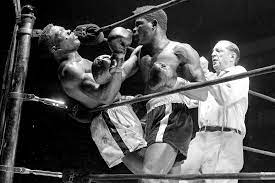
A rematch followed at Madison Square Garden in the fall, and Paret won it by a split decision after 15 grueling rounds—how happy he looked as his cornermen hoisted him aloft. Then came the third bout—at the Garden—in March 1962. The weigh-in was ugly—Paret called Griffith a “maricon”– and the ill feeling went into the ring with them. I saw it on TV. Paret floored Griffith in the sixth, but Griffith recovered and in the twelfth, he staggered Paret with a right. Paret “reeled onto the ropes,” Bob Waters reported. “His head was on the top strand of ropes and his right arm was crooked around the middle strand. Griffith hit him with a series of right uppercuts and then threw hook after hook for about 10 seconds until referee Ruby Goldstein grabbed Griffith and tugged him away.” 

In the dressing room, Clancy “allowed Griffith half an hour to be jubilant over his victory,” Waters wrote. “Then he broke the news that Paret was badly hurt” (brain dead, in fact).  Waters was moved by what he saw the next day. “A Methodist, Griffith prayed for Paret in a Roman Catholic church. Paret is a Catholic. ‘I prayed for Benny,’ Emile said. ‘I asked God, to please save him…make him well. I broke down. I wanted to regain the title very much, but no title is worth this.’” 

Despite those prayers, Paret died on April 3, and on the Fight of the Week that Saturday, the bell was tolled ten times for him. The non-boxing world was unmoved by this demonstration, and there were calls for abolition of the sport. Critics pointed out that Paret had taken a savage beating from the middleweight champ Gene Fullmer only a few months before. “Paret was one of the toughest guys I’d ever fought as far as actual tough,” Fullmer told Peter Heller. “I never hit anybody more punches harder than I hit Paret.”

The threat of death or injury didn’t deter Garcia. Fighting the Corsican Saveur Chiocca that fall, he caught a “shattering right to the jaw,” and went down for six, then hit the floor again a moment later. But he “gained control of his rapid feet” and won the fight, The Ring wrote. Next, he fought the ranked French welterweight Jean Josselin. “Josselin belted away unceasingly, always moving forward,” The Ring reported. Garcia retaliated by “roughing things up whenever he got the chance.” The heavier Josselin was “badly marked, Garcia undamaged, but utterly exhausted at the finish.” 

I asked Garcia about Paret the night we drank at the Beauburn bar. He answered, more or less, that Benny was tough, but that he didn’t think it could happen to a fighter with his own defensive skills. 

Maybe not. But a year after Paret died, two Cubans fought for world titles on the same program in Los Angeles. Welterweight Luis Rodriguez outpointed Griffith in a close one, reversing his earlier loss, and Garcia’s friend Sugar Ramos kayoed Davey Moore for the featherweight crown. Ramos was a stalker, who concentrated on “blows to the mid-section, and stinging lefts and rights,” Sports Illustrated wrote. The end came in the tenth. Moore was “knocked to the canvas twice and reeled helplessly against the ropes as the round ended,” Bob Waters wrote. In his dressing room, Moore said, ‘This just wasn’t one of my nights. It was a bad night.’” Then he collapsed, and Waters reported the next day that Moore was near death. The scene was a strange replay of the one the year before. 

“‘I am very, very sorry,’ Ramos said to the clusters of people who were standing in the hospital lobby,” Waters wrote. “’We are friends outside of the ring. I wanted to see Davey. I wanted to tell him I am sorry.’ Moore’s manager, Willie Ketchum, said, “‘Don’t worry, Kid. He’s in good hands. He’s in God’s hands. And you gotta trust God.” 

Griffith sent Ramos a telegram: “Don’t worry. It wasn’t your fault. You’ve got to pray; you’ve got to have faith.” But Moore died and boxing was again condemned. In a song titled, “Who Killed Davey Moore?”, Bob Dylan mocked the excuses of every party to it, including Ramos, “who came here from Cuba’s door where boxing ain’t allowed no more.” 

I personally resented those lyrics when I read them years later. How could you condemn a man who fought at age 12 for extra helpings of food and faced the same dangers in the ring as Moore? But the verse that upset me most seemed aimed at Bob Waters himself:

“Not me, said the boxing writer

Pounding print on his old typewriter

Saying boxing ain’t to blame

There’s just as much danger in a football game” 

Of course, the deaths depressed me—I grieved for Paret and Moore. But I felt protective toward boxing. I was sickened later when a radical newspaper tied Barney Ross to Jack Ruby and possibly to the Kennedy assassination. Barney Ross, the three-time title holder and hero of Guadalcanal? How dare they? And I agreed with Red Smith’s defense of fighters: “It is hard to believe that a nation bereft of such men would be the stronger or better for it.” 

Once again, the tragedy didn’t stop Garcia. He kayoed the Jaguar of the Sahara, Aissa Hashas, in Tunis, and won another war with Sauveur Chioca in Paris. And assuming he heard it, he ignored the commentary coming from Havana on the “criminal methods of professional boxing—boxing being run by real gangsters who are interested only in filling their bags with dollars and do not have the least regard for the lives of the fighters.” 

Sparring With Roberto Duran

By Ray Schultz

It seemed like just another Monday at Gleason’s Gym. “Feeling good?” Sammy Morgan asked a fighter coming in. 

“Yeah.”

“Well, that’s the main thing. You’ll do alright.” 

When the fighter was out of earshot, Sammy said, “He’s gonna get his (b—-) ass kicked. I saw this South American he’s fighting—a killer. He’ll knock him all over the ring.” 

Suddenly there was a commotion at the door, and Roberto Duran entered with his retinue. All eyes turned to the Panamanian. Wearing a fisherman’s white cap and a red-and-white ensemble, his eyes flashing, he greeted several people and disappeared into the locker room, returning several minutes later in his workout clothes: a plastic sweatshirt with a sleeveless yellow sweater over it. Training for a title defense against Edwin Viruet, of Puerto Rico, Duran loosened up, joked with Panama Lewis and Eddie Gregory, and sparred a round or two with a regular kid from the gym.

Then they brought in Tony Danza, an aspiring fighter and future actor. Danza was wearing tennis shoes instead of boxing shoes, and Duran was amused. But he was raging with unfocused energy. Freddie Brown grimaced and said, “No, damn it,” when Duran threw a wild right. Duran roughed Danza up a little inside, and landed a hard shot to Danza’s body. Freddie shook his head. Duran allowed himself to be maneuvered into a corner. Freddie said, “Move, move.” 

Finished with Danza, who had stood up well to it, Duran took on his next victim. He threw more body shots, and in the second round dropped the fighter with a glancing right. Freddie Brown was not impressed. “When are you gonna start moving?” he asked. 

Duran then shifted to the heavy bag, “cawing” when he threw hard shots into it. The father of the Olympic champion Howard Davis approached him and asked if he wanted to spar a few rounds with his son. This enraged Duran. “You give me the money for a 15-round fight, and I’ll fight him,” he said, then followed Davis Sr. to the front of the gym and repeated it. “Enough, get back here,” Freddie Brown said. 

Wearing new leather boxing shoes with the inscription “Rocky” on them, Duran sparred again on Wednesday. By this time, he was working with anyone who had the nerve to get in there with him. One young fighter, more poorly equipped than Danza, lacked even a protective cup. Duran made threatening faces, then aimed a shot at the kid’s groin and pulled it at the last second. Some joke: Most of us gasped. 

The moment had arrived. I approached Duran as he was leaving. “Duran, I’m from the New York Times magazine,” I said, lying. “Can you tell me about your fight with Angel Robinson Garcia?” Duran thought about it for a moment, then answered, in uncertain English, “I win a decision. He was very smart, a good fighter. I was out of shape.” Panama Lewis elaborated. “Duran fought Robinson Garcia when he was young, before he was champion. He was very fast, Garcia.” He added that Garcia drank the night before the fight. “He  wasn’t really drunk,” Lewis said. “But he had some drinks. He was, you know, hanging out.”

The lightweight fight took place in Panama City in January 1972. And Garcia showed from the start that he was not intimidated by Duran. “Garcia was knocked down by Duran by the first assault in the first round, but he raised himself from the canvas to make a true exhibition of good boxing before the desired evidence of the young Duran gaining success,” said an article on the “Gran Pelea” in Estrella de Panama. Even Duran was impressed. “Cuban, you know a lot,” he said during a clinch in round two. “The Duran fight was complicated,” Garcia said through Oscar. “I can’t explain it. The knockdown was a slip.” Duran’s one-time manager Nestor Plomo Quinones said that “Duran was all the time throwing his punches, but Garcia was blocking him all the time,” Christian Guidice wrote in his Duran biography: Hands of Stone.  

Win or lose, the Duran fight was Garcia’s ticket back to the Americas. He had beaten Bunny Grant in November In his return to Paris after seven years, but lost a month later to Jonathan Dele in Barcelona–his last fight in Europe. “The promoters didn’t want to use him after so many losses,” Oscar said. And he had little personal reason to stay. “He blew the money and blew the marriage,” Angelo Dundee said. As Chino Govin described it, “He sent his wife back to France.” 

Financed by his purse from the Duran fight, Garcia holed up in the Hotel Peral in Caracas, and tried to regroup, but he didn’t fight again for four months—maybe he was getting his paperwork in order. In April 1972, finally, he lost to Reymon Reyes in Maracaibo, and in June was matched with the new lightweight sensation Esteban DeJesus, from Carolina, PR, in Madison Square Garden’s Felt Forum. DeJesus dropped out with an impacted tooth, though, and was replaced by Cemal Kamaci, of Turkey, who had beaten Garcia in Vienna in 1970. “The turnout was so meager that Garden publicist John Condon said, ‘There’ll be no attendance announced tonight. Instead, there’ll be individual names and addresses,’” wrote sportswriter Leonard Cohen.     

That was one of several indignities. Another was the press coverage of the fight, if anyone read it to him. “Garcia’s main resemblance to Sugar Ray was the fact that Ray once reached 35, too, and, despite Angel’s ring savvy, he appeared to have neither the reflexes nor the stamina to neutralize the attack of his younger opponent,” the New York Daily News reported. Garcia cut Kamaci, but was also cut himself. And he irritated the commission doctor, Dr. Edward Kleiman, by demanding a butterfly bandage instead of stitches—he knew the stitches wouldn’t work. 

Kleiman got his revenge, as shown by this entry in Garcia’s New York record: “Ill & unavailable indefinitely—laceration. Dr. Kleiman.”  And the news reports said Garcia was a Venezuelan.  

Garcia returned to his room at the Penn Garden Hotel. As it happened, Duran was at the Concord Hotel in the Catskills, training to fight Ken Buchanan for the world lightweight title. He called Garcia and hired him as a sparring partner. Garcia lasted two days, all he could take, Quinones told Guidice. But I doubted that. Garcia had gone ten with Duran in a real fight. And he had a big bout of his own coming up: a rescheduled fight against Esteban DeJesus in San Juan. 

Oscar, who was present that night in PR, was impressed by Garcia’s performance. Garcia won several of the later rounds, and easily evaded DeJesus’ punches, but he didn’t throw many of his own and lost the fight. “DeJesus was a hard hitter,” said Oscar. “But then I saw the way Garcia moved his head and defended himself for ten rounds, and the condition he was in.” That wasn’t all he saw: Before the bout, Garcia was drunk in the Attic, a nightclub in the Hotel Borinquen. That’s where Oscar met the Cuban with the close-cropped hair. 

Less than two weeks before that bout, Duran scored a controversial TKO over Buchanan. “The record will say that Ken Buchanan lost the lightweight championship of the world after the 13th round as he rolled in pain on the canvas, holding his groin,” Bob Waters wrote. “Ken Buchanan really lost on the second punch of the first round last night at Madison Square Garden. Buchanan landed the first punch, a jab that flicked back the head of the contender, Roberto Duran of Panama. The second punch was Duran’s, a right hand led that bounced off Buchanan’s shoulder and still had enough power to drop Buchanan after it ricocheted off his jaw.” 

DeJesus soon joined that elite circle. In November, he floored and outboxed Duran in a non-title fight—Duran’s first loss. Duran got his revenge in 1974 when he kayoed DeJesus in a title defense, and again in 1978. But the fact that Garcia had gone the distance with Duran, Buchanan, DeJesus and Napoles looked good on paper in 1972. 

Back in the Day With Henry Cowen

By Ray Schultz

Return with us now to the year 1941. Franklin Roosevelt was President, Joe Louis was heavyweight king, Frank Sinatra was singing with Tommy Dorsey, and 21 year-old Henry Cowen was taking a one-time course at New York University: Direct mail copywriting.  

Not that Henry set out wanting to write junk mail copy (who ever did?). He had his eyes on a banking career. But he was a born writer, so he signed up for the course. Oddly,  the first question they asked was, “How’s your math?” 

“I didn’t know why they wanted to know that,” Henry said in an interview in 1996. But he found out. “Everything was based on the math,” he recalled. “We learned how to do the budgets and the test reports.”

I’m recalling all this because we recently passed Henry’s centennial; he died in 2011.  

Direct mail may not have been the career he wanted, but he was one of the best direct mail copywriters who ever lived, and here’s the proof: copy he wrote as a young man was still selling subs in the age of the internet. 

He was also, to me, one of the nicest guys who ever graced the business. 

The Early Days at Cowles

Henry got his first copywriting job in 1942 at Look magazine. To get it, though, he had to move to Des Moines, Iowa, a place where “the people were nice and the winters were terrible.” 

Conditions were primitive in the Cowles office in the Wallace Homestead building. “We had manual typewriters, no air conditioners and no offices,” Henry recalled. “We created little offices by using file cabinets. When the assistant sub manager traveled, I pushed his files over an inch or two to make his smaller and mine bigger.” 

Look, then five years old, was in a circulation war with Henry Luce’s Life. It had “a lot of single copy circulation, and subscriptions were just coming into their own,” Henry said.  

There were no computers in those days. Envelopes were inserted by hand. With Les Suhler and Max Ross as mentors, Henry wrote letters, studied response, served as art director and ordered mailing lists. “Les said, ‘Spread the list business around. Give everyone their fair share.’” So he did: To brokers like George Bryant, Lew Kleid, Walter Drey and Arthur Martin Karl.  

The state of mailing lists? “We could segment by geography and the age of the list—recency, frequency, that type of thing,” Henry said. “We were sophisticated in using our own names, so sophisticated we could tell whether a person had renewed once, twice, three, four, five or six times. Later, we brought in an industrial engineer and he said, ‘You’re going too far. You’re too segmented.’”

Outside lists came on labels, but the house list was on Speedomat plates, making it  difficult to change an address. Not to worry: “They explained that farmers didn’t move much, so that wasn’t a big problem,” Henry said.  

Look also used some telephone lists, typed directly from phone books by women working at home. “We took the world’s poorest mailing list and made it a good list,” Henry said. 

The basic Look letter was two pages, “nicely written,” and mailed in a No. 9 plain white business envelope. “But it wasn’t jazzy,” he added. There were no premiums and no brochures. (“I don’t believe in brochures to this day.”) But the mailings worked. The offer for new subs? “Sixteen issues for a buck.” 

“We had a different renewal series for each source, and we did a lot of advanced renewals,” Henry recalled.  They even sent hand-personalized mail. “We personalized the name with a brush and ink—in gold, red or blue,” he said. “And we tested them. Gold was best, next was red.” 

Look did sub mailings in “places where no-one was mailing: Hawaii, Guam, the Panama Canal Zone, Alaska.” It also sold subs in Mexico City, Caracas and pre-Castro Cuba. “We sent the letters in English, and got a good return, but then the advertising department decided it didn’t want that circulation,” he said.  

Look also sold subs to department store charge account customers.

“We had stores in just about town in the United States,” Henry explained. “In New York City, we would alternate between Bloomingdale’s, Macy’s and Gimbals’. The orders would come back to the stores, and they would do the billing, so the payups were 99% or better.”

Some of those pieces might look a little strange today. “One store in Ohio had a policy of not using dollar signs, so the mailing went out without dollar signs. They knew their customers” Henry said.  

Sweepstakes

In 1952, a circulation expert named Harold Mertz visited Des Moines and tried to sell Henry, now a DM veteran, on something called Publishers Clearing House. His idea? Multiple sub offers would be mailed in a single envelope.  

“I told him to save his money because people had tried that before,” Henry said. “Curtis had tried it, Sears, Roebuck and Montgomery Ward had tried it in a way.” 

But Mertz was “smarter than they were,” Henry admitted. “He worked harder and made it work.” Indeed, in 1960, after 18 years at Look, Henry found himself working at PCH.

At that time, PCH was “still only doing $4 million worth of business,” Henry said. And early PCH letters did not have stamps or sweepstakes. 

“Harold would write a letter like, ‘Dear Friend, it’s springtime,’” Henry said. “He wasn’t talking about the benefits or anything like that.” But the copy improved, thanks to Henry and a fellow copywriting legend named Marvin Barkley. 

At some point in the 60s, PCH finally started doing sweeps. But, as Henry put it, “We made a lot of mistakes.” For example, Reader’s Digest had a grand prize of $25,000. “People would say, ‘Do they really give that away?” So PCH offered a large number of small prizes—the highest was $10.

“It barely made a ripple,” Henry continued. “So we tried a $1,000 prize, and that did 25% better than $10. Then we got brave and went to $5,000, better yet, then to $25,000, then the sky’s the limit!” 

Founder Mertz was “a very smart guy, a very tough guy, a little hard for some people,” Henry said.

He added, “We didn’t even have a calculator in the office, but he could add up a column in the millions, 20 different numbers, zip zip zip. He was a genius at it.” 

Did Henry have any sample letters from the old days at Look and PCH? He got wary: He wasn’t about to share his trade secrets.  

“I still use some of those leads,” he said. “I bring them back every few years.”
The Havana Kid: In the Ring and On The Ropes With Boxing’s Greatest Journeyman

By Ray Schultz

“Sure, he ain’t going to last long. He ain’t going to last like you and me, Jerry.”— Fighter in Ernest Hemingway’s 50 Grand

Introduction

Angel Robinson Garcia, the Cuban boxer and exile, rarely discussed politics, but he did one night outside the Solar Gym in New York. “I like Fidel,” he said. ” Some day I return to Cuba.”

This was more than his manager, a Puerto Rican named Oscar Seary, could bear. “When you get off the boat, they’ll have a sign that says, ‘Welcome, Garcia,’” he retorted.

The year was 1977, and few Cuban exiles would say they liked Fidel Castro, but that’s not what Oscar was getting at. What he meant was that the socialist paradise would not embrace a washed-up pug like Garcia, with his flattened nose, mounds of scar tissue and gaps where he once had teeth. 

At his best, this wreck had held his own with Roberto Duran,  but now he could barely survive a Baltimore computer programmer named Johnny Gant. Garcia lost every round to the programmer—all he could do was butt him. And even bouts like this were getting hard to come by. 

That, not Cuba, was the real cause of the tension this night. There were no fights, no road trips, not an ounce of relief, and Oscar blamed Garcia. “Drinking is all he wants to do,” he said, “fucking around with women, smoking pot.” He turned to Garcia: “You can’t lose any more fights.”  

We’d heard it all before. To ease things, someone suggested that Oscar “do” Garcia—mimic his boxing style. A small man with a mustache and a broad smile, Oscar rolled his hips and moved his arms up and down like the poles on a carousel, to howls of laughter. Then he left to get his car, and I waited with the sulking Garcia. It was hot, we had a long ride ahead of us and we were out of beer. Still, I endured this every night, for I was Garcia’s biographer. I was there to record what he did and absorb the central lesson of his life: that greatness is not always defined by victory.